The Origin of Opium
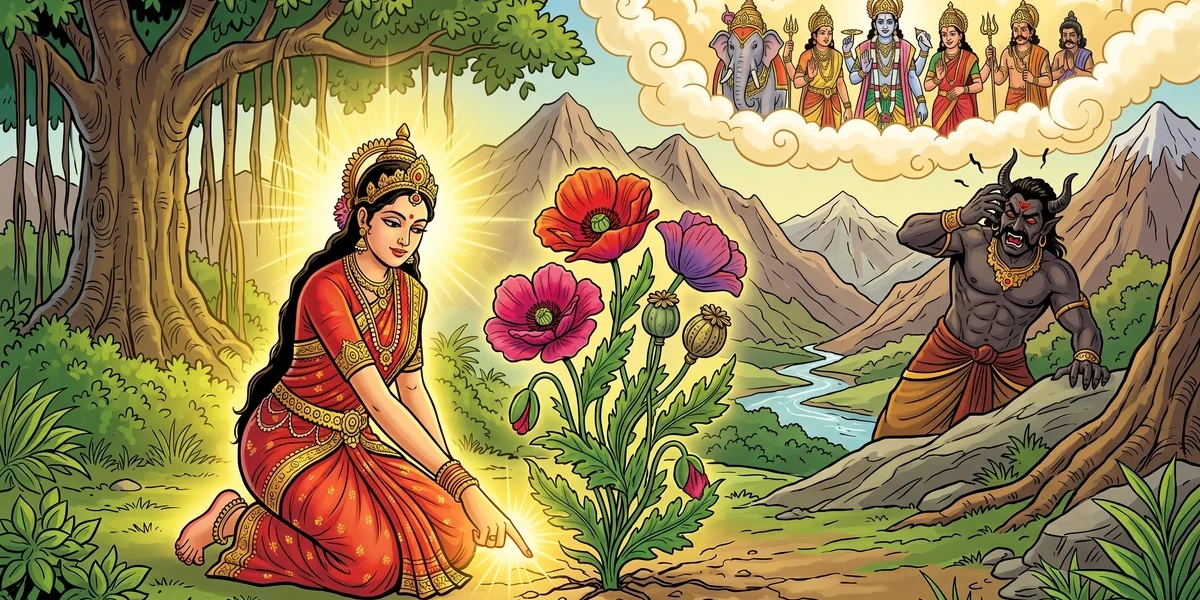
The Origin of Opium: Source: Folk Tales of Bengal | Type: Folktale | Country: India | Language: English Long ago, there was a terrible demon who lived in the
Origin and Narrative Tradition
“The Origin of Opium” is an etiological folk tale—a narrative whose primary purpose is to explain how something in the natural world came to exist. Collected by the Reverend Lal Behari Day for Folk-Tales of Bengal (Macmillan, 1883), it belongs to the ancient genre of utpatti-katha (origin tales) that runs through Indian literature from the Vedic hymns to the Puranas to the village storyteller’s nightly repertoire. In this genre, plants, rivers, animals, and natural phenomena are understood not as accidents of biology but as the crystallised residue of divine events—transformations, sacrifices, curses, or gifts that embedded a particular quality into physical matter at the moment of their occurrence. The opium poppy (Papaver somniferum, known in Sanskrit as ahiphen—literally “serpent-foam”—and in Bengali as afim) was a plant of particular social complexity in colonial Bengal: a commodity whose cultivation the East India Company had systematised into an instrument of imperial commerce, a medicine whose use Ayurvedic physicians had documented for over a millennium, and a substance whose powers of sleep, pain-relief, and dream-induction gave it an obvious mythological valence. The Bengali origin tale reaches past the colonial economy to ask a prior question: before it was a commodity, what was this plant?
Beat I — The Transformation at the Story’s Core
Bengali etiological tales typically involve a transformation: a god, demon, human being, or divine substance changes form under the pressure of some powerful event—a sacrifice, a curse, a death, an act of extreme emotion—and the resulting natural entity retains, encoded in its properties, the memory of what it once was. “The Origin of Opium” follows this logic with particular aptness. The poppy’s most striking properties—its power to induce sleep, to suppress pain, to generate vivid and uncontrollable dreams, and to bind its user in a web of craving—are properties that a mythological explanation naturally treats as legacies of a prior existence. What kind of being, the etiological imagination asks, would leave behind precisely these properties when it dissolved into plant form? The answer the Bengali folk tradition suggests points toward something divine but dangerous, powerful but ambivalent—a being whose gifts carried their shadow with them. The story’s pleasure lies partly in the precision with which the mythological origin explains the pharmacological reality: the poppy is strange because what it once was was strange.
Beat II — The Ambivalence of the Gift
Opium occupies a uniquely ambivalent position in Indian cultural history. Ayurvedic medicine (Ashtanga Hridayam, Charaka Samhita) documented its use as an analgesic, an antidiarrhoeal, and a sedative centuries before European medicine discovered it, and Mughal court culture used it both medicinally and recreationally with a sophistication that troubled British administrators who encountered it. At the same time, the Dharmashastra tradition classified intoxicants (madya) among the five great prohibitions for Brahmans, and popular culture maintained a sharp distinction between legitimate medical use and compulsive addiction. The folk origin tale encodes this ambivalence by giving opium a mythological genealogy that is simultaneously sacred and dangerous: its power to relieve suffering is real, but that power carries an equal capacity for enslavement. The Bengali village understood—through direct observation of opium cultivation and consumption in colonial Bengal—that this was a plant whose blessing and its curse were inseparable, and the etiological tale explains why: because what gave rise to it was itself inseparable from blessing and curse.
Beat III — Etiological Tales as Pharmacological Memory
Scholars of folk medicine have noted that plant-origin stories in oral traditions often encode practical pharmacological knowledge in narrative form. A plant described as arising from divine tears carries, in that origin, an implicit instruction: approach with reverence, in small quantities, for specific purposes. A plant arising from demonic blood carries an opposite instruction: handle carefully, know its limits, respect its capacity for harm. The “origin of opium” narrative, whatever its specific plot, performs this function for Bengali village audiences who might encounter the poppy as cultivators (colonial Bengal was a major opium-producing region), as patients receiving Ayurvedic treatment, or as consumers of a substance that was both legal and heavily commercialised under British administration. The story gives the plant a biography—an account of where its properties came from—that serves as a mnemonic for its appropriate use. To know the origin of a powerful substance is to know something essential about how to relate to it.
Beat IV — The Colonial Dimension
Any nineteenth-century Bengali tale about opium carries an unavoidable historical resonance that its teller and audience would both have felt even without naming it. The East India Company’s opium trade—in which Bengal’s fields were systematically converted to poppy cultivation, opium was processed at the Company’s Patna and Ghazipur factories, and the drug was sold into China in quantities that the Qing government correctly identified as a social catastrophe—was the dominant economic fact of rural Bengal during the decades when Lal Behari Day was collecting these stories. The folk tale’s assertion of a mythological origin for the poppy is, in this context, also an assertion of indigenous ownership: this plant has a Bengali story, a sacred history, a meaning that precedes and exceeds its function as a colonial commodity. The etiological tale reclaims the plant from its purely economic identity by giving it a biography rooted in the village’s own religious and narrative traditions.
Aushadhim jayanty oshhadhinam rajah soma uta—Plants are born; Soma, the king of plants, is born: may he, knowing all forms, make this medicine effective. (Atharva Veda 6.96.1, traditional invocation before medicinal plant use)
Why This Story Has Lasted
Origin tales about powerful plants endure because they transform pharmacological fact into moral instruction: here is why this substance has the properties it does, and here, implicitly, is how those properties should be approached. “The Origin of Opium” has additional staying power because the substance it explains became, during the colonial period, one of the defining economic and social realities of Bengali rural life. To have a mythological account of where it came from was to have a frame for understanding it that was not the Company’s balance sheet—a frame that placed the plant within a Bengali cosmological order rather than a British commercial one. The tale’s persistence into the post-colonial period suggests that the need for that alternative frame did not disappear when the Company did.
Tradition & Collection Notes
Collection: Folk-Tales of Bengal by Lal Behari Day (Macmillan, 1883). Tale-type: Utpatti-katha (etiological origin tale); plant-transformation subtype. Motif index: A2700–A2799 (Origin of plants), A2850 (Characteristics of plants), D215 (Transformation: person to plant). Ayurvedic context: Charaka Samhita on ahiphen; Ashtanga Hridayam, Uttara-sthana; Vagbhata’s classification of intoxicants. Colonial history: Bengal Opium Agency records; John F. Richards, “The Opium Industry in British India” (2002). Comparative parallels: Vedic Soma origin hymns (Rigveda 9); Greek origin of the poppy (Demeter and the sleep of grief); Aztec origin of pulque (Mayahuel myth). Scholarly reference: David Courtwright, Forces of Habit (2001); Projit Mukharji, Nationalizing the Body (2009).
You May Also Like
 Bengal Folk Tales
Ages 6-8
Bengal Folk Tales
Ages 6-8
The Bald Wife
The Bald Wife: Source: Folk Tales of Bengal | Type: Folktale | Country: India | Language: English Once there was a merchant who had a very beautiful wife. The
 Bengal Folk Tales
Ages 9-12
Bengal Folk Tales
Ages 9-12
The Clever Wife
The Clever Wife: In a Bengal village surrounded by rice paddies and coconut groves, there lived a merchant of modest means who had married a wife of joins a
 Bengal Folk Tales
Ages 9-12
Bengal Folk Tales
Ages 9-12
The Hermit and the Mouse (Panchatantra Retold)
The Hermit and the Mouse (Panchatantra Retold): In a cave high in the mountains, where the air was thin and the silence profound, there lived a hermit who had