The Boy Whom Seven Mothers Suckled
The Boy Whom Seven Mothers Suckled: Source: Folk Tales of Bengal | Type: Folktale | Country: India | Language: English In a certain kingdom there were seven
Origin and Narrative Tradition
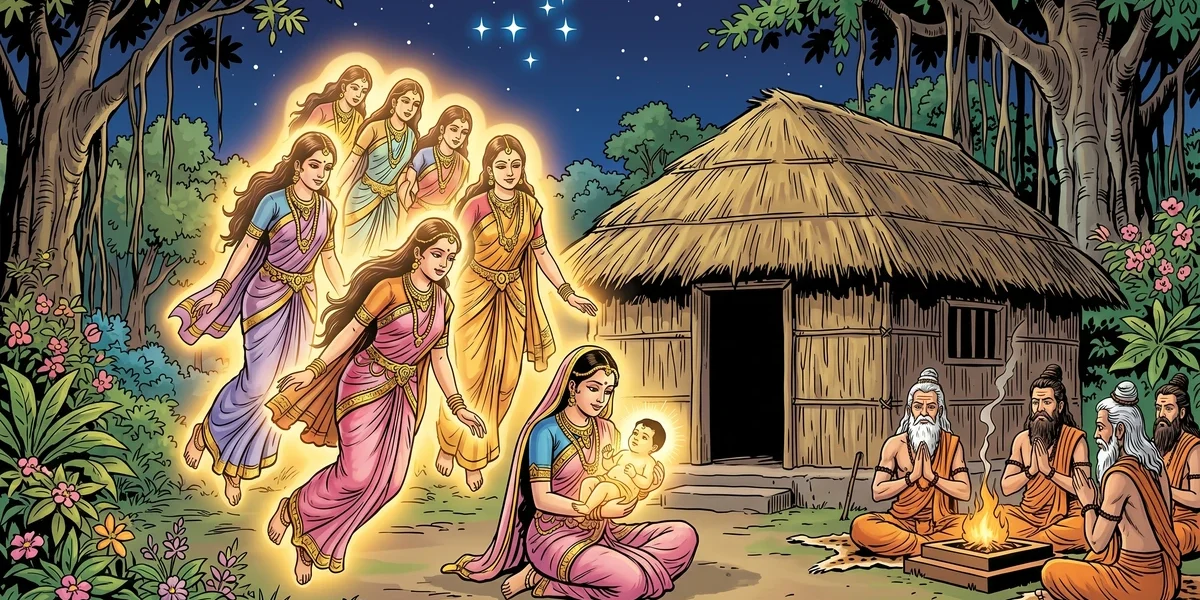
“The Boy Whom Seven Mothers Suckled” invokes one of Indian iconography’s most ancient and potent clusters: the Saptamatrika, the seven divine mother-goddesses who appear in Hindu temple sculpture from the Gupta period onward and whose protective, nourishing, and at times ferocious energy surrounds the infant god of war, Kartikeya (Skanda/Murugan). Collected by the Reverend Lal Behari Day for Folk-Tales of Bengal (Macmillan, 1883), this Bengali folk tale translates a theological iconographic tradition into a village narrative about a human boy whose exceptional nature is explained by his exceptional nourishment. In the mythological background: when the infant Skanda needed a wet nurse, the Krittikas (the Pleiades cluster, six or seven stars) each gave him their breast, and the child absorbed from each a different quality—divine strength, divine intelligence, divine courage. The folk tale reworks this celestial pattern into a terrestrial one, asking what kind of human being emerges when seven ordinary or extraordinary women each contribute something of themselves to the formation of a single child.
Beat I — The Child of Extraordinary Circumstance
The boy’s origin is marked from the beginning as exceptional. Whether he is abandoned, orphaned, or born under unusual circumstances, the narrative establishes that his biological mother cannot or does not nurse him alone—and that this deficiency is compensated by a remarkable multiplicity of surrogates. Seven women, each of different character, background, or quality, each provide nourishment at a crucial developmental moment. The Bengali folk tradition treats the act of nursing as far more than physical: it is a transmission of shakti (divine energy), character, and destiny. A woman who nurses a child gives something of her essential self. The child absorbs not merely milk but the qualities of the one who gives it. Seven mothers means seven transmissions, seven absorbed characters, seven sets of capacities that no single individual could possess alone. The boy grows up as a kind of composite human being—not a contradiction but a synthesis.
Beat II — The Seven and Their Gifts
The narrative’s middle section typically differentiates the seven mothers by their distinct qualities, even when those qualities are not explicitly named. One mother is courageous; one is wise; one is generous; one is patient; one is beautiful; one is fierce in the protection of her children; one carries divine grace of an unnamed kind. The boy who has drunk from all seven carries within him the latent capacity for each of these qualities, which emerge at need throughout his life. When the situation calls for courage, the courage absorbed from one mother surfaces. When wisdom is needed, a different inheritance answers. This narrative structure—in which the boy’s extraordinary competence is explained by the extraordinary diversity of his nourishment—encodes a community theory of human formation: the self is not a single entity with a single origin but an accumulation of relationships, each of which deposits something permanent. Bengali village culture, which maintained deep traditions of communal child-rearing, would have recognised this theory as consistent with lived experience.
Beat III — The Saptamatrika Theological Background
The Saptamatrika—the seven divine mothers named in the Devi Mahatmya (Markandeya Purana, chapters 81–93) as Brahmi, Maheshvari, Kaumari, Vaishnavi, Varahi, Aindri (Indrani), and Chamunda—are presented in that text as emanations of the seven great gods’ female energies (shaktis), called forth to assist the goddess Durga in her battle against the demons Shumbha and Nishumbha. Each is simultaneously a nurturer and a warrior; each embodies a particular aspect of divine feminine power. The Devi Mahatmya’s presentation of the seven mothers as a unified force that exceeds what any individual goddess could achieve alone provides the theological grounding for the folk tale’s central claim: that seven sources of nourishment produce a result that exceeds what any single source could achieve. Bengali Shaktism, which is theologically centred on the goddess and her multiple manifestations, would have understood the boy’s seven-fold nourishment as a miniature enactment of the Saptamatrika principle brought into the village world.
Beat IV — The Community’s Claim on the Hero
The tale’s resolution typically involves the boy’s extraordinary accomplishments being understood as community achievements rather than individual ones. Because seven women contributed to his formation, the village that produced those seven women has a legitimate claim on what he does with their combined gift. This is the folk tale’s most sophisticated social argument: it uses the mythology of seven mothers to articulate a theory of collective responsibility for individual achievement. The hero did not make himself; he was made by his community’s generosity. What he achieves with the capacities he was given belongs, in some meaningful sense, to the community that gave them. Bengali village ethics—organised around obligations of reciprocity between individuals and the communities that sustained them—are encoded in this narrative structure as naturally as water is encoded in the riverbed that shapes it.
Mātṛ devo bhava, pitṛ devo bhava, āchārya devo bhava, atithi devo bhava—Let your mother be a god to you; let your father be a god; let your teacher be a god; let your guest be a god. These are the great instructions. (Taittiriya Upanishad 1.11.2)
Why This Story Has Lasted
“The Boy Whom Seven Mothers Suckled” endures because it validates a form of family structure that has always existed alongside the nuclear ideal: the community of women who share in raising a child. In Bengali village life, where extended families, neighbours, and kin networks participated actively in childcare, the story’s central image—a child shaped by many sources of love—reflected social reality. The mythological grounding in the Saptamatrika tradition gave this everyday social pattern the dignity of divine precedent: even the god of war was nursed by seven mothers, so there is no shame and much honour in a child who carries multiple mothers’ gifts. The story’s persistence into modernity suggests that this validation remains necessary in cultures that still organise childcare communally, and its reach into comparative mythology (the Krittikas and Kartikeya, the mythological wet-nurses of multiple world traditions) suggests that the underlying human need—to explain exceptional individuals by exceptional communities—is universal.
Tradition & Collection Notes
Collection: Folk-Tales of Bengal by Lal Behari Day (Macmillan, 1883). Iconographic background: Saptamatrika tradition; Devi Mahatmya (Markandeya Purana, chs. 81–93); Gupta-era temple sculpture of seven mother goddesses. Motif index: F611 (Strong hero: extraordinary nurture), T615 (Supernatural growth), F900 (Extraordinary persons). Mythological parallels: Kartikeya/Skanda nursed by the Krittikas (six/seven Pleiades sisters); Greek myth of Achilles nursed by Thetis and multiple foster-mothers; Norse Odin’s absorption of multiple divine wisdoms. Bengali Shakta connection: Saptamatrika puja in Bengal; Durga Puja’s invocation of the seven mothers. Scholarly reference: N. N. Bhattacharyya, History of the Sakta Religion (1974); Vidya Dehejia, Yogini Cult and Temples (1986).
You May Also Like
 Bengal Folk Tales
Ages 6-8
Bengal Folk Tales
Ages 6-8
The Indigent Brahman
The Indigent Brahman: Source: Folk Tales of Bengal | Type: Folktale | Country: India | Language: English Once upon a time there was a Brahman who was very poor.
 Bengal Folk Tales
Ages 3-5
Bengal Folk Tales
Ages 3-5
The Origin of Opium
The Origin of Opium: Source: Folk Tales of Bengal | Type: Folktale | Country: India | Language: English Long ago, there was a terrible demon who lived in the
 Bengal Folk Tales
Ages 9-12
Bengal Folk Tales
Ages 9-12
The Tiger King’s Daughter
The Tiger King's Daughter: The Sundarbans - that great delta of the Ganges where land and water intertwine like lovers’ fingers - were a realm unto themselves