The Weaver’s Enchanted Cloth
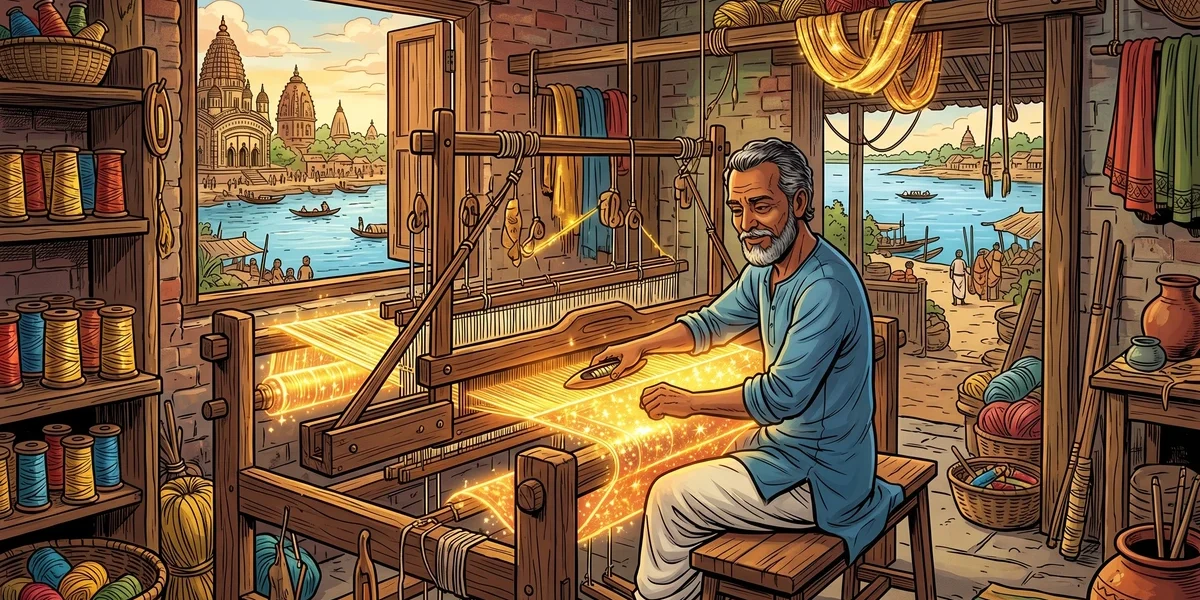
The Weaver's Enchanted Cloth: In a city on the banks of the Hooghly River, where the spires of temples rose above the rooftops like prayers made stone, there
Origin and Narrative Tradition
“The Weaver’s Enchanted Cloth” belongs to the great Bengali and pan-Indian tradition of artisan-magic narratives—stories in which the craftsman’s devoted labour produces an object that exceeds in power and meaning anything that mere technical skill could explain. Collected by the Reverend Lal Behari Day for Folk-Tales of Bengal (Macmillan, 1883), the tale draws on a deep cultural reality of Bengal: the region was one of the world’s great centres of textile production, and the Bengali weaver (tantubaya or tanti) occupied a social position at once humble and indispensable, producing the muslin, jamdani, and baluchari fabrics that were traded across the Indian Ocean world and eventually reached the courts of Persia, Rome, and later Mughal Delhi and British London. The muslin of Dhaka—woven air as Mughal chroniclers called it, so fine that a full sari could be passed through a ring—was already legendary in Lal Behari Day’s time, and the folk tradition naturally asked: what was the secret of such creation? The answer the Bengali folk tale gives is not technical but spiritual: the cloth that transcends ordinary production does so because the weaver’s consciousness, at the moment of making, transcended ordinary consciousness.
Beat I — The Weaver and the Loom
The weaver in Bengali folk narrative is a figure of paradox: socially marginal (the tanti caste occupied a low position in the varna hierarchy despite the economic importance of their product) yet cosmologically central (the loom is one of Indian metaphysics’ most persistent images for the structure of existence itself—the Brihadaranyaka Upanishad describes the universe as woven on the warp of the imperishable, and the Katha Upanishad uses the weaver’s shuttle as an image of the soul’s movement between states). The enchanted-cloth tale begins with this paradox: a weaver whose social standing is modest but whose relationship to his craft is of exceptional depth and devotion. He does not merely produce cloth; he inhabits the process of cloth-making with an attention and care that transforms it from production into practice—something closer to meditation than to labour. It is this quality of attention, the folk tale insists, that makes the cloth he produces different from what any other weaver’s loom can produce.
Beat II — The Enchantment Within the Making
The specific nature of the cloth’s enchantment varies across versions of this narrative type, but the common thread is that the cloth encodes something of the weaver’s inner state at the moment of its making. A cloth woven during a moment of pure prayer carries healing properties; a cloth woven during sustained grief produces in its wearer an inexplicable sadness; a cloth woven under divine inspiration becomes capable of protecting its wearer from harm. The Bengali folk tradition thus presents textiles not as inert objects but as records—material archives of the consciousness that produced them. This is not magic in the manipulative sense (a spell cast upon an object from outside); it is an ontological claim about the relationship between mind and matter in the act of devoted creation. The Bhagavad Gita’s concept of karma yoga—action performed with full attention and without attachment to the result—is here given its most concrete artisanal form: the weaver who practices karma yoga at the loom weaves differently from the weaver who works for wages alone, and the difference is visible in the cloth.
Beat III — The Social World of Bengali Weavers
The enchanted-cloth narrative cannot be separated from the social history of Bengali textile production. The tantubaya communities of Bengal—particularly the Jugi/Yogi weavers of Dhaka and the Basak weavers of Murshidabad—maintained hereditary craft traditions that combined technical knowledge with devotional practice. Many weaving communities were affiliated with the Vaishnava sahajiya tradition, which understood the body’s biological processes as vehicles of spiritual realization and extended this understanding to the body’s craft activities: weaving was not merely production but a form of worship, the loom a sacred instrument. The folk tale that grows from this tradition reflects a genuine social epistemology: the community knew that the best cloth came from the most devoted weavers, and it explained this knowledge through the narrative of enchantment—the idea that devotion leaves its mark on what devotion makes. The East India Company’s systematic destruction of Bengal’s handloom industry in the late eighteenth and early nineteenth centuries, which left hundreds of thousands of weavers destitute, gives the enchanted-cloth tale a retrospective poignancy: it preserves the memory of a production system in which the craftsman’s spiritual state was understood as an economic variable.
Beat IV — The Cloth as Testament
The crisis the enchanted cloth resolves—a cure, a protection, a miraculous intervention at a moment of extreme need—is the narrative’s occasion for demonstrating what the cloth’s unusual quality was actually for. Bengali folk tales in this tradition resist the reading that enchanted objects are merely weapons or tools; they insist that the cloth’s power is inseparable from the love and devotion that produced it, and therefore that its effects are specifically aligned with love and devotion. A cloth woven for someone’s healing heals; a cloth woven as a gift of protection protects; the enchantment does not produce general-purpose power but a specific response to the specific intention present at the moment of making. This alignment of maker’s intention, object’s nature, and recipient’s need is the tale’s most sophisticated theological argument: creation is not random, and its products carry the fingerprint of the consciousness that shaped them.
Yat karoshi yad ashnasi yaj juhoshi dadasi yat, yat tapasyasi kaunteya tat kurushva mad-arpanam—Whatever you do, whatever you eat, whatever you offer in sacrifice, whatever you give, whatever austerity you practise—do that as an offering to Me. (Bhagavad Gita 9.27, the karma-yoga principle applied to every action including craft)
Why This Story Has Lasted
“The Weaver’s Enchanted Cloth” endures because it answers a question that every skilled craftsperson faces: what is the difference between objects that merely function and objects that move people, that seem to carry something beyond their material composition? The folk tale’s answer—that devoted attention leaves a trace in what it makes, that the craftsman’s inner state is woven into the cloth as surely as the thread—is both theologically rich and experientially verifiable. Anyone who has handled an object made with exceptional care and love, as opposed to one made carelessly for profit, has felt something like what this story describes. The enchanted cloth is folk narrative’s account of that felt difference, translated into the language of wonder and made available to everyone who has ever received a gift made with genuine love.
For more Bengali tales about devotion, gifted objects, and the living landscape, compare The River Goddess and the Fisherman, The Golden Lotus of the River Ganges, and The Dancing Peacock of Bengal.
Tradition & Collection Notes
Collection: Folk-Tales of Bengal by Lal Behari Day (Macmillan, 1883). Craft tradition: Bengali jamdani/muslin weaving (tantubaya / tanti communities); Dhaka woven-air muslin; Vaishnava sahajiya weaving communities. Philosophical background: Brihadaranyaka Upanishad 3.8 (universe woven on the imperishable); Bhagavad Gita 9.27 (karma yoga in action); Katha Upanishad shuttle imagery. Motif index: D1050 (Magic cloth or clothing), F821 (Extraordinary garment), D1766 (Magic results from prayer or devotion). Comparative parallels: Greek myth of Athena’s weaving; Norse Norns weaving fate; Japanese Tsuru no Ongaeshi (crane wife’s magical cloth). Historical context: East India Company destruction of Bengal handloom industry (1790s–1850s). Scholarly reference: Sanjay Subrahmanyam, The Political Economy of Commerce (1990); A. K. Ramanujan, Folktales from India (1991).
You May Also Like
 Bengal Folk Tales
Ages 9-12
Bengal Folk Tales
Ages 9-12
The Clever Wife
The Clever Wife: In a Bengal village surrounded by rice paddies and coconut groves, there lived a merchant of modest means who had married a wife of joins a
 Bengal Folk Tales
Ages 3-5
Bengal Folk Tales
Ages 3-5
Life’s Secret
Life's Secret: Source: Folk Tales of Bengal | Type: Folktale | Country: India | Language: English In a certain village there lived a poor Brahman. He was very
 Bengal Folk Tales
Ages 6-8
Bengal Folk Tales
Ages 6-8
The River Goddess and the Fisherman
The River Goddess and the Fisherman - a folk tale retold for young readers with a clear moral, simple words, and the warmth of a bedtime story from long ago.