The Match-Making Jackal
The Match-Making Jackal: Source: Folk Tales of Bengal | Type: Folktale | Country: India | Language: English Once upon a time there was a jackal who lived in a
Origin and Narrative Tradition
“The Match-Making Jackal” belongs to the great Bengali animal-trickster cycle collected by the Reverend Lal Behari Day in Folk-Tales of Bengal (Macmillan, 1883). The jackal (siyar or shrigal in Bengali) occupies in Indian folk narrative precisely the position that Reynard the Fox holds in European tradition and Anansi the Spider holds in West African storytelling: he is the clever, amoral, boundary-crossing figure whose intelligence is never in doubt and whose ethics are perpetually negotiable. In Bengali village performance tradition, jackal tales were a staple of the kobiyal (wandering poet-performer) repertoire and of evening storytelling sessions in the majhpara (village common), where adults could enjoy their satirical bite while children absorbed the surface adventure. This particular tale turns the jackal’s trickery on the institution of vivaha (arranged marriage)—specifically on the figure of the ghatkali or matrimonial broker, whose social function in Bengali village life was both indispensable and chronically abused. The broker stood between families with imperfect information about each other, and the tale asks: what happens when the broker’s interests diverge completely from those of the families he ostensibly serves?
Beat I — The Jackal Assumes His Office
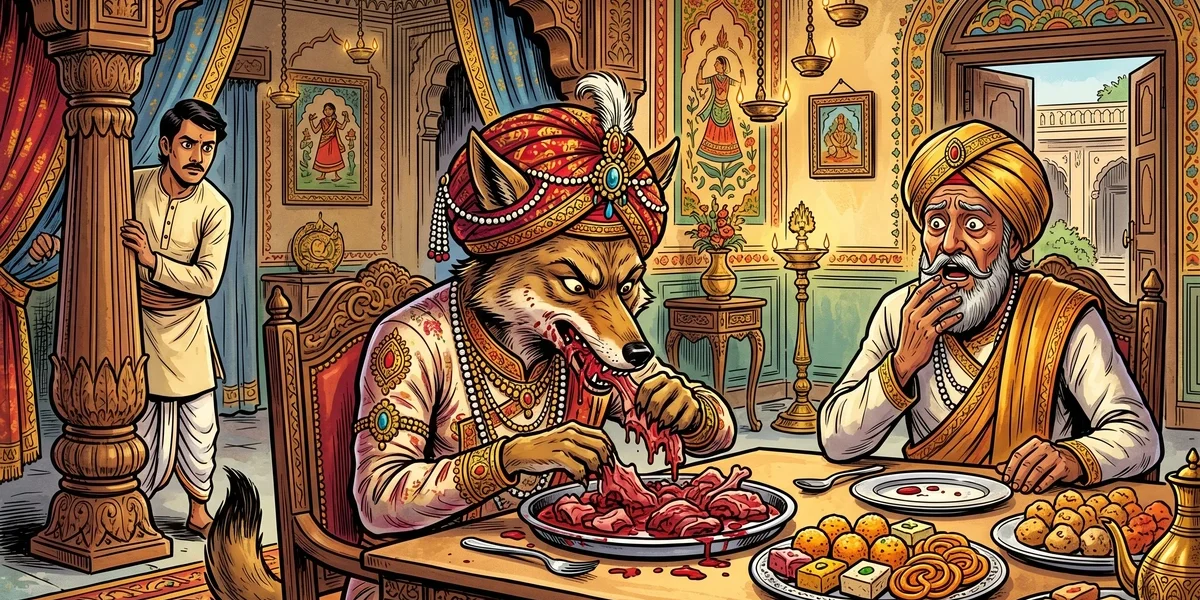
The jackal presents himself to one family—perhaps a pair of animals, perhaps a human household in the allegorical register Bengali folk tales often prefer—as a distinguished matrimonial agent with a network of superior connections. His manner is impeccable. His references are unverifiable. He speaks with the confident authority of a man who has arranged ten thousand happy marriages, and the family, hungry for a good match for their daughter, chooses to believe him rather than ask questions whose answers might disappoint. The trickster succeeds not by overcoming resistance but by understanding desire: the family wants to believe him because the alternative—remaining unmatched—is too dispiriting to contemplate. The jackal understands, with the cold clarity of the cunning, that hope is the best accomplice a deceiver can have. He accepts hospitality, takes gifts, and departs to arrange a brilliant match—at the second family’s house, where he performs the identical routine in reverse, describing the first family in equally inflated terms.
Beat II — The Architecture of Double Deception
The comic and moral centre of the tale is the jackal’s management of his double position. He has told the bride’s family that the groom is a prince; he has told the groom’s family that the bride is a beauty beyond compare. Neither claim is exactly false in the expansive rhetoric of the matrimonial broker, but neither is exactly true in the plain language of ordinary life. For a time, the jackal feeds magnificently from both tables, collecting his commission in grain, sweets, and flattering treatment. The Bengali audience would have recognized this as a precise caricature of the village ghatkali’s occupational temptation: the broker who inflates both sides of a match to collect from both sides of a match. What makes the tale structurally elegant is that the jackal’s lies are not the random fabrications of stupidity but the calibrated misrepresentations of expertise. He knows exactly how much to exaggerate without triggering immediate disbelief, exactly which details to omit, exactly which moment to accelerate the proceedings before either family has time to investigate. His downfall, when it comes, arises not from the families’ superior intelligence but from an accident of disclosure—the kind of random encounter that no amount of planning can forestall.
Beat III — The Broker’s Failure and the Critique of the System
When the two families meet—typically at the actual marriage ceremony, after the jackal has safely vanished with his commission—the misrepresentations become immediately apparent. The prince is not a prince; the beauty is not as described. The comedy of exposure collapses briefly into anger before resolving, in the Bengali manner, into a philosophical shrug: the families discover that the other party, stripped of the broker’s embellishments, is actually quite decent; they choose to proceed. The tale has it both ways—the trickster is satirised, but the institution he exploited is also gently mocked. Why did both families trust a stranger so completely? Why did they not send their own agents to verify? The Bengali folk tradition’s critique is not merely of dishonest brokers but of the systemic information asymmetry that made such brokers both necessary and dangerous. The Arthashastra (Book 3) codifies regulations for marriage contracts and intermediaries precisely because the ancient legal tradition recognised that brokers could not be trusted to self-regulate—a recognition that the folk tale encodes in narrative form for audiences who had never read Kautilya.
Beat IV — The Jackal’s Enduring Wit
What saves “The Match-Making Jackal” from being merely a morality tale is the persistent affection the Bengali tradition extends to its trickster, even while exposing him. The jackal’s intelligence is genuinely impressive. He reads social dynamics with perfect accuracy, exploits the gap between what people want to believe and what they should verify, and extracts comfort from a system that would otherwise offer him nothing—for the jackal in Indian society, as in Indian ecology, lives at the margins, dependent on the leavings of larger, more powerful creatures. His trickery is not pure villainy; it is the survival strategy of the marginal. Bengali folk culture’s fondness for jackal tales reflects a democratic scepticism about the pretensions of respectability: the jackal sees through the broker’s dignity, the matchmaker’s authority, the family’s self-importance, and finds them all equally susceptible to the simple tools of flattery and manufactured urgency.
Mithyavadino na vishvaset, satyadarshino na vishadayet—Do not trust one who speaks falsely; do not distress one who sees truly. The wise man distinguishes between the broker’s promise and the thing promised. (Hitopadesa, adapted, Book 1, maxim 14)
Why This Story Has Lasted
“The Match-Making Jackal” endures because it captures, in compact animal-story form, a social anxiety that transcends any particular era or culture: the danger of trusting intermediaries whose rewards depend on closing a deal rather than on the quality of the deal closed. Arranged-marriage societies in particular produced rich bodies of broker-satire, because the information asymmetry inherent in their structure created structural opportunities for exploitation. But the tale’s relevance extends well beyond marriage: any situation in which two parties rely on a third party to represent their interests accurately reproduces the jackal’s opportunity. Bengali village audiences laughed at the jackal and then went home to ask a few more questions of their own brokers—and that combination of entertainment and practical wisdom is precisely why this story was told, generation after generation, at every village gathering where marriages were being arranged.
Tradition & Collection Notes
Collection: Folk-Tales of Bengal by Lal Behari Day (Macmillan, 1883). Tale-type: ATU 1539 (Cleverness and Gullibility); jackal-trickster subtype. Motif index: K1810 (Deception by disguise), J1700 (Fools and gullible persons), K300 (Thefts and cheats—general). Jackal-trickster parallels: Panchatantra jackal stories (esp. Book 1, The Clever Jackal Who Outwitted the Lion); Jataka tales featuring the wily sigala; North Indian siyar folk tales. Marriage-broker satire: Arthashastra Book 3 (regulations on marriage brokers); Tamil Kamban satirical interpolations; Rajasthani ghatkali proverbs. Comparative reference: Stith Thompson, The Folktale (1946), pp. 218–220; A. K. Ramanujan, Folktales from India (1991), intro.
You May Also Like
 Bengal Folk Tales
Ages 9-12
Bengal Folk Tales
Ages 9-12
The Dancing Peacock of Bengal
The Dancing Peacock of Bengal: In the verdant countryside of Bengal, where the monsoon rains fell with regularity and the rice paddies stretched to distant
 Bengal Folk Tales
Ages 9-12
Bengal Folk Tales
Ages 9-12
The Clever Wife
The Clever Wife: In a Bengal village surrounded by rice paddies and coconut groves, there lived a merchant of modest means who had married a wife of joins a
 Bengal Folk Tales
Ages 9-12
Bengal Folk Tales
Ages 9-12
Gopal the Jester and the King’s Dream
Gopal the Jester and the King's Dream: In the prosperous kingdom of Dhaka, there ruled a king named Vikram who was respected for his strength and feared for