The Golden Lotus of the River Ganges
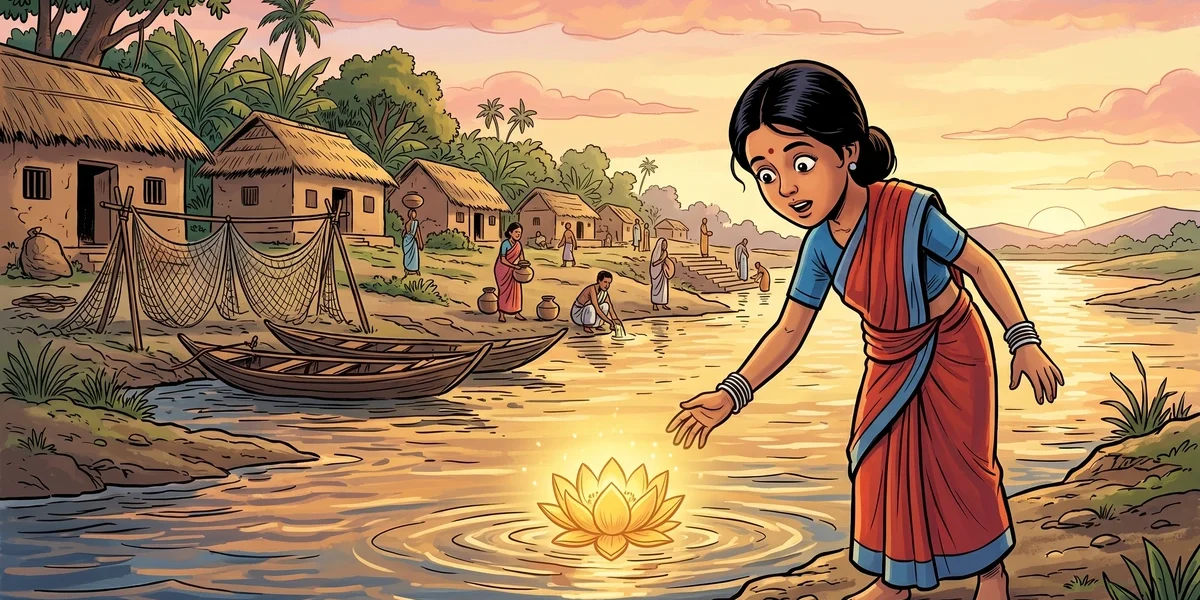
The Golden Lotus of the River Ganges: Along the banks of the Ganges, where the sacred river curves like a sleeping serpent through the plains of Bengal, there
Origin and Narrative Tradition
“The Golden Lotus of the River Ganges” fuses two of Indian civilisation’s most potent sacred symbols into a single impossible object: the Ganga, the most holy river in the Hindu world, and the lotus (kamala or padma), the flower that has served as the central emblem of purity, enlightenment, and divine creativity across the full range of Indian religious traditions from the Rigveda to the Tantras. Collected by the Reverend Lal Behari Day for Folk-Tales of Bengal (Macmillan, 1883), the story belongs to the Bengali durgam-vastu (impossible-object) quest tradition—a narrative type in which a hero must obtain something that does not merely require strength or cleverness to acquire but requires the right quality of soul. The golden lotus of the Ganga is not a magical weapon or a treasure hoard; it is the concentrated holiness of two sacred presences combined into a single bloom, and the story’s central argument is that such an object cannot be taken by force, cannot be bought, cannot be obtained by deception, and will reveal itself only to the one whose approach is characterized by the same purity the lotus embodies.
Beat I — The Sacred Geography of the Quest
The Ganga is not merely a river in Bengali religious imagination; she is a goddess (Ganga Mata), a descent of the divine into earthly form, whose waters are understood to purify sin accumulated over lifetimes and to escort the souls of the dead toward liberation. The Ramayana and Mahabharata both carry elaborate accounts of Ganga’s celestial origin and her descent to earth through the penance of King Bhagiratha—a descent for which the god Shiva agreed to hold her in his matted hair so her force would not shatter the earth. Bengali folk culture absorbed this mythology into daily life with an intimacy that the river’s physical presence in the Bengal delta made possible and constant: the Ganga flowed through the landscape of everyday existence, and its banks were the sites of cremation, pilgrimage, daily bathing, and the immersion of festival images. A golden lotus blooming in such a river would be a sign of extraordinary divine favour—a gift from the river-goddess herself to the world she flows through, available only to the one she chooses to receive it.
Beat II — The Impossible Object and Those Who Failed to Obtain It
Bengali quest tales of the durgam-vastu type establish the impossibility of the object by cataloguing prior failures: the warriors who tried to take the golden lotus by force and were swept away by the current; the merchants who attempted to buy it and found their gold dissolving in the sacred water; the clever men who planned elaborate strategies and discovered, at the moment of execution, that the lotus had simply moved beyond their reach. These prior failures serve a narrative function beyond mere obstacle-setting: they define, by negative example, the quality the successful quest requires. The lotus cannot be taken; it must be received. The Ganga cannot be commanded; she can only be approached with the reverence that her nature demands. The hero who succeeds does so by abandoning the instrumental logic of the failed questers and approaching the river not as a problem to be solved but as a presence to be honoured.
Beat III — The Lotus as Theological Symbol
The lotus (padma) is perhaps the single most semantically loaded natural symbol in Indian civilisation. In the Rigveda, the cosmic lotus (pushkara) floats on the primordial waters before creation begins. Brahma, the creator god, emerges from a lotus that grows from Vishnu’s navel. Lakshmi, the goddess of auspiciousness and abundance, stands on a lotus and holds two more. The Buddha achieves enlightenment and is subsequently depicted on a lotus throne. The Tantraloka of Abhinavagupta uses the lotus as the emblem of the sahasrara chakra—the thousand-petalled crown centre of consciousness. In all these traditions, the lotus’s defining quality is its relationship to water and purity: it grows from mud, through water, into air and light, yet its petals remain untouched by the water that surrounds them (padma-patra ivambhasa—like a lotus leaf in water, as the Bhagavad Gita 5.10 describes the liberated person’s relationship to the world). The golden lotus of the Ganga compounds this symbolism with solar gold—the metal of the gods, the substance of the immortal body—making it the emblem of enlightenment achieved in the world’s most sacred water.
Beat IV — The Gift of the River and the Character It Requires
The hero who ultimately receives the golden lotus from the Ganga does so through a quality that the Bengali folk tradition consistently values over strength, strategy, or social status: bhakti—devotion, love, the orientation of the whole self toward something beyond itself. He does not go to the river to take the lotus; he goes to the river to offer something to the river, and the lotus is given in return. This inversion of the instrumental quest—in which the hero sets out to obtain something and finds it by giving something—is one of Bengali folk narrative’s most characteristic moral structures. The Ganga responds to love; she is indifferent to ambition. The golden lotus is not a prize for the cleverest or strongest; it is a recognition of the one who has understood what sacred rivers and sacred flowers actually are—not objects of possession but manifestations of a divine generosity that responds to its own quality in whoever approaches.
Brahma-brahmatmike gangam gange shive shubhe, sarva-papa-hare devi narayani namostute—O Ganga, embodiment of Brahman, auspicious, beneficent, destroyer of all sins, divine Narayani, I bow to you. (Traditional Ganga-stuti, invocation before bathing in the sacred river)
Why This Story Has Lasted
“The Golden Lotus of the River Ganges” endures because it gives narrative form to a theological insight that is easy to state and difficult to live: that the most sacred things are not obtained but received, not taken but given in response to the quality of approach. Bengali village communities living on the banks of the Ganga understood this from daily experience: the river gives fish, water, fertile silt, and purification not because it is commanded to but because of what it is. The golden lotus is the folk tale’s way of asking: what would you have to become to receive the river’s greatest gift? The answer—someone who stops trying to possess the sacred and starts trying to be worthy of it—is the story’s permanent and universal teaching.
For more Bengali tales about the gifts of rivers, forests, and devoted craft, compare The Dancing Peacock of Bengal, The Serpent Queen of the Sundarbans, and The Weaver’s Enchanted Cloth.
Tradition & Collection Notes
Collection: Folk-Tales of Bengal by Lal Behari Day (Macmillan, 1883). Sacred geography: Ganga Mata tradition; Mahabharata and Ramayana accounts of Ganga’s descent; Bhagiratha’s penance in the Valmiki Ramayana 1.38–44. Lotus symbolism: Rigveda cosmic lotus; Lakshmi-Padma tradition; Bhagavad Gita 5.10 (padma-patra ivambhasa); Tantric sahasrara lotus. Tale-type: ATU 550 (Bird, Horse, and Princess) / durgam-vastu (impossible object) quest type. Motif index: H1333 (Quest for the impossible object), D965 (Magic plant), F811 (Extraordinary tree or flower). Scholarly reference: Diana Eck, Banaras: City of Light (1982), ch. 6 on Ganga theology; Diana Eck, India: A Sacred Geography (2012).
You May Also Like
 Bengal Folk Tales
Ages 9-12
Bengal Folk Tales
Ages 9-12
The Tiger King’s Daughter
The Tiger King's Daughter: The Sundarbans - that great delta of the Ganges where land and water intertwine like lovers’ fingers - were a realm unto themselves
 Bengal Folk Tales
Ages 9-12
Bengal Folk Tales
Ages 9-12
The Seven Champions of Bengal
The Seven Champions of Bengal: In a time when the world was younger and magic still flowed through the land like water through the Ganges delta, there lived in
 Bengal Folk Tales
Ages 3-5
Bengal Folk Tales
Ages 3-5
Life’s Secret
Life's Secret: Source: Folk Tales of Bengal | Type: Folktale | Country: India | Language: English In a certain village there lived a poor Brahman. He was very