The Demon Slayer of the Sundarbans
The Demon Slayer of the Sundarbans: In the vast mangrove forests of the Sundarbans, where water and land mingled in an endless dance of tides, there lived a
Origin and Narrative Tradition
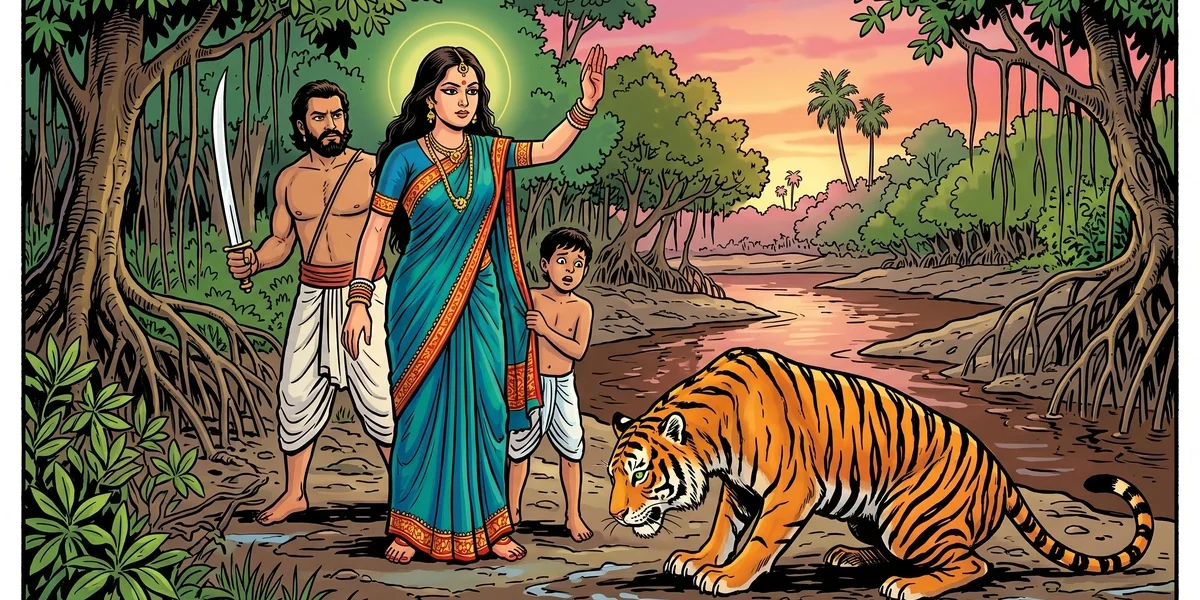
“The Demon Slayer of the Sundarbans” is the folk tale form of one of South Asian popular religion’s most remarkable phenomena: the Bonbibi Johuranama, or “The Story of Bonbibi’s Glory”—a sacred folk text of the Sundarbans mangrove forest that is worshipped with equal devotion by both Hindu and Muslim communities in the delta region. Bonbibi (“Forest Lady” or “Lady of the Forest”) is a goddess—or in Muslim devotional understanding, a pir (Muslim saint)—whose origin narrative describes her birth in Arabia, her arrival in the Sundarbans by boat, and her defeat of the terrifying forest demon Dakkhin Rai (the Southern King), who had claimed sovereignty over the forest and its human victims for himself. The Bonbibi cult’s bi-communal character—unique in Indian popular religion, where deity cults almost always align with one community or the other—reflects the specific social history of the Sundarbans: a frontier forest where Hindu and Muslim poor people entered together to harvest honey, cut wood, and fish, facing the same tigers, crocodiles, and snakes regardless of their religious identity. Bonbibi and her story speak to the shared vulnerability of the poor who enter dangerous places, transcending the communal distinctions that were so politically charged in the Bengal of the colonial and post-partition eras.
Beat I — Dakkhin Rai and the Forest’s Danger
Dakkhin Rai—the Southern King, the tiger-lord whose name is spoken in circumlocution among the Sundarbans mawali (honey-gatherers) who fear that naming him directly attracts his attention—is the Johuranama’s principal antagonist. He is not evil in the simple sense; he is the forest’s own power turned predatory, the force that takes the honey-gatherer’s life as casually as a tiger takes a deer’s. His claim to the Sundarbans is real: the forest belongs to him by right of sovereign power. What he lacks is the quality that would make his sovereign power just: daya (compassion), the recognition that the poor people who enter his forest do so not out of desire for conquest but out of necessity, that their hunger and their families’ hunger drive them into a danger they would avoid if they could. Dakkhin Rai’s power without compassion is the story’s image of pure domination—the force that takes without regard for the human reality of what it takes from.
Beat II — Dukhey and the Honest Heart
The human protagonist of the Bonbibi Johuranama’s central narrative is Dukhey (literally “the sorrowful one”)—a poor young man who has been brought into the Sundarbans against his better judgment by the merchant Dhona, who promises him a share of the forest’s riches but ultimately abandons him to Dakkhin Rai’s hunger when the demon demands a human sacrifice in exchange for a honey-laden beeswax harvest. Dukhey’s name signals his condition: he is the innocent poor person whose poverty makes him exploitable even by those who should protect him. Dhona’s betrayal—offering Dukhey to the demon to save himself and his cargo—is the story’s social critique: it is not only the forest that is dangerous to the poor; it is the hierarchies of class and commerce that can use them as expendable. Dukhey’s only recourse is to call on Bonbibi, whose protection he has been taught to claim since childhood, and his sincere cry—Bonbibi Ma! (Mother Bonbibi!)—is what the story turns on.
Beat III — Bonbibi’s Arrival and the Demon’s Defeat
Bonbibi’s arrival in response to Dukhey’s call is the Johuranama’s dramatic centrepiece. She comes with her brother Shah Janguli, materialising from wherever the sincere cry of a frightened believer reaches, and confronts Dakkhin Rai not merely as a superior force but as a moral authority: her power is greater than his not because she is stronger in raw terms but because she carries the divine mandate to protect the innocent, and his power, however real, has no such mandate. The encounter between Bonbibi and Dakkhin Rai is not simply a battle but a negotiation between two orders of power—the power of sovereign domination and the power of compassionate protection—in which the latter is eventually recognised as supreme. Dakkhin Rai is not destroyed; he is subordinated, made to acknowledge Bonbibi’s authority over the forest’s human visitors and bound by the terms of her protection: those who call on her cannot be touched. This resolution—not destruction but renegotiation of the terms of power—is one of the Johuranama’s most sophisticated elements.
Beat IV — The Democratic Theology of the Sundarbans
The Bonbibi cult’s most radical feature is its explicit indifference to religious identity: Bonbibi protects Hindus and Muslims equally, and the Sundarbans communities that worship her do not distinguish between the two in the context of forest entry. This bi-communal practice—documented by anthropologists who have worked in the region—is not the result of modern secularist ideology but of the practical logic of shared vulnerability: in a forest where tigers kill regardless of the victim’s religion, the protective deity must also be available regardless of the petitioner’s religion. The Johuranama’s own narrative embeds this logic: Bonbibi’s origin story gives her an Arabian birth and Islamic associations (she is sometimes identified with a Muslim saint, her brother Shah Janguli with another), while her forest domain and her protective function are framed in terms more immediately recognisable from Hindu goddess tradition. The result is a genuinely syncretic religious figure whose theological identity is less important than her practical function: the one who can be called on in the forest when the tiger is near.
Bonbibi Johuranama, aar na jabo bone—Bonbibi’s story of glory: I will not go into the forest without calling on you. (Sundarbans mawali prayer, recited before entering the forest, invoking Bonbibi’s protection for the journey)
Why This Story Has Lasted
“The Demon Slayer of the Sundarbans” endures because it addresses, in vivid narrative form, the experience of the poor person who must enter dangerous spaces in order to survive—and who has no protection except the sincere cry to a compassionate power that recognises his humanity where the demon does not. Dukhey’s situation is not historically unique; every generation produces its version of the honey-gatherer who must enter the tiger’s forest with nothing but his necessity and his faith. The story’s assurance—that the sincere cry of the genuine believer will be heard, that compassion exists as a force in the universe and not merely as a human sentiment—is the assurance that makes the dangerous journey possible for those who have no choice but to make it.
Tradition & Collection Notes
Primary text: Bonbibi Johuranama (The Story of Bonbibi’s Glory), Bengali folk devotional narrative; approximate composition date seventeenth–eighteenth centuries; authorship attributed to Muhammad Khater and Byasdeb; recited by both Hindu and Muslim performers. Key figures: Bonbibi (Forest Lady, goddess/pir); Shah Janguli (her brother); Dakkhin Rai (demon/tiger king, also worshipped separately); Dukhey (innocent victim); Dhona (merchant-betrayer). Religious character: Bi-communal (Hindu and Muslim) devotion; syncretic theology. Ecological context: Sundarbans mangrove forest; mawali honey-gatherer tradition; shared human-tiger space. Motif index: A485 (Deity of forest), F420 (Forest spirits), L100 (Unpromising hero—Dukhey), Q2 (Kindness and unkindness). Scholarly reference: Annu Jalais, Forest of Tigers: People, Politics and Environment in the Sundarbans (2010); Sufia Uddin, “Bonbibi and the Ecology of the Sundarbans”, Journal of the American Academy of Religion (2006).
You May Also Like
 Bengal Folk Tales
Ages 9-12
Bengal Folk Tales
Ages 9-12
The Clever Wife
The Clever Wife: In a Bengal village surrounded by rice paddies and coconut groves, there lived a merchant of modest means who had married a wife of joins a
 Bengal Folk Tales
Ages 6-8
Bengal Folk Tales
Ages 6-8
The Ghost-Brahman
The Ghost-Brahman: Source: Folk Tales of Bengal | Type: Folktale | Country: India | Language: English In a village there lived a Brahman who was very poor. The
 Bengal Folk Tales
Ages 6-8
Bengal Folk Tales
Ages 6-8
The Story of a Hiraman
The Story of a Hiraman: Source: Folk Tales of Bengal | Type: Folktale | Country: India | Language: English In a certain village there lived a poor man named