The Dancing Peacock of Bengal
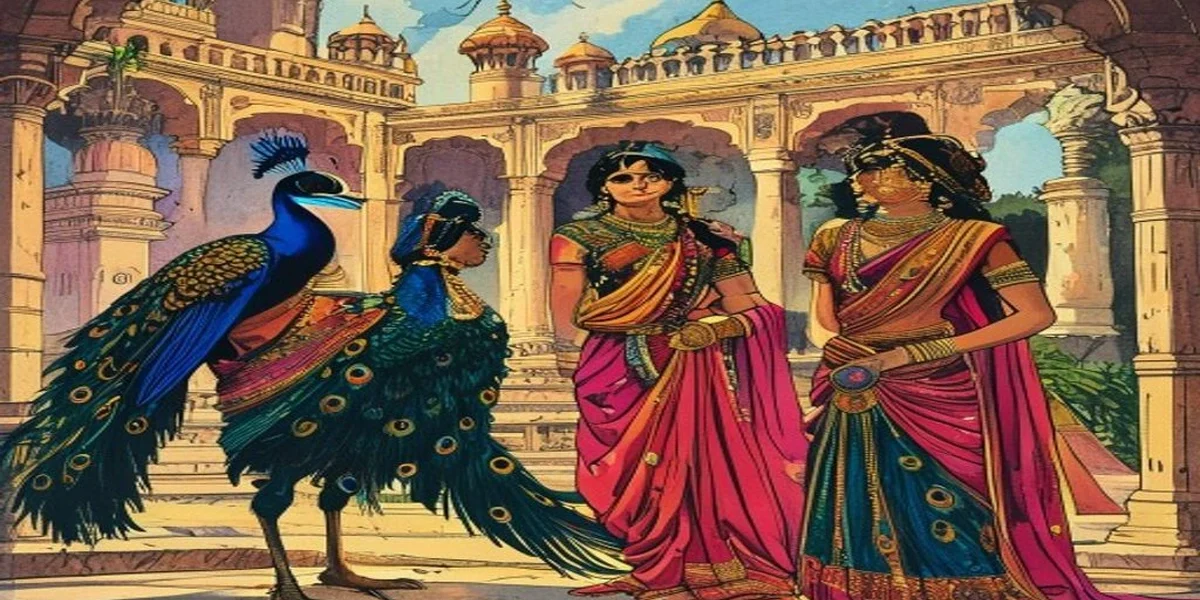
The Dancing Peacock of Bengal: In the verdant countryside of Bengal, where the monsoon rains fell with regularity and the rice paddies stretched to distant
Origin and Narrative Tradition
“The Dancing Peacock of Bengal” belongs to the great mayura-katha (peacock-tale) tradition of Indian folk and classical literature—a tradition in which the peacock is simultaneously a creature of extraordinary natural beauty, a symbol of cosmic vigilance (the “eyes” of its tail feathers), a vehicle of the god of war (Kartikeya-Murugan’s mount), and the most eloquent natural sign of the monsoon’s arrival. In Bengal, where the monsoon is not merely a meteorological event but the defining annual experience of a delta civilisation—the source of rice, fish, flood, and renewal simultaneously—the peacock’s monsoon dance carries a weight of meaning that purely ornithological description cannot exhaust. Bengali folk poetry (baromasi and viraha-kavya) invokes the dancing peacock as the emblem of joy-in-nature from the earliest medieval period; the classical Sanskrit tradition from Kalidasa’s Meghaduta (the cloud-messenger poem, fifth century CE) through the Vaishnava padavali poets (Jayadeva, Chandidas, Vidyapati) made the peacock’s response to the monsoon cloud one of the canonical images of Indian lyric poetry. The Bengali folk tale inhabits this rich literary landscape while rooting the peacock’s story in the specific ecology of Bengal’s forests and fields.
Beat I — The Peacock Before the Rain
The story’s opening establishes the peacock in its dry-season condition: magnificent in appearance, but contained, the tail folded, the dance potential latent rather than expressed. Other birds go about their business; the forest has its routine sounds; the hot season presses down on the landscape with its characteristic oppressive weight. The peacock watches the sky. This watching—patient, sustained, directed toward the horizon where clouds might gather—is the tale’s first moral teaching: the capacity for complete joy requires the capacity for complete attention. The peacock that does not watch the sky cannot respond when the sky changes. The animal’s vigil before the monsoon is, in Bengali folk and devotional interpretation, an image of the devotee who has learned to wait for the divine with the same quality of readiness—not anxious waiting but alert receptivity, the kind of attention that misses nothing because it is fully present to the current moment while remaining oriented toward the one that has not yet arrived.
Beat II — The Cloud and the Dance
When the first monsoon cloud appears on the horizon—the dark mass that Kalidasa’s yaksha sends as messenger to his beloved, the cloud that Bengali poets describe as the colour of Krishna’s skin, the megha whose arrival reorganises the entire emotional landscape of the subcontinent—the peacock’s response is immediate and total. The tail fans out in its full splendour, the iridescent eye-feathers catching the changed quality of the pre-monsoon light, and the dance begins: a whirling, prancing expression of pure delight that every tradition that has witnessed it has recognised as something beyond ordinary animal behaviour. Kalidasa calls this dance nritta—pure dance, dance that is not narrative but pure expression of an inner state. Bengali Vaishnavism reads it as a paradigm of bhakti—the soul’s unconditional response to the arrival of the divine. The peacock does not calculate; it does not consider its audience; it does not ask whether this is the right moment or the right weather. It simply responds to what the cloud is with everything that it is.
Beat III — The Eye-Feathers and Divine Watchfulness
The peacock’s tail feathers carry one of Indian iconography’s most potent images: the chandra-bindu (moon-dot) or eye-pattern that decorates each feather with a ring of iridescent colour around a dark centre. In Sanskrit poetic tradition, these are literally described as eyes—shikhi-piccha-netra—and the thousand-eyed peacock is connected to Indra (the thousand-eyed god of rain) through this visual echo. The folk tradition extends this symbolic connection: the peacock’s feathers are eyes that have witnessed the divine, and the bird carries those witnessed visions spread out in its tail for all the world to see. Krishna’s peacock feather—the single feather he wears in his crown as the emblem of his flute-playing and his intimate connection to the forest world—is the most concentrated form of this symbolism: a single eye-feather from the dancing bird worn against the forehead of the god who makes the entire natural world dance in response to his music.
Beat IV — Joy as the Story’s Deepest Teaching
“The Dancing Peacock of Bengal” ultimately teaches about the nature of authentic joy. The peacock’s dance is not performance—it is not directed at an audience, it is not calculated to impress, it does not pause to see whether anyone is watching. It is the pure expression of a creature responding to the world with its full natural capacity. Bengali Vaishnavism understood this unconditional responsiveness as the model for prema-bhakti—love-devotion that is expressed because of what the beloved is, not because of what the lover hopes to receive in return. The peacock dances because the rain has come; the devotee loves because God is; and in both cases, the absence of calculation is what makes the expression complete. The folk tale about the dancing peacock is, in this reading, not an animal story but a theology of joy: a description of what it looks like when a living being responds to what is most beautiful in the world with everything it has, without reservation and without audience.
Nritta-shikhi-piccha-dhara, megha-darshana-modita—The peacock wearing its dancing plumes, delighted by the sight of the cloud. (Meghaduta of Kalidasa, verse 9, the cloud-messenger’s journey through the peacock’s dancing country)
Why This Story Has Lasted
The dancing peacock endures as a story because it gives visible, animal form to an experience of joy that is otherwise difficult to describe: the joy that arises not from achieving something but from being fully present to something given freely by the world. The monsoon comes regardless of the peacock’s merit; the peacock dances regardless of anyone’s approval; and the result is the most beautiful natural spectacle in the Indian subcontinent’s landscape. Bengali folk culture treasured this story because it offered, in a single image, a complete philosophy of how to receive abundance: not with calculation or restraint, not with anxiety about whether it will last, but with the wholehearted, total response that the monsoon’s gift deserves.
Tradition & Collection Notes
Narrative tradition: Bengali mayura-katha (peacock-tale); baromasi (twelve-month seasonal song) tradition; viraha-kavya monsoon imagery. Classical literary background: Kalidasa, Meghaduta (fifth century CE), verses 9–11 (peacock at the cloud’s arrival); Jayadeva, Gitagovinda (twelfth century), peacock imagery in monsoon cantos; Vaishnava padavali on Krishna’s peacock feather. Iconographic background: Kartikeya-Murugan’s peacock mount; Krishna’s peacock-feather crown; Indra’s thousand eyes and the peacock’s eye-feathers. Motif index: B172 (Magic bird), A2411 (Origin of animal’s colour), F989 (Extraordinary natural events). Bengali seasonal context: Asadh-Shravan (June-August) monsoon onset; Nababarsha and Kali Puja seasonal celebrations. Scholarly reference: A. K. Ramanujan, The Interior Landscape (1967); Barbara Stoler Miller, Love Song of the Dark Lord (1977), Gitagovinda translation.
You May Also Like
 Bengal Folk Tales
Ages 6-8
Bengal Folk Tales
Ages 6-8
The Field of Bones
The Field of Bones: Source: Folk Tales of Bengal | Type: Folktale | Country: India | Language: English In a certain village there was a haunted field where no
 Bengal Folk Tales
Ages 9-12
Bengal Folk Tales
Ages 9-12
The Weaver’s Enchanted Cloth
The Weaver's Enchanted Cloth: In a city on the banks of the Hooghly River, where the spires of temples rose above the rooftops like prayers made stone, there
 Bengal Folk Tales
Ages 9-12
Bengal Folk Tales
Ages 9-12
The Demon Slayer of the Sundarbans
The Demon Slayer of the Sundarbans: In the vast mangrove forests of the Sundarbans, where water and land mingled in an endless dance of tides, there lived a