The Indigent Brahman
The Indigent Brahman: Source: Folk Tales of Bengal | Type: Folktale | Country: India | Language: English Once upon a time there was a Brahman who was very poor.
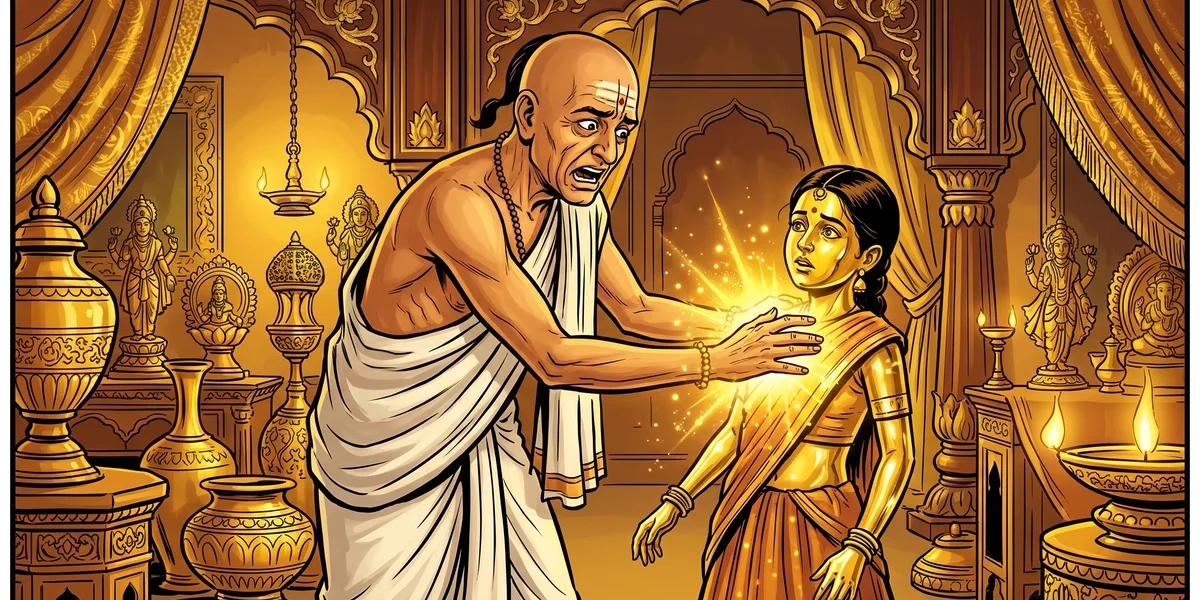
Origin and Narrative Tradition
“The Indigent Brahman” belongs to the daridra-brahman (poor-Brahman) narrative cycle, one of the most durable and socially charged story-families in Indian oral literature. Collected by the Reverend Lal Behari Day and published in Folk-Tales of Bengal (Macmillan, 1883), it reflects a persistent tension in Hindu social thought: if the Brahman caste is theoretically the most honoured in the varna hierarchy, why does the village scholar so often go hungry while the merchant and landlord grow fat? This paradox—sacred status without material security—generated a whole genre of Bengali folk tales in which the poor, learned Brahman serves simultaneously as comic figure, moral touchstone, and divine favourite. Stories in this genre appear in the Sanskrit Panchatantra (the foolish Brahman who loses his goat to thieves who convince him it is a dog), in the Tamil Kamban Ramayanam’s interpolated tales of Valmiki’s poverty, in Odia paala performance, and throughout North Indian kissa tradition. What the Bengali telling distinctively adds is a domestic intimacy—the poor Brahman is typically embedded in a village where everyone knows his name and his hunger—and a theological reassurance: the goddess Lakshmi (or her surrogate, a mysterious visitor) keeps a quiet account of the virtuous scholar’s patience, and her ledger always balances in the end.
Beat I — The Scholar in the Empty House
The story opens in the register of dignified destitution. The Brahman is learned—he knows the Vedas, recites the Puranas, teaches the village children—but his house contains almost nothing. His wife manages on grains measured in pinches and water carried from a distant well. His neighbours respect him in the abstract and forget him at mealtimes. The folk tale establishes this situation not with melodrama but with quiet exactitude: we learn what the Brahman eats (very little), what he does not eat (everything his neighbours take for granted), and how he maintains his equanimity despite hunger that would bend a lesser man. This portrait of dignified poverty is not accidental; it performs a social argument that Bengali village audiences would have recognised immediately. The Brahman’s hunger is the community’s moral debt. His patience is proof of his quality. Every detail of his bare house indicts the society that permits such poverty to coexist with such learning.
Beat II — The Intervention of Grace
The narrative turning point arrives through divine or quasi-divine intervention, typically in the form of a stranger—a wandering sadhu, a disguised goddess, a mysterious merchant—who appears at the Brahman’s door at a moment of crisis. The Brahman, faithful to the atithi-devo bhava principle (the guest is God, Taittiriya Upanishad 1.11.2), offers whatever he has, even when what he has is essentially nothing. This act of hospitality—offering the last handful of rice or the only cup of water—is the hinge of the entire tale. It demonstrates that poverty has not corroded the Brahman’s virtue, that generosity does not require abundance, and that the ancient duty of hospitality supersedes personal want. The mysterious visitor, revealed as an emissary of Lakshmi or as Lakshmi herself in disguise, rewards this offering with a boon: a inexhaustible vessel, a magic seed, a gift that transforms the Brahman’s household without transforming his character. He remains the same humble scholar; the world around him simply rearranges itself to match his inner worth.
Beat III — The Theology of Daridra Narayana
“The Indigent Brahman” operates within a theological framework that Bengali Vaishnavism and Bengali Shaktism share despite their doctrinal differences: the idea of daridra Narayana, the divine presence that inhabits poverty. Popularised in modern times by Swami Vivekananda—who made service to the poor the centrepiece of his social gospel—this idea has much older folk roots. In Bengali village religion, the poor and learned were understood to carry a special claim on divine attention precisely because worldly reward had not corrupted them. The daridra brahman tale-type enacts a theology of inversion: the last shall be first, not as a future promise but as a present structural reality visible to those with eyes to see. The divine bookkeeper keeps more accurate accounts than any landlord. Lakshmi—goddess of wealth and auspiciousness—is not indifferent to the poor scholar; she is specifically drawn to him, because his learning and patience have made his house the one genuinely auspicious place in a village full of prosperous but spiritually mediocre households. The story corrects a social misreading: what appears to be divine neglect (why is this good man so poor?) is actually divine testing and, ultimately, divine preference.
Beat IV — The Critique Encoded in Comedy
Bengali folk versions of the indigent-Brahman story often carry a satirical edge beneath their devotional surface. The wealthy neighbour who refuses to feed the scholar, the merchant who borrows the Brahman’s astrological knowledge without paying, the landlord who extracts labour without compensation—these figures appear as comic foils whose ultimate embarrassment (when the Brahman’s fortunes reverse) provides the audience’s deepest satisfaction. This satirical dimension was not incidental; it was the reason village women and low-caste audiences particularly treasured these stories. The tale gave voice, within a sanctioned narrative frame, to resentment of caste hierarchy’s practical failures: a system that claimed to honour learning routinely failed to feed the learned. The reversal at the story’s end was not escapism; it was a statement of how things ought to be, and the pleasure of the telling came from hearing the community’s moral logic vindicated, however temporarily, in narrative.
Vidya dadati vinayam, vinayad yāti pātratām, pātratāt dhanam āpnoti, dhanāt dharma, tataḥ sukham—Knowledge gives humility; from humility comes worthiness; from worthiness comes wealth; from wealth comes virtue; from virtue, happiness. (Hitopadesa, Introduction 6)
Why This Story Has Lasted
“The Indigent Brahman” has survived because it addresses a wound that never entirely healed in Indian village life: the gap between the prestige conferred on learning and the material reward actually available to the learned. Every generation of Bengali villagers who heard this story recognised its central figure, because every village had one—the man or woman of genuine knowledge whom the economy had failed to reward. The story’s theological consolation (Lakshmi sees, Lakshmi remembers, Lakshmi acts) gave communities a framework for maintaining respect toward their scholars even during long stretches of collective poverty. It also gave the scholars themselves a narrative of patience: endurance is not defeat; it is the condition that divine attention requires before it moves.
Tradition & Collection Notes
Collection: Folk-Tales of Bengal by Lal Behari Day (Macmillan, 1883). Tale-type: ATU 750 (Wishes) / ATU 841 (One Beggar Trusts God, Another Man); daridra-brahman subtype. Motif index: Q1 (Hospitality rewarded), D1470 (Magic object providing food or wealth), Q45 (Hospitality to disguised deity). Theological framework: Atithi-devo bhava (Taittiriya Upanishad 1.11.2); daridra Narayana tradition; Lakshmi-puja folk theology. Regional parallels: Panchatantra Book 5 Brahman tales; Tamil Periya Puranam Brahman devotee stories; Rajasthani lok-katha of the poor pandit. Scholarly reference: A. K. Ramanujan, Folktales from India (1991); Sunitikumar Chattopadhyaya, Bengali Folk Literature (1955).
You May Also Like
 Bengal Folk Tales
Ages 6-8
Bengal Folk Tales
Ages 6-8
The Jewel in the Lotus
The Jewel in the Lotus: In Bengal, in the land of green rice paddies and meandering rivers, there lived a poor farmer named Ashok who owned nothing but his
 Bengal Folk Tales
Ages 3-5
Bengal Folk Tales
Ages 3-5
Life’s Secret
Life's Secret: Source: Folk Tales of Bengal | Type: Folktale | Country: India | Language: English In a certain village there lived a poor Brahman. He was very
 Bengal Folk Tales
Ages 3-5
Bengal Folk Tales
Ages 3-5
The Origin of Opium
The Origin of Opium: Source: Folk Tales of Bengal | Type: Folktale | Country: India | Language: English Long ago, there was a terrible demon who lived in the