The Boy With the Moon on His Forehead
The Boy With the Moon on His Forehead: Source: Folk Tales of Bengal | Type: Folktale | Country: India | Language: English Once upon a time there was a king who
Origin and Attribution
The Boy With the Moon on His Forehead is one of the most celebrated tales in the Bengali folk narrative tradition — a story that combines the universal elements of jealous rivals, miraculous birth, concealment, and eventual recognition with the specific sensibility of the Bengal delta: its lush imagery of water and forest, its belief in the power of divine marks, and its particular sympathy for the child born into difficulty whose gifts cannot ultimately be suppressed. The tale was collected and published by the Reverend Lal Behari Day in his landmark anthology Folk-Tales of Bengal (1883), one of the earliest systematic scholarly collections of Bengali oral literature in English, and subsequently referenced in multiple literary treatments of the Bengal folk tradition including discussions associated with Rabindranath Tagore’s engagement with the thakurmar jhuli (grandmother’s bag) tradition of Bengali storytelling.
The story belongs to the broader Indic narrative type of the “marked child” — a child born with a physical sign of divine favour (a moon on the forehead, a star on the palm, lotus marks on the feet) who is threatened by jealous co-wives or rivals, concealed or abandoned, and eventually restored to his rightful place by the power of the mark itself. This type appears in Sanskrit literature (the Mahabharata’s Karna, born with divine armour and earrings; Shakuntala’s son Bharata, born with a lion’s grip), in the Jataka tradition, and across the folk literatures of Bengal, Rajasthan, Tamil Nadu, and Kerala with local inflections at each site.
Beat I — The King’s Three Wives and the Promise
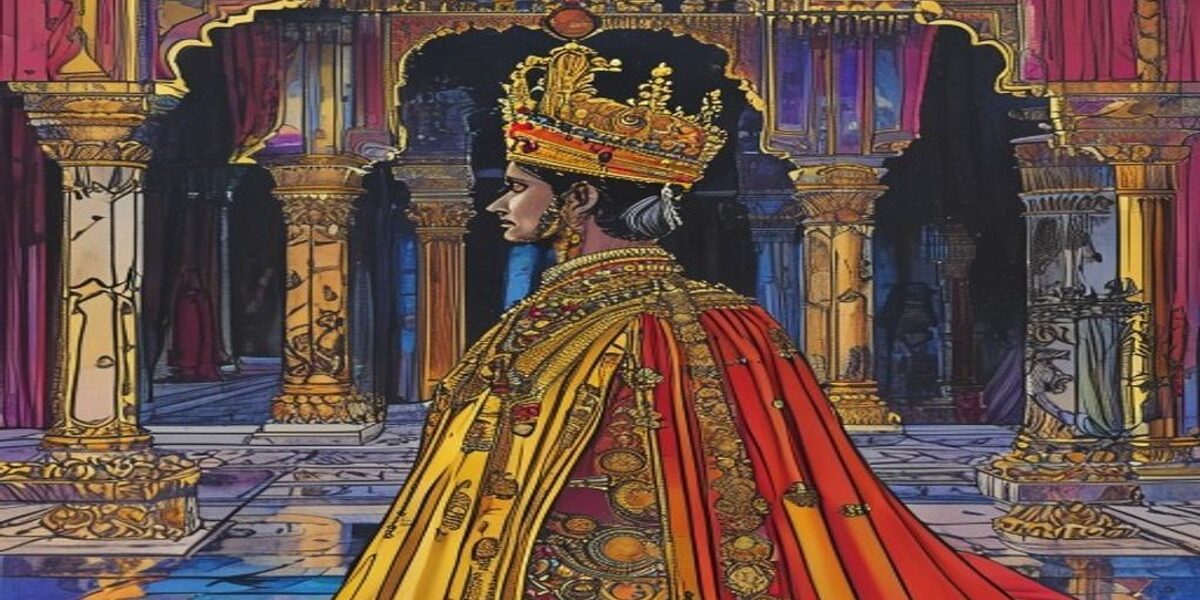
A king of a prosperous Bengal kingdom had three wives. The first two were beautiful, well-born, and deeply jealous of one another and of any potential rival. The third was a young woman of humble origin whom the king had married after encountering her on a journey — she was gentle, unremarkable in appearance, and possessed of a quality of inner composure that the king found restful in a palace full of calculation and display. The first two wives despised her immediately and with the focused intensity of those who recognise, despite themselves, a quality they cannot match.
A wise old woman — in the Bengali tradition, such figures are typically either elderly yoginis with supernatural knowledge or disguised goddesses — visited the palace and spoke to the third wife privately: “You will bear a son. He will be born with the moon on his forehead, which is the sign of a king among kings. Guard him, for there are those who will try to destroy what they cannot become.”
The third wife told no one. But in a palace full of watchful ears, private words travel; and the first two wives learned enough to understand that something extraordinary was coming — something that would permanently alter the balance of power in the household. They began to plan.
Beat II — The Concealment and the Substitution
When the third wife’s labour came, the first two wives arranged to be present at the birth with the ostensible purpose of assistance. The child was born: a boy, and on his forehead the moon — a luminous mark, pale and perfect as the full moon at harvest time, that lit the room faintly when the lamps were low. The midwife saw it and started. The first two wives saw it and moved.
In the confusion of the birth chamber, they substituted the child: the moonlit boy was placed in a basket of reeds and set afloat on the river that ran behind the palace, and a stillborn animal — or, in some variants, a stone — was placed in his stead. The king was told his third wife had born a monstrous thing and the child had died. The third wife, weak from the birth, was half-delirious; she knew something had happened to her son but could not articulate it clearly enough to be believed against the testimony of her two senior co-wives.
The Bengali narrative tradition handles this moment with particular care. It does not dwell on the horror of what the two wives have done; it moves quickly to the river, to the reed basket, to the current carrying the child downstream toward the unknown. The river in Bengali folk narrative is frequently a figure for fate — not fate as inevitability but fate as the medium through which the destined and the actual are eventually brought together, despite the obstacles that human jealousy and cruelty interpose.
Beat III — The Discovery and the Growing
The reed basket came to rest at the ghat — the river steps — of a poor fisherman’s village many miles downstream. A childless old fisherwoman found it in the early morning, lifting it from the water with hands accustomed to nets and expecting nothing more than a caught branch. She opened it and found the boy — alive, the moon on his forehead still glowing softly in the dawn light, his eyes open and regarding her with the calm that the Bengali tradition attributes to children born with divine marks.
She took him home. She told no one about the mark at first — not from calculation but from the instinct of someone who has cared for fragile things and knows that the world does not always treat fragile things kindly. She raised him as her own son, and he grew in the village with the fishermen’s children, learning the river and the nets and the stars by which the night fishermen steered.
But the moon on his forehead could not be permanently hidden. It glowed when he slept. It lit the water when he waded. The village children whispered about it; travellers who passed through spoke of it; and eventually the stories reached a radius wide enough to intersect with the palace’s own circles of information — and with the king, who had never been entirely at peace with the account of his third wife’s “monstrous” birth.
Beat IV — Recognition, Justice, and the Moral
The king’s investigation — undertaken carefully, against the resistance of the first two wives who understood exactly what it would uncover — eventually led him to the fisherman’s village. He arrived at the ghat to find his son: now a young man of striking presence, the moon on his forehead unmistakable to anyone who had been told what to look for. The reunion with the third wife — long confined, never believed, but never broken — was the emotional centre of the tale’s resolution. The first two wives were exposed; the king’s justice, though the Bengali folk tradition is typically more interested in restoration than in punishment, was delivered.
The Bengali narrative tradition’s handling of the resolution is characteristic: the third wife does not gloat or demand vengeance; she simply receives her son and her place. The boy does not proclaim his divine mark or display it for effect; he is what he was born to be, and the mark does what marks do — it makes itself visible when the time is right, to the right eyes, in the right circumstances. The justice of the resolution is not achieved by any single dramatic act of exposure but by the accumulation of evidence that could not ultimately be suppressed, because the mark itself was irrepressible.
The governing moral of the tale is encoded in this irrepressibility. Jealousy can hide a child in a basket. It can send him down the river. It can tell the king he was never born. What jealousy cannot do is change what the child is — and what the child is will, eventually, become visible. The Bengali oral tradition considered this not merely a consoling fantasy but a statement about the relationship between genuine quality and the world’s eventual recognition of it: the moon on the forehead cannot be removed, only temporarily hidden, and the hiding is always temporary.
“They put him in a basket and set him on the river. The river carried him to his mother. The mother found him in the morning. The moon on his forehead lit her face as she lifted him. She knew, as the river had known, that this child was not lost — only travelling.”
The story’s resonance across generations lies in its address to everyone who has experienced the specific form of injustice in which genuine quality is denied, hidden, or suppressed by those who benefit from its concealment. The mark on the forehead is the narrative’s way of saying: genuine quality is not destroyed by the attempt to conceal it; it persists, it glows, it eventually becomes visible to the eyes that are looking for it. This is not a guarantee of swift justice — the boy grows up in a fisherman’s village, not in the palace — but it is a claim about permanence: the mark does not fade.
Why This Story Lasted
The Boy With the Moon on His Forehead has been told across the Bengali tradition for centuries because it speaks to one of the most common forms of injustice in any hierarchical society: the suppression of genuine worth by those who have the positional power to do so temporarily. The reed basket, the river, the fisherwoman’s ghat — these are the Bengali tradition’s way of encoding a hope that is simultaneously realistic (the boy does not emerge immediately into his rightful place; he grows up among fishermen) and permanent (the moon on his forehead does not go out; recognition comes). Stories that hold realism and hope in this precise balance survive in the communities that need both.
You May Also Like
 Bengal Folk Tales
Ages 9-12
Bengal Folk Tales
Ages 9-12
The Hermit and the Mouse (Panchatantra Retold)
The Hermit and the Mouse (Panchatantra Retold): In a cave high in the mountains, where the air was thin and the silence profound, there lived a hermit who had
 Bengal Folk Tales
Ages 6-8
Bengal Folk Tales
Ages 6-8
The Field of Bones
The Field of Bones: Source: Folk Tales of Bengal | Type: Folktale | Country: India | Language: English In a certain village there was a haunted field where no
 Bengal Folk Tales
Ages 9-12
Bengal Folk Tales
Ages 9-12
Gopal the Jester and the King’s Dream
Gopal the Jester and the King's Dream: In the prosperous kingdom of Dhaka, there ruled a king named Vikram who was respected for his strength and feared for