The Hermit and the Mouse (Panchatantra Retold)
The Hermit and the Mouse (Panchatantra Retold): In a cave high in the mountains, where the air was thin and the silence profound, there lived a hermit who had
What the mountain confessed to the wind, the wind confessed to the cloud, the cloud confessed to the sun: that there is no greatness in the world that the small cannot, in some way, undo. And so the hermit’s daughter went home to her own kind, and was happy.
This is one of the most beloved fables in the Panchatantra, and one of the most misunderstood by modern retellings. It is the story of the Mouse Maiden — known in folklore studies as “The Mouse Maid Made Mouse” — and the canonical Sanskrit version is older, stranger, and far more luminous than the modern English versions usually preserve. The hermit in the canonical text does not search for husbands among kings and merchants and scholars. He searches at the very scale of the cosmos itself. He calls upon the Sun; the Sun defers to the Cloud; the Cloud to the Wind; the Wind to the Mountain; and the Mountain, of all things, to the Mouse. The chain of confessions is the heart of the tale, and the lesson it carries — svabhāvo duratikramaḥ, “innate nature is hard to overcome” — is one of the deepest and gentlest in Indian wisdom literature.
The story comes from Book III of the Panchatantra, called Kākolūkīyam (काकोलूकीयम्, “Of Crows and Owls”), composed in Sanskrit by Vishnu Sharma (Viṣṇu Śarmā) c. 200 BCE. Within the larger Crows-and-Owls war frame, the wise old crow-counsellor Sthirajīvin tells this tale to illustrate that one cannot escape one’s true nature — that no transformation, however well-meant, can rewrite the self. The same story appears in the slightly later Hitopadeśa (हितोपदेश, c. 9th–12th century CE), attributed to Nārāyaṇa Paṇḍita, in its Book III on War. La Fontaine, the great 17th-century French fabulist, retold it in Book IX.7 of his Fables as La Souris métamorphosée en fille (“The Mouse Changed Into a Maid”), and in his preface he named the Sanskrit source explicitly. Folklorists today catalogue the motif as ATU 2031C, “The Mouse Who Was to Marry the Sun” — and they have collected versions of it from Japan (where it is the marriage-story Nezumi no yomeiri), from Russia (where a rat-father wants to marry his daughter to the sun), from Spain, Italy, and Germany. It is one of the most widely-distributed parables in the Indian-origin folk tradition.
Here is the story as the Sanskrit tradition has held it for two thousand years.
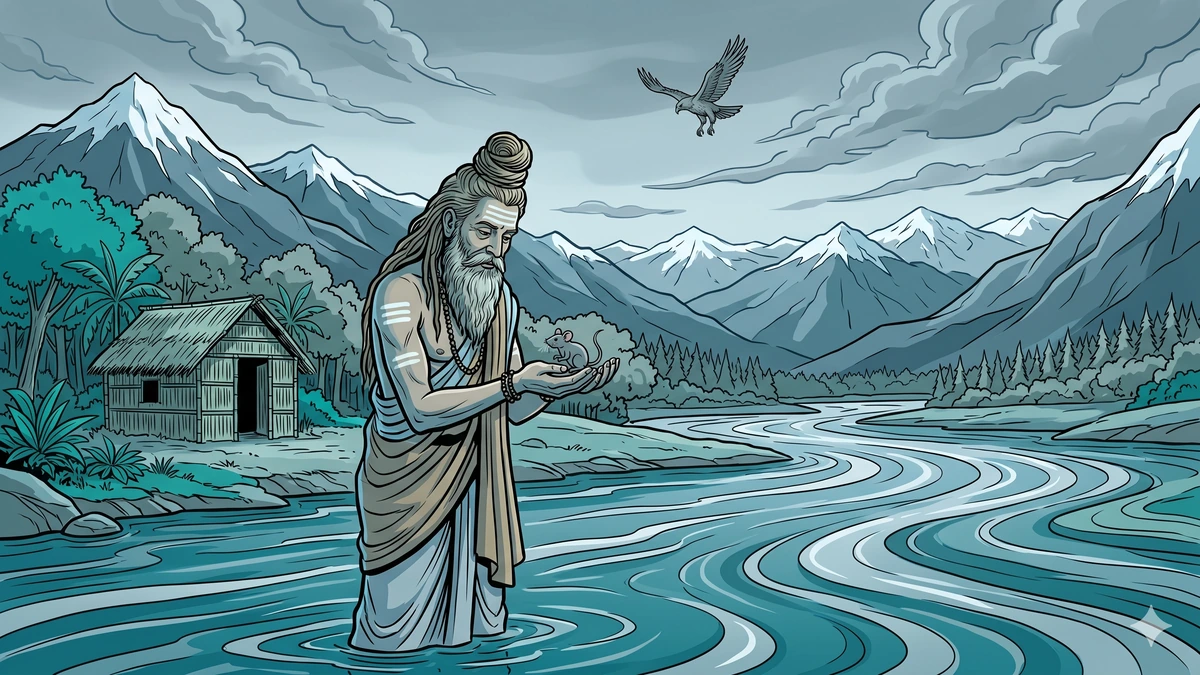
By the bank of the Ganges, where the river is wide and the great cool wind comes down from the Himālaya in the early afternoons, there stood a small ashram of palm-leaf and bamboo. In it lived a hermit — a muni, an ascetic of the older school, his hair matted into the long topknot of the forest sages, his forehead marked with the three lines of holy ash, his speech slow, his power great. He had performed his austerities for so many years that the gods, when he called upon them, came.
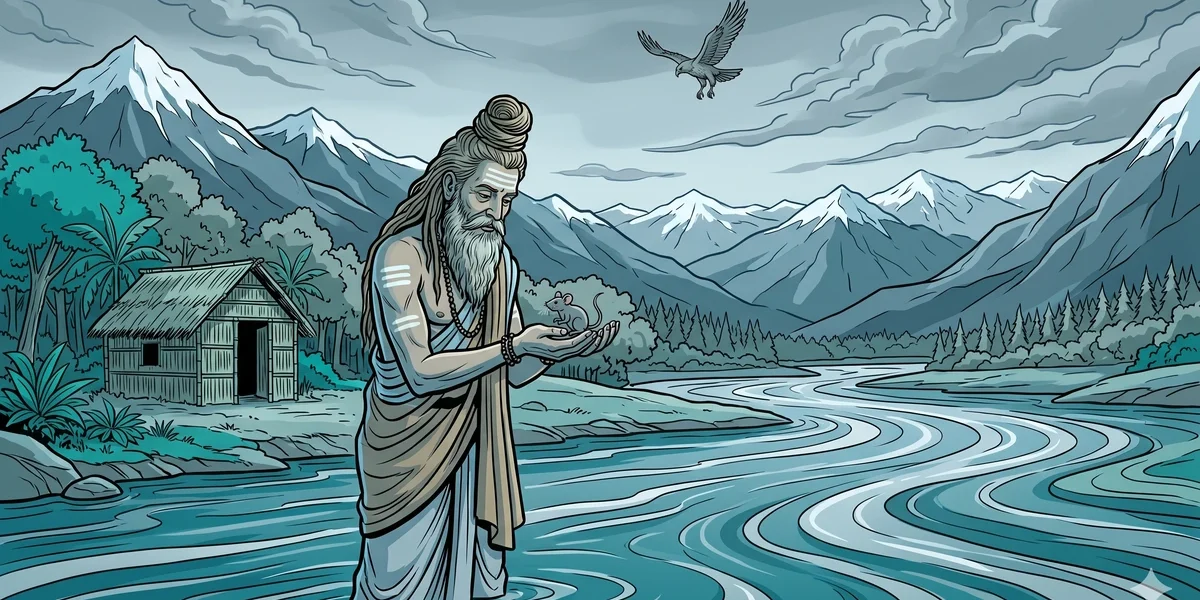
One morning, while he was at his ablutions in the river, a hawk circled overhead, and from its talons, by some accident of grip or fear, dropped a tiny grey field mouse. The mouse fell — small as a ball of cotton — into the hermit’s open hand.
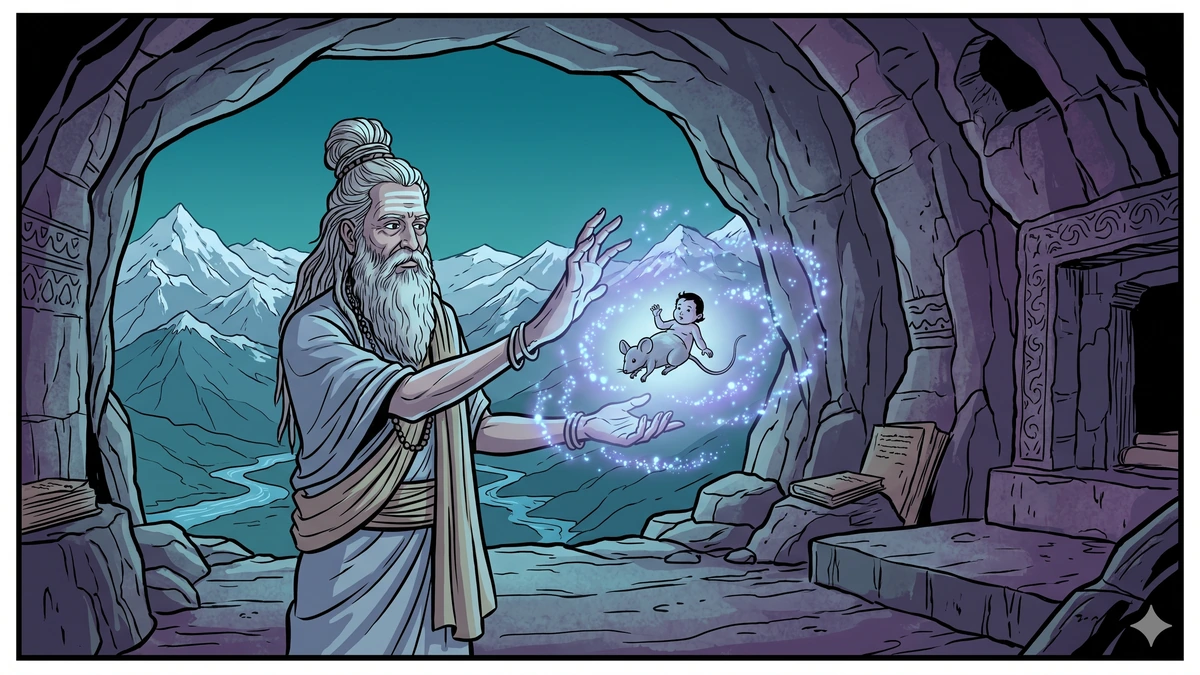
The hermit was a man of compassion, and the mouse was alive but trembling. He could have set it down at the river’s edge and walked on. But the mouse looked up at him with the clear black eyes of a creature in absolute helplessness, and the hermit, almost without thinking, spoke a verse of his ascetic power and turned the mouse into a baby girl. He took her home and raised her as his own daughter. She did not remember being a mouse. She grew, year by year, into a kind and intelligent young woman, with eyes that were perhaps a little quicker than other women’s, and a way of going perfectly still when she heard a footstep that no one ever quite remarked upon.
The years passed. The girl came to the age of marriage, and the hermit, who loved her as a father loves a daughter, began to think of her future. She should not be a hermit’s daughter forever; she should have a husband. And because she was dear to him, and because she had once been a mouse, and because hermits with great ascetic power tend to think on a grand scale, he resolved that she should marry the most powerful being in the universe.
He sat in meditation, and he summoned the Sun.
The Sun came — Sūrya, lord of the sky, blazing in his cool celestial chariot drawn by seven horses, his form a thousand spokes of pale silver-white. He stood before the ashram and bowed.
“Lord Sūrya,” said the hermit, “you are the most powerful being in the worlds. I have brought you here to offer my daughter in marriage. She is beautiful and good. Will you take her as your wife?”
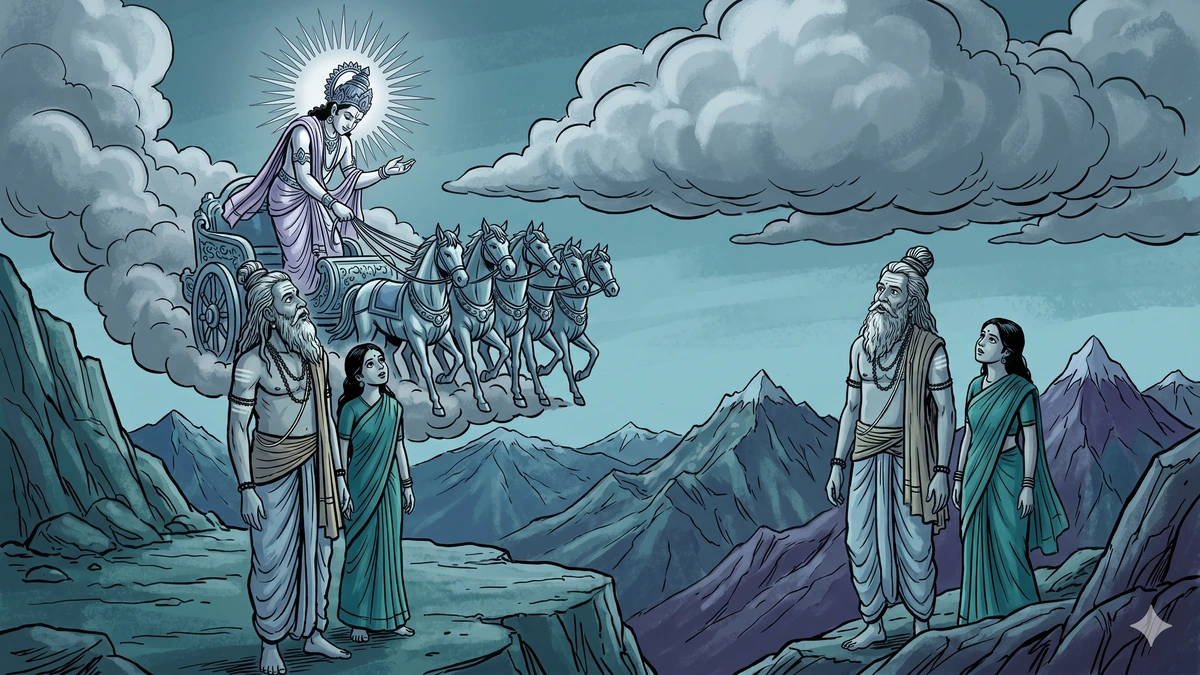
The Sun looked at the maiden, and was charmed; but the Sun was an honest god. “Hermit,” he said, “I am flattered, but I am not the most powerful being in the worlds. The Cloud is more powerful than I am — for the Cloud comes between me and the earth, and I cannot see through him, and my whole light is blotted from the world by him. Speak to the Cloud.”
The hermit was thoughtful. He sat again, and he summoned the Cloud.
The Cloud came — Megha, dark-bellied, soft-edged, vast and rolling, smelling of the rains of the eastern monsoon. He stood before the ashram and inclined himself.
“Lord Megha,” said the hermit, “you are more powerful than the Sun. Will you marry my daughter?”
The Cloud looked at the maiden, and was charmed; but the Cloud was an honest god. “Hermit,” he said, “I am not the most powerful being. The Wind is more powerful than I am — for the Wind scatters me wherever he pleases. He drives me before him as a herd of cattle. Speak to the Wind.”
The hermit summoned the Wind.
The Wind came — Vāyu, swift and slender and never quite at rest, his garments flowing about him like a river running upward. He stood before the ashram, restless even in stillness.
“Lord Vāyu,” said the hermit, “you are more powerful than the Cloud. Will you marry my daughter?”
The Wind looked at the maiden, and was charmed; but the Wind was an honest god. “Hermit,” he said, “I am not the most powerful. The Mountain is more powerful than I am — for he stands fast and does not move when I rage against him. I have torn forests from the earth, but the Mountain I cannot move. Speak to the Mountain.”
The hermit summoned the Mountain.
The Mountain came — slow, immense, deep teal-grey, his shoulders thick with cold pine forests, his head capped with the eternal snow of the Himavat. He came so slowly that he was already there before he had begun, in the way of mountains.
“Lord Parvata,” said the hermit, “you are more powerful than the Wind. Will you marry my daughter?”
The Mountain looked at the maiden, and was charmed; but the Mountain was an honest god, and he laughed a deep slow laugh — the kind of laugh that took several minutes to get out of him.
“Hermit,” said the Mountain, “I am not the most powerful being in the worlds. The mouse is more powerful than I am.”
“The mouse?” said the hermit.
“The mouse,” said the Mountain. “He burrows into my flanks. He makes whole cities of tunnels through me. I cannot stop him. I stand against the wind without flinching, but I cannot keep one small mouse out of my own body. Speak to the mouse.”
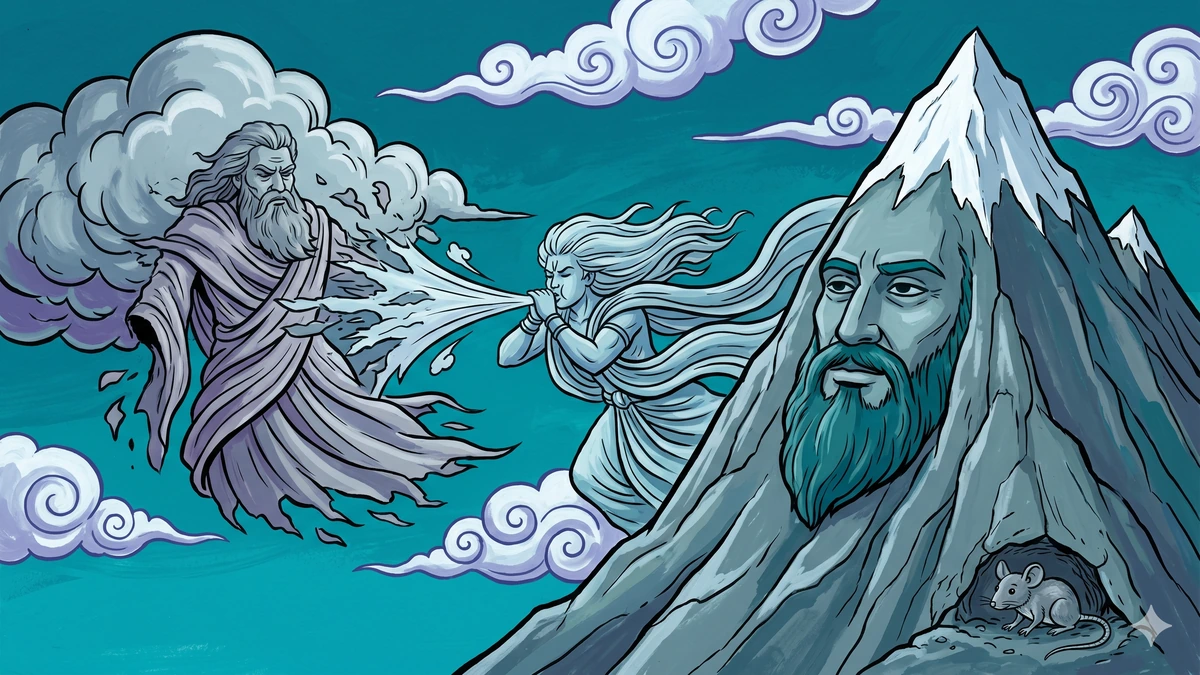
The hermit sat down on the warm stone of the riverbank and looked, for a long while, at the slow water. He was a clever man, and he had begun to understand. He summoned a mouse.
The mouse came — a small grey field mouse, very like the one a hawk had dropped into the hermit’s hand many years before. He twitched his whiskers and looked up.
“Mouse,” said the hermit, “the Sun has told me you are more powerful than he is. The Cloud agrees. The Wind agrees. The Mountain agrees. I have a daughter — beautiful and good — and I would like you to marry her.”
The mouse looked at the maiden — tall, in her sari, her hair dressed as a young woman’s hair is dressed — and the mouse was puzzled. “Sir,” said the mouse, “I am happy to marry. But how would she fit into my burrow? My burrow is the size of a fist. Could she perhaps be made smaller? Could she perhaps be made — a mouse?”
The hermit looked at his daughter. The daughter looked at the mouse. There was a small silence. And then the daughter, who had perhaps known all along — who had perhaps been still as a mouse is still, listening for footsteps, all her human life — smiled, and nodded.
The hermit spoke a second time the verse of his ascetic power. The maiden grew small, smaller still, the smallest, until she was a grey field mouse with quick black eyes — and she ran to the mouse-husband, and the two of them turned and went together into the hole at the foot of the mountain, where they lived, by every account, very happily for the rest of their lives.
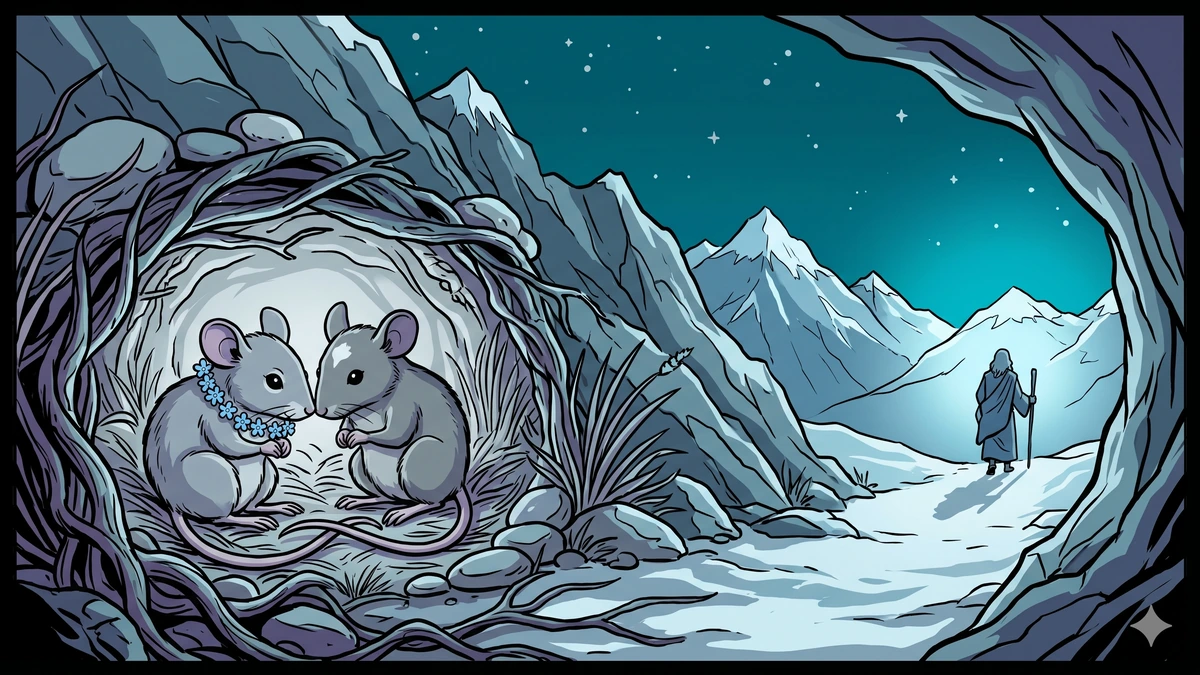
The hermit watched them go, and stood for a long while at the entrance to the small hole. He had learned a thing, late in life, that he had not known when he had first lifted the mouse from the river. He had learned that what is given by birth cannot quite be unlearned by any other gift; that one’s nature, to use the Sanskrit word, is one’s svabhāva — one’s “self-being” — and that the deepest blessing one can give to a creature is not to make it grand, but to let it be itself among its own kind. He went back to his meditations, and he meditated longer that day than he ever had before.
What the story is really about
The Sanskrit verse Vishnu Sharma attaches to the Mouse Maid story is famous in Indian philosophical literature: svabhāvo duratikramaḥ (स्वभावो दुरतिक्रमः) — “innate nature is hard to overcome.” It is the same word — svabhāva — that the Bhagavad Gītā uses when Krishna tells Arjuna that he must do his own duty, however imperfect, rather than another’s, however well; and the same word that Patañjali’s Yoga Sūtra uses to mean the deep grain of one’s own being. The Mouse Maid story is the gentlest possible illustration of it. The hermit means well. The hermit loves his daughter. The hermit wants her to marry the Sun himself. And the deepest kindness the story offers her is not the marriage to the Sun — it is the return to the mouse.
This is, in a sense, the Panchatantra’s quiet rebuttal to the modern self-help notion that we can become anything we choose. There is, the story argues, a self that we are. We can polish it; we can refine it; we can give it a sari and teach it Sanskrit; but its centre — what wakes up at footsteps, what listens, what is happy — is given. The deepest fulfilment is not transformation. It is recognition. The maiden is happy at the end of the story because she has been allowed to be a mouse, and the storyteller does not pity her for it. The story does not say be small. It says: be yourself, and find others of your kind, and be among them, and the mountain will not have to defer to you for you to be content.
There is also a quieter reading the Panchatantra never quite states but always implies. The mouse, in the story, is the most powerful being in the worlds — more powerful than the Sun, the Cloud, the Wind, the Mountain. Not because of strength; not because of grandeur; but because of fit. The mouse is exactly suited to be a mouse. The Sun is grand but defeated by clouds; the Mountain is grand but defeated by mice. Greatness in the wrong place is a kind of weakness. The mouse, doing what mice do, is invincible. The story is, in this reading, a short and very Indian meditation on what it means to be at home in one’s own life.
How the story travelled
From its Panchatantra root, the Mouse Maid moved out of India in the 6th century CE through the Persian physician Borzūya, who translated the Panchatantra into Pahlavi for the Sasanian court of Khosrow I. From Pahlavi it passed in the 8th century into Arabic, in Ibn al-Muqaffaʿ’s Kalīla wa Dimna, where the maiden’s transformation is sometimes mediated by a cat rather than a mouse for cultural reasons. From Arabic it moved into Persian as the Anvār-i Suhaylī, into Hebrew as the work of Rabbi Joel, into Latin as the Directorium Humanae Vitae of John of Capua, and from there into Spanish, Italian, and German. In 17th-century France, Jean de La Fontaine retold it as La Souris métamorphosée en fille in Book IX.7 of his Fables, and in his preface to that fable he explicitly named the Sanskrit source — one of the rare moments in European fable-writing where the Indian origin of a tale is acknowledged.
The story also travelled east. In Japanese tradition it became Nezumi no yomeiri, “The Mouse’s Marriage,” in which a mouse-father searches for the most powerful husband for his daughter and the chain runs Sun → Cloud → Wind → Wall → Mouse (the wall replaces the mountain, fitting the Japanese village setting). In Russian folktales a rat-father seeks to marry his daughter to the sun. In Spain the chain becomes Sun → Wall → Mouse. In every version the structure is the same: the cosmic chain of confessions, ending in the small creature that is, by being exactly what it is, more powerful than everything that thought itself greater.
Folklorists call the entire family ATU 2031C, “The Mouse Who Was to Marry the Sun.” It has been collected in over thirty languages. It is one of the most successful philosophical exports from ancient India.
For thoughtful readers — a small reflection
The most moving line in the entire fable is the one nobody quotes, because it is not in the dialogue at all — it is in the narrator’s note that the maiden, at the moment of being asked, smiled and nodded. She had perhaps known all her life that she was a mouse. She had been still as a mouse is still, listening for footsteps, all her human years. The hermit had given her a beautiful gift — a sari, a Sanskrit education, the company of a wise father. But what he could not give her, no matter how powerful his ascetic verse, was the experience of being something she was not. He gave her instead, in the end, the deepest gift a parent can give: he let her go home.
And the story does not end with the mouse and the mouse-husband at all. It ends with the hermit, standing at the small hole in the earth, having understood, late, what his daughter had perhaps always known. There is a self that we are. The work of a life is not to escape it, but to find it, and to let it be what it is, in the company of others of its kind. Svabhāvo duratikramaḥ — innate nature is hard to overcome. And this, the story insists, is good news.
Frequently Asked Questions
What is the moral of The Hermit and the Mouse?
Which Panchatantra book contains The Hermit and the Mouse?
How did the mouse become a tiger in the story?
What lesson does The Hermit and the Mouse teach children?
Who is the hermit in The Hermit and the Mouse?
You May Also Like
 Bengal Folk Tales
Ages 9-12
Bengal Folk Tales
Ages 9-12
Gopal the Jester and the King’s Dream
Gopal the Jester and the King's Dream: In the prosperous kingdom of Dhaka, there ruled a king named Vikram who was respected for his strength and feared for
 Bengal Folk Tales
Ages 6-8
Bengal Folk Tales
Ages 6-8
The Jewel in the Lotus
The Jewel in the Lotus: In Bengal, in the land of green rice paddies and meandering rivers, there lived a poor farmer named Ashok who owned nothing but his
 Bengal Folk Tales
Ages 3-5
Bengal Folk Tales
Ages 3-5
The Origin of Opium
The Origin of Opium: Source: Folk Tales of Bengal | Type: Folktale | Country: India | Language: English Long ago, there was a terrible demon who lived in the