The Story of Prince Dodul and the Ruby Queen
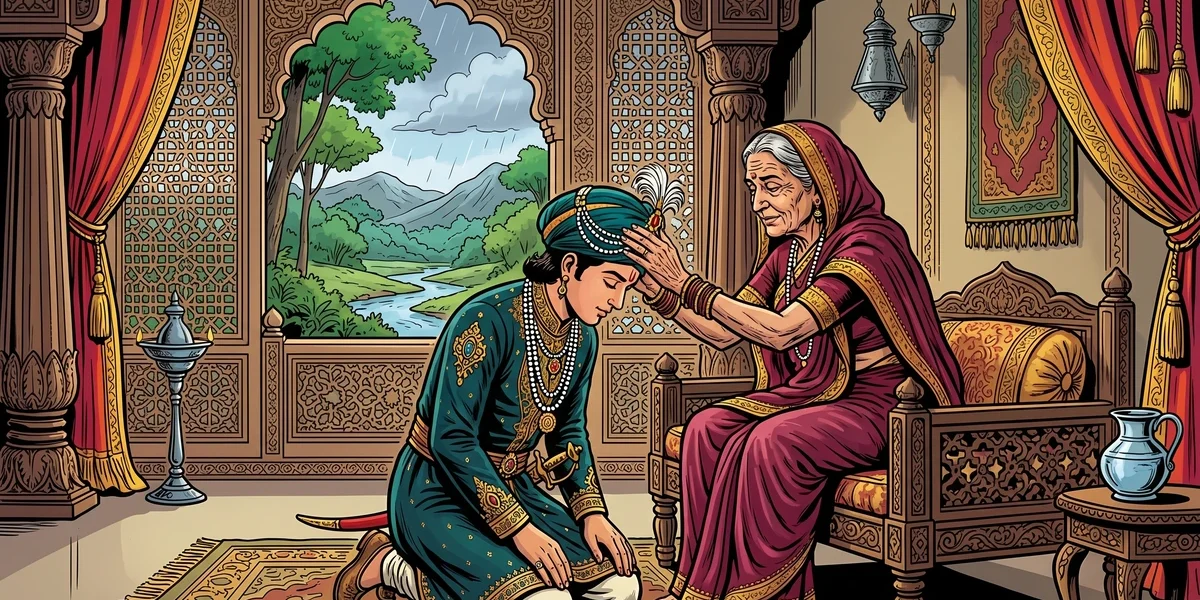
The Story of Prince Dodul and the Ruby Queen: In the ancient kingdom of Gaur, nestled between the Ganges and the Brahmaputra rivers, there lived a prince named
Origin and Narrative Tradition
“The Story of Prince Dodul and the Ruby Queen” belongs to the Bengali rajkumar-katha—the prince-quest narrative cycle that is, arguably, Bengali folk literature’s most consistently beloved and elaborately developed genre. Collected by the Reverend Lal Behari Day for Folk-Tales of Bengal (Macmillan, 1883), the tale combines the pan-Indian quest-narrative structure (a hero of special destiny journeys through trials to a magical destination) with a distinctively Bengali gemstone symbolism in which precious stones are not merely beautiful objects but concentrations of supernatural power, cosmic resonance, and divine favour. The ruby (padmaraga in Sanskrit, chuni in Bengali)—red as blood, red as fire, red as the setting sun that the Puranas associate with Surya and with the warrior aspect of the divine feminine—is an appropriate emblem for a queen of extraordinary power. In Indian gemological tradition (the Ratna-shastra texts codified in the Garuda Purana and Agni Purana), the ruby belongs to the sun, confers royalty and protection in battle, and is the stone most closely associated with the vital force of blood and sovereignty. The Ruby Queen is thus, from the first moment of her naming, a figure of concentrated solar, martial, and royal power.
Beat I — The Prince of Restless Destiny
Prince Dodul—whose name in Bengali carries the sense of gentle motion, of something that sways between states—is the typical Bengali rajkumar hero: young, brave, and possessed of a destiny too large for the palace he was born in. The palace is comfortable but insufficient; the world outside calls with the insistence of a story that has already begun without him. A dream, a prophecy, a stray word overheard from a bird (perhaps a Hiraman parrot), or simply an uncontainable restlessness sets him moving toward the unknown. The Bengali folk tradition understands this restlessness not as immaturity or recklessness but as the first symptom of destiny: those whom fate has chosen for extraordinary things cannot remain comfortable in ordinary circumstances. The prince’s departure from his kingdom is therefore not an act of disobedience but of recognition—he is simply the first to understand what the story requires of him.
Beat II — The Journey Through Impossible Country
The journey to the Ruby Queen’s realm passes through the standard landscape of Bengali magical geography: forests where no ordinary traveller has returned, rivers that shift course according to the traveller’s courage, mountains that move at night, and kingdoms of supernatural beings whose assistance or hostility determines whether the hero reaches his destination. At each threshold, Prince Dodul encounters a test—not primarily of physical strength (though strength is required) but of character: the ability to show mercy when cruelty would be easier, to give when taking would be simpler, to speak truth when flattery would serve better. The helpers who attach themselves to him—a bird with magical knowledge, an old woman who is more than she appears, a wind-spirit who owes a debt—do so because they have observed his character and found it worth assisting. The Bengali folk tradition consistently presents the hero’s accumulation of helpers as a consequence of his moral record rather than his luck: generosity in the first village makes the second village safe to enter.
Beat III — The Ruby Queen and the Gemstone Cosmology
The Ruby Queen—Chuni Rani or Padmaraga Rani in Bengali nomenclature—rules a realm that embodies the qualities of her gem: brilliant, fierce, warmer than the surrounding air, and capable of cutting the hand that grasps it carelessly. She is not a passive prize waiting to be claimed; she is a sovereign in her own right, whose hand is available only to a hero who can survive her court’s tests and who demonstrates qualities that match her own. This active, testing queenship is characteristic of the Bengali folk tradition’s most interesting female figures: the supernatural bride who chooses rather than being chosen, who administers rather than awaits the hero’s adventure. The Indian ratna-shastra tradition provides the cosmological background: a true ruby identifies itself to its rightful owner through warmth and luminosity that counterfeits cannot replicate. The Ruby Queen similarly reveals herself—her genuine nature, her full power—only to the one who approaches with the right quality of perception and intention.
Beat IV — The Union as Cosmological Completion
The union of Prince Dodul and the Ruby Queen is, in the theological vocabulary that Bengali folk narrative inherits from Sanskrit literary tradition, a gandharva vivaha (marriage of mutual recognition) between complementary cosmic principles—the solar warrior-king and the gem-sovereign who concentrates solar power in a different but complementary form. Bengali Vaishnavism would read this union in the register of lila (divine play): the cosmic masculine and cosmic feminine recognising each other through a journey whose apparent obstacles were actually the preparation both required. The prince’s journey made him worthy of the Ruby Queen; the Ruby Queen’s waiting and testing made her realm worthy of a king whose character had been proven in the hardest possible conditions. Neither was complete without the other, and the story’s resolution—the two kingdoms joined, the two sovereignties merged—is presented not as conquest but as fulfilment.
Padmarago mahaniyah suryasya priyaratnam hi, dharanaat sarvarogaghnah shatrubhayavinashanah—The ruby is supremely excellent, the sun-god’s beloved gem; worn on the body, it destroys all disease and dispels the fear of enemies. (Garuda Purana, Ratna-shastra section)
Why This Story Has Lasted
“The Story of Prince Dodul and the Ruby Queen” endures because it satisfies, simultaneously, the appetite for adventure (a long journey through magical landscapes), the appetite for romance (a hero worthy of an extraordinary partner), and the appetite for cosmological order (the right king and the right queen finding each other across every obstacle that fate and wickedness can place between them). Bengali folk audiences heard in this story a confirmation of the belief that genuine worth is never permanently hidden—that the Ruby Queen’s realm, however remote and guarded, is accessible to the one who has prepared himself through the journey. The story’s geography is ultimately internal: the magical kingdoms through which Dodul passes are the landscapes of his own character being tested and confirmed, and the Ruby Queen is the destination his true nature has been moving toward since the story began.
Tradition & Collection Notes
Collection: Folk-Tales of Bengal by Lal Behari Day (Macmillan, 1883). Tale-type: ATU 400 (The Man on a Quest for His Lost Wife) / ATU 301 (The Strong Man and His Companions); Bengali rajkumar-katha subtype. Motif index: H1220 (Quest voluntarily undertaken), F130 (Otherworld location), T91 (Extraordinary love of man for supernatural woman). Gemstone cosmology: Garuda Purana ratna-shastra; Agni Purana gem classification; ruby as solar stone in Sanskrit tradition. Bengali queen-figure parallels: Rupabati, Chandravati, and other supernatural Bengali brides in the mangalkavya tradition. Scholarly reference: Dineshchandra Sen, History of Bengali Language and Literature (1911); A. K. Ramanujan, Folktales from India (1991).
You May Also Like
 Bengal Folk Tales
Ages 9-12
Bengal Folk Tales
Ages 9-12
Thakurmar Jhuli: The Prince of the Golden Palace
Thakurmar Jhuli: The Prince of the Golden Palace: In a realm where palaces shimmered like jewels and kingdoms prospered along great rivers, there existed a
 Bengal Folk Tales
Ages 9-12
Bengal Folk Tales
Ages 9-12
The Hermit and the Mouse (Panchatantra Retold)
The Hermit and the Mouse (Panchatantra Retold): In a cave high in the mountains, where the air was thin and the silence profound, there lived a hermit who had
 Bengal Folk Tales
Ages 9-12
Bengal Folk Tales
Ages 9-12
The Dancing Peacock of Bengal
The Dancing Peacock of Bengal: In the verdant countryside of Bengal, where the monsoon rains fell with regularity and the rice paddies stretched to distant