East Of The Sun And West Of The Moon
East Of The Sun And West Of The Moon: Once on a time there was a poor husbandman who had so many children that he hadn’t much of either food or clothing to
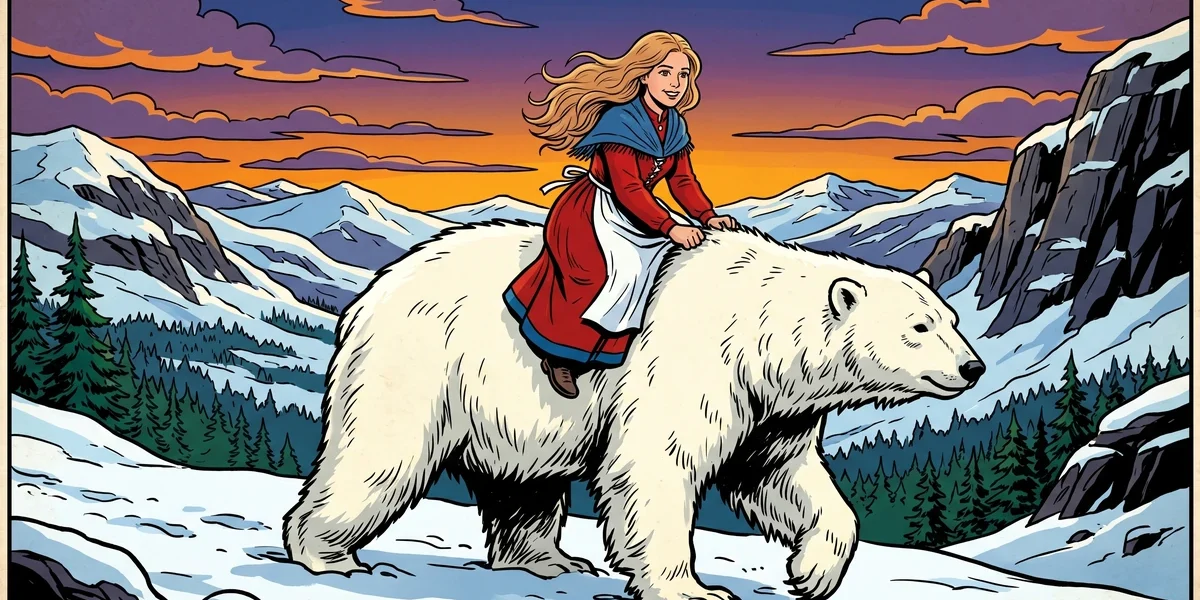
Norway kept a great many tales of bewitched princes and the brave folk who broke their curses, but the one the storytellers reached for again and again — the one that became, in time, the most beloved wonder-tale the country ever produced — was the story of a poor man’s youngest daughter, a great white bear who spoke like a gentleman, and a castle so far away it could only be described by saying where it was not: not here, not there, but somewhere east of the sun and west of the moon.
It is, on its surface, a tale of magic — trolls and talking winds, gold apples and enchanted shirts. But underneath the wonders it is a tale about a mistake and what is done after it. The heroine is given one rule, breaks it out of love and curiosity, and loses everything in a single night. What makes the story Norwegian, and what makes it last, is not the curse or the castle. It is the long, footsore, unglamorous journey she chooses to make afterwards — the decision that a mistake is not the end of a story but the beginning of the hardest part of it.
The White Bear at the Window
There was once a poor husbandman who had so many children that there was never enough food or clothing to go round. All of them were handsome, but the loveliest by far was the youngest daughter, whose beauty had no end to it. The family lived close to the bone, the way poor families did in the hard country of the Norwegian north, where winter came early and stayed long and a bad harvest could empty a cottage.
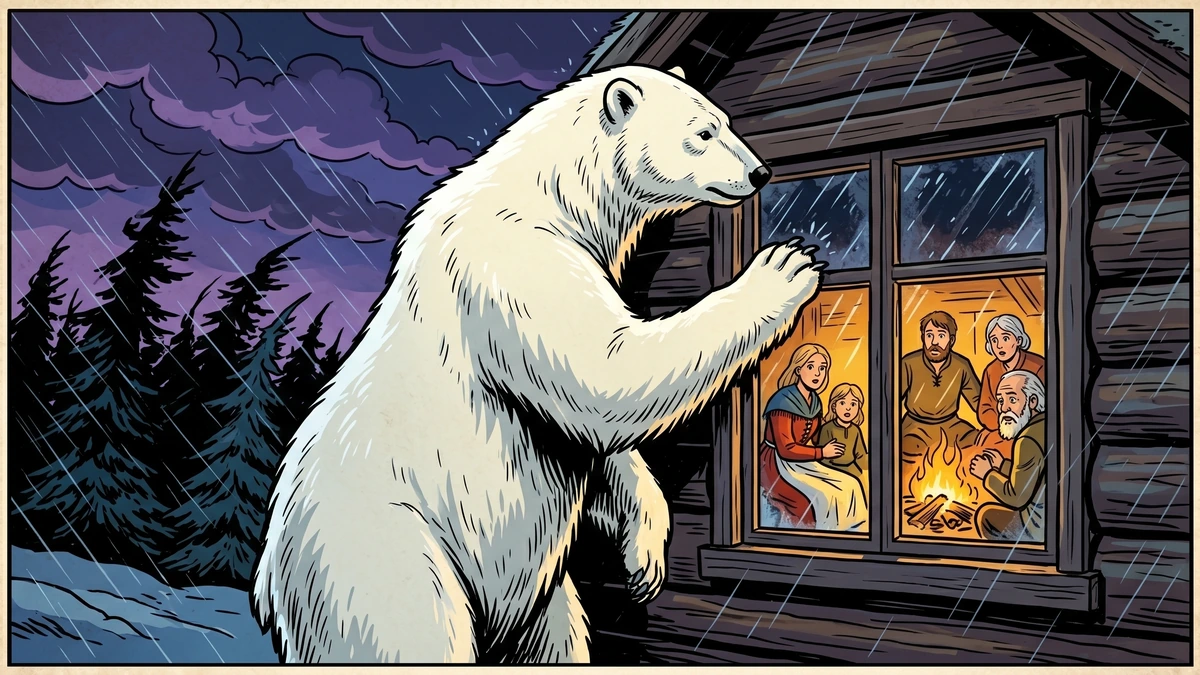
One Thursday evening late in the autumn, with the weather wild and the rain driving and the wind shaking the very walls of the cottage, something gave three slow taps on the window-pane. The father went out to see, and there in the dark and the wet stood a great white bear. “Good-evening,” said the bear, courteously, as though it were the most natural thing in the world. It made the man an offer plainly: give me your youngest daughter, and I will make you as rich as you are now poor.
The father would not have minded the riches at all, but he would not answer for his daughter without asking her, and the girl, when she heard it, said no outright. Nothing could move her. So the bear was told to come back the next Thursday for his answer, and through the week the father talked to her — of the wealth, of the comfort, of how much easier every life under that roof would be. At last, for the sake of the others, she washed and mended her poor rags, made herself as neat as she could, and when the white bear returned she climbed up onto his broad back with her small bundle, and they set off into the dark.
It is worth pausing on that beginning, because the tale never lets us forget it. The heroine does not run off after an adventure. She is, in effect, sold — gently, lovingly, with everyone meaning well — to lift her family out of poverty. Everything brave she does afterwards, she does having started from a place of having very little choice at all.
The Castle and the Forbidden Light
They travelled far, and when the bear asked “Are you afraid?” the girl answered honestly that she was not, and he told her only to hold tight by his shaggy coat. At last they came to a great steep hill; the bear knocked, a door opened in the face of it, and they entered a castle of lit rooms gleaming with silver and gold, with a table already laid and every grand thing she could wish for. The bear gave her a silver bell: whatever she wanted, she had only to ring, and it would come.
But at night, when she had put out her light and gone to her fine bed, a man came and lay down beside her in the dark. It was the white bear, who cast off his beast-shape once the sun was down — though she never saw him, for he came only after the candle was out and was gone again before the dawn. So she lived: rich, comfortable, and utterly alone all the long days, with a husband she had never once looked upon.
In time the loneliness pressed on her, and she grew silent and sorrowful, and longed to see her family. The bear agreed she might visit them, but laid one condition on her, gravely and clearly. She might talk with her mother as much as she liked — but she must never let her mother get her alone for a private word. “Else,” he warned, “you will bring bad luck on us both.”
At home there was great joy, for the family was now wealthy and wanted for nothing. But it happened exactly as the bear had foreseen. Her mother drew her aside, pressed her, and at last the girl told the whole strange truth — the husband she never saw, the dark that never lifted. Her mother was horrified. “It may well be a troll you sleep beside!” she said, and she pressed on her daughter a candle-end: light it while he sleeps, she urged, and look at last upon the thing that shares your bed.
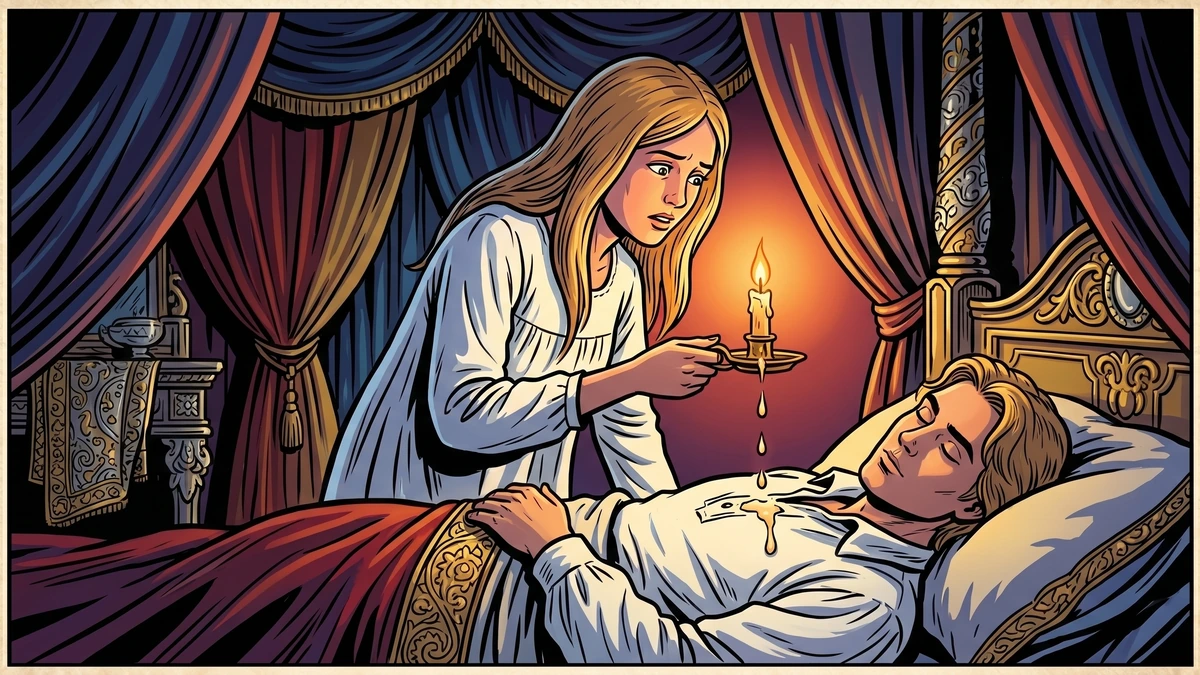
That night, back in the castle, the girl could not resist. When she heard her husband sleeping she rose, struck a light, and let it fall on him — and there lay the loveliest prince anyone ever set eyes on. She loved him so suddenly and so completely that she bent to kiss him; and as she did, three hot drops of tallow fell from the candle onto his shirt, and he woke.
His grief was immediate and terrible. Had she only held out one single year, the spell would have broken and he would have been free. He had a stepmother, he told her, a troll-queen who had bewitched him — a white bear by day, a man by night — and now the bargain was broken, and he must leave her and go to that stepmother’s castle, and marry a troll-princess with a nose three ells long. And the castle lay east of the sun and west of the moon, where she could never come. In the morning prince and castle were gone, and the girl woke alone on a small green patch in a gloomy wood, with only her old bundle of rags beside her.
The Long Search and the Four Winds
Here the tale turns, and turns on a choice. The heroine has made her mistake. She has lost her husband through her own act — though it was an act of love and natural longing, and her mother’s urging behind it. She could have wept on that green patch and gone home. Instead she rubbed the sleep from her eyes, wept until she was tired of weeping, and then stood up and began to walk. The greater part of the story is that walk.
She came first to a high crag where an old woman sat playing with a golden apple. The old woman did not know the way to the castle east of the sun and west of the moon — but she lent the girl a horse to carry her to her neighbour, and gave her the gold apple to keep. The neighbour, under another crag, had a golden carding-comb and no better knowledge of the road, but she too lent a horse and gave the comb away. A third old woman, with a golden spinning-wheel, knew no more — but she sent the girl on to the East Wind, who had blown into many corners of the world.
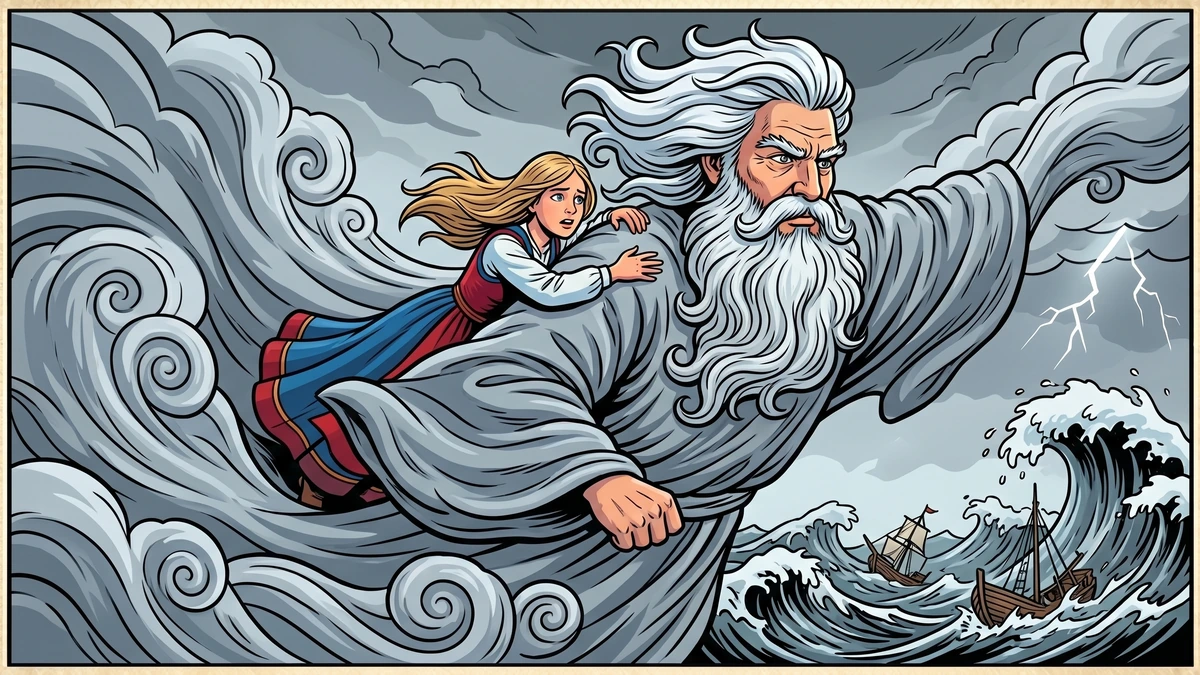
The East Wind had heard of the castle but had never blown so far; he carried her to the West Wind. The West Wind had never reached it either, and carried her to the South Wind, who had blustered through most of the world and still fell short. So the South Wind bore her at last to the North Wind — the oldest and strongest of the four, wild and roaring and cold. And the North Wind knew the place. Once, long ago, he had blown a single aspen-leaf there, and been so spent by it he could not raise a puff for days after. But he would try. He told her to sleep the night and gather his strength, and in the morning he swelled himself huge and gruesome and took her up on his back.
They went so high and so hard that below them a storm flattened forests and sank ships by the hundred. The North Wind grew wearier and wearier, sinking lower until the crests of the waves washed over his heels — but he had strength enough left, at the very end, to fling the girl ashore beneath the windows of the castle that lay east of the sun and west of the moon. Note what the tale has quietly insisted across this whole stretch: she does not arrive by magic or luck. She arrives because she kept asking, kept going, and accepted help from every old woman and every wind who had a little to give. Persistence in this story is not one heroic leap. It is a hundred small ones.
The Shirt and the Three Drops of Tallow
Now the heroine had the three golden gifts — the apple, the comb, the spinning-wheel — and she used them with patient cunning. Sitting beneath the castle window she played with the gold apple, and the long-nosed troll-princess, greedy for it, asked its price. It was not for sale for gold or money, the girl said; but the princess might have it if she would let her pass one night with the prince. The bargain was struck. But that night the prince lay in a sleep so deep that all her calling, shaking, and weeping could not wake him — for the princess had given him a drugged drink — and at dawn she was driven out. The next day she traded the golden carding-comb for a second night, and it ended the same way.
But the castle held other captives — ordinary folk the trolls had carried off — and through the wall they had heard a woman weeping and pleading by the prince’s bed two nights running, and they told him so. On the third day the girl traded her golden spinning-wheel for a third night; and this time, when the troll-princess brought the sleeping-draught, the prince only pretended to drink it and poured it away over his shoulder. So when the girl came in, she found him awake at last, and the whole story poured out between them.
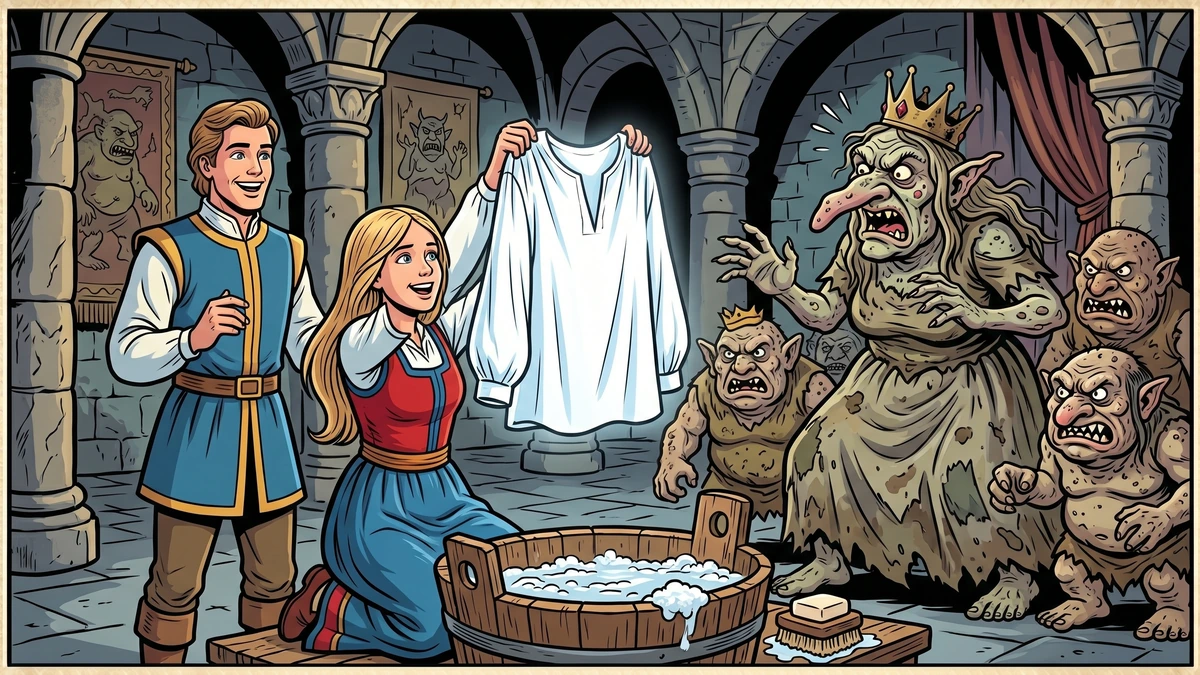
The prince had a plan, and it was a clever one, built on the very thing that had undone them. The next day was to have been his wedding to the long-nosed princess. He would announce that he would marry no woman who could not first wash three drops of tallow from his shirt — for, he said, he wanted to see what his bride was fit for. The troll-princess scrubbed, and the spots only grew; her troll-mother scrubbed, and the shirt went blacker; the whole company of trolls scrubbed, and the shirt grew as black as if it had been up a chimney. Then the prince called in the beggar-girl waiting outside. She dipped the shirt once, and it came up as white as driven snow. “You are the lassie for me,” said the prince.
It is a detail worth dwelling on. The stain on the shirt is the very tallow she spilled on the sleeping prince, the proof of her old mistake made visible. The trolls cannot wash it out; only she can. The tale is telling us something precise: the one who made the error is the one fitted to undo it, and the long journey has earned her the right and the power to do so. At that, the old troll-hag burst with rage on the spot, and the long-nosed princess after her, and the whole pack of trolls after them. The prince and the girl set free all the captive folk, took the silver and gold of the castle, and flitted away together as far as ever they could from the place that lay east of the sun and west of the moon.
The Moral of the Tale
It would be easy to read this story as a warning — a tale that punishes a curious woman for breaking a rule, as so many old stories do. But the Norwegians who told it for generations did not tell it as a story that ends with the broken rule. They told it as a story that begins there. The lit candle is the hinge of the plot, not its verdict. What the tale spends almost all its length on, and plainly cares about most, is everything the heroine does after the mistake.
And what she does is refuse to let the mistake be the end. She does not sit in the gloomy wood and call it fate. She gets up. She walks until her feet are sore, and when walking is not enough she asks, and asks again, and asks four winds in turn, and accepts a horse and a gold apple from every old woman who has one to spare. She is not rescued. She does the work of her own rescue, in a hundred small, unmagical, exhausting steps. The deepest lesson of the tale is that a single error — even a costly one, even one that breaks something precious — does not have to define a life, so long as the one who made it is willing to pay the long price of setting it right. The old Norwegian saying puts the same truth in the plainest possible words:
“Den som intet våger, intet vinner.”
— Traditional Norwegian ordtak: “He who ventures nothing, wins nothing.”
The heroine ventures everything. She ventures the comfort of the castle, the safety of going home, her own pride each time she has to knock on another stranger’s door and confess that she is lost and looking for a husband she lost herself. The story honours that venturing above her beauty, above her first obedience, above every gift the winds and the old women hand her. It teaches, too, a gentler thing alongside it: that the people who help her — the crone with the apple, the blustering winds — each know only a little, and pass her on to someone who knows a little more, and that this is how hard roads are actually travelled. No one holds the whole answer. You reach the castle east of the sun and west of the moon by collecting small kindnesses and small directions, and by being humble enough to keep asking.
The Tale’s Origins and Canonical Sources
“East of the Sun and West of the Moon” — in Norwegian, Østenfor sol og vestenfor måne — is one of the crown jewels of the Norwegian national folk-tale collection, the Norske Folkeeventyr. That collection was the work of two friends, Peter Christen Asbjørnsen (1812–1885) and Jørgen Moe (1813–1882), who gathered tales from oral storytellers across Norway and published them in instalments beginning in 1841. This particular tale appeared in the collection in the early 1840s, and from the second edition onward it was illustrated by the artists Erik Werenskiold and Theodor Kittelsen, whose images shaped how Norwegians have pictured trolls and wonder-castles ever since.
Asbjørnsen and Moe stood in Norway roughly where the Brothers Grimm stood in Germany: their work was both a scholarly rescue of a vanishing oral tradition and a milestone in the making of a national literature. They wrote the tales down in a Norwegian-inflected prose at a time when Danish was still the language of Norwegian books, and so the collection became a quiet act of cultural independence as well as a folklore archive. The English-speaking world met the tale through Sir George Webbe Dasent, whose translation Popular Tales from the Norse (1859) carried “East of the Sun and West of the Moon” into English with the rolling, colloquial voice — “the lassie,” “a long, long way” — that English readers have loved ever since.
In the international Aarne–Thompson–Uther index of folk-tale types the story is classified as ATU 425A, “The Animal as Bridegroom” — one branch of the great tale-family known broadly as “The Search for the Lost Husband” (ATU 425). That family reaches back to the ancient Greco-Roman story of Cupid and Psyche, told by Apuleius in the second century AD, in which Psyche likewise lights a forbidden lamp upon a sleeping divine husband, loses him, and must complete a series of impossible tasks to win him back. Versions of the same pattern appear all across Europe — the French “Beauty and the Beast,” the Norwegian “White-Bear-King-Valemon,” numerous Scottish and Italian cousins. In Ørnulf Hodne’s catalogue The Types of the Norwegian Folktale, the tale is registered under its own Norwegian title as the model example of the type. The recurring images — the four winds as cosmic helpers, the three gifts of pure gold, the unwashable stain — are old, widely shared motifs that the Norwegian tellers fitted to their own cold northern landscape of bears, trolls, and storms.
Why the Tale Has Lasted
One reason the story has outlived almost two centuries of print — and untold generations of telling before that — is the strange, beautiful exactness of its central image. “East of the sun and west of the moon” is not a place that can be found on any map, and the tale knows it; the phrase is a way of naming the farthest imaginable distance, the place reached only by someone who will not stop. The words have lodged themselves so deeply in the language that they have been borrowed for books, songs, films, and poems by people who never read the original tale — a sure sign that a story has touched something permanent.
The deeper reason, though, is the heroine herself, and the particular shape of her courage. She is not a warrior and she works no magic of her own. Her heroism is made entirely of endurance: of getting up after the worst night of her life and walking, of asking for help without shame, of trading away every gift she is given for one more chance at a sleeping man who will not wake. Anyone who has ever made a serious mistake — broken a trust, spoiled something good, acted on an impulse and watched the cost come due — can recognise the country she walks through. And the tale offers them the most generous possible message: that the mistake is real, and the cost is real, and the road back is long and unglamorous and made of small steps — but that it exists, and that a person willing to venture everything can walk it to the end. That is why “East of the Sun and West of the Moon” is still being read on a page like this one, in a language its first tellers never spoke, generations after the cottage and the candle and the great white bear — because it tells us, in the plain voice of an old Norwegian winter, that a wrong turning is not the end of the journey, only the beginning of the harder, truer part of it.
You May Also Like
 Norse Folk Tales
Ages 3-5
Norse Folk Tales
Ages 3-5
The Three Billy-Goats Gruff
Norwegian *De tre bukkene Bruse* — three goats, one bridge, one greedy troll — ages 3–5 / 6–8. Asbjørnsen & Moe.
 Norse Folk Tales
Ages 9-12
Norse Folk Tales
Ages 9-12
The Lad Who Went To The North Wind
The Lad Who Went To The North Wind: Once on a time there was an old widow who had one son; and as she was poorly and weak, her son had to go up into the safe
 Norse Folk Tales
Ages 9-12
Norse Folk Tales
Ages 9-12
Thor and the Giant’s Kettle
Thor and the Giant's Kettle: In the golden halls of Asgard, where the gods feasted and plotted, the need for a new cauldron had become undeniable. The old