Ragnarok: The Twilight of the Gods
Ragnarok: The Twilight of the Gods: The seer stood before Odin in the great hall Asgard, and she spoke of a future that all the gods wished not to hear, yet
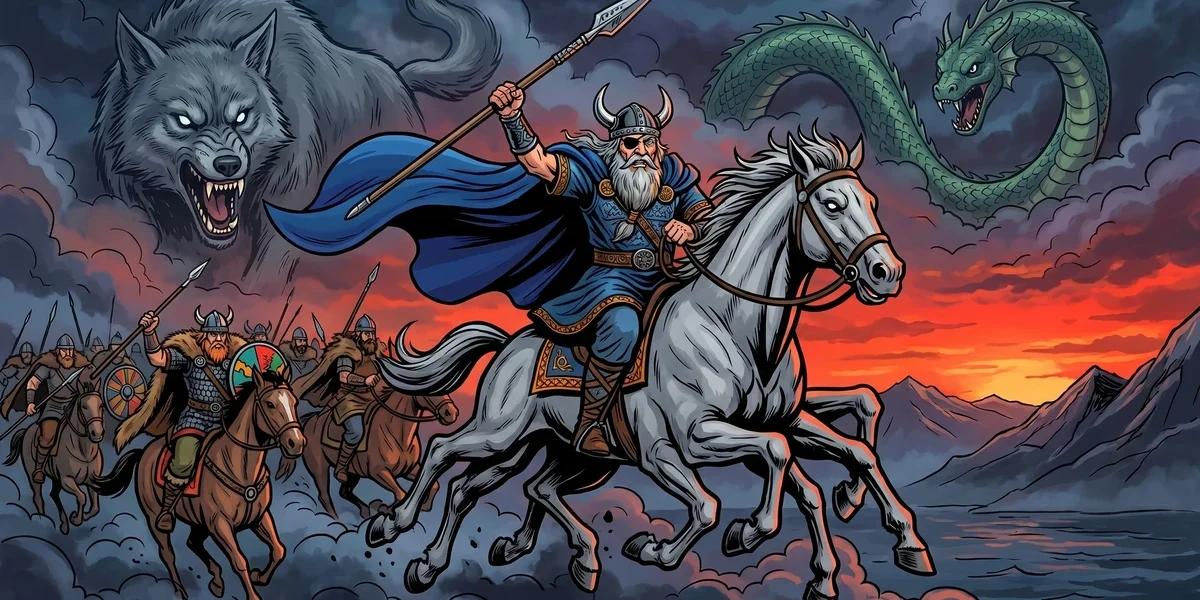
Of all the world’s mythologies, only the Norse tells its gods plainly that they are doomed. Ragnarök — the “Twilight” or more accurately the “Doom of the Powers” — is the prophesied destruction of Odin, Thor, and the whole bright order of Asgard, foretold to them in detail and accepted by them without flinching. It is an apocalypse the gods cannot prevent, cannot win, and choose to fight anyway. That single, austere idea has made Ragnarök one of the most influential end-of-the-world stories ever told, echoing from medieval Iceland into Wagner’s opera house and the modern cinema screen.
This is the tale of how the world the gods built comes apart — the long winter, the snapping of every chain, the last battle on the plain called Vígríðr — and, just as importantly, of the green earth that rises afterward from the sea.
Origins and Canonical Attribution
Ragnarök is preserved in two great medieval Icelandic collections. The fullest poetic account stands in the Völuspá (“The Prophecy of the Seeress”), the opening poem of the Poetic Edda, in which a völva — an ancient seeress — recounts to Odin both the world’s beginning and its end. The poem is preserved chiefly in the Codex Regius (GKS 2365 4to), the priceless manuscript written in Iceland around 1270, with a second version in the Hauksbók (early 14th century). Scholars generally date the poem’s composition to roughly 1000, on the cusp of Iceland’s conversion to Christianity, which may explain its haunted, transitional tone.
The same Codex Regius preserves Vafþrúðnismál (“The Lay of Vafthrúdnir”), a riddle-contest in which Odin and a wise giant trade cosmological lore, including the names of those who will survive the end. The short eschatological poem Baldrs draumar (“Baldr’s Dreams”) and the fragmentary Völuspá hin skamma (“The Short Völuspá”) add further detail.
The second great source is the Prose Edda of Snorri Sturluson, the Icelandic chieftain, historian, and poet, composed around 1220. In its mythological section, Gylfaginning (“The Beguiling of Gylfi”), Snorri retells Ragnarök in orderly prose, naming combatants, weaving the verse sources together, and supplying the connective narrative the poems leave implicit. Nearly every modern retelling — including this one — descends from Snorri’s synthesis checked against the older verse. The word ragnarök itself means “fate (or doom) of the gods”; the variant ragnarøkkr, “twilight of the gods,” gave Richard Wagner his title Götterdämmerung.
The Prophecy and the Fimbulwinter

The seeress begins not with violence but with cold. The first sign of the end is Fimbulvetr, the “mighty winter”: three winters following one upon another with no summer between them, snow driving in from every direction, the wind bitter and unbroken, the sun giving no warmth. Vafþrúðnismál tells how the human pair Líf and Lífþrasir will shelter through this winter in the wood Hoddmímir, surviving on the morning dew.
During this starving age, the moral order of the world dissolves before the physical one does. Brothers kill brothers; kinship-bonds, the very foundation of Norse society, are broken; oaths mean nothing. The seeress names this an age of axes and swords, of wind and wolves. Then the celestial signs come. The wolves Sköll and Hati, who have chased the sun and moon across the sky since the beginning, at last catch and devour them. The stars vanish. The cock Fjalar crows in the giant-world, golden-combed Gullinkambi wakes the warriors of Valhalla, and a third red rooster crows in the halls of Hel. Three crowings, three worlds, one alarm: the end has begun.
The Bonds Break: Fenrir, Jörmungandr, and the Ship Naglfar
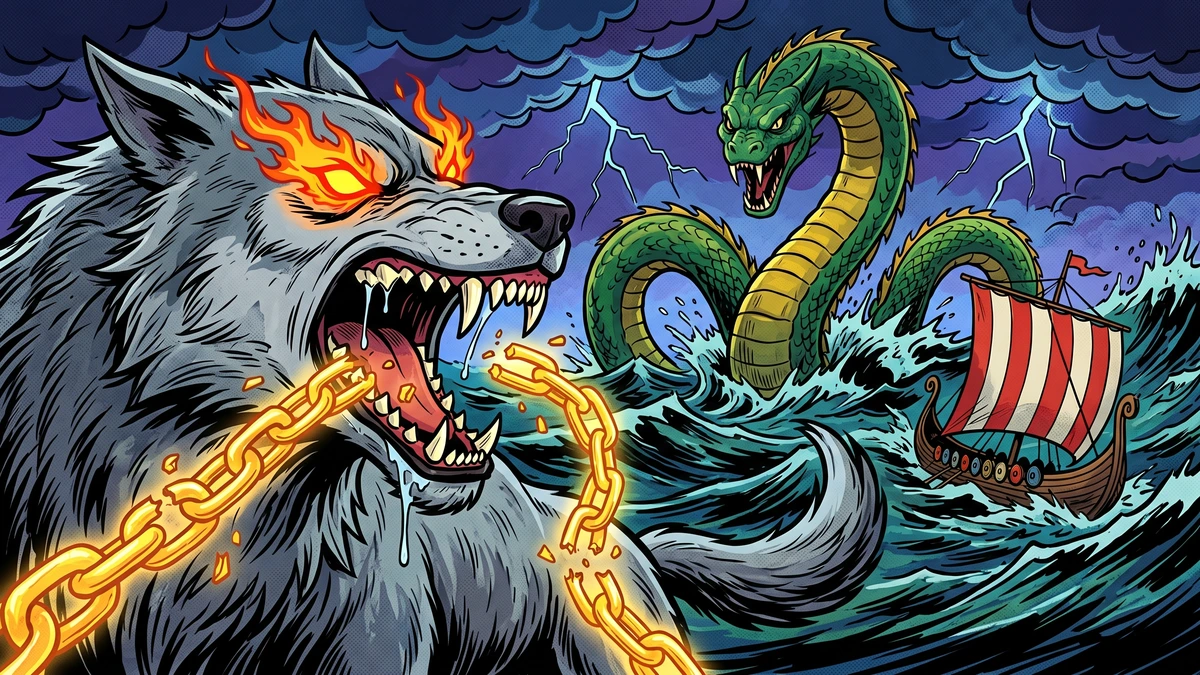
Norse cosmology is held together by bindings, and Ragnarök is the moment every binding fails. The wolf Fenrir, whom the gods chained in their youth with the magical fetter Gleipnir — at the cost of the god Týr’s right hand — finally snaps free. He advances with his lower jaw on the earth and his upper jaw against the sky, fire streaming from his eyes and nostrils.
In the sea, the Midgard Serpent Jörmungandr, who has lain coiled around the whole of the human world biting his own tail, rises and writhes ashore, spewing venom across air and water. His thrashing lifts the seas and floats free the ship Naglfar — built, the sources insist with grim specificity, from the untrimmed fingernails and toenails of the dead. (Snorri adds the warning, half folklore and half moral instruction, that a dead person should be buried with nails trimmed, lest the material for that ship be increased.) Naglfar sails crewed by the hosts of chaos. The earth shakes; mountains fall; the rainbow bridge Bifröst shatters under the weight of the riders crossing it. From the fiery realm of Múspell comes Surtr, the flame-giant, his sword brighter than the sun. Loki, freed from the cave where the gods bound him after Baldr’s death, steers the ship of the dead. The watchman Heimdall raises the horn Gjallarhorn and blows a blast that is heard through all nine worlds.
The Last Battle on the Plain of Vígríðr

The opposing hosts meet on Vígríðr, a battlefield the sources measure as a hundred leagues on every side. Here the Norse imagination performs its most characteristic act: it pairs each god against the precise enemy who will kill him, and shows the god going forward anyway.
Odin, the All-Father, leads the warriors he gathered into Valhalla for exactly this day — and is swallowed whole by Fenrir. His son Víðarr, wearing a great shoe forged for this single purpose, sets one foot on the wolf’s lower jaw, grips the upper, and tears the beast apart, avenging his father. Thor meets the Midgard Serpent, his lifelong adversary; he kills it with Mjölnir, then walks nine steps and falls dead, drowned in its venom. Týr, the one-handed god of law, falls fighting the hound Garmr, each slaying the other. Freyr, who long ago gave away his sword for love, faces Surtr without it and dies. Heimdall and Loki — watchman and traitor, order and mischief — meet at last and kill each other. Then Surtr flings his fire across the whole world. The sun turns black; the earth sinks into the sea; the stars fall from heaven; steam and flame play against the vault of the sky itself.
Renewal: The Green Earth Rises from the Sea

And here the Norse apocalypse parts company with most others. After the fire and the drowning, the seeress’s vision does not end in darkness. She sees the earth rise a second time out of the water, green again, its waterfalls loud, an eagle hunting fish above the cliffs.
A remnant survives. Víðarr and Váli, sons of Odin, live; Móði and Magni, sons of Thor, inherit the hammer Mjölnir. Most movingly, Baldr — the gentle god killed by Loki’s malice long before — returns from the dead, reconciled with his blind brother Höðr who was tricked into killing him. The survivors gather on the field of Iðavöllr, where Asgard once stood, and find in the grass the golden game-pieces the old gods once played with. The human pair Líf and Lífþrasir come out of the wood to repopulate the earth, and a new sun — the daughter the old sun bore before the wolf took her — rides the sky. The story of the world, the Norse insist, is not a line ending in fire. It is a cycle, and the wheel turns once more.
The Moral of Ragnarök
Ragnarök’s central teaching is not despair but a particular, hard-edged kind of courage. The gods know the prophecy. They know they will lose. They arm themselves and ride to Vígríðr regardless, because the worth of a deed, in the Norse moral imagination, does not depend on its success. What endures after a person is the orðstírr — the “word-fame,” the reputation — and that is earned in how one meets fate, not in whether one escapes it.
The seeress frames the collapse of the world as, first, a collapse of human decency — and the warning is pointed:
“Brœðr munu berjask ok at bǫnum verðask,
munu systrungar sifjum spilla;
hart er í heimi, hórdómr mikill,
skeggǫld, skálmǫld, skildir ro klofnir,
vindǫld, vargǫld, áðr verǫld steypisk.”“Brothers will fight and kill each other, kinsmen will break the bonds of kinship; it is hard in the world, adultery is rife — an axe-age, a sword-age, shields are split — a wind-age, a wolf-age, before the world goes down.” — Völuspá, stanza 45
The end of the world, the poem says, begins when people stop keeping faith with one another. That is a moral a Viking-age listener could act on, and a modern reader still can.
Historical and Cultural Context
Ragnarök took the shape we know in a society living through its own ending. The Völuspá was likely composed around the year 1000, the very decade Iceland adopted Christianity, and the poem reads like a pre-Christian worldview taking a clear-eyed measure of its own twilight. Some scholars hear faint Christian echoes in the surviving remnant and the returning Baldr; others argue the cyclical pattern is wholly native, kin to the cyclical cosmologies of Hindu and Buddhist thought, where destruction is a phase rather than a finale.
Whatever its origins, the myth’s preservation was an Icelandic achievement. Without the Codex Regius and Snorri Sturluson’s careful prose, the most complete pagan eschatology of medieval Europe would have been lost entirely. From that thin manuscript thread the story has spread astonishingly far: into the operatic vision of Wagner’s Ring cycle, into J.R.R. Tolkien’s “long defeat,” into comics, novels, video games, and films. Few myths recorded by so few hands have travelled so widely.
Why This Story Has Lasted
Ragnarök has lasted a thousand years because it answers a question other mythologies tend to avoid: how should one live, knowing the end is certain? Most apocalypse stories offer escape — a chosen people saved, a paradise to come. The Norse myth offers none. It tells you the date is fixed, the outcome is loss, and your task is simply to meet it well.
That refusal of false comfort is exactly why modern readers find the tale bracing rather than bleak. It speaks to anyone facing something unavoidable — illness, decline, the passing of an institution or an age — and it does not lie to them. It says that dignity, loyalty, and courage are worth practising even when they cannot change the result, and that endings make room for beginnings. The green earth rises from the sea; the surviving gods find the golden game-pieces in the new grass; the children inherit the hammer. A folk tale that has crossed from a Viking longhouse to a modern screen without losing that message has earned its long life.
Frequently Asked Questions
What is Ragnarök in Norse mythology?
Ragnarök is the prophesied end of the cosmic order in Norse mythology — a chain of catastrophes in which the gods, giants, and monsters destroy one another, the sun is devoured, and the earth sinks into the sea. The word means “doom (or fate) of the gods.” Crucially, it is not a final ending: a renewed, green earth rises afterward, and a remnant of gods and humans survives to begin again.
Which medieval sources describe Ragnarök?
The fullest poetic account is the Völuspá in the Poetic Edda, preserved in the Codex Regius (c. 1270) and the Hauksbók. Further detail appears in Vafþrúðnismál and Baldrs draumar. The most orderly prose account is in Gylfaginning, part of Snorri Sturluson’s Prose Edda (c. 1220), which weaves the older verse sources into a connected narrative.
What is the Fimbulwinter and why does it matter?
The Fimbulvetr or “mighty winter” is three consecutive winters with no summer between them, the first physical sign that Ragnarök has begun. It matters because it shows the Norse end-of-the-world starting with cold and famine rather than battle — and because the moral collapse it triggers, brothers killing brothers, is presented as inseparable from the world’s physical ruin.
Does Ragnarök mean the Norse gods are gone forever?
No. Although Odin, Thor, Týr, Freyr, Heimdall, and Loki all die, the myth describes survivors: Odin’s sons Víðarr and Váli, Thor’s sons Móði and Magni who inherit Mjölnir, and the reborn Baldr returning from the dead with his brother Höðr. They gather on the site of old Asgard to rebuild, making Ragnarök a story of renewal as much as destruction.
How is Ragnarök different from other apocalypse myths?
Most apocalyptic traditions promise escape or salvation for a chosen group. Ragnarök does not. The gods are told their doom in advance and ride to a battle they know they will lose, because meeting fate with courage is itself the value. Combined with the rebirth of the world afterward, this makes Ragnarök a uniquely cyclical and fatalistic vision — closer to the cyclical cosmologies of Hindu and Buddhist thought than to a single, final Judgement Day.
You May Also Like
 Norse Folk Tales
Ages 3-5
Norse Folk Tales
Ages 3-5
The Three Billy-Goats Gruff
Norwegian *De tre bukkene Bruse* — three goats, one bridge, one greedy troll — ages 3–5 / 6–8. Asbjørnsen & Moe.
 Norse Folk Tales
Ages 9-12
Norse Folk Tales
Ages 9-12
The Creation of the World from Ymir’s Body
The Creation of the World from Ymir's Body: In the beginning, before the world was formed and before time itself had meaning, there existed only Muspelheim and
 Norse Folk Tales
Ages 9-12
Norse Folk Tales
Ages 9-12
Thor and the Giant’s Kettle
Thor and the Giant's Kettle: In the golden halls of Asgard, where the gods feasted and plotted, the need for a new cauldron had become undeniable. The old