The Princess On The Glass Hill
The Princess On The Glass Hill: Once on a time there was a man who had a meadow, which lay high upon the hill-side, and in the meadow was a barn, which he had
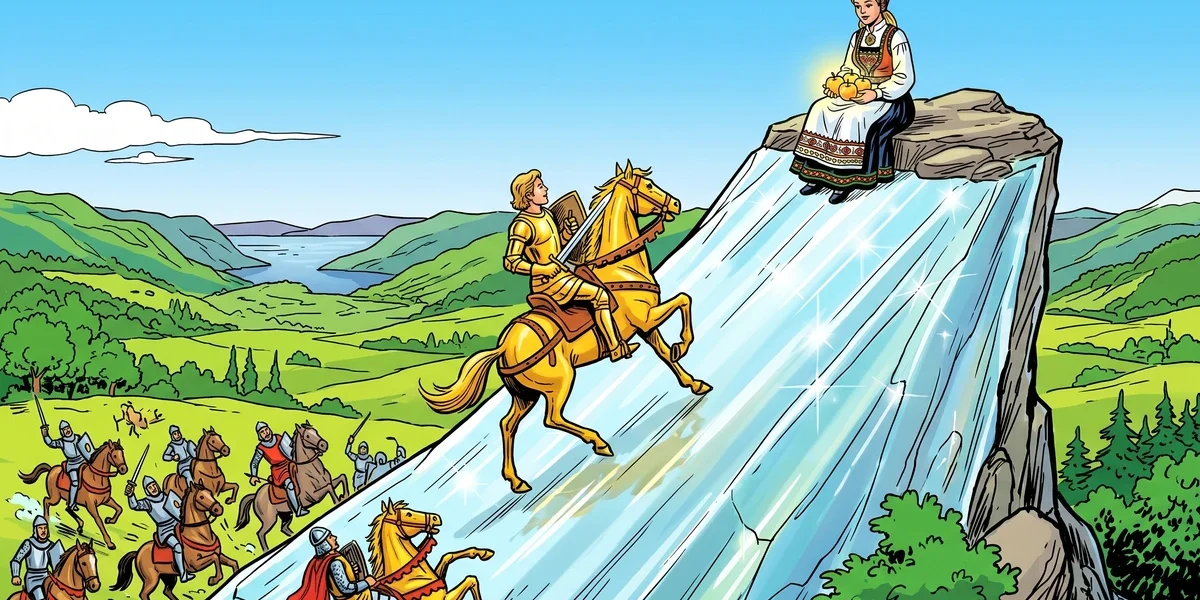
High on a mountain of sheer, shining glass sits a king’s daughter with three golden apples in her lap, and at the foot of the slope a whole kingdom of armoured riders spurs and slips and tumbles back down. “The Princess on the Glass Hill” is one of the best-loved wonder tales of Norway — a story in which the youngest, sootiest, most overlooked boy in the house turns out to be the only one who can ride straight up a wall of ice. Beneath its glitter lies a quiet argument the Norwegian storytellers never tired of making: that worth is not always where the world expects to find it.
Where the Story Comes From
“The Princess on the Glass Hill” — in Norwegian “Jomfruen på glassberget” — was gathered in the middle of the nineteenth century by Peter Christen Asbjørnsen (1812–1885) and Jørgen Engebretsen Moe (1813–1882), the two friends whose collecting work did for Norway what the Brothers Grimm had done for the German lands a generation earlier. Their landmark anthology, Norske Folkeeventyr (Norwegian Folk Tales), first appeared in instalments from 1841 to 1844; “Jomfruen på glassberget” entered the collection in the expanded editions of the early 1850s and has stood among its most reprinted pieces ever since.
The tale reached English-speaking readers through Sir George Webbe Dasent, whose Popular Tales from the Norse (1859) translated Asbjørnsen and Moe with a vigour that has rarely been bettered. It was Dasent who fixed the hero’s English nickname as “Boots” — his rendering of the Norwegian Askeladden, the “Ash-lad” or Cinderlad who lies by the hearth raking the embers. Later editions carried the unmistakable illustrations of Erik Werenskiold and Theodor Kittelsen, the artists who gave Norwegian folklore its enduring visual face.
Folklorists classify the story as international tale type ATU 530, “The Princess on the Glass Mountain,” in the Aarne–Thompson–Uther index. Versions of the glass-mountain quest are scattered across Europe — from Poland and Germany to the Slavic east — but the Norwegian telling, with its hearth-ash hero, its St. John’s Eve vigils, and its three horses shod in brass, silver and gold, is the one the world remembers best.
The Meadow That Was Eaten Bare
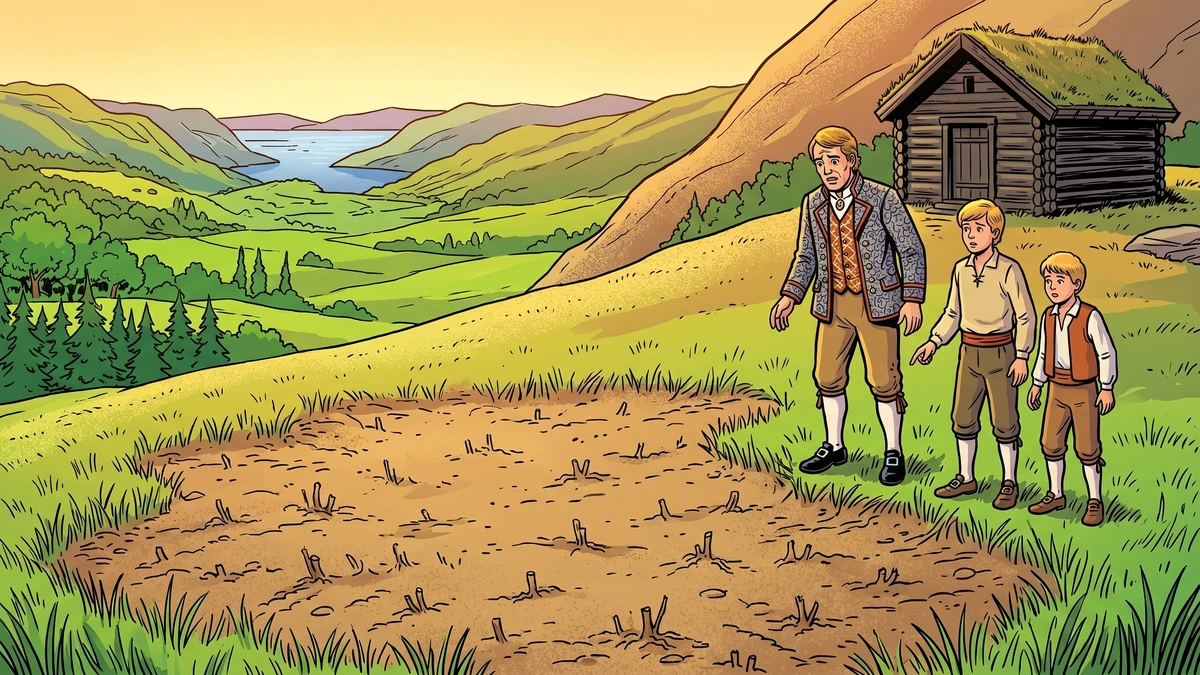
There was once a man who had a meadow high on the hillside, and in that meadow stood a barn where he stored his hay. But of late there had been very little hay to store, for every year on St. John’s Eve — midsummer night, when the grass stood tallest and the light never wholly left the sky — the meadow was grazed to the roots, as bare as if a flock had passed over it or a scythe had swept it clean. It happened once, and the man frowned. It happened twice, and the man grew angry. The third year he made up his mind that this would not happen again, and he told his three sons that one of them must sit out in the barn and keep watch.
The eldest son went first, swaggering a little, certain the business would be settled by morning. But he had not been long in the barn when the earth began to rumble and the walls to shake, and the boy took to his heels and ran, and never once looked behind him. In the morning the meadow was eaten bare again.
The second son went the next year, and the same thing befell him: the rumble, the shudder of the timbers, the cold clutch of fear, and a long run home through the dark. And again the grass was gone.
Then it was the turn of the youngest, the boy the household called Boots — for he was forever poking among the ashes of the hearth and never seemed fit for anything better. His brothers laughed until they had to hold their sides. “You, Boots? You, who have never been further than the woodpile? You will keep watch on the glass-hill night?” But Boots only said that he would go, and go he did.
The Vigil and the Three Horses
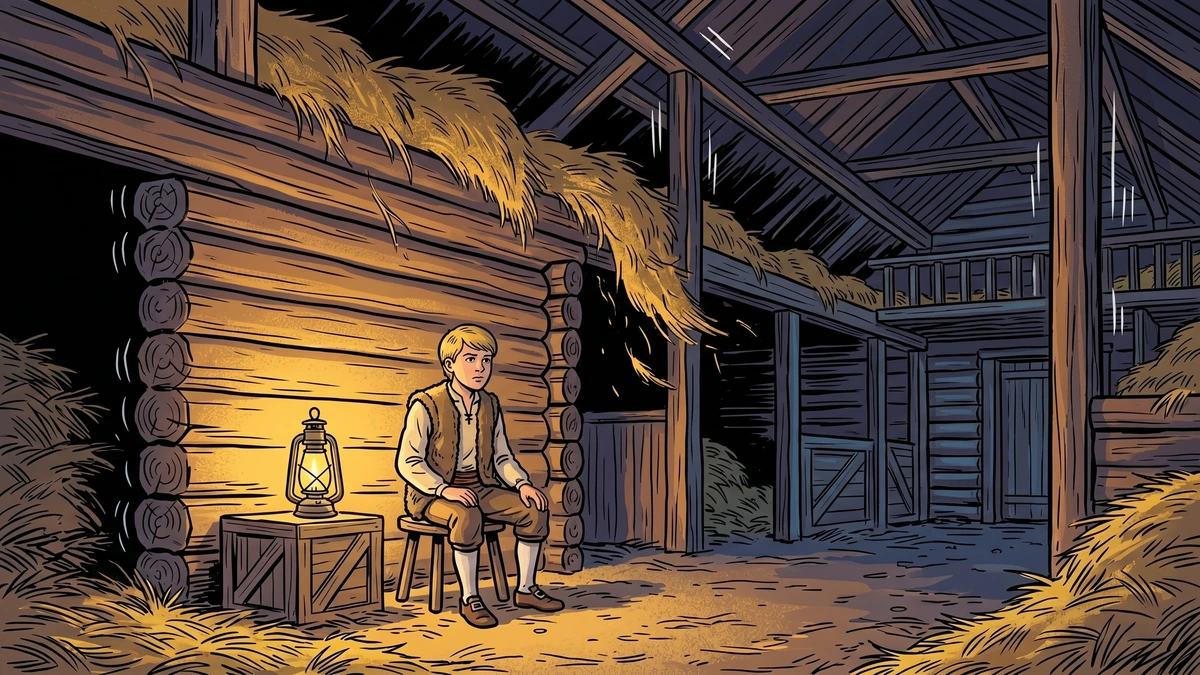
Boots settled himself in the barn and waited. Sure enough, after a while the ground began to rumble and the whole building groaned on its foundations. “If that is all,” said Boots to himself, “then I can bear it well enough” — and he kept his seat. The rumbling came a second time, harder, so that the wisps of hay danced down from the rafters. “If that is all,” said Boots again, and he did not stir. Then it came a third time, so violently that he thought the walls would come down about his ears; and then, all at once, it was still.
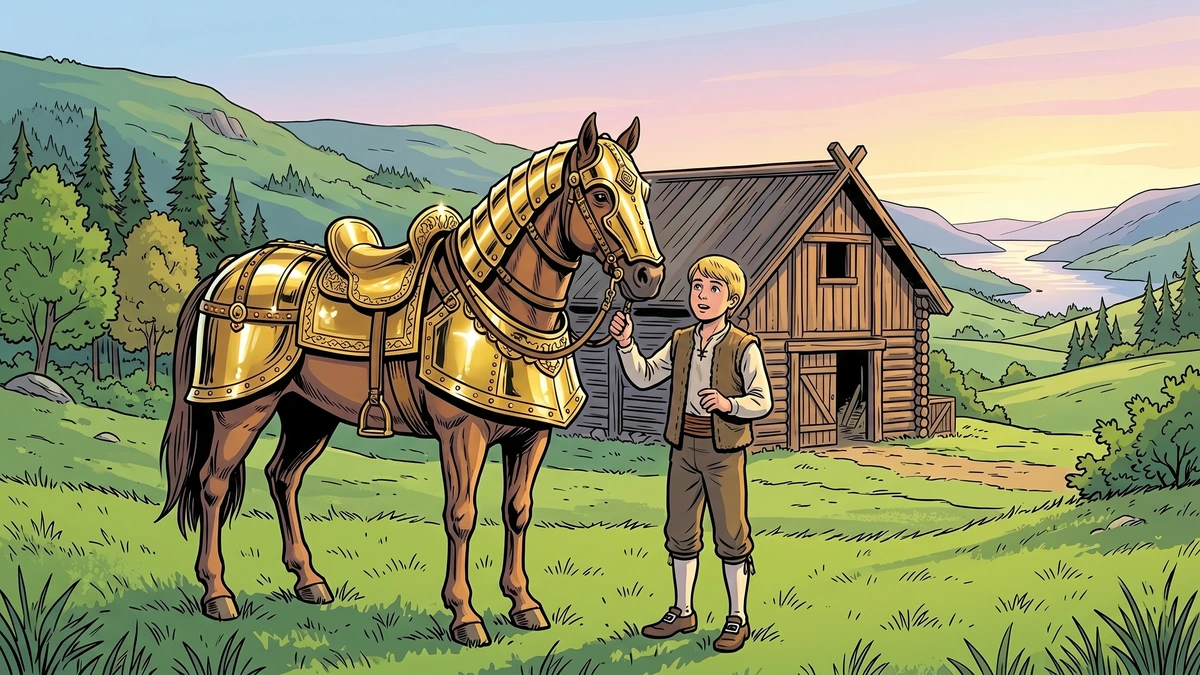
When Boots crept to the door, there outside stood a horse — and such a horse he had never dreamed of. It was cropping the grass, fat and gleaming, and on its back lay a saddle and bridle and a full suit of armour, all of gleaming brass, so bright it threw back the midsummer light. Boots had brought with him a little steel tinderbox, and he had heard that steel cast over a creature of magic will bind it fast. He flung the steel across the horse’s back — and at once the great beast grew gentle as a lamb. He led it away and hid it where no one would think to look, and went home and said not a word. His brothers asked, with much grinning, whether the meadow had eaten him this time.
The next St. John’s Eve the same thing happened, and Boots came away with a second horse, finer than the first, with armour all of shining silver. And the third year there came a third horse, the finest of all, with a saddle and harness and a suit of armour of pure red gold. Three times Boots had sat where his brothers had run; three times he had won what their fear had cost them. And still he said nothing, and still the household thought him good for nothing but the ashes.
The Glass Hill and the Golden Apples
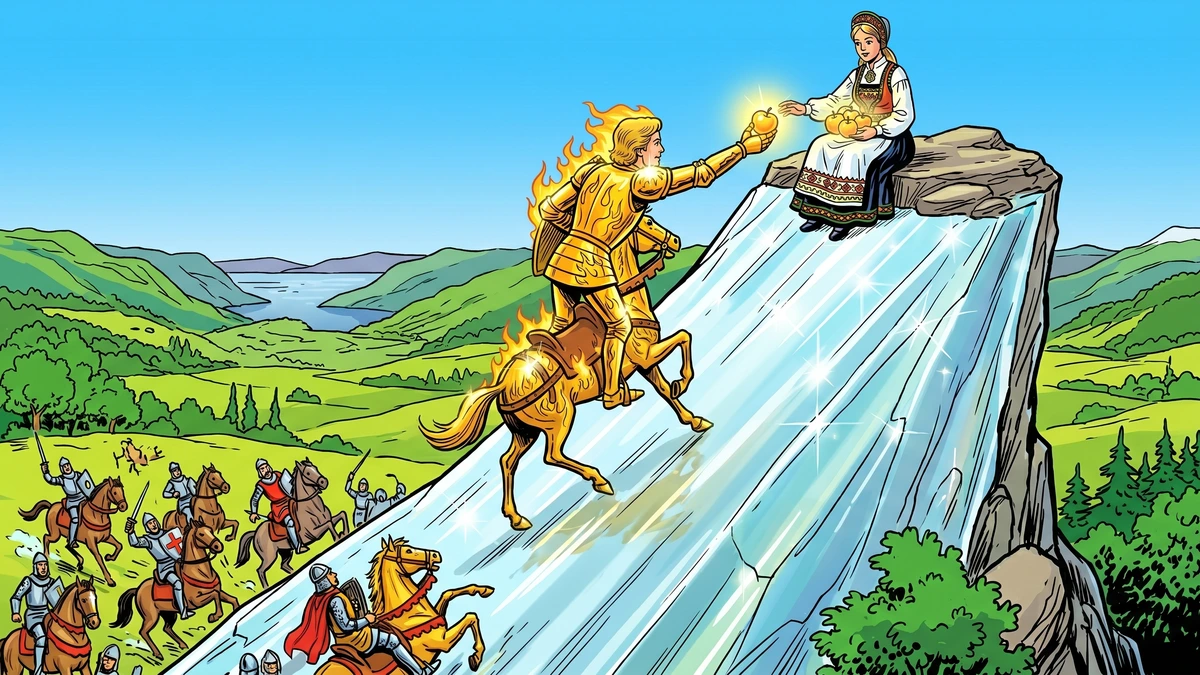
Now in that same kingdom there was a king with a daughter so lovely that everyone wished to win her, and the king had set a strange condition upon her hand. He had caused to be raised — or perhaps it had always stood there, no one quite knew — a hill of pure glass, high and steep and slippery as new ice. At the very top sat the princess, and in her lap she held three golden apples. Whoever could ride up that glittering slope and carry off the apples should have the princess and half the kingdom besides.
On the appointed day the field below the glass hill was a forest of banners. Kings’ sons came, and knights, and great lords, every one of them mounted on the proudest horse he owned and shining in his finest harness. One after another they charged at the slope — and one after another their horses’ hooves skidded and scrabbled on the glass, and down they came in a tangle of armour and pride. Boots’ two elder brothers were there too, in the crowd, jeering as loudly as any. Boots had asked to come along and they had refused him outright; so when a knight in brass armour appeared from nowhere, riding a horse no one knew, and spurred a third of the way up that impossible hill before wheeling calmly back down and vanishing, not one of them guessed who sat inside the armour.
The princess had marked him well. As the brass knight turned away she tossed one of the golden apples after him, and it rolled into his keeping, and he was gone before anyone could lay a hand on his bridle.
The second day a knight in silver armour rode two-thirds of the way up the glass before he, too, turned and disappeared — and again the princess threw an apple, and again it fell to the stranger. And on the third day a knight in armour of flaming gold rode straight up the glass hill to the very summit, took the third golden apple from the princess’s lap, and rode down and away while the whole field stood with its mouth open.
The Sooty Boy in the Golden Armour
The king now wanted very much to know who this golden rider was, for a man who had touched the princess herself and carried off her apple could not simply be allowed to ride out of the story. He summoned the whole kingdom and commanded that every man, high or low, should come before him, so that the holder of the three golden apples might be found.
One by one the proud suitors came and were searched, and not one of them had an apple to show. Boots’ brothers came and had nothing. At last someone remembered the lad by the hearth — the ash-raker, the good-for-nothing — and they fetched him, sooty and ragged, while the great hall rocked with laughter at the very sight of him. The king asked, half in jest, whether he had anything to show.
And Boots reached into his clothes and brought out one golden apple, and then a second, and then a third; and then he stood up straight and let them see him in the suit of pure gold armour he had worn up the glass hill. The laughter died in the hall. The princess knew her rider at once. And so the boy whom everyone had written off — the one left to the ashes, the one his brothers would not even let walk to the king’s field — won the princess and half the kingdom, and there was a wedding-feast that was talked of for many years after.
Askeladden: Norway’s Hero by the Hearth
Boots is no ordinary protagonist. He is Askeladden, the “Ash-lad,” and he is so central to Norwegian folk tradition that Asbjørnsen and Moe’s collection returns to him again and again — in “The Ashlad Who Stole the Troll’s Silver Ducks,” in “The Ashlad Who Had an Eating Match with the Troll,” and in many tales besides. The figure is always the same: the youngest of three brothers, dismissed as idle because he sits raking the embers, yet possessed of a watchful patience and an unhurried good sense that the world mistakes for laziness. Folklorists have long read him as a kind of Norwegian national self-portrait — the small, poor, underestimated figure who endures and observes and, in the end, comes out on top. In “The Princess on the Glass Hill” the type is shown at its purest: Boots wins not by strength or noble birth but by being the only one of the three sons willing to sit through the shaking of the barn.
The story’s calendar matters too. The vigils fall on St. John’s Eve — Sankthansaften, the Norwegian midsummer — the shortest, most luminous, and most magical night of the year, when the boundary between the ordinary world and the world of trolls and enchanted beasts was believed to be thinnest. It is no accident that the three armoured horses appear on exactly that night. The tale is rooted in a real seasonal belief, and its hearers would have felt the midsummer setting as a signal that wonders were now possible.
The Glass Mountain and Its Worldwide Cousins
The image at the centre of the tale — a hill of glass that no horse can climb — is far older and far more widespread than the Norwegian version alone. Catalogued as ATU 530, “The Princess on the Glass Mountain,” the type appears across Europe in many guises. There is a well-known Polish tale called simply “The Glass Mountain”; German tradition knows the glass mountain as a place of enchantment, and the Brothers Grimm use the motif in tales such as “The Seven Ravens” (KHM 25), where a glass mountain imprisons the lost brothers. Slavic and Hungarian variants send their heroes up slopes of glass or steep ice on magical steeds to win a princess and her golden tokens.
What the Norwegian telling adds to this old international skeleton is its particular furniture: the three horses shod and armoured in brass, silver and gold; the steel tinderbox cast over the magic horse to tame it, a detail drawn straight from Scandinavian folk belief that cold iron and steel bind creatures of enchantment; and, above all, the hearth-ash hero. The slippery hill is itself a near-universal symbol of a goal that defeats the proud and the merely powerful — a test that cannot be passed by force, only by the right preparation quietly made in advance. Stith Thompson and later folklorists treated the glass mountain as one of the clearest examples of how a single striking image can travel across languages and centuries while each culture re-dresses it in its own clothes.
The Heart of the Tale
For all its glass and gold, “The Princess on the Glass Hill” turns on a very plain idea. The two elder brothers fail not because they lack horses or courage in the ordinary way, but because they run at the first rumble — they will not sit still and see the thing through. Boots succeeds because three times over he says, in effect, “if that is all, I can bear it,” and keeps his seat. His reward is not luck; it is what patience and steady nerve uncover while the bold and the boastful are busy running away. Norwegian storytellers, who knew hard winters and long vigils, prized exactly that quality — the will to endure the shaking barn until the morning shows what the night was hiding.
The tale is just as pointed about judging by appearances. Everyone in Boots’ world reads him by his soot and his hearth-corner and decides he is worthless; the glass hill, indifferent to reputation, simply asks who can climb it. There is an old Norwegian saying that fits the Ash-lad better than any other:
“Man skal ikke skue hunden på hårene.”
— One should not judge the dog by its hairs.
The glass hill is the perfect test for such a moral, because glass cannot be flattered, bribed or impressed. It does not care how fine your banner is. It will hold up only the rider who has quietly earned the right horse — and in this story that rider is the boy nobody bothered to look at twice.
Why the Story Has Lasted
“The Princess on the Glass Hill” has outlived a century and a half of retellings because its promise never grows stale: the overlooked child, the one laughed at by the hearth, carries a secret the loud and the lucky know nothing about. Children hear it and recognise the unfairness of being underestimated; adults hear it and recognise the long, unglamorous patience that real achievement is built from. Asbjørnsen and Moe rescued it from the Norwegian countryside at the very moment such tales might have been lost, Dasent carried it across the sea, and Werenskiold and Kittelsen gave it a face. It endures, finally, because every reader would like to believe what it insists upon — that somewhere under the ashes sits a suit of golden armour, and a hill that only the patient can climb.
You May Also Like
 Norse Folk Tales
Ages 9-12
Norse Folk Tales
Ages 9-12
The Children of Odin: How Sif Lost Her Hair
The Children of Odin: How Sif Lost Her Hair: In Asgard, the great realm of the gods where immortal beings dwelt in golden halls and the boundaries of How Sif
 Norse Folk Tales
Ages 9-12
Norse Folk Tales
Ages 9-12
The Three Princesses Of Whiteland
The Three Princesses Of Whiteland: Once on a time there was a fisherman who lived close by a palace, and fished for the _King’s_ table. One day when he was out
 Norse Folk Tales
Ages 9-12
Norse Folk Tales
Ages 9-12
East Of The Sun And West Of The Moon
East Of The Sun And West Of The Moon: Once on a time there was a poor husbandman who had so many children that he hadn’t much of either food or clothing to