The Three Princesses Of Whiteland
The Three Princesses Of Whiteland: Once on a time there was a fisherman who lived close by a palace, and fished for the _King’s_ table. One day when he was out
Among the wonder-tales that Peter Christen Asbjørnsen and Jørgen Moe gathered from the firesides of nineteenth-century Norway, few travel so far or wish so hard as The Three Princesses of Whiteland. It begins, as so many Norse stories do, on the grey water with an empty hook — and ends at the rim of the known world, in a country white as snow, where a husband must out-walk the wind itself to win back the wife he carelessly lost. It is a tale of a rash bargain, a buried kindness, a broken promise, and a love that refuses to accept that any road is too long.
A Tale from the Norske Folkeeventyr
The story was collected in Norwegian as De tre prinsesser i Hvittenland (also spelled Hvidtenland, “Whiteland”) by Peter Christen Asbjørnsen (1812–1885) and Jørgen Moe (1813–1882), the two friends whose collaborative collection Norske Folkeeventyr — first issued in instalments from 1841 and steadily enlarged through the augmented editions of the 1850s and the definitive 1879 printing — did for Norway what the Brothers Grimm had done a generation earlier for the German lands. Where the Grimms worked largely from manuscript and middle-class informants, Asbjørnsen, a naturalist by training, and Moe, a poet and later a bishop, walked the valleys themselves, taking down tales from cottagers, ferrymen and farmhands and rendering them in a fresh, plain-spoken Norwegian prose that helped a young nation hear its own voice.
English readers met the tale through the Scottish folklorist Andrew Lang, who placed it in The Red Fairy Book (1890), the second of his celebrated coloured Fairy Books, drawing on the earlier and much-loved English versions of the Norske Folkeeventyr made by Sir George Webbe Dasent, whose Popular Tales from the Norse (1859) first carried Asbjørnsen and Moe’s stories across the North Sea. The original Norwegian editions were illustrated by the artists Erik Werenskiold and Theodor Kittelsen, whose brooding, granite-shouldered trolls and luminous northern landscapes fixed the visual imagination of these tales for more than a century.
Folklorists classify the story as international tale type ATU 400, “The Man on a Quest for the Lost Wife,” in the Aarne–Thompson–Uther index. In the Norwegian national catalogue, Ørnulf Hodne’s The Types of the Norwegian Folktale (1984) actually takes De tre prinsesser i Hvidtenland as the title-bearing example of that type. The pattern is ancient and worldwide: a hero wins a bride of supernatural origin or rescues a princess from enchantment, marries her under a prohibition, breaks the prohibition, loses her to a far country, and must journey to the ends of the earth — usually helped by the rulers of beasts, birds and fish, or by the Sun, Moon and Wind — to win her back. Norway’s own shelf of ATU 400 cousins includes East of the Sun and West of the Moon and Soria Moria Castle; further afield it touches the Scottish Black Bull of Norroway and the Grimms’ The King of the Golden Mountain.
The Rash Bargain on the Water
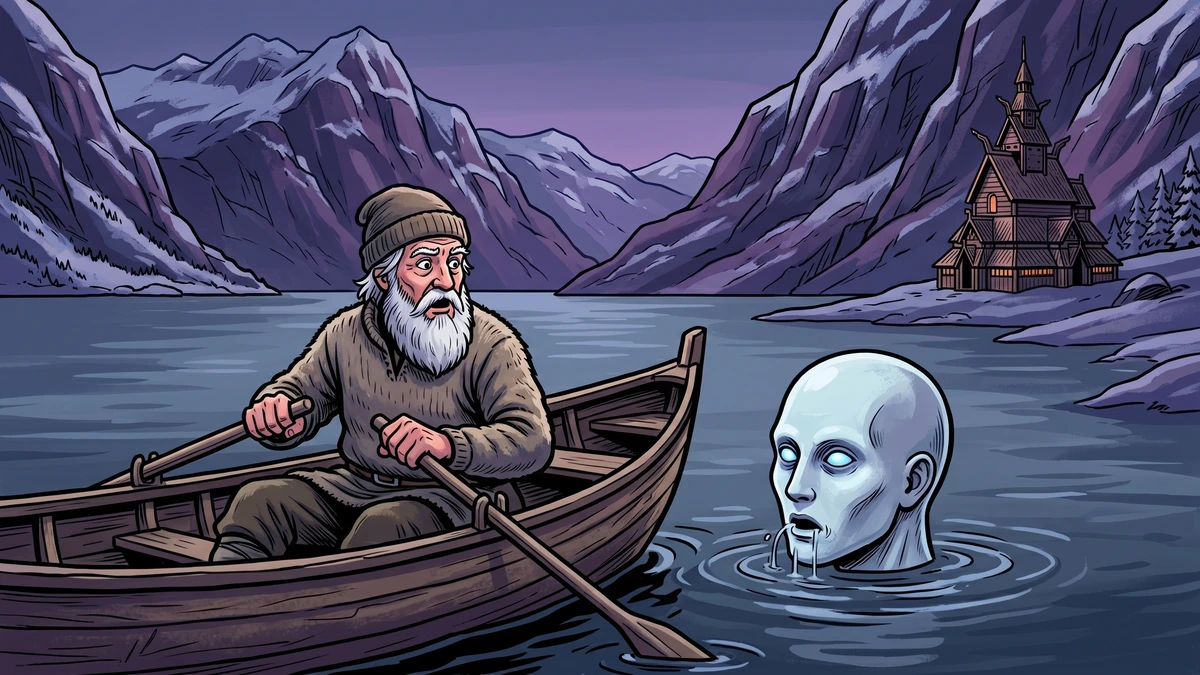
A fisherman who supplies the king’s table rows out one morning and catches nothing — no matter the bait, no matter the angle, the hook comes up bare. As the day fails, a head rises out of the sea and offers him a bargain: fish enough to fill the boat, in exchange for “what your wife bears under her girdle.” Thinking only of his empty nets, the man says yes — and only when he comes home laden with fish does his wife weep and tell him that she is carrying a child. He has promised away his own unborn son.
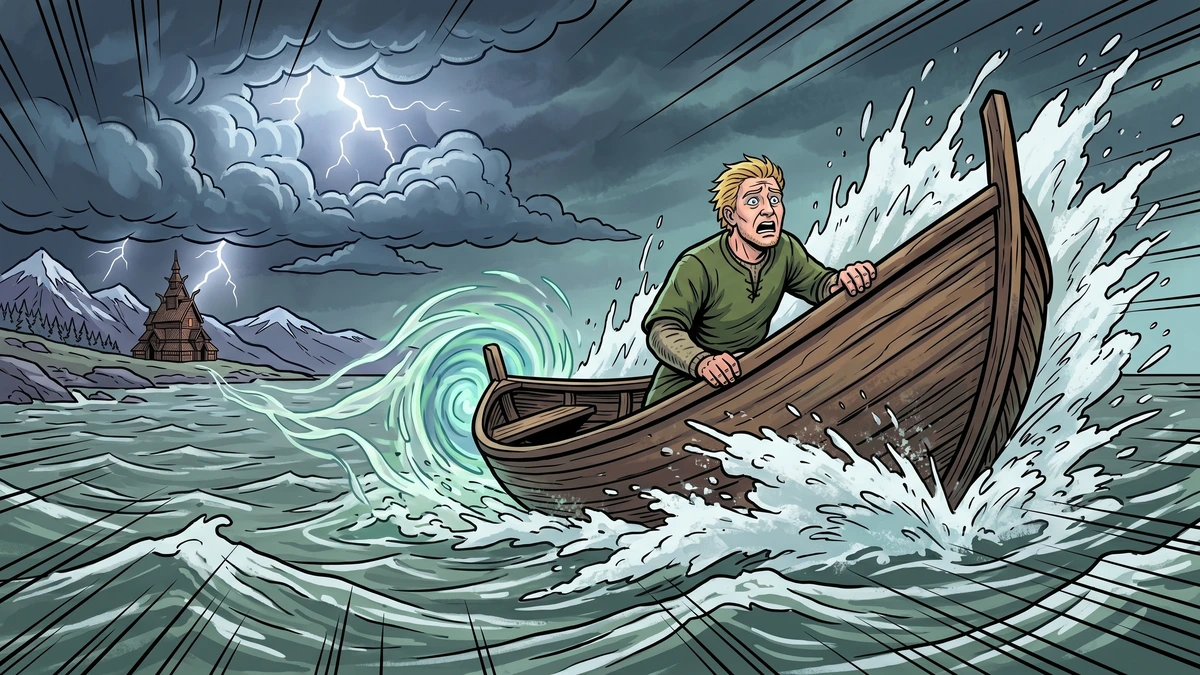
When the story reaches the castle, the king does a generous and shrewd thing: he offers to take the boy and raise him as his own, reasoning that the creature of the deep will find it harder to claim a child kept safe behind palace walls. And so the boy grows up a prince in all but blood — until the day he begs to go fishing, just once, with the father he was born to. The king resists, then yields. The instant the lad steps into the boat it tears loose from the shore of its own accord and runs out across the water, faster than any oar, until it grounds at last on the shore of a country he has never seen.
This opening is the folktale motif of the rash promise — the bargain made in ignorance, sworn for a small gain, that comes due with terrible interest. It is the same engine that drives Beauty and the Beast and the Grimms’ The Singing, Springing Lark, and the Norwegian storyteller wastes not a word moralising about it. The point is simply made and left to ring: a promise is a debt, and the sea always collects.
The Buried Princesses and the Trolls of Whiteland
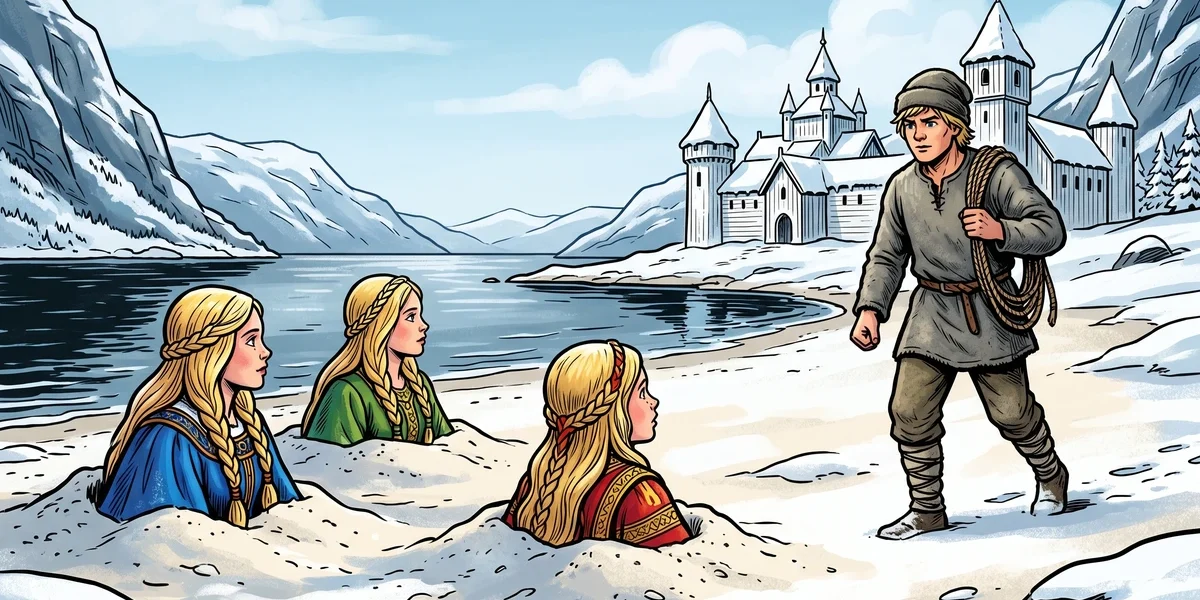
On the strange shore an old man tells the boy where he has come: this is Whiteland. If he walks along the beach he will find three princesses buried in the sand up to their necks. He must pass the first two without a word and speak only to the third and youngest — and that will bring him good fortune. He does exactly so, and the youngest princess tells him the price of everyone’s freedom. Three trolls hold the sisters under an enchantment. If the boy will go up to the castle on the shore and let each troll beat him with rods for one whole night, the spell will weaken and break. A flask of healing ointment stands ready by the bed to mend every wound he takes, and a sword hangs there that alone can cut the trolls’ heads away.
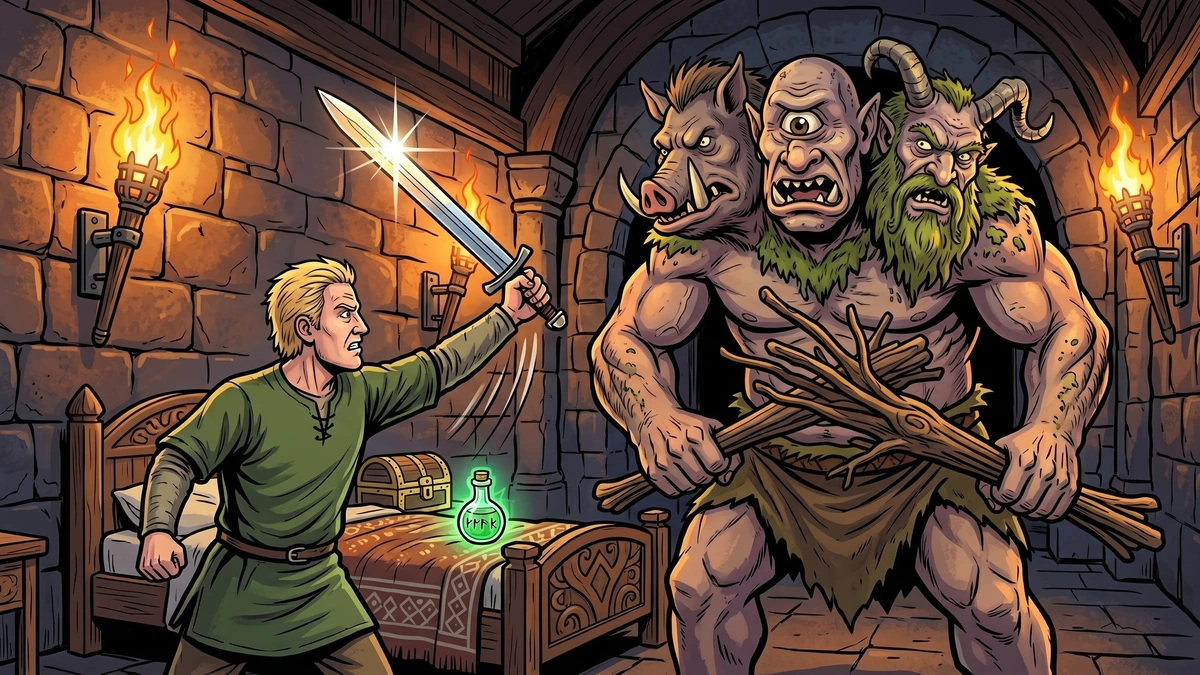
The ordeal climbs in the steady threefold rhythm that Norse tales love. The first troll has three heads and three rods; when the boy has endured the night and struck the heads off, the princesses have risen out of the sand to their waists. The second troll has six heads and six rods; the night survived, the sisters stand free to their knees. The third troll has nine heads and nine rods, and beats the boy so savagely that he cannot crawl to the ointment — but the blows themselves fling him against the wall, the flask shatters over him, and the spilling balm heals him in the very moment of his defeat. He rises, takes the sword, and frees the princesses entirely.
The image of the buried princesses is one of the eeriest in the Norwegian canon — royalty sunk in the cold earth, alive but voiceless, waiting for someone willing to be hurt on their behalf. The boy’s heroism is not the slaying of a monster in single combat; it is the slower, humbler courage of enduring — of standing still under the rods, three nights running, trusting a stranger’s word that the pain will be worth it. The healing ointment that arrives by accident, in the worst instant, is the tale’s quiet promise that grace can reach a person even when his own strength has wholly failed.
The escalation by threes — three heads, then six, then nine; three rods, then six, then nine — is no idle ornament. In the oral tradition such patterns were a teller’s scaffolding, a rhythm that let both the storyteller and the listening children feel the danger mounting toward a known and bearable shape. The trolls of Whiteland are recognisably the trolls of every Norwegian valley: not clever, not subtle, but vast, brutal and many-headed, the personified weight of the long northern winter and the wild country beyond the last farm. To break their spell is to win back what the cold took — and the very name Hvittenland, the white land, carries that double sense of a snow-locked country and a place of enchantment waiting to be thawed. The youngest princess, chosen over her elder sisters, is the familiar folktale truth that fortune rewards the one who waits patiently for the right word rather than the one who clamours first and loudest.
The Ring, the Mother’s Pride, and the Vanished Wife
The boy marries the youngest princess, and for several happy years Whiteland is home enough. Then homesickness stirs — he longs to see the father and mother he left behind. His wife agrees, but reluctantly, and arms him with two careful gifts: a ring that will grant exactly two wishes, one to carry him home and one to bring him back, and a single, grave instruction. Do only what your father asks of you. Do not do what your mother wishes.
He goes home, and his mother is so proud of her splendid son that she will not rest until the king has seen him. His father warns against it; his mother prevails, as the prohibition foretold she would. At the palace, surrounded by the king’s court and the king’s own beautiful wife, the young man cannot hold his tongue: he boasts that his princess is far lovelier, and to prove it he wishes her there before them all. The wish is granted — and it is the second wish, the one meant to carry him back to Whiteland. His wife stands suddenly in the king’s hall, summoned like a servant to settle a vain quarrel. Without a word of reproach she takes the ring from his hand, knots a small ring marked with her name into his hair while he is unaware, and wishes herself home alone. He is left behind, in his parents’ country, with no ring, no road, and a wife at the white edge of the world.
Here the tale turns on its hinge. The broken prohibition is the heart of every ATU 400 story, and Norwegian audiences would have felt the justice of it keenly: the husband was not cruel, only careless and proud, and carelessness with a trust is its own kind of betrayal. Yet the wife’s response is not vengeance. The hidden ring knotted in his hair is a token of recognition — a thread of hope she leaves him even in the act of leaving. She has not stopped loving him. She has only stopped making the journey easy.
The Kings of Beast, Bird and Fish — and the Long Walk to Whiteland
Determined to find Whiteland by his own feet, the young man sets out. He comes first to the King of all the Beasts, who summons every animal on earth and asks the way; none of them knows it, but the king lends the traveller a pair of snowshoes that will carry him to his brother, the King of all the Birds. The birds are called from every quarter of the sky; they too cannot answer, and a second pair of snowshoes speeds him on to the third brother, the King of all the Fish. The fish gather from every sea — and still no answer, until at last an old pike comes paddling in, the very last to arrive, and says yes: he knows the road to Whiteland, and worse, he knows that the lost wife is to be married again the very next day.
The King of the Fish sends the traveller to a field where three brothers have been fighting for a hundred years over their inheritance — a hat, a cloak and a pair of boots that together make the wearer invisible and carry him instantly wherever he wishes to be. The young man offers to judge the contest fairly, asks to test the gifts first, puts them on — and wishes himself, in the same breath, to Whiteland. On the road he meets the North Wind, who promises to come roaring against the wedding castle as though to flatten it. The wind is as good as its word: it storms Whiteland, snatches up the false bridegroom and carries him off into the sky, and in the uproar the young man slips unseen to his wife’s side. She runs her fingers through his hair, finds the small ring knotted there with her own name upon it, and knows him at once. The long quest ends in recognition, and the marriage is made whole.
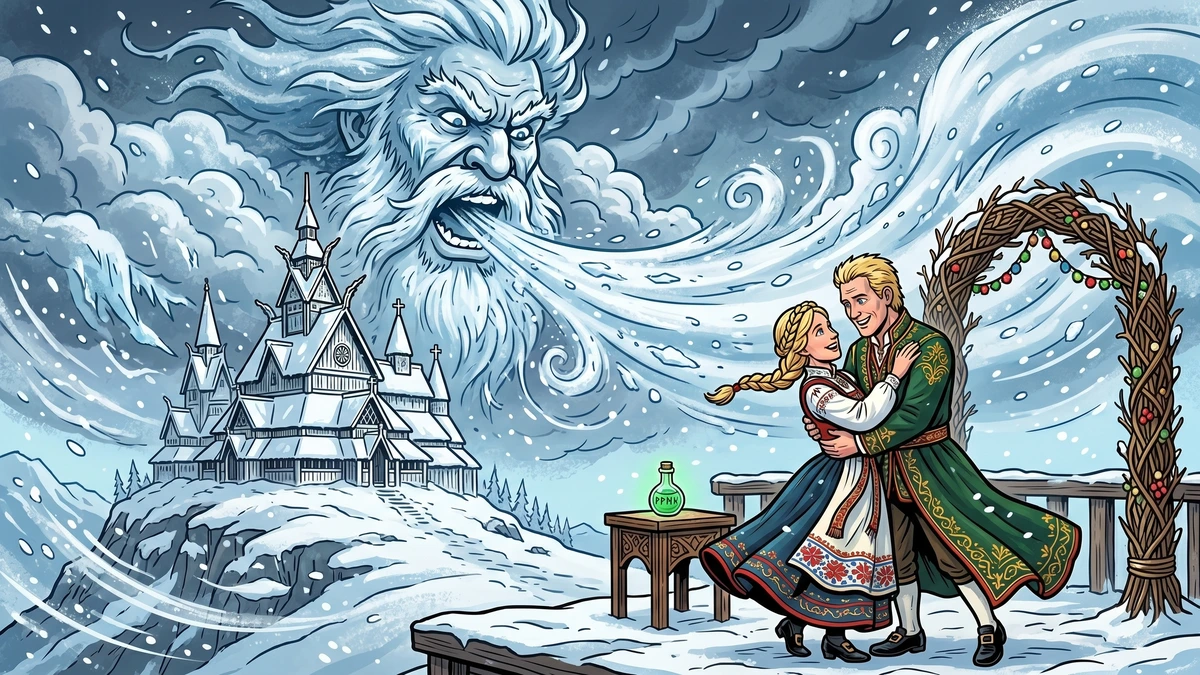
The cascade of helper-kings — beast, bird and fish — is one of the most satisfying structures in European folktale, a search that widens to take in the whole living world before it narrows to a single old pike who happens to know. It tells the listener that the lost thing is found not by force but by patience and by humility: by being willing to ask, and ask again, and walk on after every “I do not know.” And it is fitting that the final help comes from the North Wind, the oldest Norwegian helper of all — the same wind that, in East of the Sun and West of the Moon, carries another faithful traveller the last impossible stretch of the way.
There is a sly piece of folk wisdom hidden in the field where the three brothers have quarrelled for a hundred years over a hat, a cloak and a pair of boots. The treasures are real and powerful — invisibility and instant travel, the very tools the hero needs — yet a century of fighting over them has carried the brothers exactly nowhere. It takes an outsider with a clear purpose to lift the gifts and actually use them. The contrast is the tale’s neatest joke at the expense of greed: the squabblers possess everything and accomplish nothing, while the traveller who wants only to reach his wife borrows the magic for a single afternoon and crosses the world with it. Power, the story shrugs, is worth precisely what it is spent on; hoarded, it is only a reason to keep fighting.
The Moral: A Promise Kept Is a Road Walked to the End
The Three Princesses of Whiteland turns, from first scene to last, on the keeping and breaking of promises. The fisherman’s careless “yes” on the water sets the whole machine in motion; the son’s careless wish in the king’s hall undoes years of happiness; and the story is only resolved when the husband stops bargaining, stops boasting, and simply walks — through the courts of beasts and birds and fish, past every closed door — until the road runs out at Whiteland. The wife never demands an apology. She demands a journey. Love, the tale insists, is proved not by fine words but by the willingness to cross the world on foot to mend what fine words broke.
“Den som venter på noe godt, venter ikke forgjeves.” — He who waits for something good does not wait in vain. (Norwegian proverb)
There is a gentler lesson folded inside the larger one, carried by the warning the wife gives at the door: do what your father asks, not what your mother wishes
You May Also Like
 Norse Folk Tales
Ages 9-12
Norse Folk Tales
Ages 9-12
The Princess On The Glass Hill
The Princess On The Glass Hill: Once on a time there was a man who had a meadow, which lay high upon the hill-side, and in the meadow was a barn, which he had
 Norse Folk Tales
Ages 9-12
Norse Folk Tales
Ages 9-12
Tyr and the Binding of Fenrir
Tyr and the Binding of Fenrir: In the time before Ragnarok, when the gods still believed they could prevent the end times through cunning and sacrifice, there
 Norse Folk Tales
Ages 9-12
Norse Folk Tales
Ages 9-12
The Creation of the World from Ymir’s Body
The Creation of the World from Ymir's Body: In the beginning, before the world was formed and before time itself had meaning, there existed only Muspelheim and