The Mead of Poetry
The Mead of Poetry: Before the world was young, before the stars had settled in their places, the giants possessed a great treasure - the Mead of Poetry. When
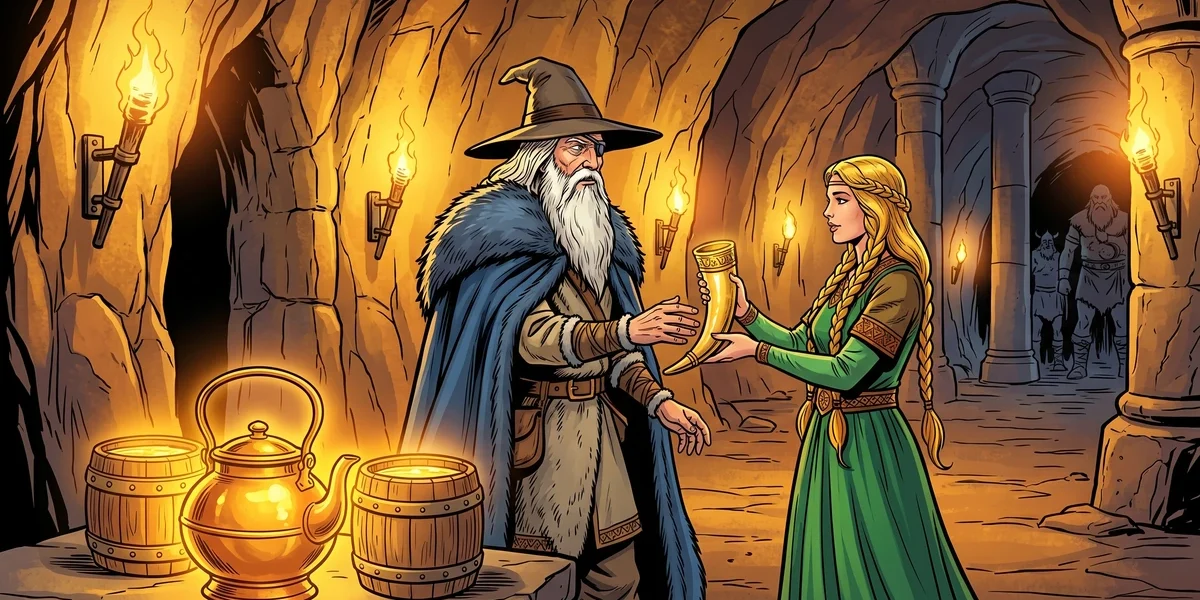
There is a drink, the old Norse poets said, that no farmer ever brewed and no king ever bought — a mead that turns the one who tastes it into a maker of verse. Drink it, and words arrive in ordered ranks; speech becomes song; the plain account of a thing becomes a thing worth remembering. The Norse called this drink simply skáldskapar mjöðr, “the mead of poetry,” and they told a long, strange tale of how it was made out of murder, hoarded by giants, and at last stolen back for gods and humankind by Odin himself. It is, in the end, a story the poets told about where their own gift came from — and about the price that was paid for it.
This is not a gentle story. It begins with a war between two families of gods, passes through three killings, a drowning, a millstone, and a long deception, and ends with a god fleeing through the sky in the shape of an eagle with a pursuer close behind. Yet for all its violence it is, at heart, a story about inspiration — about how the ability to speak well is something received rather than invented, something that has travelled a hard road to reach the tongue that finally uses it.
Where This Story Comes From
The fullest account of the Mead of Poetry survives in the Prose Edda of Snorri Sturluson, the Icelandic chieftain, lawspeaker, and historian who compiled that handbook of Norse mythology and poetics around 1220 CE. The tale appears in the section called Skáldskaparmál (“The Language of Poetry”), and specifically in its opening frame, the Bragarœður, in which the poet-god Bragi recounts the myth to the sea-giant Ægir at a feast. Snorri tells it precisely because it explains the kennings — the compressed poetic metaphors — by which skalds referred to poetry itself: “Kvasir’s blood,” “the dwarfs’ drink,” “Odin’s booty,” “the liquid of Óðrerir.” The Prose Edda text is reconstructed from several medieval manuscripts, chief among them the Codex Upsaliensis (DG 11, copied c. 1300–1325, the oldest), the Codex Regius of the Prose Edda (GKS 2367 4to), the Codex Wormianus (AM 242 fol.), and the Codex Trajectinus.
A second, older and more allusive source is the Poetic Edda. In the poem Hávamál (“The Sayings of the High One”), preserved in the Codex Regius manuscript GKS 2365 4to (compiled c. 1270 from older oral tradition), Odin himself speaks of the adventure in the first person — of the maiden Gunnlöð, of the auger named Rati, of the precious mead and the oath he swore and broke (stanzas 13–14 and 104–110). Because Hávamál only gestures at events its audience already knew, and Snorri narrates them in full, scholars read the two together. The myth is therefore genuinely old — older than Snorri’s thirteenth-century retelling — and was familiar to skalds across the Viking Age, who could name poetry “the ship of the dwarfs” and trust their hearers to follow.
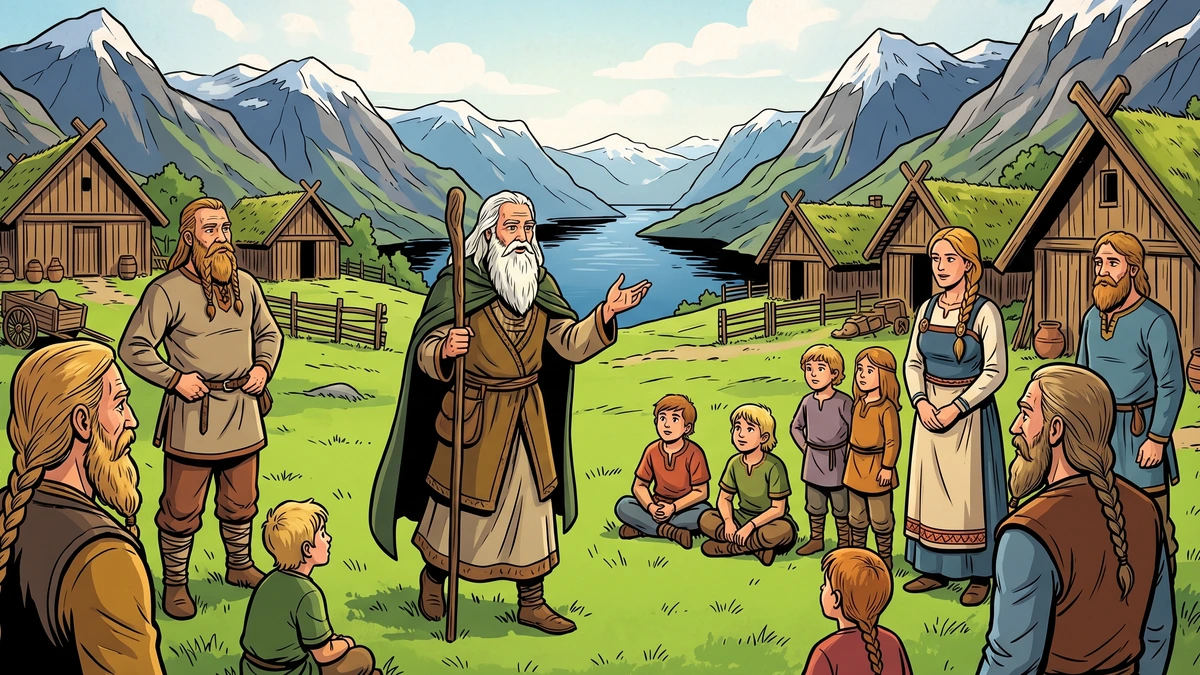
Kvasir, and the Brewing of the Mead
The story reaches back to the end of the first war among the gods. The two divine families — the Æsir, gods of sky and sovereignty, and the Vanir, gods of fertility and the sea — had fought to a standstill and then, wisely, made peace. To seal the truce they performed an act that bound them together: each of them stepped to a great vessel and spat into it, and from that mingled spittle of every god the Æsir shaped a living man. They named him Kvasir.
Kvasir was the wisest being who had ever lived. There was no question anyone could put to him that he could not answer. He did not hoard this gift; he walked the wide worlds teaching, and wherever he went people grew wiser for his visit. But wisdom that travels freely also travels into danger. Two dwarfs, Fjalar and Galar, invited Kvasir to their home, drew him aside in private, and killed him. They let his blood run into three vessels — two vats called Boðn and Són, and a kettle called Óðrerir (“the stirrer of inspiration”) — and they blended that blood with honey. What stood in the vessels when they had finished was the Mead of Poetry. Anyone who drank of it became a poet or a scholar; the wisdom of the wisest man, distilled and sweetened, could now be swallowed.
When the gods asked after Kvasir, the dwarfs answered with a chilling little lie: he had, they said, simply choked on his own wisdom, for there was no one learned enough to question him and drain it from him. It is the first of the story’s sour jokes — that the most precious thing in the cosmos was made by killing the one being who carried it freely, and that the killers felt no shame at all.
Gilling, Suttung, and the Mountain Hnitbjörg
Fjalar and Galar did not keep the mead for long, and they lost it the same way they had gained it — through cruelty that finally overreached. They invited a giant named Gilling and his wife to visit. Taking Gilling out to sea in a boat, they steered onto a hidden rock and capsized it; Gilling, who could not swim, drowned. When the dwarfs rowed back and told the giant’s wife, she wept so loudly that Fjalar, irritated by her grief, asked whether it would ease her to look out at the sea where her husband had died. When she went to the door to look, Galar — waiting above — dropped a millstone on her head and killed her too.
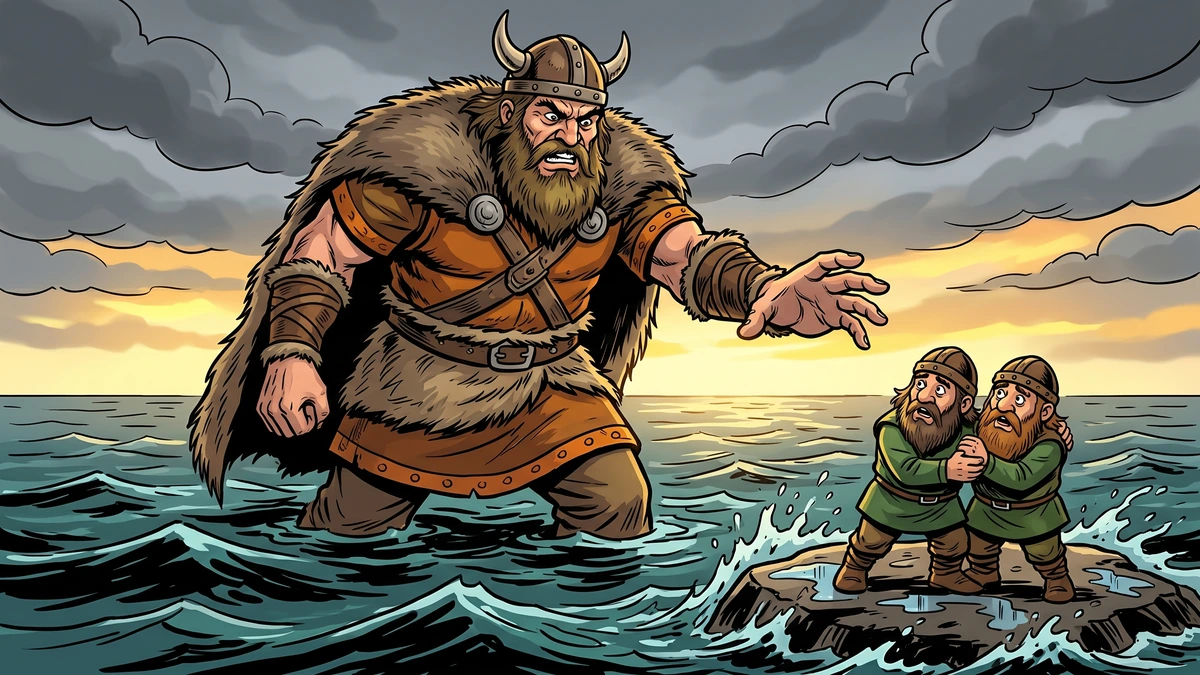
This time the murder had a witness who could act. Gilling’s son, the giant Suttung, learned what had been done. He seized the two dwarfs, rowed them out, and set them on a skerry — a low reef — that the rising tide would soon cover. As the water climbed toward them the dwarfs begged for their lives, and they offered Suttung the one thing that might buy them: the Mead of Poetry, in weregild for his father. Suttung accepted, took the mead home, and hid it deep inside a mountain called Hnitbjörg. To guard it he set his own daughter, Gunnlöð, who kept watch over the three vessels in the dark of the rock. The poets’ treasure had passed from gods to dwarfs to giants — and it was now locked away from everyone, as far from the tongues that might use it as a thing can be.
Bölverk’s Winter: the Whetstone and the Auger Rati
Odin, the All-Father, the god most hungry for wisdom in all its forms, set out to win the mead back. He did not march on Hnitbjörg with an army; that was never his way. He went disguised, under a false name — Bölverk, which means “worker of misfortune” or “evil-doer,” an honest enough warning for anyone who cared to read it.
He came first to a hayfield belonging to Baugi, Suttung’s brother, where nine thralls were mowing. Bölverk offered to whet their scythes, and drew out a wonderful whetstone; the blades came away so keen that every thrall wanted the stone for himself. Bölverk said he would sell it — and threw it up into the air. As the nine men lunged and grabbed for it, they swung their newly sharpened scythes and cut one another’s throats, every one of them dead in the field. It is a brutal episode, and the saga does not soften it; it shows the reader exactly what kind of guest “Bölverk” is.
Bölverk then went to Baugi and found him troubled, for his nine workers had killed each other and the harvest stood unfinished. The disguised god offered a bargain: he would do the work of all nine men through the coming winter, and his only wage would be a single drink of Suttung’s mead. Baugi warned that the mead was his brother’s and not his to give, but agreed to help ask for it. Bölverk laboured all winter and finished the work of nine. When the time came, the two went to Suttung — who flatly refused them a single drop.
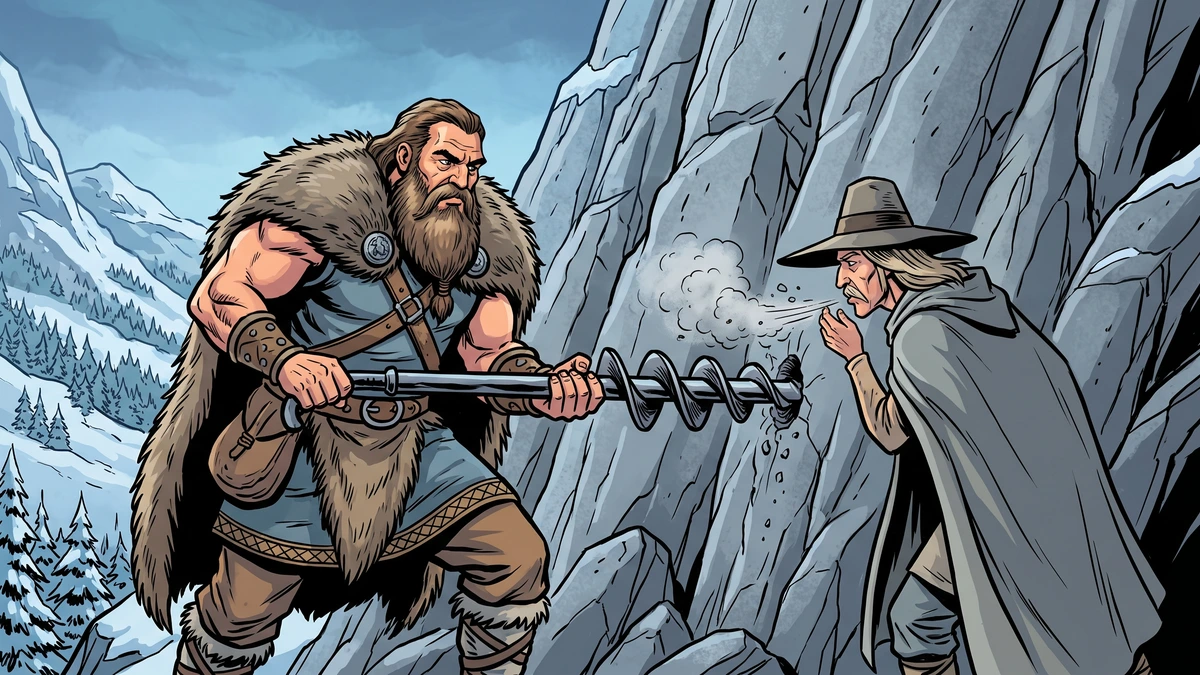
So Bölverk proposed a trick instead, and Baugi went along with it. Bölverk produced an auger called Rati and told Baugi to bore a hole into the mountain Hnitbjörg. Baugi drilled, then said the hole was through; but when Bölverk blew into it the rock-dust flew back into his face, and he knew Baugi was lying and trying to stop short. He made him bore again, and this time when Bölverk blew, the chips flew inward. The way was open. Bölverk changed his shape into a serpent and slid into the narrow hole. Baugi stabbed after him with the auger — one last treachery — but missed, and the snake was already gone into the dark of the mountain.
Three Nights, Three Draughts, and the Eagle’s Flight
Inside Hnitbjörg, in the chamber where the three vessels stood, Odin put off the serpent’s shape and came to Gunnlöð. He stayed with her three nights, and she — won by him — granted him what he had truly come for: three drinks of the mead, one for each night. But Odin did not sip. At the first draught he emptied the kettle Óðrerir; at the second, the vat Boðn; at the third, the vat Són. In three swallows every drop of the Mead of Poetry was inside him.
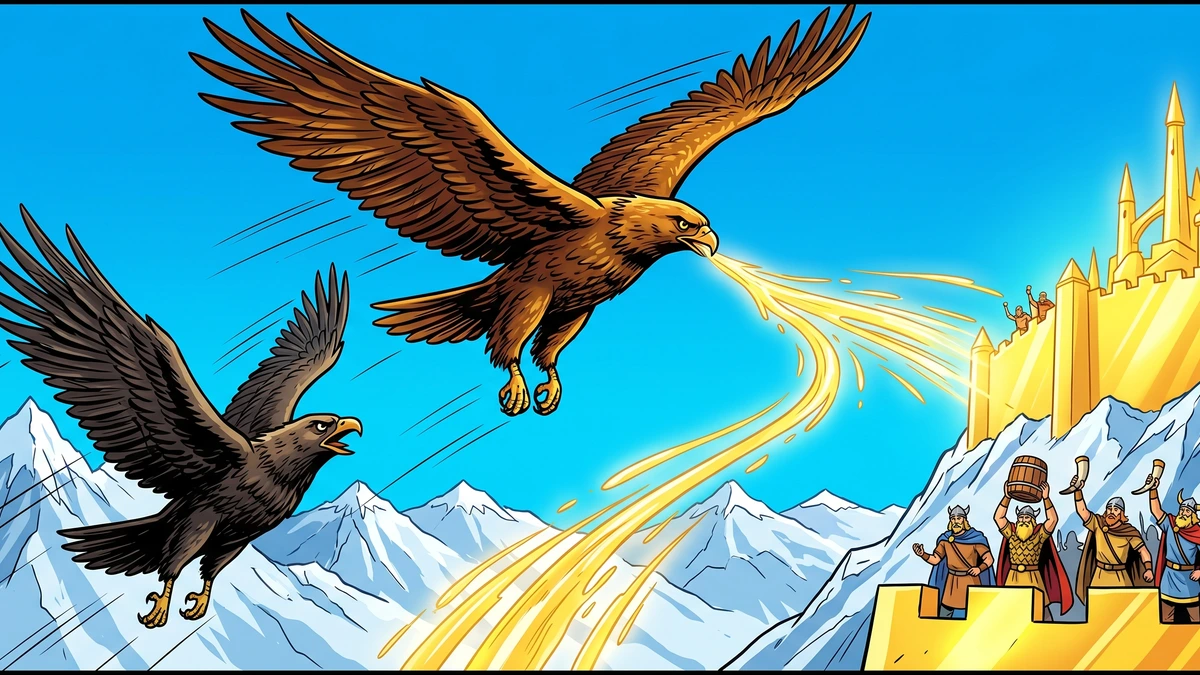
Then he turned himself into an eagle and flew for Asgard as hard as his wings would carry him. Suttung soon found the vessels empty, understood, and put on his own eagle shape to give chase. The Æsir, seeing Odin come, set out their great vats in the courtyard; and Odin, reaching the walls, spat the mead up out of himself into the waiting vessels. He came so near to being caught that, in his haste, a little of the mead escaped him the other way, spilled and untended, and that portion the gods left for anyone to take. The Norse called it the skáldfífla hlutr, “the rhymester’s share” or “the bad poets’ portion” — a wry explanation for why some verse is clumsy: its makers drank only the spillage.
The good mead, though, Odin kept — and gave. From his keeping it passes to the Æsir and to those mortals he chooses to make poets. That is the gift the skald claims every time he opens a poem: not raw talent alone, but a draught handed down from the All-Father, who paid for it with a winter of labour, a borrowed name, and a promise to Gunnlöð that he did not keep.
The Meaning of the Story
The Mead of Poetry is, before anything else, a myth about where eloquence comes from — and its answer is humbling. Poetry is not generated freshly by the poet; it is received. It was distilled from the blood of the wisest being who ever lived, hoarded by the greedy, locked in stone, and recovered only by long effort and cunning. To speak well, the myth says, is to be the temporary holder of something far older and dearer than oneself.
There is a clear moral edge to it as well. Every being who simply hoards the mead loses it: the dwarfs lose it to Suttung, Suttung loses it to Odin. It moves, in the end, to the one who means to share it — Odin takes the mead not to drink alone but to pour out for gods and humankind. Wisdom and art, the story insists, are not treasure to be sealed in a mountain; they are a drink meant to be passed from hand to hand. In the Hávamál, Odin gives the lesson its plainest words, looking back on the whole hard adventure:
Vel keypts litar / hefi ek vel notið,
fás er fróðum vant,
því at Óðrœrir / er nú upp kominn
á alda vés jaðar.“The shape I bought at a good price I have used well; little does the wise one lack — for Óðrerir has now come up to the rim of the dwelling-place of men.” — Hávamál, stanza 107
The mead has “come up” to the world of people. It is no longer a giant’s buried hoard; it is available, on the rim of human life, to whoever is given a share. And the story is honest about cost. Odin’s victory is not clean: nine men die for a thrown whetstone, Gunnlöð is deceived, an oath is broken. The myth does not pretend that the gift came without harm. That sober honesty is part of why it has weight — it knows that the things most worth having are rarely had cheaply.
Why the Story Has Lasted
The Mead of Poetry has outlived the religion that produced it for a simple reason: it is the rare myth that explains the very craft used to tell it. Every skald who recited it was, in the act of reciting, demonstrating the gift the story describes — and quietly crediting Odin for it. That self-awareness gave the tale a permanent home inside the poetic tradition. Snorri preserved it not as a curiosity but as the master-key to Norse verse: once you know that poetry is “Kvasir’s blood” and “Odin’s booty,” a hundred kennings unlock at once.
It endures, too, because its central image is so exact. Inspiration really does feel like that — like a thing that arrives, that fills you, that you must then spend quickly before it fades; and afterwards there is always the spilled portion, the lines that came out clumsy. Poets in every later century have recognised themselves in the myth. And it lasts because it tells the truth about how culture is carried: wisdom is made from a real person’s mind, it is fought over, it is nearly lost, and it survives only because someone is willing to go to great trouble to bring it back and pour it out for others. A story handed from giant to dwarf to god to skald to a child reading today is itself a cup of the mead, still being passed along.
Frequently Asked Questions
What is the Mead of Poetry in Norse mythology?
The Mead of Poetry (Old Norse skaldskapar mjodr) is a mythical drink that gives anyone who tastes it the gift of poetry and scholarship. It was brewed from the blood of Kvasir, the wisest being ever made, mixed with honey, and stored in two vats called Bodn and Son and a kettle called Odrerir. In Norse tradition the mead is the very source of eloquence, and skalds referred to poetry itself with kennings such as ‘Kvasir’s blood’ and ‘Odin’s booty’.
Who was Kvasir and how was the mead made?
Kvasir was a living man created by the gods to seal the peace ending the war between the Aesir and the Vanir. Each god spat into a vessel, and from that mingled spittle the Aesir shaped Kvasir, the wisest being who ever lived, able to answer any question. The dwarfs Fjalar and Galar murdered him, drained his blood into the vessels Odrerir, Bodn and Son, and blended it with honey. The result was the Mead of Poetry; the dwarfs told the gods that Kvasir had choked on his own wisdom.
How did Odin steal the Mead of Poetry?
Disguised under the name Bolverk, Odin worked a whole winter for the giant Baugi, doing the labour of nine men in exchange for a drink of the mead. When Baugi’s brother Suttung refused to share it, Bolverk had Baugi bore into the mountain Hnitbjorg with the auger Rati, turned into a serpent, and slipped inside. He spent three nights with Suttung’s daughter Gunnlod, who guarded the mead, and won three drinks; in three draughts he emptied all three vessels. He then became an eagle and flew to Asgard, spitting the mead into vats the gods had set out.
What is the original source of the Mead of Poetry myth?
The fullest account is in the Prose Edda of the Icelander Snorri Sturluson, written around 1220 CE, in the section Skaldskaparmal, where the poet-god Bragi tells the tale to the sea-giant Aegir. The Prose Edda survives in manuscripts including the Codex Upsaliensis (c.1300-1325), the Codex Regius GKS 2367 4to, and the Codex Wormianus. Odin also recalls the adventure in the first person in the Poetic Edda poem Havamal (stanzas 13-14 and 104-110), preserved in the Codex Regius GKS 2365 4to.
What does the Mead of Poetry myth mean?
The myth explains where eloquence comes from: poetry is not invented fresh by the poet but received, distilled from the wisdom of the wisest being and handed down. It also carries a moral about sharing. Every figure who simply hoards the mead loses it, and it comes to rest with Odin, who takes it not to drink alone but to pour out for gods and humankind. Wisdom and art, the story insists, are a drink meant to be passed from hand to hand rather than sealed away.
You May Also Like
 Norse Folk Tales
Ages 9-12
Norse Folk Tales
Ages 9-12
The Three Princesses In The Blue Mountain
The Three Princesses In The Blue Mountain: There were once upon a time a _King_ and _Queen_ who had no children, and they took it so much to heart that they
 Norse Folk Tales
Ages 9-12
Norse Folk Tales
Ages 9-12
Thor and the Giant’s Kettle
Thor and the Giant's Kettle: In the golden halls of Asgard, where the gods feasted and plotted, the need for a new cauldron had become undeniable. The old
 Norse Folk Tales
Ages 9-12
Norse Folk Tales
Ages 9-12
The Husband Who Was To Mind The House
The Husband Who Was To Mind The House: Once on a time there was a man, so surly and cross, he never thought his _Wife_ did anything right in the house. Empathy