The Creation of the World from Ymir’s Body
The Creation of the World from Ymir's Body: In the beginning, before the world was formed and before time itself had meaning, there existed only Muspelheim and

Every mythology must answer one impossible question before it can tell any other story: where did everything come from? The Norse answer is among the strangest and most physical ever imagined. The world we walk on, the Norse said, is not a thing that was spoken into being or shaped from clean clay. It is a body. The earth is the flesh of a murdered giant, the sea is his blood, the mountains are his bones, and the sky overhead is the dome of his hollowed skull. To live in Midgard, in the Norse imagination, is to live inside a corpse — and to know that the same cold matter that became the ground beneath your feet was once alive, and was killed, so that you might exist at all.
This is the tale of Ymir, the first being, born from the meeting of fire and frost in a yawning void, and of how the three young gods who became his great-grandsons rose against him, struck him down, and built the ordered world out of his ruined body. It is a creation myth without comfort and without apology. It tells us that order is carved out of chaos by violence, that the cosmos is recycled from something older and wilder, and that beneath every settled field there lies the memory of a giant.
Where the Story Comes From
The creation of the world from Ymir’s body is one of the best-attested narratives in all of Norse mythology, and it survives because two great medieval Icelandic works happened to record it within a few decades of one another. The fuller, most orderly account is found in the Prose Edda, the handbook of mythology and skaldic poetics compiled by the Icelandic chieftain, lawspeaker and historian Snorri Sturluson around the year 1220. In its first main section, Gylfaginning (“The Beguiling of Gylfi”), Snorri stages the whole cosmogony as a dialogue: a curious king questions three mysterious figures, and they describe in sequence the void, the birth of Ymir, the primeval cow, the rise of the gods, and the building of the world from the slain giant’s flesh. Snorri’s Edda itself comes down to us through several manuscripts — among them the Codex Upsaliensis (DG 11, copied around 1300–1325), the Codex Regius of the Prose Edda (GKS 2367 4to), the Codex Wormianus (AM 242 fol.) and the Codex Trajectinus — and the differences between them remind us that Snorri was working a generation or two after Iceland’s conversion to Christianity, shaping older pagan material into a connected story.
Snorri did not invent the myth, and he was careful to show his sources. He quotes, as proof, from the older body of anonymous mythological poetry that scholars call the Poetic Edda, preserved chiefly in a single priceless Icelandic vellum, the Codex Regius (GKS 2365 4to), written down in the second half of the thirteenth century but transmitting verse considerably older. Three of its poems carry the creation in compressed, archaic form. Völuspá, “The Prophecy of the Seeress,” recalls the time when there was neither sand nor sea nor cool waves, only the gap of Ginnungagap. Vafþrúðnismál, “The Sayings of Vafþrúðnir,” frames the cosmogony as a deadly wisdom-contest in which Odin questions an ancient giant, and stanza 21 states flatly that from Ymir’s flesh the earth was shaped. Most vivid of all is Grímnismál, “The Sayings of Grímnir,” whose stanzas 40 and 41 itemise the transformation organ by organ. These poems are older than Snorri’s prose, and the fact that his careful narrative agrees with their cryptic verses is what gives the myth its authority.
The Void Between Fire and Ice
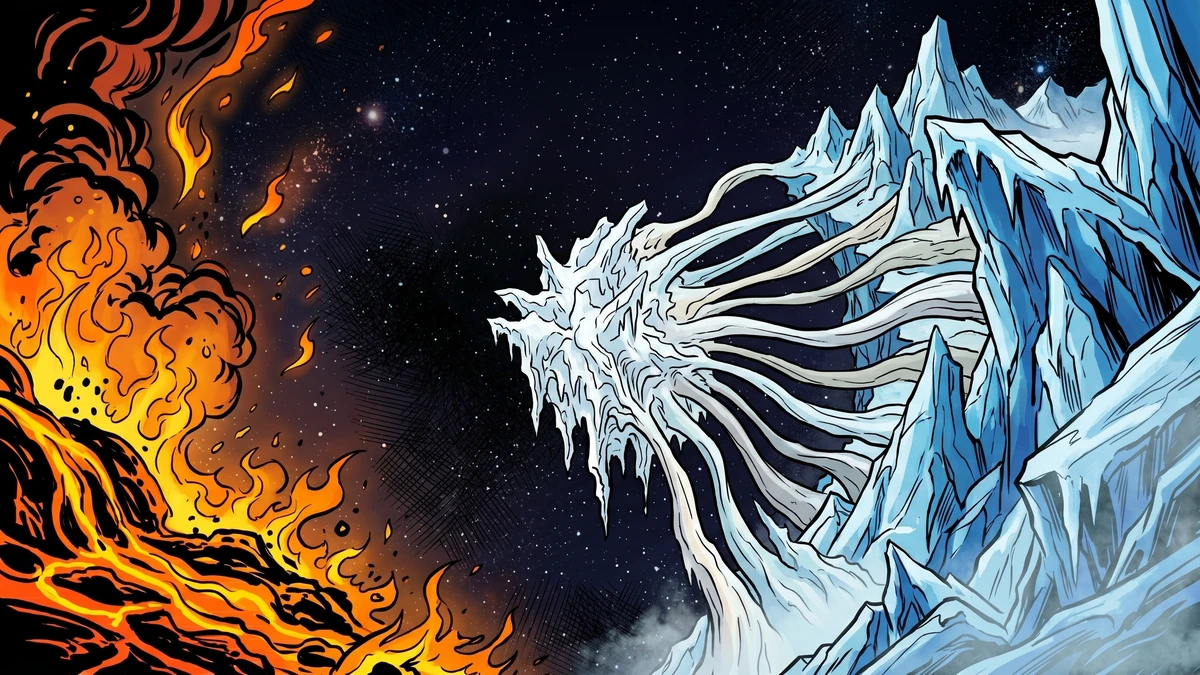
In the beginning there was no beginning that anyone could point to — only Ginnungagap, the “yawning emptiness,” a void so vast that the words for distance lost their meaning inside it. The Norse did not imagine creation rising out of nothing. They imagined it rising out of a meeting. To the south of the gap lay Muspelheim, a country of pure fire, blinding and roaring, so hot that none but those born to it could endure its borders; at its frontier stood Surtr, a fire-giant with a flaming sword, who is promised a part in the world’s ending as well as a presence at its beginning. To the north lay Niflheim, the realm of mist and freezing dark, and from a spring within it, called Hvergelmir, flowed eleven icy rivers known together as the Élivágar. As those rivers poured into the empty gap, far from their source, they thickened, slowed and froze, and layer upon layer of rime built up until the northern reaches of Ginnungagap were choked with ice.
And then the two extremes touched. Sparks and warm air drifting north from Muspelheim met the rime drifting south from Niflheim, and where heat played upon ice, the ice began to thaw and drip. Creation, in the Norse telling, is not a command but a climate: the cosmos begins as weather, as melting, as the quarrel of opposites in a middle ground temperate enough for something to live. That single image — life condensing in the narrow band between unbearable fire and unbearable cold — is the seed from which everything else in the myth grows.
Ymir and the Primeval Cow
From the dripping, quickening rime a shape took form, and it was alive. This was Ymir, the first of all beings, a frost-giant of measureless size, neither good nor evil but simply enormous and ancient, a living weather-system in the form of a body. The Norse also called him Aurgelmir, and from him the whole race of the hrímþursar, the frost-giants, would descend — for as Ymir slept, he sweated, and from the sweat of his left arm grew a man and a woman, while one of his legs fathered a son upon the other. He reproduced without intention, the way ice spreads or mould blooms: a being too primitive to choose, generating life as a by-product of simply existing.
But Ymir had to eat, and the same thaw that made him made his food. Out of the melting rime came a second great creature, the cow Auðumbla, and four rivers of milk ran from her udder, and on that milk the giant was nourished. The cow in turn needed sustenance, and she found it by licking the salty blocks of rime. Here the myth performs one of its quietest and most beautiful turns. As Auðumbla licked the ice, day by day, a shape began to emerge from it, the way a sculptor’s figure emerges from stone. On the first day a man’s hair appeared; on the second, his head; on the third, the whole man stepped free. He was Búri, “the Begetter,” the first of the gods’ line — handsome, powerful, and utterly unlike the brute mass of Ymir. From the very start, then, two kinds of being share the newborn world: the giants, vast and formless and old, and the gods, shapely and deliberate and new. The cosmos has a fault-line running through it before it even has a floor.

The Sons of Borr Rise Against the Giant
Búri had a son named Borr, and Borr married Bestla, a daughter of the giant Bölþorn — so that the gods, from their second generation onward, carry giant blood in their veins, a detail the Norse never tried to hide. Borr and Bestla had three sons, and their names are among the oldest and greatest in the mythology: Odin, Vili and Vé. They were gods of mind and will and craft, and as they looked upon the slumbering immensity of Ymir they saw not a kinsman but an obstacle. While Ymir lived and bred, the world could only ever be giant-stuff: cold, shapeless, multiplying without direction. There could be no Midgard, no halls, no measured fields, no human beings, while the first frost-giant filled the gap with his sprawling, mindless life.
So the three brothers did the terrible, founding deed. They rose against Ymir and they killed him. It is the first death in the cosmos, and it is also the first act of order, and the Norse refused to let those two things be separated. The myth does not call the slaying a sin and it does not call it a triumph; it calls it necessary, and it makes the reader sit with the cost. So much blood gushed from the wounds of the dying giant that it rose like a flood across Ginnungagap and drowned the entire race of frost-giants — every child of Ymir’s sweat and limbs — save two. One giant, Bergelmir, climbed with his wife onto a hollowed vessel, a lúðr, and rode out the deluge of blood, and from that single surviving couple the later giants are descended. Creation and near-extinction happen in the same instant. The world the gods are about to build is founded on a killing and salted with the grief of an almost-vanished people.
The World Built From a Body
Now came the work that gives the myth its name. Odin, Vili and Vé took the body of Ymir, dragged it into the centre of Ginnungagap, and out of it, piece by piece, they constructed the ordered cosmos. Nothing was created from nothing; everything was made from him. His flesh became the earth, the soil and the level ground. His blood — all that did not run off in the great flood — became the sea and the lakes and the encircling ocean. His bones were set up as the mountains, and his teeth and the splinters of his shattered bones became the rocks and scree and gravel. His hair was planted as the trees and the forests. And his vast skull the brothers raised over everything as the dome of the sky, fixing it at four points and setting a dwarf — Norðri, Suðri, Austri and Vestri, North, South, East and West — to hold up each corner.
They were not finished. They took his brain and flung it upward, and it became the clouds, heavy and brooding. They caught sparks and embers blown from Muspelheim and set them in the dome of the skull as the sun, the moon and the stars, giving each its appointed road across the heavens so that time itself could be measured. And from Ymir’s eyebrows — or, in some tellings, his eyelashes — they built a wall, a fortified enclosure in the middle of the world, and named it Midgard, the “middle enclosure,” a guarded homeland fit for the human beings who would soon be made. The maggots that had bred in the giant’s dead flesh were given wit and shape and became the dwarves, the underground smiths. Every region of the Norse universe, in the end, is one organ of one body. To stand on a mountain is to stand on a bone; to sail the sea is to sail on blood; to shelter under the sky is to shelter beneath a skull.

A Universe That Remembers It Was Once Alive
It would be hard to invent a creation story less sentimental than this one, and that is precisely its power. The Norse cosmos is not a gift and it is not a garden. It is a recycled thing, assembled by hard-handed craftsmen out of salvaged material, and it never forgets where its material came from. The myth insists on a single, unsettling continuity: the matter of the world is not separate from the matter of its creatures. The same substance is giant, then corpse, then earth, and one day — at Ragnarök — much of it will burn and sink and rise again. Nothing in this universe is wasted, and nothing in it is entirely safe.
The story also quietly explains why the Norse world is the way it is. Why are gods and giants forever at war? Because the gods built their home on a giant’s body, drowned a whole giant race to do it, and let two survivors live to carry the grievance forward. The enmity is not random malice; it is the unpaid debt of creation. Why is the world beautiful and ordered and yet shot through with menace? Because order here is not the opposite of violence but the product of it. The Norse looked at their hard northern land — its black mountains, its grinding ice, its brief fierce summers — and told a story in which all of that was the literal, physical remnant of a primordial act, neither clean nor cruel, simply the price of there being a world at all.
How the Myth Lived in Everyday Norse Speech
One sign that a myth was truly believed, rather than merely told, is that it leaks into ordinary language — and the creation from Ymir did exactly that. The skalds, the professional poets of the Viking Age, prized a kind of riddling metaphor called the kenning, and the body-cosmos gave them an inexhaustible supply. The sea could be named “Ymir’s blood,” the earth “Ymir’s flesh,” the sky “Ymir’s skull” or “the giant’s helm,” and rocks “the giant’s bones.” A listener who did not know the creation myth simply could not follow the poem; the cosmogony was not stored in a temple but carried in the heads of everyone who valued verse. To speak well, in Norse society, was to keep the death of Ymir in mind.
This is why the myth feels so concrete compared with gentler creation stories. The Norse did not relate to it as distant theology. They walked on it. A farmer breaking frozen ground, a sailor reading a grey swell, a traveller sheltering under a cliff — each was moving across a part of the first giant, and the language they had inherited would not let them forget it. The story endured for centuries before Snorri ever wrote it down precisely because it was woven into the practical business of describing the world. You could not point at the horizon without, in a sense, pointing at Ymir.
The Moral of the Tale
The creation from Ymir’s body is not a fable with a tidy lesson pinned to its end, but it carries a moral as bracing as the climate that begins it. It says that order is something made, not something given — that a habitable world has to be carved, with effort and with cost, out of a chaos that would otherwise simply sprawl. It says that creation and destruction are not enemies but partners: the same hands that struck Ymir down raised his skull as the sky. And it says, with the bleak honesty the Norse loved, that everything is built from something, that nothing arrives free of a history, and that to live gratefully in a finished world is to remember the unfinished and violent matter it was shaped from.
The seeress of the Völuspá reaches back to this very beginning when she remembers the time before the world, and the cold grandeur of her words has never been bettered:
Ár var alda, þar er Ymir bygði,
vara sandr né sær né svalar unnir;
jörð fannsk æva né upphiminn,
gap var ginnunga, en gras hvergi.“It was early in ages, when Ymir made his dwelling: there was neither sand nor sea nor cool waves; earth was nowhere found, nor the sky above — there was the yawning of Ginnungagap, and grass nowhere.”
To hear those lines is to stand, for a moment, in the emptiness before the body was broken and the world was built — and to understand that everything we call solid was once a question the gods had to answer with their own hands.

Why the Story Has Lasted
The myth of Ymir has outlived the religion that produced it because it speaks to something older and more durable than any creed: the suspicion that the world was not made for us, and was not made gently. Long after the last sacrifice to Odin, the image survives — a universe quarried from a body, a sky that is a skull, a sea that is blood — because it gives shape to a feeling every honest person knows, that we live among the leftovers of something vast and that our comfortable order is thinner and more recent than it looks.
It has lasted, too, because it is strangely modern. The Norse said that nothing is created and nothing is destroyed, only transformed — that matter passes from giant to god’s handiwork to earth and will pass on again. Poets, scientists and storytellers have been drawn back to that idea for a thousand years, because it is both terrifying and consoling: terrifying, because it means nothing is permanent; consoling, because it means nothing is ever truly lost. Ymir is dead, and Ymir is also the ground, the hills, the rain-heavy clouds and the stars. The first being did not vanish. He became the world — and that, the Norse believed, is the most that any of us can finally hope to do.
You May Also Like
 Norse Folk Tales
Ages 9-12
Norse Folk Tales
Ages 9-12
The Three Princesses Of Whiteland
The Three Princesses Of Whiteland: Once on a time there was a fisherman who lived close by a palace, and fished for the _King’s_ table. One day when he was out
 Norse Folk Tales
Ages 9-12
Norse Folk Tales
Ages 9-12
East Of The Sun And West Of The Moon
East Of The Sun And West Of The Moon: Once on a time there was a poor husbandman who had so many children that he hadn’t much of either food or clothing to
 Norse Folk Tales
All Ages
Norse Folk Tales
All Ages
Freya’s Necklace: The Brisingamen
Freya's Necklace: The Brisingamen: In the golden halls of Asgard, where gods walked and the fates of worlds were woven, there existed a beauty so transcendent