Freya’s Necklace: The Brisingamen
Freya's Necklace: The Brisingamen: In the golden halls of Asgard, where gods walked and the fates of worlds were woven, there existed a beauty so transcendent
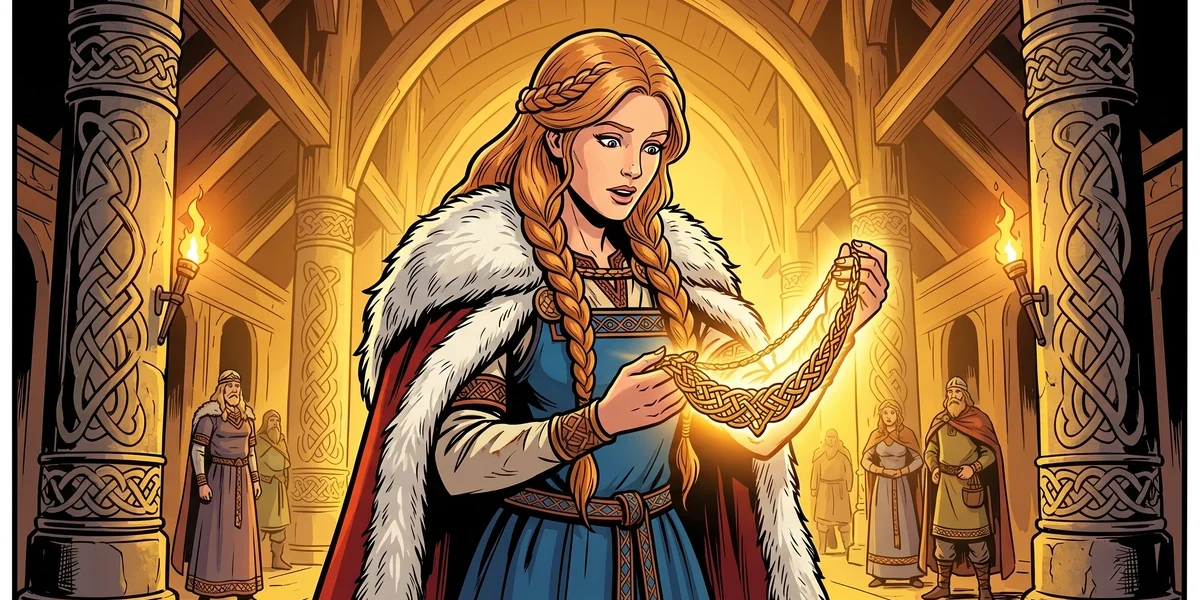
There is a moment in Norse myth when the goddess of love walks underground. Freyja — mistress of the Vanir, keeper of the slain, the deity to whom half of all who fall in battle belong — leaves the bright meadows of Asgard and follows a thread of light into a hollow in the rock. What waits for her there is the most beautiful object ever forged, and the price the dwarf-smiths set upon it will follow her, and the Aesir, all the way to the edge of the world. This is the story of the Brísingamen, the necklace of the Brísings, and of how a thing of pure beauty became the seed of an everlasting war.
A Necklace Recorded in Ink and Memory
The Brísingamen is one of the oldest named treasures in the Germanic imagination, and it survives in fragments scattered across five centuries of texts. The single most complete narrative — the account of how Freyja actually obtained the necklace — appears in Sörla þáttr (“The Tale of Sörli”), a short prose þáttr embedded in the expanded saga of King Óláfr Tryggvason. That saga is preserved in Flateyjarbók (GKS 1005 fol.), the great Icelandic codex copied between roughly 1387 and 1394 by two priests, Jón Þórðarson and Magnús Þórhallsson. Sörla þáttr is therefore a late, Christian-era retelling, and it frames the old myth with unmistakable irony — yet its plot preserves a genuinely archaic story.
The necklace itself, however, is far older than that manuscript. The skald Úlfr Uggason described Heimdallr and Loki contending for the “Brísings’ ornament” in his Húsdrápa, composed around 985 CE. Snorri Sturluson, writing his Prose Edda about 1220, twice invokes the treasure: in Skáldskaparmál he lists “owner of the Brísingamen” among the kennings proper to Freyja, and he alludes to the seal-shaped duel of Loki and Heimdallr over the necklace at the rock called Singasteinn. In the Eddic poem Þrymskviða, when Thor is disguised as a bride, the famous Brísingamen is fastened at his throat — proof that an audience needed no explanation of what the object was. And in the Old English epic Beowulf (lines 1197–1201) the poet compares a Geatish treasure to the “Brosinga mene,” the necklace of the Brosings, showing that the legend was shared across the whole North Sea world. There is no single ATU folktale number for this material; it belongs instead to the family of divine theft and contested treasure myths, kin to motifs catalogued under the theft of precious objects from supernatural smiths.
The Goddess and the Smiths of the Stone
To understand why the Brísingamen matters, it helps to know who stands at each end of the bargain. Freyja is not a minor figure of the Norse pantheon. She is the foremost goddess of the Vanir, the older family of fertility deities who were joined to the Aesir after the first war between the two divine kindreds. Snorri tells us she rules the field of Fólkvangr and chooses half of the battle-slain for her own hall, while Odin receives the rest in Valhöll — a startling detail that places the goddess of love on exactly the same footing as the All-Father where the dead are concerned. She owns the falcon-feather cloak that lets its wearer fly; she taught the Aesir the magic called seiðr; and she weeps tears of red gold for her wandering husband Óðr. A goddess of that stature is not easily astonished, which is precisely why the necklace’s power over her is worth the telling.
At the other end stand the dwarfs. In Norse cosmology the dwarfs are the master-smiths of creation, the makers of nearly every great treasure the gods possess: Thor’s hammer Mjöllnir, Odin’s spear Gungnir, Sif’s golden hair, the ship Skidbladnir, the boar Gullinbursti, and the ring Draupnir all come from their forges. They are not the comic figures of later folklore but ancient, autonomous powers who live within the rock and answer to no god. When Dvalinn, Alfrik, Berlingr, and Grerr set their price, they are not haggling like merchants; they are exercising the leverage of the only craftsmen in the cosmos who can make a thing the gods themselves cannot. The necklace is the proof of that monopoly, and the bargain is its interest rate.
Beat One: The Light Beneath the Stone
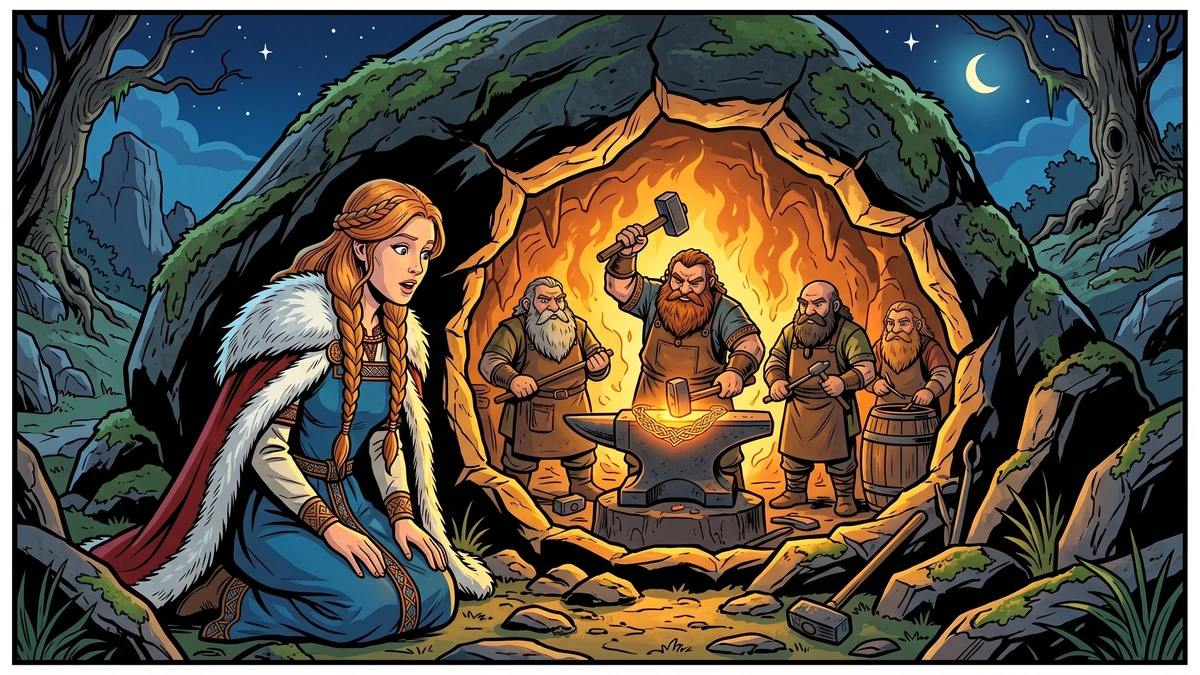
The tale opens with a wandering. In Sörla þáttr, Freyja keeps a bower of her own, set a little apart, and it is on one of her solitary walks near the open rocks that she sees the glow. Four dwarfs — named Dvalinn, Alfrik, Berlingr, and Grerr — are at their forge inside the stone, and on the anvil between them lies a finished thing: a collar, a torc, a necklace of worked gold so bright that it seems to hold a small captured sunrise. The Norse word used of such craftsmanship is smíð, and these smiths are reckoned the finest of their kind.
Freyja stops. The goddess of love is not a stranger to beautiful things; she rides in a chariot drawn by cats, she weeps tears of red gold for her absent husband Óðr, and her own hall Sessrúmnir is famous. Yet the necklace silences her. She asks to buy it. She offers silver and gold; she offers, the tale says, a great price. The dwarfs — and this is the hinge of the whole myth — refuse every coin. They have all the gold they could ever want; they are its makers. What they name as the price is something a buyer cannot simply hand across an anvil. Each of the four will surrender his share of the necklace only if Freyja spends one night with him.
Beat Two: The Bargain in the Dwarf-Halls
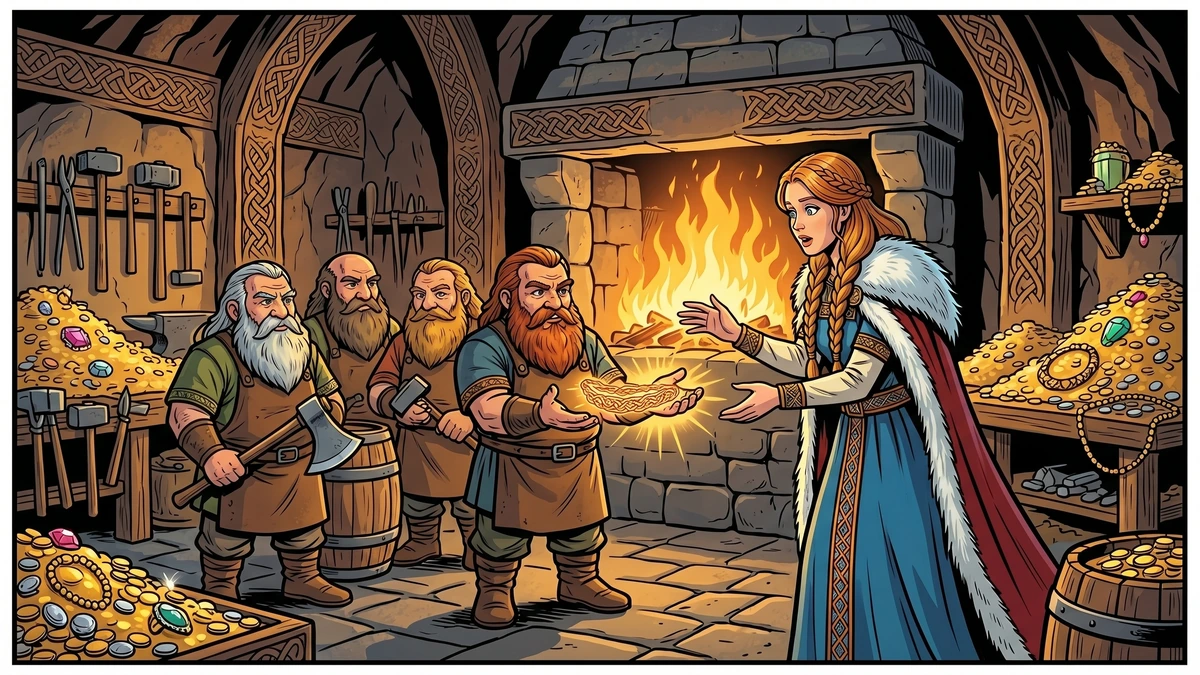
Here the medieval Christian narrator of Sörla þáttr sharpens his pen, for the episode let him cast the old goddess as a figure of shame. But strip away the moralising frame and an older logic remains, one that runs through many myths of the North: the truly priceless object can never be bought, only paid for in something of the self. The dwarfs do not want Freyja’s wealth. They want a portion of her, and the necklace will cost exactly four nights of her own choosing.
Freyja agrees. The saga states it plainly and moves on; it is the modern reader, not the myth, who lingers. She remains four nights beneath the stone, and at the end of them the smiths keep their word. The Brísingamen is clasped about her neck, and she carries it up into the light of Asgard. It becomes, from that hour, her defining ornament — so identified with her that poets need only say “the necklace’s lady” and every listener knows the goddess meant. The treasure and the deity have become a single image. What no one in the dwarf-halls has noticed is that the bargain was witnessed.
Beat Three: The Fly at the Window
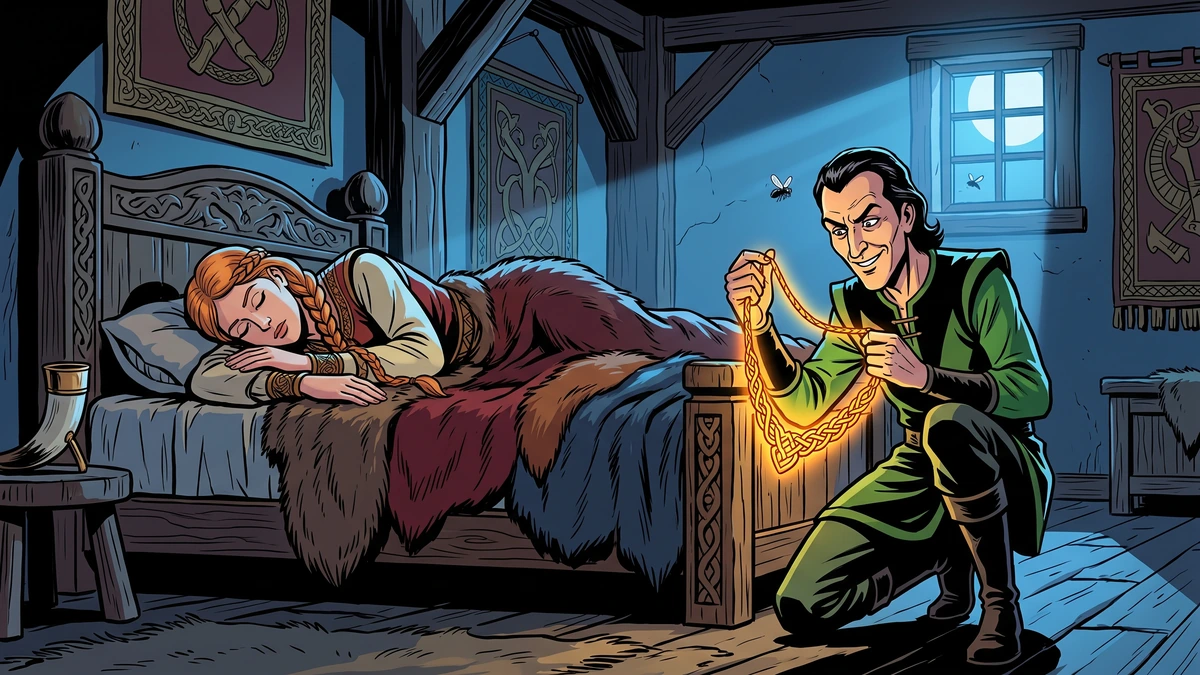
Loki sees everything. In Sörla þáttr it is Loki who carries word of the necklace and how it was won to Odin, and Odin — here called by the saga’s grim Christian framing a king of sorcery — gives a hard command: bring me the Brísingamen. Loki protests that Freyja’s bower is locked and that no one may enter against her will. Odin is unmoved. Fail, he says, and do not return.
So Loki does what Loki does best. He changes his shape. He shrinks himself small and slips through a gap no larger than a needle could make, becoming — in the saga’s telling — a fly that crawls the dark of the sleeping chamber until it finds the goddess at rest. The necklace is clasped beneath her, the catch turned against the pillow where no fingers could reach it. Loki becomes smaller still, a biting insect, and stings her cheek so that she stirs and turns in her sleep. The clasp comes free. He takes the Brísingamen, slips back through the gap, and carries the most beautiful object in the nine worlds to Odin’s hand. When Freyja wakes, her door is still shut, her bower still sealed — and her necklace is gone. She knows at once who in all the worlds could have done such a thing, and she goes to Odin.
Beat Four: Odin’s Price and the Everlasting Battle
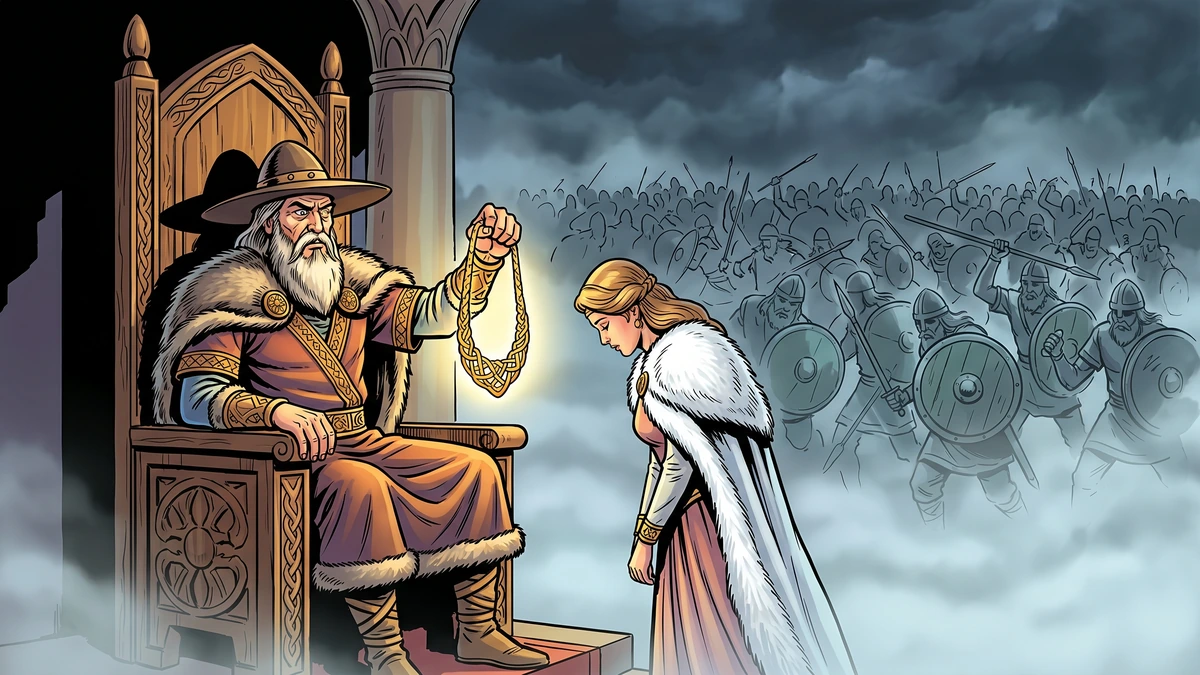
Odin will return the Brísingamen, but, exactly like the dwarfs, he names a price that is not made of gold. Freyja must set two kings at war against one another — each of them served by twenty lesser kings — and she must lay so strong an enchantment upon the quarrel that every warrior who falls in it will rise again at nightfall to fight once more at dawn. The battle must renew itself, dead men lifting dead swords, until the end of the world.
Freyja consents, and the curse takes flesh in the legend of the Hjaðningavíg, the “battle of the Hjaðnings.” The kings Heiðinn and Högni are bound to it; Högni’s daughter Hildr walks the corpse-field each night and wakes the slain, and the slaughter resets with every sunrise. In the older heathen tradition the spell was to endure until Ragnarök itself. The Christian author of Sörla þáttr gives it one mercy: the everlasting war is finally broken not by a god but by a mortal, one of King Óláfr Tryggvason’s men, when the new faith arrives in the North. The old curse ends; the old gods recede. But the shape of the lesson is plain in either telling. A single ornament, desired past all reason, has purchased a war without an ending.
The Moral: The Costliest Ornament
The Brísingamen is the most beautiful thing the myth can imagine, and the myth spends its whole length showing what beauty of that order actually costs. Nothing in the story is bought with money. The dwarfs will not take gold; Odin will not take gold; every transaction is paid in something living — nights, trust, and at last the lives of an entire army, renewed and spent and renewed again. The necklace passes from hand to hand and leaves a wound at every clasp.
It is no accident that the wisdom poetry of the same Eddic tradition keeps returning to the difference between possessions and what truly endures. The Hávamál, the “Sayings of the High One” in the Poetic Edda, puts it in words an Icelandic listener would have known by heart:
Deyr fé,
deyja frændr,
deyr sjálfr it sama;
en orðstírr
deyr aldregi
hveim er sér góðan getr.“Cattle die, kinsmen die, the self must also die; but the fair fame of one who has earned it never dies.” — Hávamál, stanza 76
The Brísingamen is the perfect counter-example to that stanza, and that is precisely why the myth keeps it at its centre. It is treasure — fé — raised to its highest possible power, and like all treasure it cannot be carried past the grave. What it can do is outlive its owners as a curse. The goddess gains the necklace and loses her peace; the gods gain the necklace and bind themselves to a war; the warriors gain nothing at all and die every single day. Desire, the tale says, is not free even when the desired thing is flawless. Especially then.
Loki, Heimdallr, and the Necklace Regained
The Brísingamen leaves a second, fainter trail through the sources, one that Sörla þáttr does not tell. Snorri Sturluson, in Skáldskaparmál, records that Loki once stole the necklace and that Heimdallr — the watchman of the gods, who guards the rainbow bridge Bifröst — pursued him to a sea-rock called Singasteinn. There the two changed shape into seals and fought in the surf, and Heimdallr won back the treasure. The skald Úlfr Uggason had already carved the same scene into verse in his Húsdrápa two and a half centuries earlier, describing the necklace by the kenning “the lovely sea-kidney” and naming Heimdallr its recoverer. Because of that episode, “seeker of Freyja’s necklace” became one of Heimdallr’s standard poetic titles.
The two traditions do not contradict each other so much as confirm a single truth: the Brísingamen is never quietly at rest. It is stolen, hunted, fought over in human shape and in animal shape, demanded as ransom, and bound to a war. Every text that touches the necklace touches it in motion. A treasure that beautiful, the myth keeps insisting, generates its own turbulence; possession of it is not a state but a struggle, and the struggle does not end because the object does not let it end.
Why the Tale Has Lasted
Few Norse stories have travelled as far or as quietly as this one. The necklace surfaces in a tenth-century skaldic poem, in Snorri’s thirteenth-century handbook for poets, in the Eddic Þrymskviða, in a fourteenth-century Icelandic codex, and — under the worn spelling “Brosinga mene” — in an Old English epic written in a different country and a different language. A treasure that can be recognised across all of that distance has become something more than a prop. It has become a symbol the whole Germanic world agreed upon: the object so beautiful that wanting it is dangerous.
Modern readers meet the Brísingamen again and again without always knowing its name — in the cursed rings and irresistible jewels of later fantasy, in every story where a perfect, glittering thing draws good people into ruin. The myth endures because it refuses the comfortable lie that beauty is harmless. It looks straight at the most desirable object imaginable and asks the only question that matters: what did it cost, and who is still paying? In Freyja’s necklace the answer is carved in gold and renewed every dawn on a battlefield that never empties. That is why, a thousand years on, the Brísingamen still gleams — and still warns.
Frequently Asked Questions
What is the Brisingamen?
The Brisingamen (Old Norse Brisinga men, ‘the necklace of the Brisings’) is the famous golden necklace or torc belonging to Freyja, the Norse goddess of love. It is one of the oldest named treasures in Germanic legend and became so closely tied to the goddess that poets could refer to her simply as its owner.
Where does the story of how Freyja won the necklace come from?
The fullest narrative survives in Sorla thattr, a short prose tale embedded in the expanded saga of King Olaf Tryggvason and preserved in the Icelandic codex Flateyjarbok, copied between about 1387 and 1394. The necklace itself is far older, appearing in Ulfr Uggason’s Husdrapa (c. 985), Snorri Sturluson’s Prose Edda (c. 1220), the Eddic poem Thrymskvida, and even the Old English epic Beowulf as the ‘Brosinga mene’.
Who made the Brisingamen and what did Freyja pay for it?
Four dwarf master-smiths — named Dvalinn, Alfrik, Berlingr and Grerr — forged the necklace. In Sorla thattr they refuse Freyja’s offers of gold and silver entirely; the price they set is that she spend one night with each of the four. The myth’s point is that a truly priceless object cannot be bought with wealth, only paid for in something of the self.
How and why did Loki steal the necklace?
Loki saw how Freyja had won the necklace and reported it to Odin, who ordered him to bring it. Loki shrank himself, slipped as a fly through a needle-thin gap into Freyja’s locked bower, stung her so she shifted in her sleep, and unclasped the Brisingamen. Snorri preserves a second tradition in which Heimdallr later fights Loki in the shape of a seal at the rock Singasteinn to win the treasure back.
What is the everlasting battle linked to the Brisingamen?
Odin agreed to return the necklace only if Freyja set two kings at war and laid an enchantment so strong that every warrior slain would rise again at dawn to fight once more. This is the Hjadningavig, the everlasting battle of the Hjadnings, bound to the kings Hedinn and Hogni; in the heathen tradition it was to last until Ragnarok. The detail makes the necklace’s true cost a war without an ending.
You May Also Like
 Norse Folk Tales
Ages 3-5
Norse Folk Tales
Ages 3-5
The Three Billy-Goats Gruff
Norwegian *De tre bukkene Bruse* — three goats, one bridge, one greedy troll — ages 3–5 / 6–8. Asbjørnsen & Moe.
 Norse Folk Tales
Ages 9-12
Norse Folk Tales
Ages 9-12
Odin’s Quest for Wisdom
Odin's Quest for Wisdom: From the moment of his birth, Odin All-Father burned with a need that nothing could satisfy. While other gods delighted in feasts and
 Norse Folk Tales
Ages 9-12
Norse Folk Tales
Ages 9-12
The Creation of the World from Ymir’s Body
The Creation of the World from Ymir's Body: In the beginning, before the world was formed and before time itself had meaning, there existed only Muspelheim and