The Cat On The Dovrefell
A traveller's 'white cat' is really a great white bear — and on Christmas Eve he teaches a band of trolls a lesson they never forget.
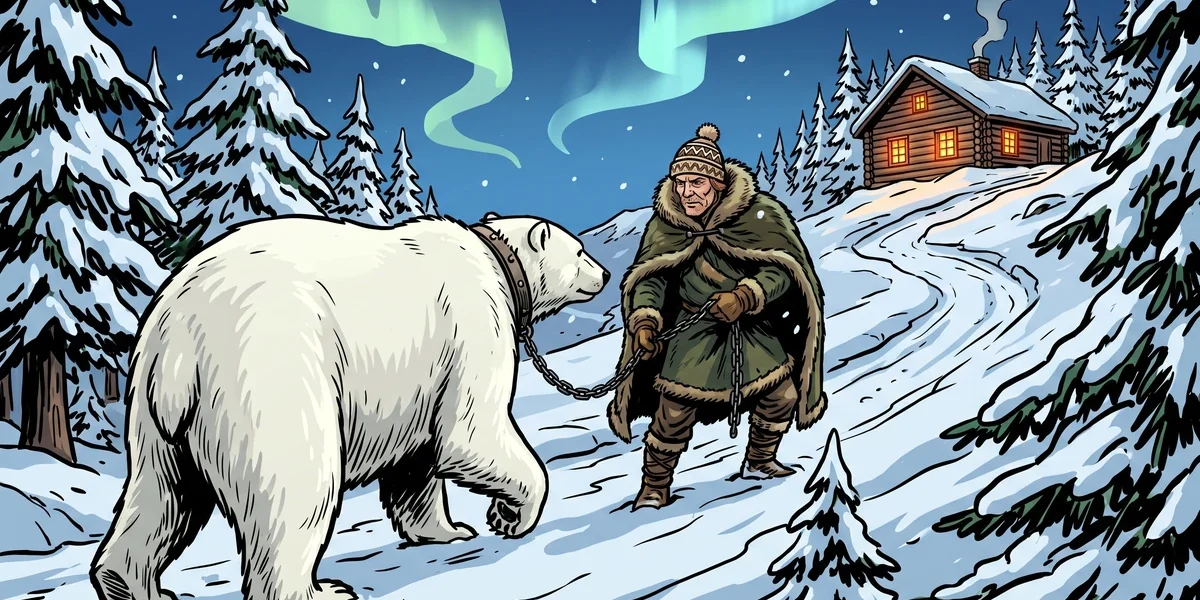
Of all the tales the old people of Norway told around the wood stove on the long blue nights of December, few are loved as warmly as the little Christmas story of a farmer, a band of trolls, and a great white bear that everyone took for a cat. It is short, it is funny, and it ends with the kind of laughter that lingers — but underneath the laughter it carries the steady wisdom of a people who lived close to the dark and learned how to face it.
“The Cat on the Dovrefell” is not a tale of heroes with swords. Its weapons are an open door, a calm word, and a quick, clever answer given at exactly the right moment. The farmer Halvor does not defeat the trolls who plague his house every Christmas; a traveller’s bear does that by accident. What Halvor does — and what the story quietly praises — is to keep his head, welcome a stranger on the worst night of his year, and, a year later, finish the trolls off for good with nothing but a few well-chosen words. The tale asks how an ordinary person stands against something far stronger than himself, and answers, in the plain voice of a Norwegian winter, that courage and wit together can send even a mountain full of monsters running.
Where the Story Comes From
“The Cat on the Dovrefell” is a Norwegian folktale, known in Norwegian as Kjetta paa Dovre — literally “the she-cat on the Dovre.” The Dovre, or Dovrefjell, is a real and famous mountain range in central Norway, a high, cold plateau long regarded as the very backbone of the country; the Norwegian constitutional oath of 1814 swore loyalty “enige og tro til Dovre falder” — united and faithful until the Dovre mountains fall. To set a tale of trolls there was to root it in the most Norwegian ground imaginable.
The story was gathered and set down by Peter Christen Asbjørnsen (1812–1885) and Jørgen Moe (1813–1882), the two friends whose collection Norske Folkeeventyr (“Norwegian Folktales”), published in instalments from 1841 through the 1840s, did for Norway what the brothers Grimm had done a generation earlier for Germany. Asbjørnsen, a naturalist who tramped the country districts, and Moe, a clergyman and poet, took down the tales from rural tellers and wrote them in a fresh, plain Norwegian that helped shape the national written language itself. English readers met the tale through Sir George Webbe Dasent, whose translation Popular Tales from the Norse (Edinburgh, 1859) carried the title we use today, “The Cat on the Dovrefell.”
Folklorists class the story as international tale type ATU 1161, “The Bear Trainer and His Cat” — a comic type in which a trained bear, mistaken for an oversized house cat, routs a household of trolls or evil spirits. In Norway it also lives among the migratory legends, the short, half-believed local stories that travelling tellers carried from valley to valley, attaching them each time to a particular farm and a particular mountain. That double life — a wandering international joke and a treasured local legend of the Dovre — is exactly why the tale feels at once so universal and so deeply rooted. In the twentieth century it travelled again: the American author and illustrator Tomie dePaola retold it as the picture book The Cat on the Dovrefell: A Christmas Tale (1979), and it remains a favourite read-aloud for the Christmas season.
Trolls, the Dovre, and the Norwegian Midwinter
To feel the full force of this tale, it helps to know what a troll meant to the people who first told it. In Norwegian folk belief the troll was not a single fixed creature but a whole family of them — sometimes mountain-sized giants who turned to stone in sunlight, sometimes small, sly, hill-dwelling things, always heathen, always hostile to the ordered, Christian world of the farm. Trolls belonged to the wilderness: the high fjell, the deep forest, the rock and the dark. The farmstead, with its hearth-fire and its livestock and its family, was the human island in the middle of that wildness, and the folktales are forever testing the fragile border between the two.
Midwinter was when that border grew thinnest. The old Norwegians believed that the long, sunless nights around Christmas — the season they called jul, older than Christianity itself — were a time when the unseen world pressed close to the lamplight. Households took precautions: they brewed and baked in abundance, set extra food aside, and put out a bowl of buttered porridge for the farm’s own guardian spirit, the nisse, to keep him content through the dark months. A tale in which trolls come down from the mountain to seize a farmer’s Christmas feast is, in that light, not a random fancy. It dramatises a very real midwinter anxiety — that on the darkest nights the wilderness might come indoors and take what the family had worked all year to gather.
That is what makes Halvor’s yearly surrender so telling before the traveller arrives. He does not fight the trolls because, in the logic of folk belief, you simply could not out-muscle the powers of the mountain. What the story then proposes is quietly radical: the wilderness can be held back, but by nerve and cleverness rather than by strength. The bear — itself a creature of the wild north — is the accident that breaks the siege, but it is the human qualities around it, the traveller’s steadiness and Halvor’s wit, that the tale truly celebrates. And there is a satisfying irony in the trolls’ defeat: a people who fear the unknown are themselves routed by something unknown to them, the strange white “cat” they cannot place. Fear of the unfamiliar, the story hints with a grin, cuts both ways.
The Story
A Stranger at the Door on Christmas Eve
High on the edge of the Dovrefell stood a lonely log farmhouse belonging to a quiet, hard-working farmer named Halvor. By any ordinary measure Halvor was a fortunate man — good fields, a snug house, a loving family — but he carried one heavy trouble. Every single year, on Christmas Eve, a whole pack of trolls came roaring down out of the mountain and took over his home. They shouldered the door open, devoured every dish in the kitchen, drank the house dry, smashed the crockery, and danced on the tables until dawn. There was nothing Halvor could do but bundle his wife and children out into the freezing dark and wait in the cowshed until the monsters had gone.
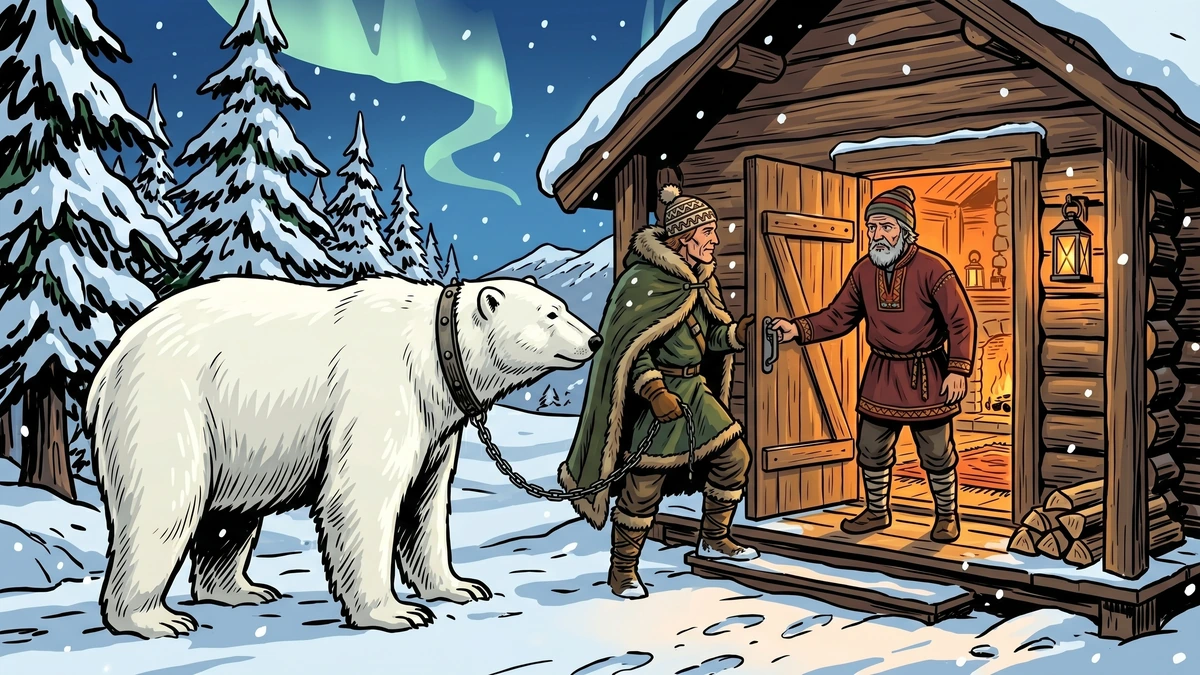
One year, on the short grey afternoon before Christmas Eve, a traveller came up the snowy track. He had walked all the way from the far north, and he was leading, on a stout chain, an enormous tame white bear. The man was carrying the bear south as a gift — a royal Christmas present for the King of Denmark. He knocked at Halvor’s door and asked, very politely, whether he and his animal might shelter under the farmer’s roof for the night.
Halvor’s heart sank. “Friend, you would be welcome on any other night,” he said, “but you have come on the worst night of our year. We cannot even stay here ourselves.” And he told the whole sorry tale of the trolls. The traveller listened, looked down at his great calm bear, and only smiled. “Is that all?” he said. “My bear and I have slept in worse company than trolls. Let us stay. I think we shall give you no trouble — and perhaps we shall do you a little good.” Halvor, who had nothing left to lose, agreed. He laid food out across the table for the trolls, as he did every year, and then took his family off to the safety of the cowshed. The traveller settled his bear down to sleep on the warm hearth, in the cosy space beneath the great iron wood stove, and lay down himself in a corner to wait.
The Trolls Come Down the Mountain
They came at midnight, as they always did. The door banged wide and the trolls of the Dovrefell poured in — a wild, hairy, mismatched crowd of them. Some were tall as young pine trees; some were squat as tree stumps. They had bulging noses and bristly elbows and fingernails like garden rakes; some had only a single eye, and several had long ratty tails. They fell on Halvor’s Christmas table with shrieks of delight, gobbling the porridge and the meat and the cakes, slurping the drink, flinging plates at the walls for the joy of the noise.
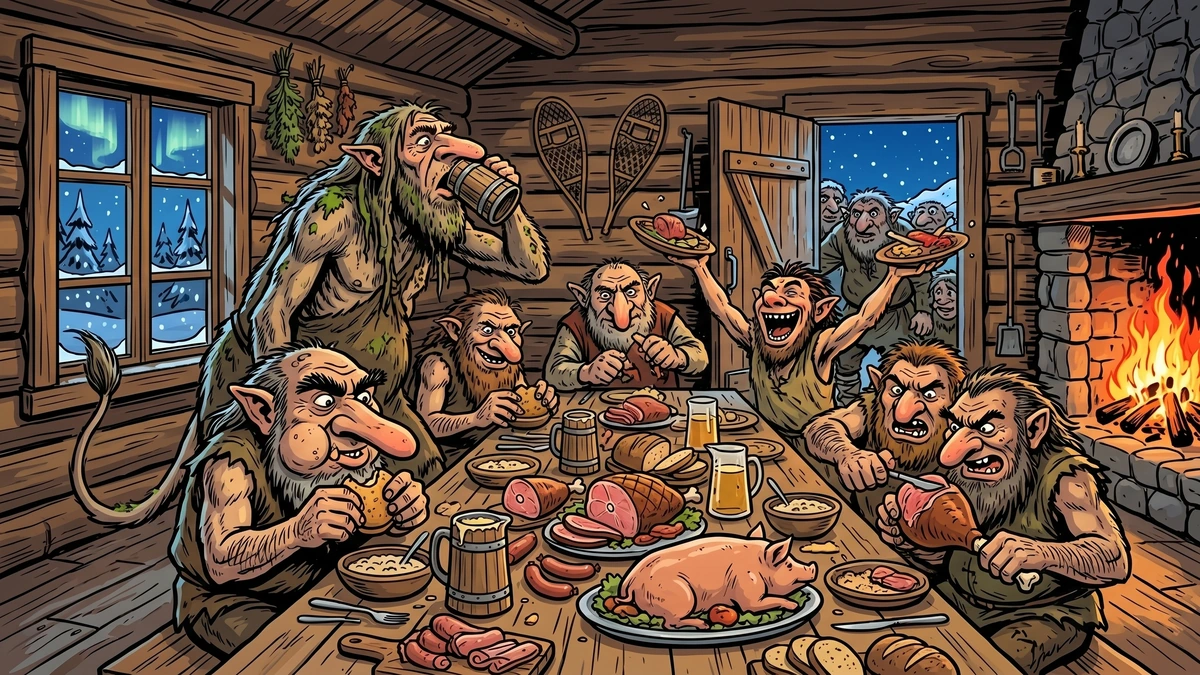
In the middle of the feast, one small troll caught sight of the white bear dozing under the stove. To a troll, who had never seen such a creature, the big white shape looked exactly like a fat, sleepy house cat curled up in the warm. The little troll thought it would be great fun to tease it. He speared a hot, dripping sausage on the end of an iron fork, carried it over, and pushed it right against the bear’s nose. “Pussy,” he jeered, in the sing-song voice trolls keep for tormenting things smaller than themselves, “pussy, will you have some sausage?”
“Pussy, Will You Have Some Sausage?”
The bear woke up.
It opened one eye, then both. It felt the scald of the sausage and smelled the reek of trolls crowding its quiet hearth — and it rose. Up and up it rose, until its white head brushed the rafters, and it let out a roar that shook the snow from the roof and rattled every unbroken plate in the house. Then it came out from under the stove with its claws spread wide.
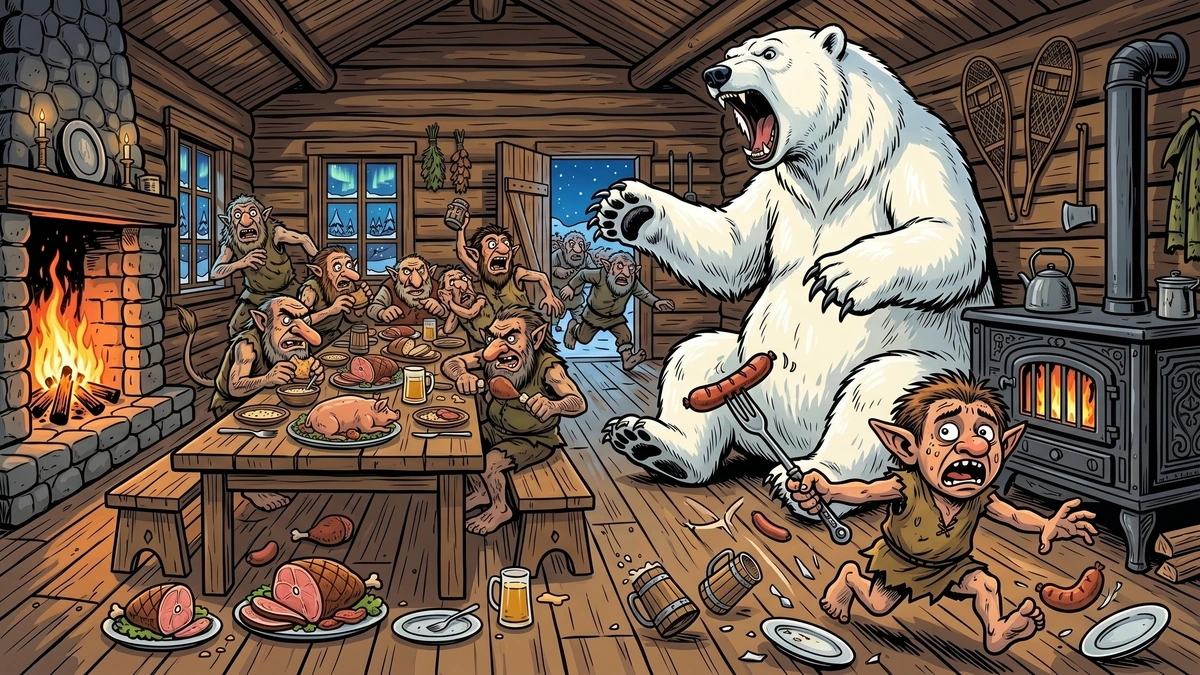
The trolls did not stay to argue. They tumbled over one another in their panic — out the door, off the porch, across the snow, shrieking, scattering sausages and stolen cakes behind them, and away up the dark side of the Dovrefell as fast as their crooked legs would carry them. By the time the echoes died, Halvor’s house stood quiet, the stove still warm, the bear settling back to sleep as though nothing at all had happened. In the morning the traveller thanked his host, took up the chain, and went on his way south with his bear, leaving behind him the first peaceful Christmas the farm had known in living memory.
A Year Later: The Voice on the Mountain
A whole year went by. The next Christmas drew near, and Halvor — out in the forest one cold afternoon, cutting wood for the holiday — heard a voice hailing him from across the valley. It was a troll, calling from the far slope of the Dovrefell, too wary to come any closer.
“Halvor! Halvor!” the troll bellowed. “Have you got that great cat of yours at home still?”
Halvor leaned on his axe. He understood in a heartbeat what the troll meant — and he understood, too, that the whole future peace of his house hung on what he said next. So he answered, loud and cheerful and without a flicker of doubt: “Oh yes, she is at home, lying fast asleep under the stove this very minute. And” — here he let the words ring out across the snow — “she has had seven kittens now, every one of them far bigger and far fiercer than she is herself!”
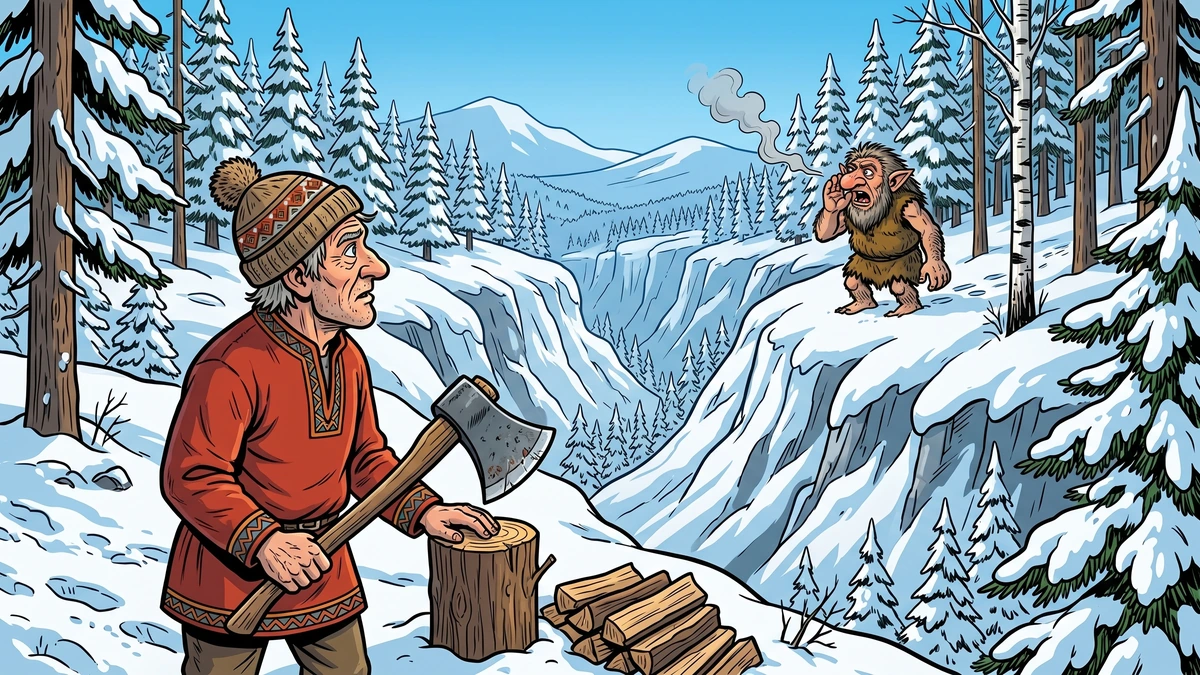
There was a long silence on the mountain. Then the troll called back, in a voice gone suddenly small: “Then we shall never come to Halvor’s place again.” And they never did. From that Christmas onward the trolls of the Dovrefell left the farm in peace, and Halvor and his family kept their holiday by their own warm stove, every year, for the rest of their days.
The Moral of the Story
“The Cat on the Dovrefell” wears its lesson lightly, the way the best old tales do, but the lesson is a sturdy one. The trolls are not beaten by force — Halvor never lifts a hand against them — and they are not beaten by magic. They are beaten first by a calm refusal to panic, and then, a year later, by a clever tongue. The traveller is not afraid to shelter under a haunted roof. Halvor is not afraid to take a stranger in on his unluckiest night. And when the troll’s voice comes across the valley, Halvor does not stammer or run; he answers at once, turning a single accident — one frightened bear — into a permanent victory by letting the troll’s own fear do the rest of the work.
That is the heart of it. The trolls were always more frightened than fierce; their power over the farm lasted exactly as long as no one stood up to it. The story tells children — and the grown-ups listening behind them — that bullies and bogeymen feed on the alarm of their victims, and that a steady nerve and a quick, confident word can turn the whole thing around. The old Norwegian saying catches it exactly:
“Den som ler sist, ler best.”
— He who laughs last, laughs best.
Halvor laughs last. He gives no ground, tells no lie he cannot stand behind — there truly is a “cat” under his stove, after all — and lets the trolls frighten themselves away forever. Courage opened the door to the stranger; wit closed it on the monsters for good.
Why the Story Has Lasted
There is a reason this small tale has outlived the wooden farmhouses it was first told in. It works, first of all, as pure comedy: the gorgeous, ridiculous mistake at its centre — a creature large enough to brush the rafters, taken for a tabby and offered a sausage on a fork — is the kind of joke a four-year-old and a grandparent can laugh at together, and the punchline of the seven enormous kittens is one that listeners see coming and love all the more for it. A tale that can be told in five minutes and lands a laugh every time does not get forgotten.
But it has lasted for warmer reasons too. It is a Christmas story, bound up with the Norwegian midwinter — the candles in the windows, the bowl of porridge set out for the household nisse, the dark mountain pressing close around the lamplight — and it carries the deep folk feeling that the worst night of winter is exactly the night to open your door to a traveller. Halvor’s hospitality is rewarded; the stranger’s courage is rewarded; kindness and nerve, offered freely, come back as a lifetime of peace. And beneath the comedy it leaves children with something they can actually use: the knowledge that the things that loom largest in the dark are often the most easily sent running, and that a calm face and a clever answer are a kind of strength of their own. Generations of Norwegian families have handed the story down by the light of the wood stove, and it still travels — from the high cold plateau of the Dovre to a page like this one — because it tells us, gently and with a grin, that fear is a guest we need not feed, and that the last laugh, given bravely, can keep a whole house safe for good.
You May Also Like
 Norse Folk Tales
Ages 9-12
Norse Folk Tales
Ages 9-12
The Lassie And Her Godmother
The Lassie And Her Godmother: Once on a time a poor couple lived far, far away in a great wood. The wife was brought to bed, and had a pretty girl, but they
 Norse Folk Tales
Ages 9-12
Norse Folk Tales
Ages 9-12
The Death of Baldur
The Death of Baldur: In the golden halls of Asgard, there lived a god so beautiful, so pure, so beloved by all beings in the Nine Worlds that his very presence
 Norse Folk Tales
Ages 9-12
Norse Folk Tales
Ages 9-12
Sigurd and the Dragon Fafnir
Sigurd and the Dragon Fafnir: In the northern lands, in a place where mountains rose like the spears of giants and forests spread like dark green cloaks across