The Husband Who Was To Mind The House
The Husband Who Was To Mind The House: Once on a time there was a man, so surly and cross, he never thought his _Wife_ did anything right in the house. Empathy
Among the comic tales the storytellers of Norway carried from farm to farm through the long winters, few have travelled farther or raised more laughter than the small domestic comedy of a husband who was certain he could keep house better than his wife — and who proved, in a single disastrous day, exactly the opposite. It is a tale built for the telling: a chain of small mistakes, each tumbling straight into the next, until the whole household stands on its head, quite literally, in a pot of porridge.
“The Husband Who Was To Mind The House” is not a story of kings or trolls or magic. Its stage is an ordinary turf-roofed farmstead, its cast a married couple and their few animals, and its only enemy the husband’s own stubborn certainty that the work of the home is light, simple, and beneath a strong man’s notice. The tale never lectures. It simply hands the man a churn, a pig, a cow and a porridge pot, steps back, and lets him discover the truth the hard way. By the time his wife cuts him loose, the story has made its point so completely — and so cheerfully — that no child who hears it ever needs it explained.
Where the Story Comes From
“The Husband Who Was To Mind The House” is a Norwegian folktale, known in Norwegian as Mannen som skulle stelle hjemme — “the man who was to keep house at home.” It was gathered and written down by Peter Christen Asbjørnsen (1812–1885) and Jørgen Moe (1813–1882) for their landmark collection Norske Folkeeventyr (“Norwegian Folktales”), the great national gathering of tales they published in instalments from 1841 onward. Asbjørnsen, a naturalist who roamed the rural districts, and Moe, a parson and poet, took the stories down from country tellers in a plain, lively Norwegian that helped shape the modern written language itself — doing for Norway very much what the brothers Grimm had done a generation earlier for Germany.
English-speaking readers met the tale through Sir George Webbe Dasent, whose translation Popular Tales from the Norse (Edinburgh, 1859) introduced the title we still use today. Dasent’s version proved so durable that it was reprinted again and again, and the tale later found a home in the celebrated gift-book East of the Sun and West of the Moon, with its famous illustrations by the Danish artist Kay Nielsen. Asbjørnsen and Moe themselves praised Dasent’s English renderings as the happiest and best their tales had ever received, and this brisk little comedy — all motion and mishap from its first line to its last — is one of the clearest proofs of it.
Folklorists class the story as international tale type ATU 1408, “The Man Who Does His Wife’s Work,” in the Aarne–Thompson–Uther index of folk narratives. It is a type found in many lands. A close cousin appears in the old Scots poem The Wife of Auchtermuchty, set down in the sixteenth century, in which a husband who scorns his wife’s indoor labour insists on swapping places and fares no better than the man of the Norwegian tale. The same comic engine — a man humbled by the very housework he despised — turns up in Sweden, in Germany, in the British Isles and far beyond. That wide scattering tells us something important: the joke answered something real that people recognised wherever it was told.
A Joke as Old as Marriage
To enjoy the tale fully it helps to picture the farm it grew from. On a nineteenth-century Norwegian smallholding the work of the household was not the small, tidy business a careless eye might take it for. The wife’s daily round — churning butter, brewing and tapping the ale, baking, grinding meal, cooking the porridge that fed everyone, and tending the pig and the cow that were the family’s living wealth — was a web of tasks that all had to be carried forward at once, each one watched while the others went on. It demanded planning, timing, and a steady, divided attention that never quite came to rest.
The husband’s outdoor labour was hard, but it was hard in a different shape: a mower in the hayfield bends to one great task and holds to it from morning until night. The whole comedy of the story rests on this difference. The man imagines that minding the house means doing each chore in its turn, simply and slowly, the way he mows a meadow. He has no notion that the real skill lies in holding a dozen half-finished jobs in mind together — and the instant he tries, the churn, the ale, the pig and the cow all fall due at the same moment, and he cannot hold a single one of them.
The tale belongs, too, to a much older and broader family of stories that folklorists call the numskull or noodle tales — comic stories about well-meaning people who reason their way, one confident step at a time, into ridiculous trouble. What lifts “The Husband Who Was To Mind The House” above an ordinary joke is that its numskull is never foolish out of malice, and never even out of laziness. He works hard the whole day long. He fails because he began that day certain that another person’s work was easy — and that single false idea, and not any lack of effort, is what finally pitches him head-first down his own chimney.
The Story
A Bargain Struck at Haymaking Time
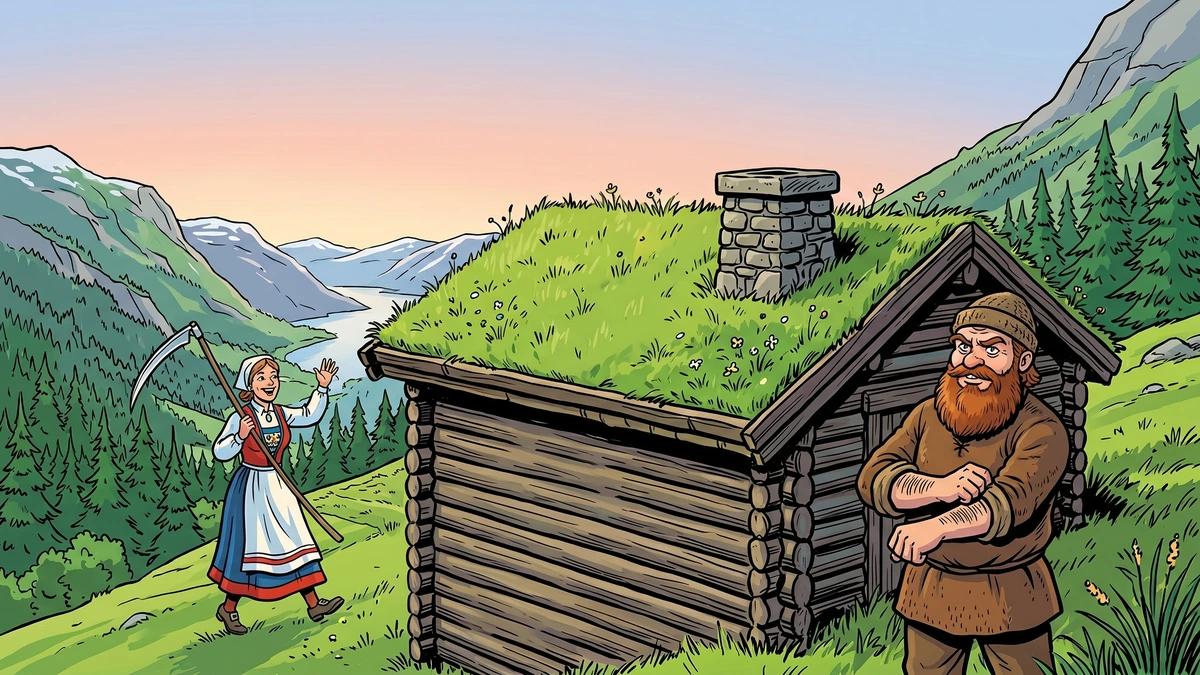
Once upon a time there was a man so surly and so cross that he never thought his wife did anything right about the house. All through the busy haymaking season he came tramping home from the meadow each evening, scolding and grumbling and stamping his boots, certain that the day’s work indoors had been idled away while he sweated under the summer sun.
One such evening his wife had heard quite enough. “Dear love, do not be so angry; there’s a good man,” she said, gently and without temper. “Here is a notion. To-morrow let us change our work. I will take the scythe and go out to the hayfield with the mowers, and you shall stay and mind the house at home.”
The husband thought this an excellent plan indeed. After all his long complaining he was very willing — more than willing — to show her at last how lightly and how handsomely a house ought to be kept. He would have the whole place in fine order, he promised himself, long before she came home tired from the field.
So the next morning, while the dew still lay on the grass, the wife put the scythe over her shoulder and went off to the meadow with the other mowers, and the husband rolled up his sleeves and set about the business of the house.
The Pig, the Churn, and the Vanished Ale
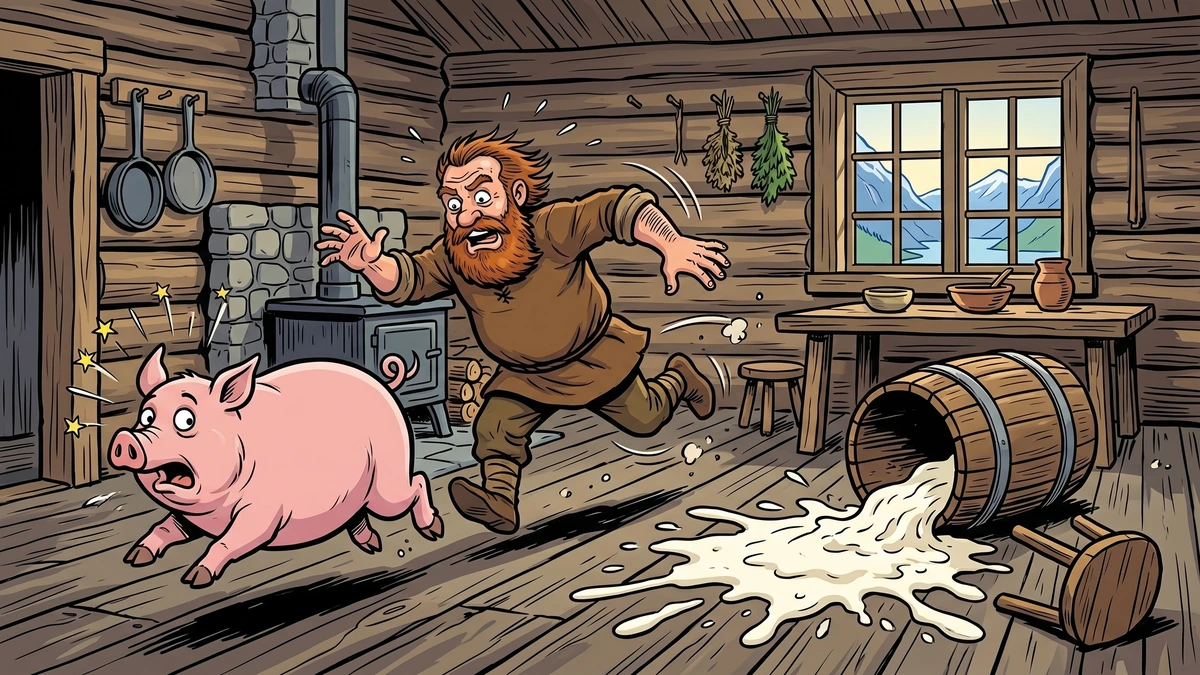
First of all, he decided, he would churn the butter. He fetched the cream and set to work, and the churning went well enough — until, after a while, the labour made him thirsty. So he left the half-churned butter standing and went down into the cellar to tap a barrel of ale. Just as he had knocked in the bung and was fitting the tap to the cask, he heard, in the kitchen overhead, the heavy trotting of the pig come indoors.
Up the cellar steps he bolted, the tap still gripped in his hand, hoping to drive the creature out before it could do any mischief — but he was already too late. The pig had knocked the churn clean over and stood happily routing and grunting in the spreading pool of cream. The man flew into so great a rage that for a moment he forgot everything else in the world. He chased the pig, caught it at the very door, and dealt it so furious a kick that the poor animal lay stunned upon the ground. And then, with the tap still in his fist, he remembered the ale — and remembered, too, that he had left the cask standing wide open. He ran back down to the cellar; but every last drop of the ale had long since run out across the floor.
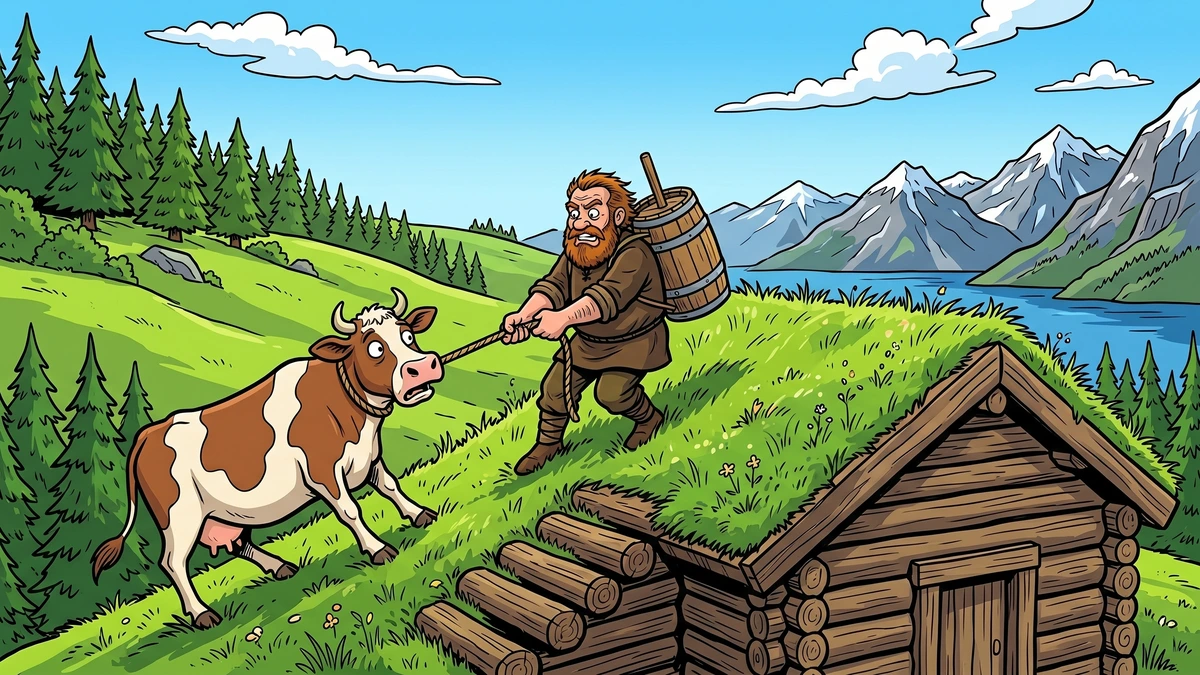
He was not a man to be beaten by a single morning’s bad luck. He gathered what little cream the pig had spared, set the churn upright, and began the butter all over again, and at last had it going nicely. And then he remembered the cow. She was still shut in the byre, and in all the morning’s uproar he had given her neither a mouthful of food nor a drop of water, and the sun now stood high. To lead her all the way down to the meadow was too far, and there was no one to mind her there. But the house, he saw, had a fine thick roof of growing turf, deep in good green grass — and the farm was built snug against a steep bank, so that a careful man might walk a cow straight up the slope and out onto the roof. So that, he decided, was where the cow should graze her dinner.
A Cow Upon the Roof
Getting the cow up onto the turf was the easy part of it. Keeping the churning going at the same time was the harder, for he dared not leave the work below where some new mishap might upset it a second time. So he took the churn upon his own back and carried it with him — and in that fashion, with the heavy churn riding on his shoulders, he led the cow up the bank and out onto the grassy roof of his own house.
Now the well stood close beside the wall, and the man thought he had better water the cow before he climbed down and left her grazing up there. But as he bent over to set the churn down off his back, all the cream came pouring out of it — down his neck, over his shoulders, and away down the hill. And so the butter was lost for the second time that day.
Dinner-time was drawing on now, and he had not so much as begun the porridge. He filled the great pot with water and hung it over the fire to come to the boil. Then a new fear struck him: the cow might wander too near the edge of the roof and break her legs, or her neck. To keep her safe he climbed up once more, tied one end of a stout rope firmly round the cow, dropped the other end down the open chimney, and — coming back inside — made it fast about his own waist, so that he and the cow were now bound together by a single rope that ran down the chimney between them. Well pleased that the cow could now come to no harm at all, he set to grinding the oatmeal and stirring the porridge for dinner.
Between Heaven and Earth
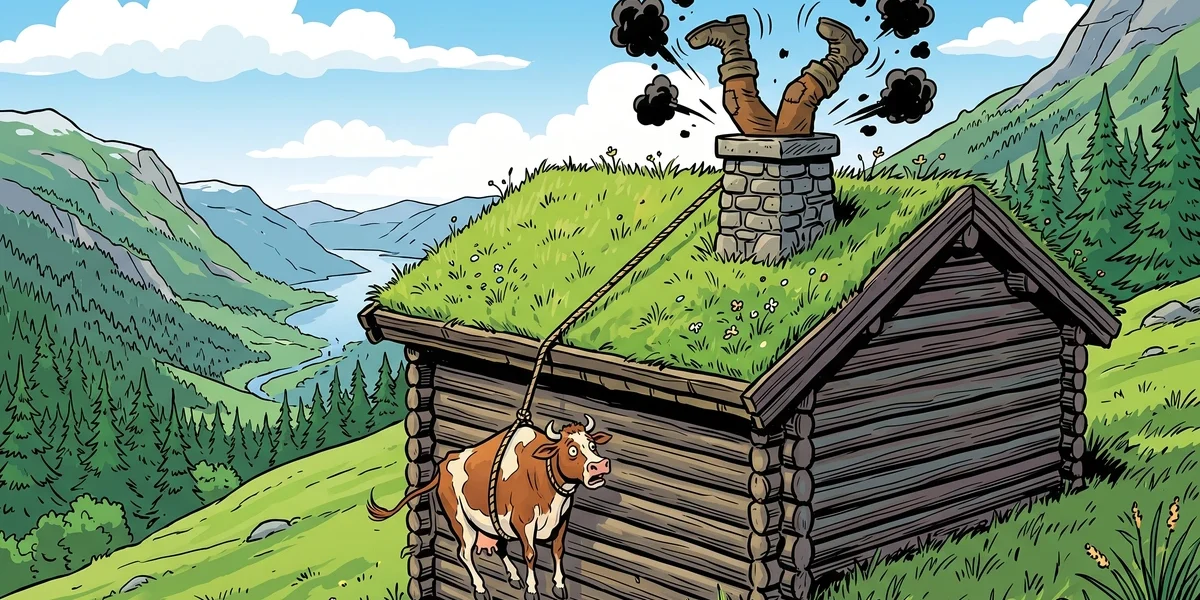
He had not stirred the porridge for very long when it happened. Up on the roof the cow, just exactly as he had feared she might, stepped a hoof too near the edge — and over she went, tumbling down off the eaves. The rope snapped taut. The whole weight of the falling cow snatched the man clean off his feet and hauled him straight up the inside of the chimney, where he stuck fast, wedged and kicking among the soot. And the cow hung down the outside wall, swinging halfway between the roof and the ground, and could go neither up nor down. There the two of them dangled — the cow between heaven and earth on one side of the wall, the husband jammed in the dark of the flue on the other — while down below the porridge pot bubbled and boiled away with no one to mind it.
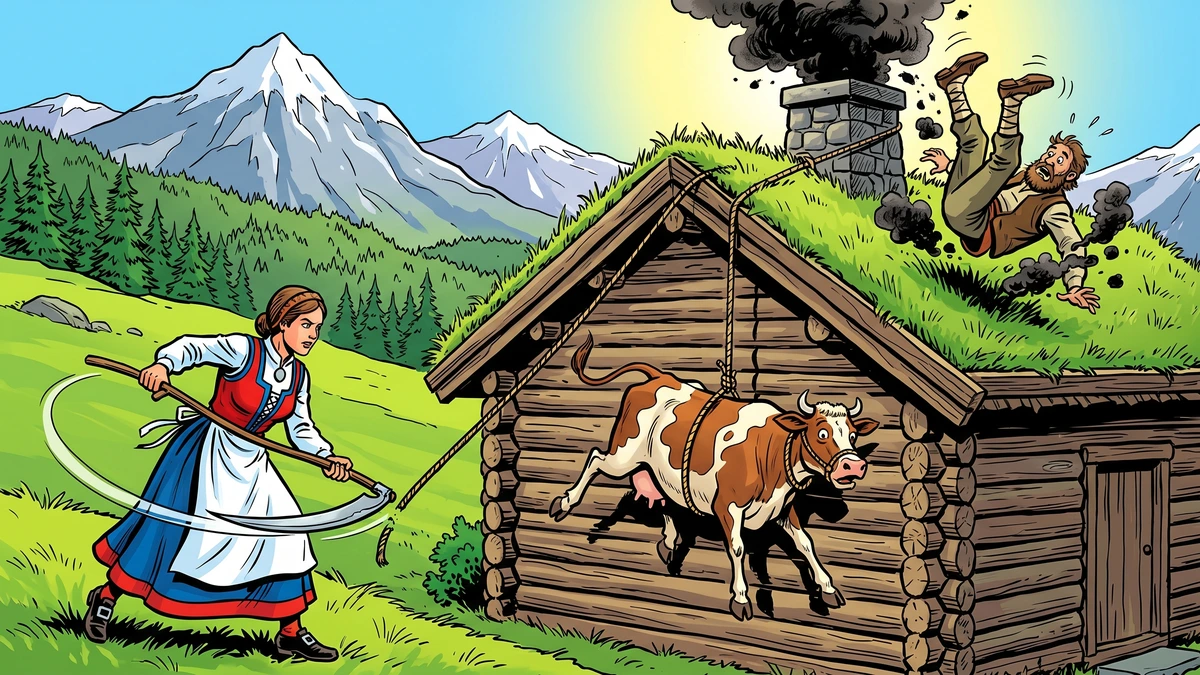
Out in the hayfield the wife had been mowing all the morning, and waiting, and wondering. She had felt sure her husband would call her home to dinner long before this hour; but no call ever came across the meadow. At last she gave up her waiting, shouldered her scythe, and set off home herself. The moment the farmstead came in sight she saw the cow hanging there against the wall in the strangest fashion in the world, and she ran up the last of the slope and cut the rope clean through with a single stroke of her scythe.
But the instant the rope was cut, the weight that had held the husband aloft was gone. Down the chimney he came — soot and all — and when his wife stepped at last through her own door, she found her husband standing on his head in the porridge pot, with his two heels waving in the air.
The Moral of the Story
The tale never once stops to spell out its lesson, and it has no need to, for the lesson is the story. The husband begins his day certain that keeping house is light and simple work, and that his wife’s daily round is hardly worth the honest name of labour. He ends it jammed upside down in the porridge pot, the butter spilled twice over, the ale all run dry, the pig kicked senseless and the cow half-hanged from the eaves — and not because he was idle, for he ran and toiled and sweated the whole morning through, but because he had never once understood the work he so freely scorned.
That is the quiet wisdom tucked under all the laughter. The skill of the household was never in any single chore; it lay in the holding of them all together, in the timing and the watchfulness that the husband simply could not see until he was fairly drowning in it. The story asks us not to weigh the worth of another person’s work until we have first carried it on our own shoulders — and it makes the asking so funny that the point slips in painlessly and stays for life. The old Norwegian saying puts the very same truth in a handful of plain words:
“Det er lettare sagt enn gjort.”
— It is more easily said than done.
The husband had said, loudly and often, how easily a house might be kept. The doing of it stood him on his head. And there is a gentler note still in the way the tale ends: the wife does not scold, does not crow, does not offer so much as a single “I told you so.” She simply cuts the rope and quietly sets the whole household to rights — which is, the story hints with a smile, exactly the calm, unshowy competence that her husband had failed all day long to recognise in her.
Why the Story Has Lasted
Part of the answer is simply that the tale is built like a fine piece of clockwork. Every disaster is the child of the one just before it: the thirst sends him down to the cellar, the cellar leaves the pig free at the churn, the chasing of the pig loses the ale, the loose and hungry cow drives him up onto the roof, and the roof and the rope and the boiling porridge pot all draw tight together into one perfect, inevitable catastrophe. A listener can see each step coming from a mile off and still laugh aloud when it lands — and a tale that can be told in a few minutes and ends every single time on a roar of laughter is a tale that storytellers take care to keep alive.
But it has lasted for warmer reasons than its clever craftsmanship alone. It is one of the kindest comedies in the whole folk tradition: nobody in it is wicked, nobody is truly harmed, and the husband’s only real crime is a very ordinary and very human one — the easy, careless assumption that someone else’s work must surely be lighter than our own. Generations of families have laughed at this man precisely because they have recognised him — and recognised, a little sheepishly, something of themselves. The story was told and retold around Norwegian hearths, gathered up into Asbjørnsen and Moe’s great national collection, carried into English by Dasent, and onward into picture books and schoolrooms all across the world. And it still travels, from a turf-roofed farmhouse on a Norwegian hillside to a page exactly like this one, because under its tumbling soot-and-porridge comedy it carries a truth that never grows stale: respect the work you have not yourself done, for it is very often a great deal heavier than it looks — and far, far more easily said than done.
You May Also Like
 Norse Folk Tales
Ages 9-12
Norse Folk Tales
Ages 9-12
Ragnarok: The Twilight of the Gods
Ragnarok: The Twilight of the Gods: The seer stood before Odin in the great hall Asgard, and she spoke of a future that all the gods wished not to hear, yet
 Norse Folk Tales
All Ages
Norse Folk Tales
All Ages
Freya’s Necklace: The Brisingamen
Freya's Necklace: The Brisingamen: In the golden halls of Asgard, where gods walked and the fates of worlds were woven, there existed a beauty so transcendent
 Norse Folk Tales
Ages 9-12
Norse Folk Tales
Ages 9-12
The Blue Belt
The Blue Belt: Once on a time there was an old beggar-woman, who had gone out to beg. She had a little lad with her, and when she had got her bag full she