The Monkey With The Tom Tom
The Monkey With The Tom Tom: In a remote wood there lived a monkey, and one day while he was eating wood-apples, a sharp thorn from the tree ran into the tip
This story is one of the twenty-six Tamil-Telugu fables that Mrs Howard Kingscote (Lady Georgiana Wolff Kingscote, 1858–1916) and the Madras-born scholar Pandit Sangendi Mahalinga Natesa Sastri (1859–1906) collected from village storytellers across the Madras Presidency in the late 1880s and published as Tales of the Sun, or Folklore of Southern India through W. H. Allen & Co. of London in 1890. Natesa Sastri — a polyglot of eighteen languages, an officer of the Archaeological Survey of India under Robert Sewell, and the foremost Tamil folklorist of his generation — supplied the original narrators’ words; Kingscote, the wife of the British army officer Howard Kingscote and an accomplished London woman of letters, polished them for the English drawing-room and the Anglo-Indian children’s shelf. The underlying tale belongs to the great pan-Eurasian cycle of cumulative trickster bargains indexed by Hans-Jörg Uther as ATU 1655 (“The Profitable Exchange”), with strong contamination from ATU 170 (“The Fox Eats His Fellow-Lodger”) and the South Asian Pancatantra-derived chain-trickster type that Stith Thompson’s Motif-Index of Folk Literature tags as K251 (deceptive bargain), K2371 (heaven entered by trick), J2415 (foolish bargain), Z41.4 (cumulative tale of profitable exchanges), and L114.1 (lazy hero rises by repeated swaps). The European mirror-image of this very tale-type is the Brothers Grimm’s Hans im Glück (KHM 83, 1819), in which a fool trades down from a lump of gold to a stone — whereas the Tamil monkey, characteristically of South Asian trickster-cycle logic, trades up from a thorn in his tail to a triumphal drum.
Origin and Source
The tale was set down by Natesa Sastri from a Brahmin storyteller of the Cauvery delta — one of the rural professional reciters known in nineteenth-century Tamil country as a villu paatu singer or katha kalakshepam man, whose evening performances in the courtyards of the village headman and on the steps of the Shiva temple kept the great tradition of oral folk-narrative alive long after print and the vernacular newspaper had begun to displace it elsewhere in the Madras Presidency. Natesa Sastri, who was at the time serving as the Tamil and Sanskrit interpreter to the Government Epigraphist at Bangalore and writing weekly literary columns for the Madras Mail, had a particular ear for what he called “the small comic fables of the village” — the short, pointed, repetition-loving stories that grandmothers tell to children at the end of the meal — and he saved this one from extinction with the same careful, almost ethnographic attention he had brought to his earlier collection Folklore in Southern India (Bombay Education Society’s Press, 1884–1893, four parts), which Edward Tylor at Oxford had praised as “the most authentic body of South Indian narrative material yet published in English.”
The cycle of tricks the monkey works in this story — thorn-for-razor, razor-for-fuel, fuel-for-cakes, cakes-for-tom-tom — has cousins in every Indian-language storytelling tradition. The bargain-chain reappears in the Bengali Thakurmar Jhuli tale of “Sheyaler Dhol” (“The Jackal’s Drum”) collected by Dakshinaranjan Mitra Majumdar in 1907; in the Punjabi cycle of “The Bear’s Bad Bargain” that Flora Annie Steel and Richard Carnac Temple included in Tales of the Punjab (Macmillan, 1894); and in the Maithili village-cycle of “Bandar ka Dhol” that George Grierson recorded for the Linguistic Survey of India (1903–1928, Volume V Part II) from a Vidyapati-era Mithila tradition. The same trickster logic — the small grievance leveraged into successively larger profits by the rule of substitute-or-replace — is the engine of the Pali Vanarinda Jataka (No. 57, in E. B. Cowell’s six-volume Cambridge translation, 1895–1907), of the Pancatantra’s Mitra-bheda book (Franklin Edgerton 1924, Arthur Ryder 1925), and of the Hitopadesha’s opening “Tit for Tat” cycle (Friedrich Max Müller 1864). What is distinctive about the Tamil version — what makes it a piece of South Indian rather than North Indian folk-narrative — is its terminal image: the monkey not silently profiting from his last and best swap, as a North Indian or Punjabi monkey would do, but climbing the highest tree he can find and beating his drum in a public, ear-splitting, triumphal song. The southern monkey has to announce his cleverness. The southern audience laughs at him for it.
The Thorn, the Barber, and the First Bargain
The story opens in a kaadu — the Tamil word for the thick mixed-deciduous forest of teak, sandalwood, and wild jamun that once covered the whole of the southern Deccan plateau between the Cauvery and the Krishna rivers — somewhere in what is now the Salem or North Arcot district of Tamil Nadu. A young grey langur monkey of the species Semnopithecus priam — the long-tailed, black-faced southern langur sacred to Hanuman and to the Vaishnava temples of the Tamil country — is sitting in a wood-apple tree (Limonia acidissima, the vilam-pazham of the Tamil hill villages) eating the hard green-yellow fruits one after another. His tail, held loosely curled around the branch above him for balance, brushes against the trunk, and one of the long iron-hard spines of the wood-apple thorn drives itself deep into the soft pink pad at the very tip of his tail.
The monkey, who is no ordinary monkey but a beast of considerable cunning, screams once with the sting of it, jumps down to the forest floor, and tries every trick his small black hands can devise to pull the thorn out. He bites at it; the thorn is too short. He scrapes it against the bark of the tree; the splinter only goes deeper. He sits on a flat stone and tries to grind it loose; the tail bleeds. At last, in the way of folktale animals everywhere, he gives up on his own resources and walks the three miles down the dust track to the nearest village — a small Vellalar farming hamlet of perhaps thirty thatched huts ranged around a temple tank — and presents himself at the wooden veranda of the village nappitan, the barber, who in the Tamil village system serves as razor-cutter, ear-piercer, tooth-puller, head-shaver for funerals, and rough-and-ready surgeon all at once. “Friend barber,” the monkey says, holding out his bleeding tail, “a thorn has run into my tail. Kindly remove it, and I will reward you.”
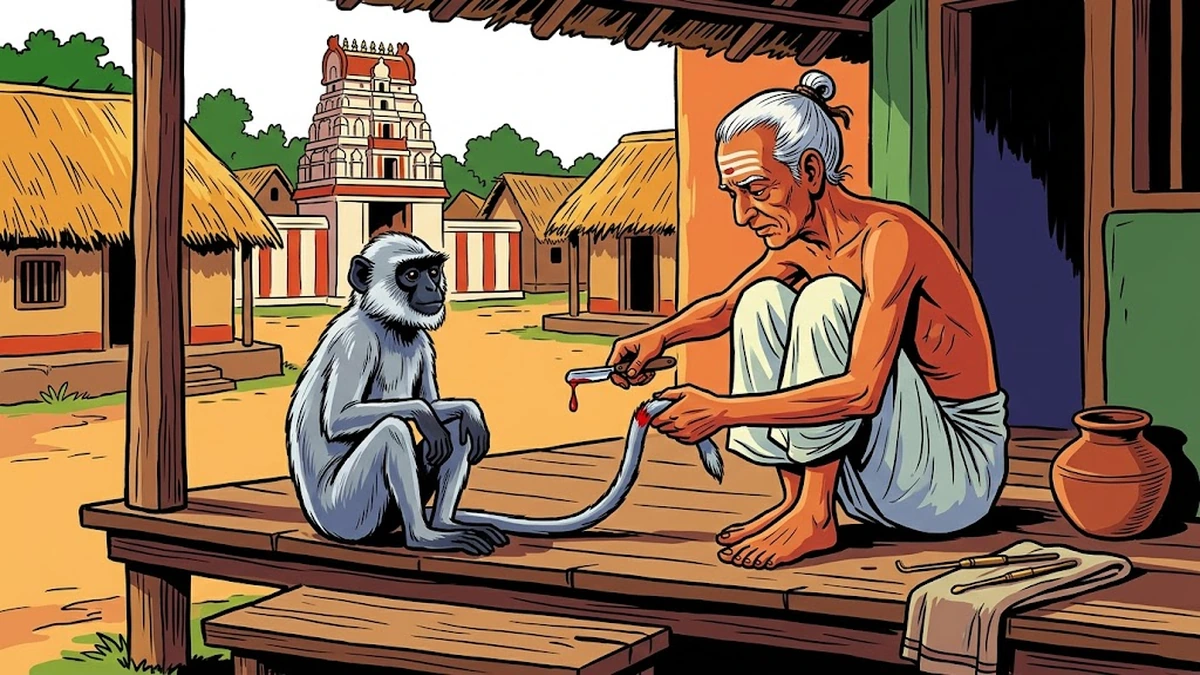
The barber, a stooped old man of perhaps sixty in a faded white veshti with sacred ash on his forehead, takes up the small folding straight-razor of country steel that is his trade’s tool, props the monkey’s tail across his bony knee, and sets to work. But the thorn has gone in deep, and the barber’s eyes are no longer young; he saws with the razor a moment too long, and the curved blade slips and shears clean through the very tip of the monkey’s tail along with the thorn. A bright drop of red falls onto the white veshti. The monkey leaps up with a shriek that scatters the temple crows from the gopuram, and turns on the barber with all the offended dignity that a monkey with a freshly shortened tail can muster. “Friend barber,” he says, in the high formal village-court Tamil that nobody in the hamlet has heard from the lips of an animal before, “you have cut off the tip of my tail. Give it back to me, or give me your razor in its place.”
The barber cannot give back what he has thrown away in the dust of the veranda. The custom of the Tamil village — the unwritten code of nyayam, of fair dealing and substitute-restitution that has governed the village panchayats of the south since the time of the Cholas — binds him. He hands over the razor. The monkey takes it, tucks it carefully under his armpit, makes a small mocking namaskaram with his free hand, and goes back up the dust track into the forest with a smile that no monkey in a Tamil tale ever smiles for an innocent reason.
The Razor, the Old Woman, and the Bundle of Fuel
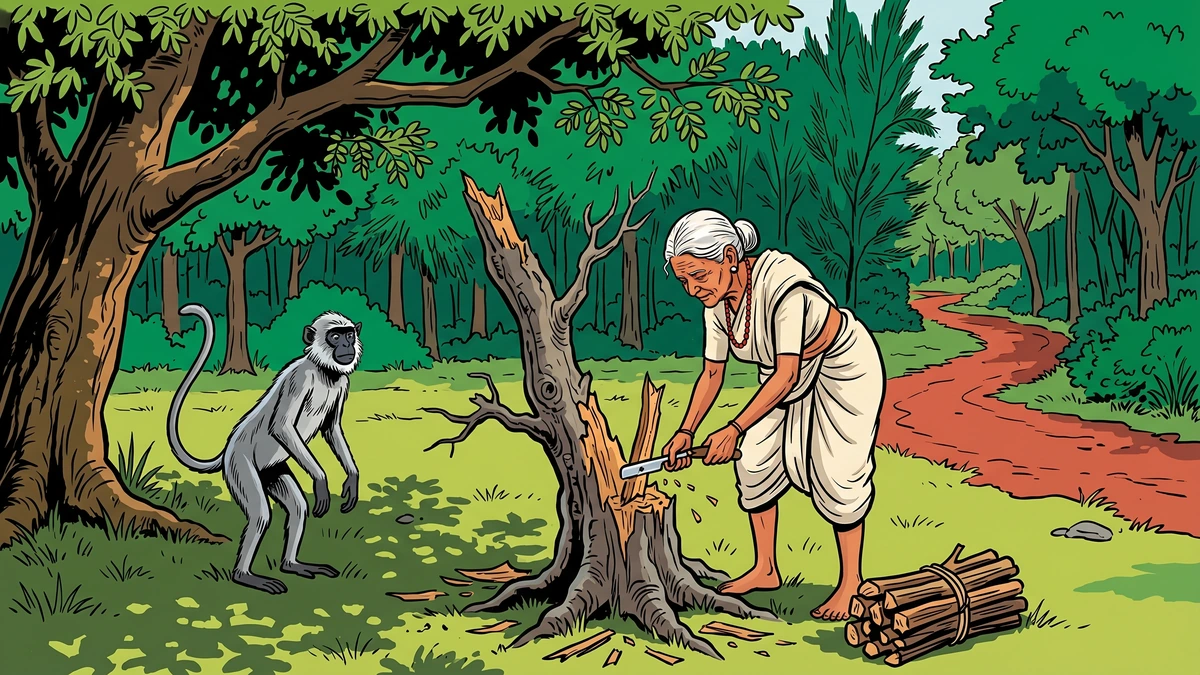
The track winds upward through groves of casuarina and tamarind, and on a clearing not very far from the wood-apple tree the monkey comes upon an old fuel-gathering widow, a thazhambu-kari in the Tamil village idiom, of perhaps seventy — her white hair tied back in a small knot, her plain undyed cotton sari hitched up at the knee for work, her small bronze sickle in her right hand. She is bent painfully over a half-dead vembu-margosa stump, sawing at it with the dull bronze sickle and making no progress at all; the wood is hard, the sickle is blunt, and her hands have begun to shake. The monkey watches her for a moment, and then he comes forward all consideration and concern, the razor balanced in his right palm. “Grandmother, grandmother,” he says in the soft cooing Tamil that village children use to wheedle their grandmothers, “the tree is very hard. You had better use my sharp razor; you will cut your fuel easily, and finish your day’s work before the sun is even at noon.”
The old woman, whose own husband’s funeral she paid for two monsoons ago and who has lived since then on the few annas she earns each week selling fuel-wood to the temple kitchens, has never in her life been offered a razor by a monkey, but the offer is a kind one and the sickle is truly very blunt. She thanks him, takes the razor, and falls to work on the dead margosa stump. The thin folding razor, never made for cutting hardwood, splinters and chips against the tough margosa fibre after only six or seven strokes. By the time the old woman has cut enough fuel to fill her small head-bundle, the razor is a piece of buckled scrap-steel with no edge left on it at all. The monkey, who has been waiting under a nearby tamarind tree with the patience of a tax-farmer, steps forward as soon as she straightens up, takes the ruined razor from her hand, holds it up to the noon light with theatrical horror, and says: “Grandmother, you have spoiled my razor. You must either give me your fuel, or get me a better razor at once.”
The old woman cannot procure another razor; the village is three miles off, and even if she sold every stick of her fuel-wood at the temple gate she could not afford a new straight-razor of country steel for less than four annas, which is more cash than has passed through her hands in a month. She looks at the small head-bundle she has just cut, looks at the monkey, looks back at the bundle, and with a deep sigh of an old woman who has been outwitted but cannot quite see how, she lifts the bundle off her own head and sets it on top of the monkey’s. He stands a moment very pleased under his sudden hat of dry brown sticks, makes another mock namaskaram, and goes off down the track toward the next village.
The Fuel, the Pudding-Maker, and the Plate of Rice-Cakes
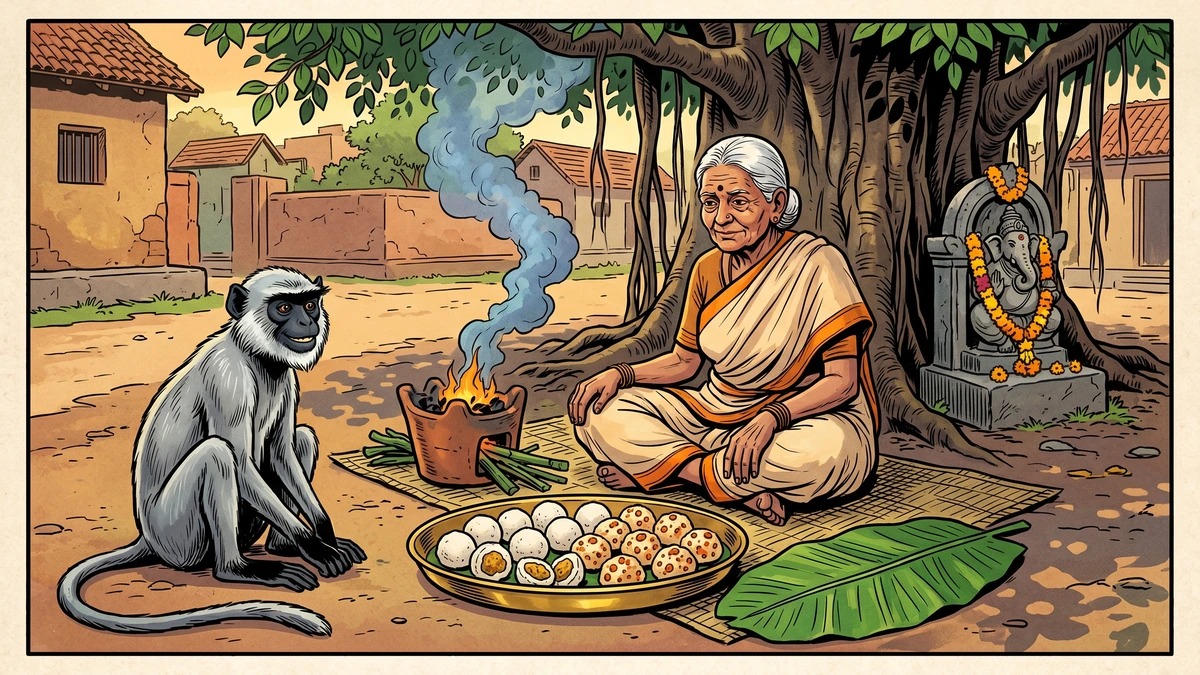
Some way down the track, where the forest opens onto a small dust crossroads with a stone Ganesha shrine under a banyan tree, the monkey comes upon a second old woman — this one a kozhukattai-maker, a pudding-seller, sitting by the roadside on a low palm-leaf mat with a small clay charcoal-stove in front of her and a wide brass tray of rice-flour batter at her side. She is making the small steamed Tamil rice-dumplings that are sold for one paisa each to passing pilgrims and bullock-cart drivers — sweet ones with jaggery-and-coconut filling for festival days, savoury ones with lentil-and-mustard tempering for ordinary mornings — and her clay stove is faltering; the small bundle of dried casuarina twigs she had brought from her own kitchen has burned away, and her last batch of dumplings sits half-cooked in the steamer. The monkey halts in front of her, lowers his head-bundle of fresh-cut margosa wood with a great show of generosity, and says: “Grandmother, grandmother, you are making puddings, and your fuel is already exhausted. Use mine, and make more cakes.”
The pudding-maker, blessing his grandmotherly thoughtfulness in the small invocations of the village — “may Ganesha and Murugan and Mariamman be good to him” — takes his bundle, breaks it up small with her sickle, and feeds it stick by stick into her stove. The fresh margosa, full of green sap, burns sluggishly and smokes out half the cooking-pots in the lane; but it burns. The half-cooked dumplings finish steaming. A new batch goes in. The monkey sits in the shade of the banyan watching the whole performance with the same patient attention. When the pudding-maker has used up the very last twig of his fuel and is wiping her hands on her sari ready to count out her morning’s takings, the monkey stands up. “Grandmother,” he says with the same reproachful courtesy, “you have used up all my fuel. You must either give me a plate of your puddings, or fetch me a fresh head-load of casuarina wood from your own kitchen at once.”
The pudding-maker, who has fewer dry sticks at home than the monkey suspects and a brass tray full of fresh hot dumplings she has not yet been paid for, looks once at her steaming pile of kozhukattai and once at the patient monkey and reaches resignedly for a wide green plantain-leaf. She heaps it with thirty of her best dumplings — sweet jaggery-coconut on top, savoury lentil-mustard underneath, all of them still hot enough to burn an unwary tongue — ties the leaf into a neat bundle with a strip of banana-fibre, and hands it across to him. The monkey accepts it with the third namaskaram of the morning, swings the bundle of warm dumplings onto his head, and walks on. By now even the village dogs that watch him pass are beginning to look at him sideways; nobody who is innocent walks out of three transactions in a single morning carrying more than he came in with.
The Puddings, the Drummer, and the Sky-Splitting Tom-Tom
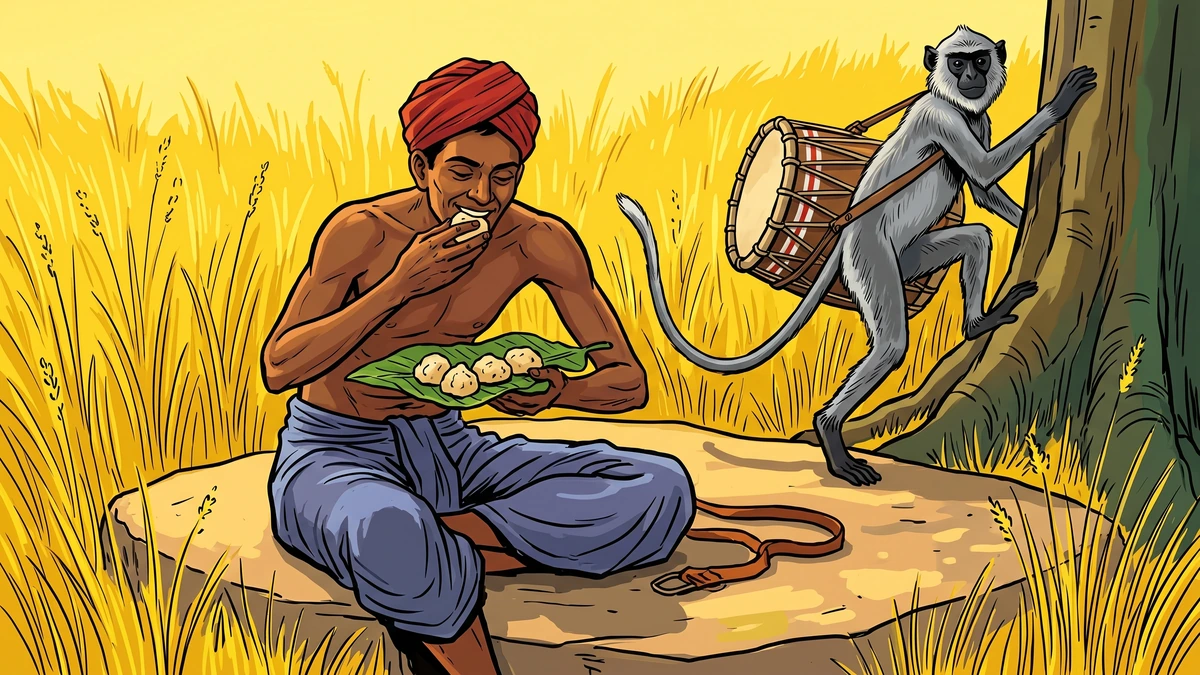
The track climbs at last over a low ridge of red laterite earth and comes down into a meadow of tall yellow thumbai-grass, in the middle of which sits the fourth and final character of the story: a wandering parai-drummer of the Paraiyar caste, walking the pilgrim road with his great cylindrical tom-tom — the south Indian parai drum, made of a hollowed-out tamarind-wood frame two cubits across with a stretched cow-hide head laced taut by leather thongs, daubed in white and red sandal-paste designs along the rim, slung from his shoulder by a thick bullock-leather strap. The parai-drum is one of the most resonant percussion instruments in the Tamil village — in the temple processions of the south it announces the coming of the deity through the streets, in the funeral cortèges it walks in front of the dead, in the harvest celebrations it leads the dancers around the threshing-floor — and the drummer who carries one is at the bottom of the village caste-system but at the top of its musical hierarchy.
This particular drummer, however, has been walking since dawn on a hot day with no breakfast in his stomach, and when he sees the monkey trotting toward him with a fresh-tied plantain-leaf of warm sweet rice-cakes balanced on his head, his eyes widen and he stops dead in the road. The monkey, reading the drummer’s face like a proper Tamil trickster — the same way a village peddler reads the face of the housewife at the door — stops too, and unties the leaf, and lets the warm coconut-and-jaggery scent rise up between them on the still noon air. “Brother drummer,” the monkey says, in the most casual conversational Tamil he can muster, “you look hungry, and I am tired of carrying these. I will gladly give you the whole leaf-load of dumplings — sweet and savoury both — if you will let me have, in exchange, that big drum of yours. I think I have a use for it.”
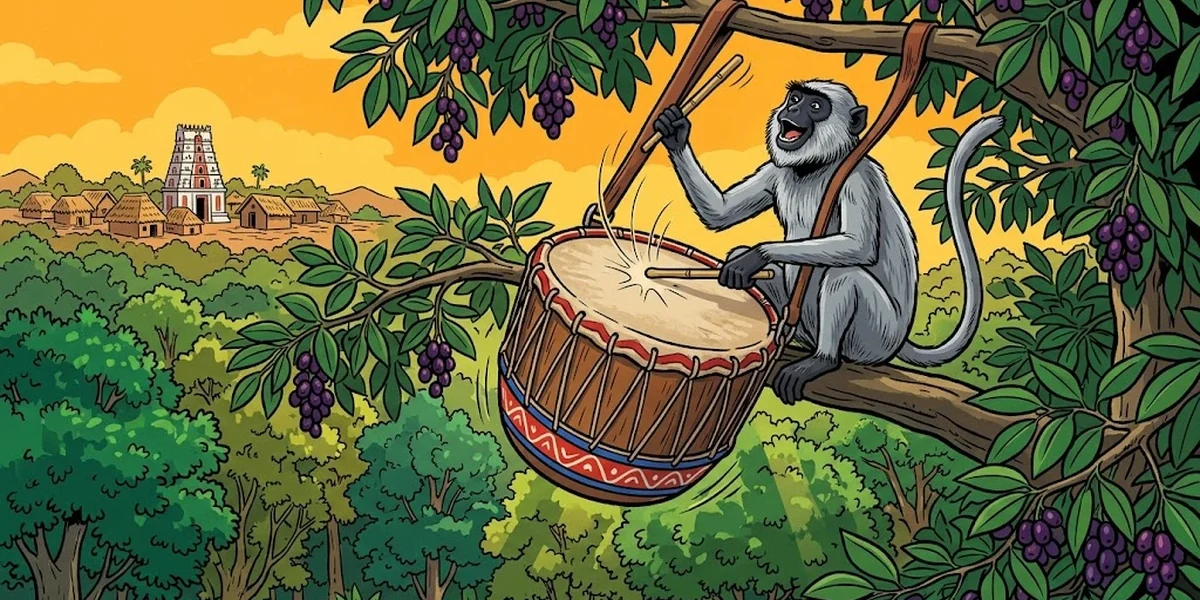
The drummer, whose stomach has not seen a hot dumpling since the festival of Thai Pongal two months ago, does not pause to think for very long. He swings the drum off his shoulder, hands over the great tamarind-wood frame and the laced cow-hide head and the bullock-leather strap, takes the warm bundle of kozhukattai in both hands, sits down on the nearest flat stone, and begins to eat. The monkey hangs the strap of the drum across his own narrow chest, settles the weight of the frame against his side, and walks straight past the drummer into the next stand of forest, where the tallest jamun tree on the ridge raises its spreading crown a clear ten cubits above the canopy. He climbs to the very topmost fork of the jamun, ties the drum’s leather strap to a stout horizontal branch so that the drum hangs square in front of him, takes up two short bamboo drumsticks from inside his armpit, and begins to beat.
The first stroke rolls out across the forest in a low full boom–boom–boom that reaches the village headman’s veranda three miles away. The barber, the fuel-cutting widow, the pudding-maker, and the drummer all sit up at the same time, recognising the voice of the great parai. And the monkey, gripping the topmost fork with his prehensile feet and his free tail (now an inch shorter than it was at sunrise), throws his small black face back to the noon sky and begins to chant, in the rolling sing-song meter of the Tamil villu paatu ballad, the cumulative song that is the climax of every version of this story from the Cauvery delta to the Krishna river:
“In the wood I had a thorn,
And the thorn became a razor,
And the razor became a bundle of fuel,
And the fuel became a plate of dumplings,
And the dumplings became a tom-tom drum,
And the drum — ah, the drum is mine!
Boom-boom-boom! Boom-boom-boom!
Listen, oh village, the monkey sings!”
And he beats the drum and beats the drum and beats the drum, until the noise of his own triumph fills the whole forest and the whole village and reaches even the ears of the king at his stone fort across the river. The Tamil grandmothers who tell this story always end it just here, with the monkey alone at the top of his jamun tree, drumming and singing his cumulative chain of clever swaps to the empty noonday sky — and they always pause just long enough afterwards for the listening child to feel, for the first time, the small uncomfortable shiver of the moral that is about to fall.
The Moral — Pongi Vazhndhal Nilai Illai, “Pride That Climbs Has No Ground Beneath It”
The Tamil proverb that closes this tale in Natesa Sastri’s village notebooks is not the easy English-language moral of “cleverness is its own reward” but the much harder, much older, much more characteristically South Indian saying:
“பொங்கி வாழ்ந்தால் நிலை இல்லை.”
“Pongi vaazhndhaal nilai illai.”
“Pride that climbs aloft has no ground beneath it.”
The proverb — first recorded in print in the seventeenth-century Tamil moral compendium Konrai Venthan attributed to Auvaiyar of the Sangam tradition and reused in the Beschi-era Christian-Tamil schoolbooks of the eighteenth century — asks the listener to remember what the cumulative trickster has chosen not to think about. The monkey has indeed climbed the chain of swaps from a thorn to a tom-tom; he has indeed cheated four village adults in a single morning; he has indeed carried home in his arms the loudest and most splendid object he has ever owned. But he has done his cheating in such a way that everybody he cheated knows exactly who he is, where he lives, and which jamun tree he can be heard beating his trophy-drum from at noon every day. The barber has lost his razor; the widow has lost her morning’s firewood; the pudding-maker has lost a leaf-load of cakes; the drummer has lost his living instrument. And the monkey, now that he is at the top of the highest jamun tree on the ridge announcing his cleverness in a song that can be heard from the village headman’s veranda — the monkey has handed his enemies his location, his routine, his treasure, and, when he tires of beating the drum, his only escape route. The southern grandmother does not need to finish the sentence. The child finishes it for her. Hunters with nets, woodsmen with clubs, the four cheated adults with their grievances all know exactly where to come. Pride that has climbed aloft has no ground beneath it.
This is the deeper Tamil-Telugu moral of the tale: not that cleverness is bad, and not that the four villagers were stupid, but that any cleverness which insists on being publicly admired turns into the cage of its own admirer. The wise trickster of the South Indian village — the same trickster who in the cycles of Tenali Rama and Paramartha Guru outwits the Vijayanagara court and the Madurai Nayak with the same sequence of cumulative swaps — never beats a drum at the top of a tree to announce his trick. He pockets it, walks home, and lets the village be three days behind him before they realise what has happened. The monkey’s real mistake is not the chain of small thefts; it is the song.
Why the Tale Has Lasted
“The Monkey with the Tom-Tom” survives in the storytelling repertoire of Tamil grandmothers a hundred and thirty-six years after Natesa Sastri set it down in 1890 not because it teaches children that cheating is wrong — many other tales teach that more directly — but because it teaches them, in the same comic five-minute breath, the much subtler social wisdom of the South Indian village: that the worst kind of pride is the kind that has to perform itself. Every Tamil child who has heard the four-step swap chant rolling toward its triumphant tom-tom climax knows, somewhere under the laughter, that the monkey is going to be caught precisely because he could not bear to enjoy his cleverness in silence. The chain of bargains was the easy part — an Indian fable can construct one of those in three sentences. The drum at the top of the tree, however, is the part that has kept the tale in the village memory through the Vijayanagara wars, through the long centuries of Mughal and Nayak and East India Company administration, through the famines and the railways and the radio and the satellite television, and into the smartphone-lit Tamil family living rooms of 2026. The monkey is still climbing his jamun tree every evening, in some house in Salem or Chennai or Coimbatore, and the grandmother is still pausing just before the moral, and the child is still about to learn the South Indian version of the lesson the Tamil proverb keeps on telling us: pride that climbs aloft has no ground beneath it, and the louder it sings, the further it has to fall.
The genius of Natesa Sastri’s preservation is that he and Kingscote did not over-explain it. The 1890 W. H. Allen edition gives us the four swaps and the song, and stops — trusting the cumulative comic structure to do the moral work, the way a Tamil grandmother trusts the listening child. That trust is what has carried “The Monkey with the Tom-Tom” from a village courtyard in late-nineteenth-century Madras Presidency through Project Gutenberg edition #37002 of Tales of the Sun and into a thousand twenty-first-century English-language children’s anthologies. The tale knows what it is doing. The grandmother knows what the tale is doing. The child knows what the grandmother is doing. And the monkey, at the top of the highest jamun on the ridge, beating his great parai drum at the empty noonday sky — the monkey, alone of the five characters in the story, does not.
Frequently Asked Questions
**Q: Why is this story important?**
You May Also Like
 Indian Folk Tales
Ages 6-8
Indian Folk Tales
Ages 6-8
The Mouse Deer and the Crocodile: How Wit Overcomes Danger
The Mouse Deer and the Crocodile: How Wit Overcomes Danger: In the dense forests of Indonesia, where the rivers flow like liquid silver and the jungle is alive
 Indian Folk Tales
Ages 3-5
Indian Folk Tales
Ages 3-5
How Raja Rasalu Played Chaupur With King Sarkap
How Raja Rasalu Played Chaupur With King Sarkap: Now, when evening came, Raja Rasâlu went forth to play chaupur with King Sarkap, and as he passed some
 Indian Folk Tales
All Ages
Indian Folk Tales
All Ages
The Brahmarakshas And The Hair
The Brahmarakshas And The Hair: Long ago, in a small town near the banks of the river Narmada, there stood an ancient banyan tree so vast that its aerial roots