The Billy Goat And The King
The Billy Goat And The King: In the ancient kingdom of Varanasi, there lived a king who was known for his piety and his devotion to religious rituals. The
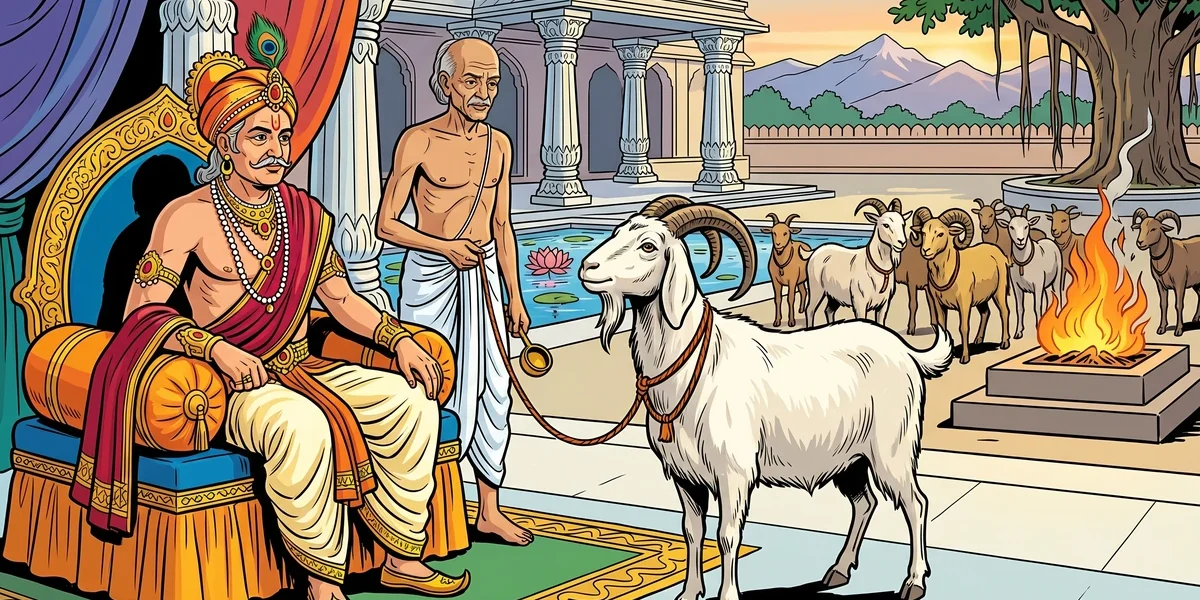
From the Pāli Buddhist canon — the Matakabhatta Jātaka (Jātaka No. 18, “The Feast for the Dead”), preserved in the Jātakatthavaṇṇanā and adapted in later Indian folk retellings as the parable of the laughing goat and the king of Vārāṇasī.
In the ancient kingdom of Vārāṇasī — the holy city on the banks of the Gaṅgā that medieval pilgrims called the oldest continuously inhabited place on the earth — there once reigned a sovereign celebrated for his piety and his unwavering devotion to ritual sacrifice. Bards praised him at every court, and Brahmin priests blessed him at every dawn. He believed, as many of his ancestors had believed, that the gods grew strong upon the offerings of mortals, and that no kingdom could prosper until the smoke of the sacred fire had risen to heaven for a hundred days. The priests, of course, encouraged him in this belief, for from each ceremony they drew their share of grain, gold, and grateful repute.
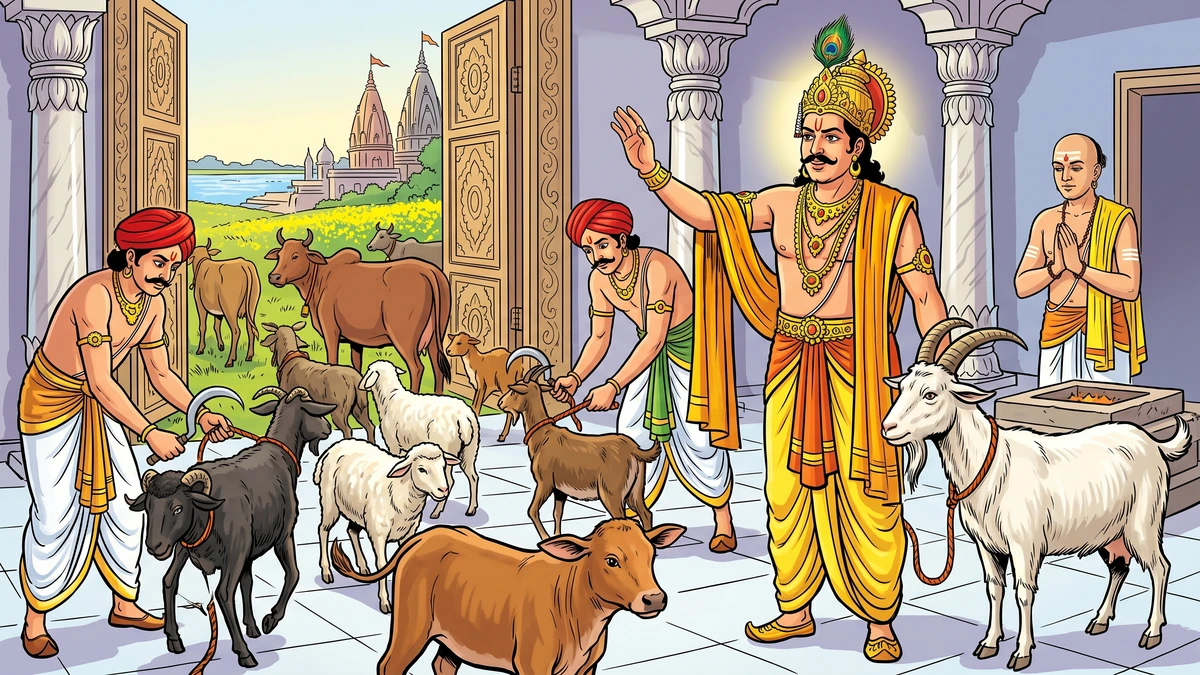
One bright spring morning, the king’s chief purohita came to the throne with a proposal that he had been turning over for many nights. “Your Majesty,” he said, bowing low, “the conjunctions of the stars are favorable. If you would but perform the great Aśvamedha-style fire ceremony, offering one hundred animals upon the consecrated altar, your name shall be carved into the memory of the gods, and your kingdom shall flourish for a hundred years and more.” The king, who had already begun to dream of monuments and chronicles, gave his assent without delay. He commanded that one hundred of the kingdom’s finest beasts — goats and rams, sheep and cattle — be gathered in the royal courtyard before the next full moon.
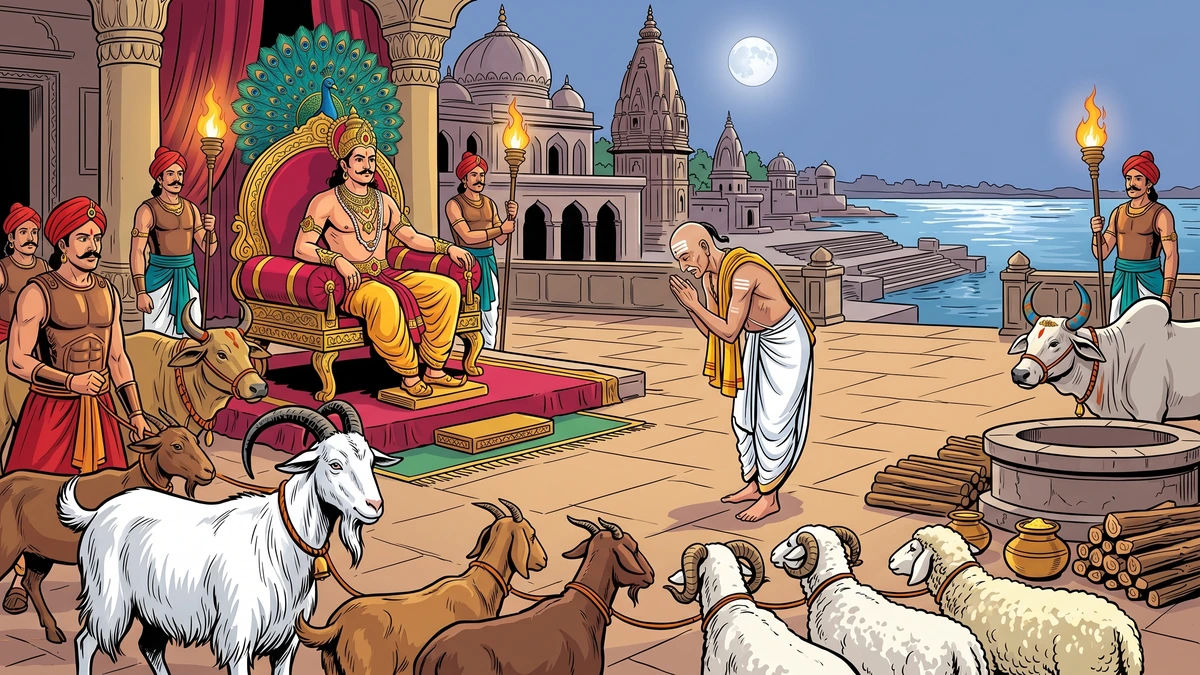
The Goat That Laughed and Wept
Among the animals brought to the palace was a magnificent billy-goat, his coat as white as the snow upon the Himavat, his curving horns polished by years of grazing on the rocky slopes of the mountain villages. He was old, and his eyes held the long memory of one who has seen many monsoons. The truth of him, however, was a deeper thing than any of the courtiers could imagine. In his previous birth — so the Jātaka teaches — he had been a learned brahmin, an expert in the three Vedas, who had once performed a great sacrifice and fed his ancestors with the flesh of a single goat. For that one act he had been condemned to be reborn five hundred times as a goat himself, and five hundred times beheaded upon altars across the long arc of saṁsāra. This morning, brought into the king’s courtyard, he stood at the very edge of his last and four-hundred-and-ninety-ninth life.
As the royal cooks bound a saffron cord about his neck and led him toward the courtyard altar, the goat did a thing that astonished every soul present. He laughed. It was a clear, rolling, unmistakable peal of laughter, ringing out across the flagstones with such freedom that even the carrion-crows on the parapet fell silent. A heartbeat later — before the cooks could recover their wits — the laugh dissolved into a long and bitter weeping, the tears running down his white face into the dust. Courtiers gasped. The cooks stepped back. The chief purohita, who had been chanting the preliminary verses, faltered and turned pale. The king himself rose from his throne and came forward to look upon this strange and weeping creature.
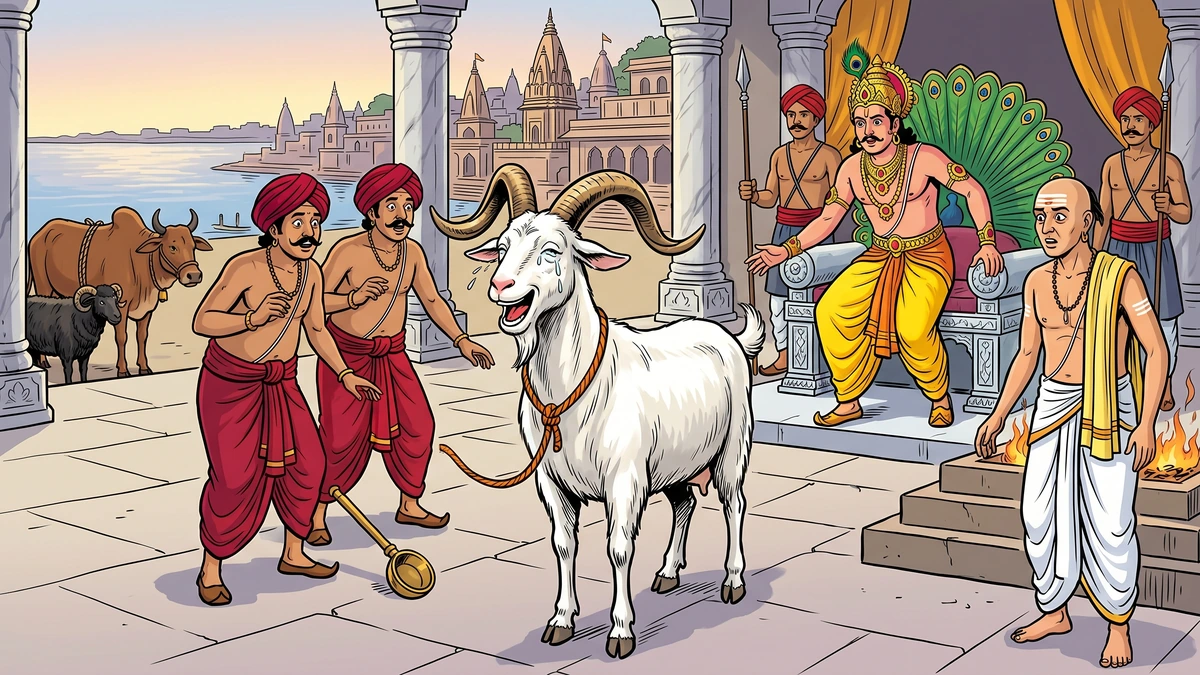
“Goat,” the king said, with a steadiness that surprised his ministers, “what is the meaning of this? You laugh, and then you weep. Speak — for clearly some understanding lies upon you that has not been granted to my own priests.”
The goat lifted his head. When he answered, his voice was the voice of one who has spoken truth in many lifetimes. “Great king,” he said, “I laughed because for five hundred lives I have been a goat upon the altar, and this morning I knew that this beheading would be the last. After this, I shall return to the path of the deva-loka and trouble the cycle of slaughter no more. But then I wept — for I remembered the brahmin I once was, and I saw your priest standing beside the fire, and I knew that he too would suffer five hundred lifetimes of being beheaded if he continued in the path he is teaching you. I wept for him. I wept for all the priests who have not yet learned. I wept for the law of kamma, which is patient, but which forgets nothing.”
The King’s Awakening
A great silence fell over the courtyard. The chief purohita’s hand trembled where it gripped the sacred ladle. The king looked at the goat for a long moment, and then he looked at the priest, and then he looked at the row of bound animals waiting their turn at the altar. He had been raised to believe that the gods were nourished by such offerings; he had been told a hundred times that the smoke of burning flesh was the sweetest incense in heaven. But now an old goat, white as snow and weeping for his executioner, had spoken with the calm of one who knew the law of cause and effect from inside out. The king felt the weight of the chronicles he had wished to write — and he felt them turn, in his hand, to a weight of suffering rather than glory.
He turned to his ministers. “Untie him,” he said. “Untie all of them. Let no animal be slain in this courtyard today, nor any other day. The fire ceremony is concluded. We shall offer flowers and grain and frankincense, as the older sages did before our ancestors corrupted the tradition. The blood of the helpless is not a gift the gods asked of us. It is a debt we have invented and tried to charge to heaven.” The courtiers, accustomed to obey before they understood, scrambled to do as he commanded. The ropes were cut, the gates were thrown open, and one hundred trembling animals walked out into the spring sunshine — to the pasture, to the village, to lives they had not expected to keep.
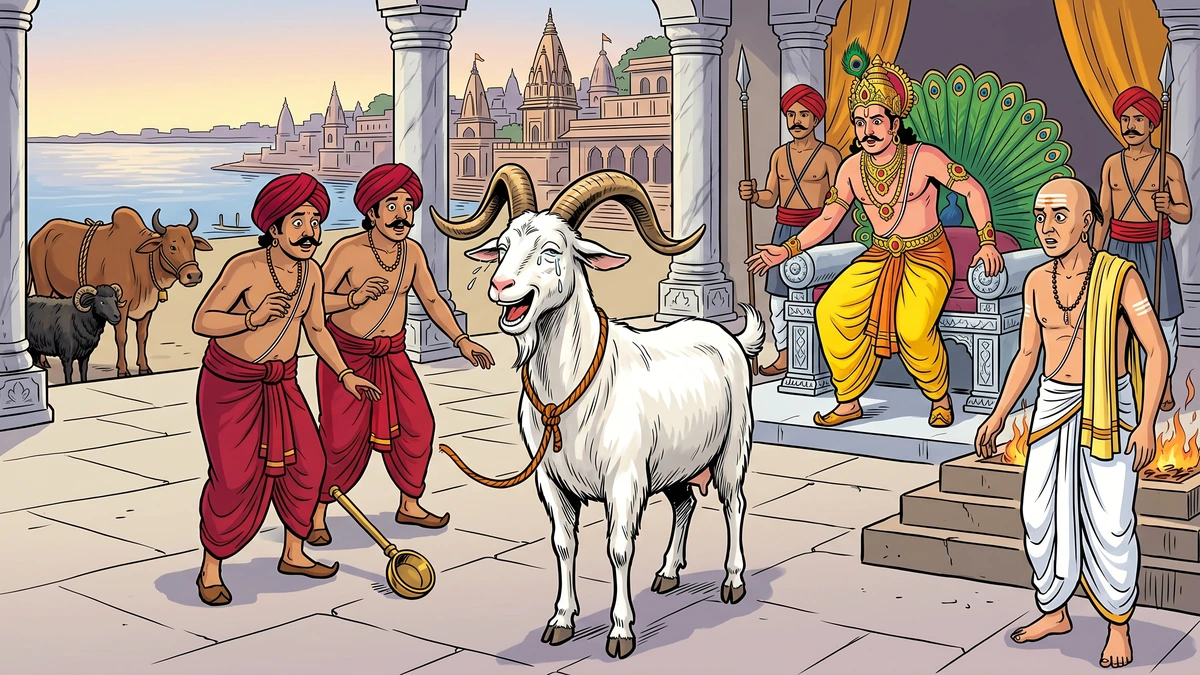
The Goat’s Last Counsel
The white goat, freed of his cord, turned to the king and bowed his old white head a final time. “You have done well, O king,” he said. “Yet hear one more counsel before I depart this life — for depart I must, and soon, by the appointed time of my own kamma.” His voice had grown softer, as though he spoke from a long way off. “True devotion to the divine does not consist in taking what is not freely offered. The deva-realms are not nourished by terror. They are nourished by the steady labour of mercy. A king who feeds his hungry, who shelters his old, who tends his wounded, and who lifts up his poorest subject — that king has performed a sacrifice greater than any altar can contain. Carve that into your chronicles, and the gods will remember you longer than the smoke of any fire.”
And so it came to pass. Even as the white goat spoke, a great storm rolled across Vārāṇasī from the direction of the mountains, and a single bolt of lightning, falling far from the place where the animals stood, struck a tall sal-tree at the edge of the courtyard and split it from crown to root. From beneath the splintered trunk fell a glittering shard of stone — and as the people gasped, the old goat laid himself down upon the grass with great dignity, closed his eyes, and quietly departed. He passed, as he had foretold, into a higher birth, and the cycle of his five hundred sacrifices was at last complete. The king ordered that the goat be buried with the honours due to a wise teacher, and that a small white shrine be raised upon the spot. For many generations afterward, travellers passing through Vārāṇasī would see the shrine and remember the day a goat had spoken truth to a king.
The Decree of Mercy
The king kept faith with the lesson he had been given. He published an edict throughout his realm forbidding the slaughter of any animal upon any altar, royal or village, public or private. He established the first of what would later be called abhayadāna, the gift of fearlessness — sanctuaries for old, sick, and abandoned creatures, tended by monks at the kingdom’s expense. The chief purohita, who had stood pale through the goat’s words, performed long penances and afterwards became a respected teacher of the new, bloodless ritual. Court bards composed verses about the day the white goat laughed and wept, and these verses passed in time into the hands of the Pāli Buddhist compilers, who set them down in the eighteenth tale of the great Jātakatthavaṇṇanā, where they have remained for more than two thousand years. The kingdom did not, in fact, prosper for one hundred years; it prospered, the chronicles say, for far longer — and not because of the smoke of any altar, but because of the silent, steady mercy of a king who had once been brave enough to listen to a goat.
Moral
“Yo so dīpaṅkaro buddho, mātāpitusu sannidhi, paṇḍitehi ca vaṇṇitā: ahiṁsā paramo dhammo.”
— Adapted from the Mātakabhatta-Jātaka (Pāli), with the closing maxim from the Mahābhārata, Anuśāsanaparva 115.25: “Non-injury is the highest dharma.”
True piety is measured not by the grandeur of what we offer to heaven, but by the mercy we extend to the helpless on earth. No ceremony can sanctify an act of cruelty; no smoke from any altar can rise high enough to wash blood from the hand that lit the fire. The king of Vārāṇasī learned, in a single morning, what a generation of priests had failed to teach him: that the gods are not appeased by terror, that ritual without compassion is only ritual, and that the surest way to honour the divine is to spare the life of one trembling creature who cannot speak for itself. The white goat’s last counsel — to lift up the poorest, to shelter the oldest, to tend the wounded — has rung down through Indian moral literature ever since, from the Pāli canon to the Mahābhārata to the village storytellers of Bengal, the Punjab, and the Deccan. Ahiṁsā paramo dharmaḥ. Non-injury is the highest law.
Why This Story Has Lasted Two Thousand Years
The Mātakabhatta Jātaka is one of the oldest recorded animal-fables in the Buddhist tradition, set down in Pāli around the third century BCE and edited into the great commentarial collection — the Jātakatthavaṇṇanā — in roughly the fifth century CE by scholar-monks at the Mahāvihāra in Anurādhapura, Sri Lanka. Its critical Pāli edition was prepared by V. Fausbøll between 1877 and 1896 in seven volumes, and its standard English translation appeared in E. B. Cowell’s six-volume The Jātaka, or Stories of the Buddha’s Former Births (Cambridge University Press, 1895–1907), where the goat-and-priest tale appears as story No. 18. The version told above is the Indian folk redaction, which substitutes a king and his royal purohita for the original brahmin householder, and which has circulated in Hindi, Punjabi and Bengali oral retellings for at least the last seven hundred years.
Folklorists classifying the tale within the Aarne-Thompson-Uther index place it under motif group B335 (helpful animal warns against sacrifice) and B216 (animal that speaks the language of men), with broader resonance in the global tradition of “the talking sacrificial victim” — a motif that surfaces in the Greek tale of the bull of Phalaris, the Hebrew binding of Isaac, and the Buryat-Mongolian shamanic stories of the eloquent reindeer. What makes the Indian version distinctive is its Buddhist treatment of kamma: the goat does not appeal to mercy as a sentimental virtue, but explains the moral law of cause and effect with the calm of a tax-collector reciting a ledger. The priest’s five hundred future lives are not a threat — they are a forecast. This calm precision is what the Pāli compilers wished to preserve, and it is what gives the story its unusual moral force two and a half millennia later.
The tale also belongs to a small but powerful genre of Indian moral literature in which a humble being — a goat, a sparrow, a cow, an outcaste boy — speaks truth to a sovereign who has been surrounded by flatterers. The pattern recurs in the Hitopadeśa, in the Pañcatantra‘s “Book of Friends Lost,” in the medieval Bengali maṅgala-kāvyas, and in the modern Hindi short stories of Premchand. It is a deeply Indian conviction — and arguably a deeply human one — that wisdom often arrives not from the high seat but from the low one, and that a king who cannot listen to a goat will, in the end, lose the right to listen to anyone.
Historical & Canonical Attribution
- Pāli Title: Mātakabhatta-jātaka (“The Feast for the Dead Birth-Story”), Jātaka No. 18.
- Source Collection: Jātakatthavaṇṇanā (the canonical commentary on the Pāli Jātaka verses, compiled in Sri Lanka, c. 5th century CE).
- Critical Edition: V. Fausbøll, The Jātaka, Together with its Commentary, 7 vols., London: Trübner, 1877–1896.
- Standard English Translation: E. B. Cowell (ed.), The Jātaka, or Stories of the Buddha’s Former Births, 6 vols., Cambridge University Press, 1895–1907; vol. I, pp. 51–53.
- ATU Motif Classification: B216 (animal speaks human language); B335.1 (animal warns human against sacrifice); broader analogue with K2110.1 (slanderer condemns himself).
- Folk Redaction Region: Punjab, North India and Bengal, oral tradition c. 13th–19th c.
- Closing Verse: Ahiṁsā paramo dharmaḥ, from the Mahābhārata, Anuśāsanaparva 115.25.
Reflection & Discussion
- Why does the goat laugh first and then weep? What does each emotion teach the king that a calm explanation could not?
- The chief purohita is never punished, only re-educated. What does the story imply about how a community should treat a leader whose teaching has done harm?
- The goat speaks of kamma as a “patient” law that “forgets nothing.” How does this differ from a system of divine reward and punishment? What does the difference mean for how we live each day?
- Many cultures have tales of a sacrificial animal that suddenly speaks. Why do you think this image — the wordless creature finding words — recurs across so many traditions?
- The king establishes abhayadāna, the “gift of fearlessness,” as a public institution. What modern equivalents of this gift exist in your own community?
Did You Know?
- The Mātakabhatta Jātaka is one of the earliest texts in any Indian language to argue explicitly against animal sacrifice — predating most Sanskrit dharma literature on the same subject by several centuries.
- The Sri Lankan commentarial tradition records that the Buddha narrated this story to a community of monks in Jetavana, in response to a question about whether ritual offerings to dead ancestors could ever be of benefit.
- The Pāli word mātakabhatta literally means “food for the dead” — it refers to the funerary feast for ancestors, which in the original brahmanical tale provided the occasion for the goat’s intended slaughter.
- The white goat’s posthumous shrine at Vārāṇasī, mentioned in the folk redaction, has been variously identified by 19th-century travellers with sites near Sarnath; no archaeological evidence survives, but the tradition was still being recounted by local guides as recently as the 1880s.
- E. B. Cowell’s six-volume Jātaka translation was completed only after his death in 1903 by his student W. H. D. Rouse — the project took nearly thirty years to bring to print.
You May Also Like
 Indian Folk Tales
Ages 3-5
Indian Folk Tales
Ages 3-5
The Lambikin 2
The Lambikin 2: Once upon a time there was a wee wee Lambikin, who frolicked about on his little tottery legs, and enjoyed himself amazingly. Now one day he
 Indian Folk Tales
Ages 3-5
Indian Folk Tales
Ages 3-5
The Snake Woman And King Ali Mardan
The Snake Woman And King Ali Mardan: Once upon a time King Ali Mardan went out a-hunting, and as he hunted in the forest above the beautiful Dal lake, which
 Indian Folk Tales
Ages 9+
Indian Folk Tales
Ages 9+
If Only Fairy Tales Could Be Like This
A modern Cinderella story-poem and short essay for ages 9+: what real beauty means, why kindness matters more than looks, plus a clear moral and FAQ.