1003+ Stories from Ancient India — Free to Read! Explore all stories →

How Raja Rasalu Killed The Giants

A rousing Punjabi legend about the hero-prince Raja Rasalu, a grieving mother, and the giants who terrorise the city of Nila until a bold young king ends their reign.

Origin: Fairytalez
How Raja Rasalu Killed The Giants - Indian Folk Tales
Ad Space (header)

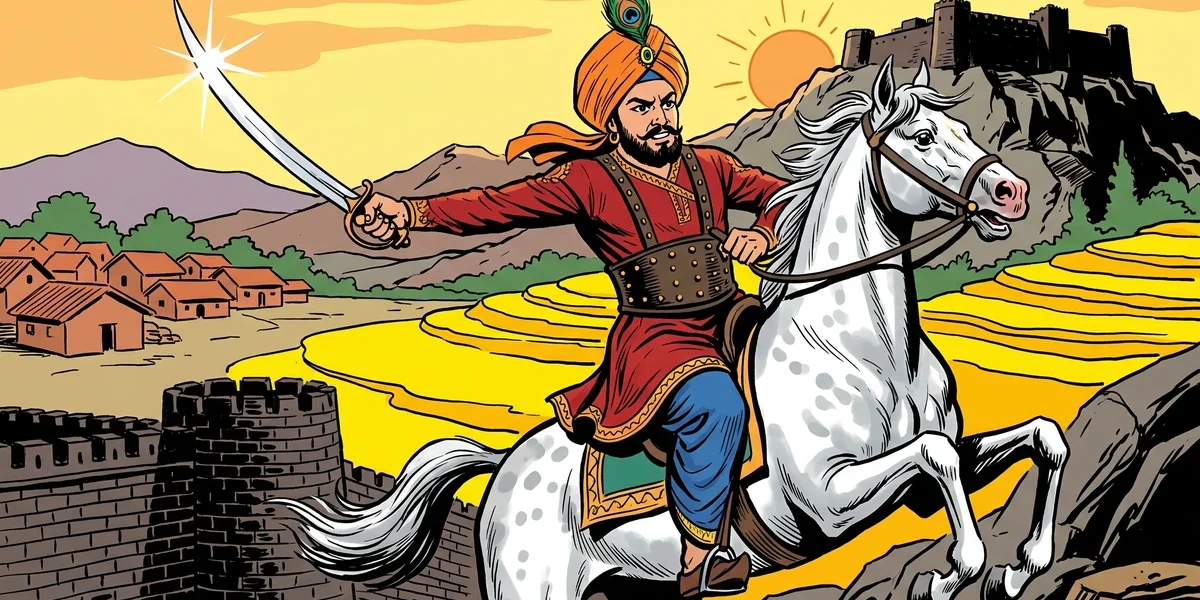
An old widow weeps over the dough she is kneading, because today it is her last son’s turn to be carried away by the giants of Nila. Out of the dust of the Punjabi road rides a young prince — alone, unarmed but for the sword at his belt, his great horse Bhâur Irâqi steaming after a long day’s travel — and he stops, as no other traveller has ever stopped, to ask her what is wrong. How Raja Rasālū Killed The Giants is the seventh chapter of the long Punjabi epic of Rasālū, and it is the moment in which the wandering boy-king of Sialkot proves that he is not merely a chess-player and a hunter but a defender of the weak. The episode contains, in less than two thousand words, every motif that the Punjabi imagination has ever loved: the tyrannical monster, the courageous outsider, the trembling city, the magical horse, and the moment of laughter in the middle of grief that signals to the listener that the rescue has already begun.

Raja Rasalu meets the weeping widow at the city gate of Nila — Punjabi folktale illustration

Origin and Canonical Sources

The episode comes from Flora Annie Steel‘s landmark collection Tales of the Punjab Told by the People (Macmillan, London, 1894), prepared with explanatory notes by R. C. Temple and decorated with the line drawings of John Lockwood Kipling — the elder Kipling, then Principal of the Mayo School of Industrial Arts in Lahore. Steel had lived in the Punjab from 1867 onward and had taken down the Rasālū cycle directly from the women of the village in their own dialect. In the chapter she titled The Adventures of Rajah Rasalu, the journey to Nila is the seventh installment, sitting between the night in the graveyard with the headless corpse and the climactic chaupur match against King Sarkap of Kot Bithaur.

Behind Steel’s English prose stands the older verse recension of Sir Richard Carnac Temple, whose three-volume The Legends of the Panjâb (Bombay and London, 1884–1900) preserves the bardic Punjabi exactly as it was sung by the Mirâsis, the hereditary genealogist-bards of Sialkot who had carried the cycle in song for at least four centuries before any pen touched paper. Charles Swynnerton‘s Romantic Tales from the Panjâb (Westminster, 1903) provides a third independent witness, recorded from Punjabi singers who had no knowledge of Steel’s earlier book. Where these three nineteenth-century recensions agree — on the names of the giants, on the sequence of beheadings, on the closing image of the city’s gates flung open in gratitude — folklorists agree that the episode is part of the genuine traditional cycle and not a Victorian embellishment.

For comparative folklorists the tale belongs squarely to ATU 300 in the Aarne-Thompson-Uther index, “The Dragon-Slayer” — the international tale-type in which a hero arrives in a city paying tribute of human victims to a monster, takes the place of the next victim, and slays the monster, often through cleverness as much as strength. The pattern unites this Punjabi episode with Greek Andromeda-and-Perseus, with English Saint George, with Anglo-Saxon Beowulf-and-Grendel, with Russian Ilya Muromets-and-the-Tugarin-Dragon, and with the South Indian Manimekalai cycle. The widow-and-seven-sons motif at the opening of the tale is catalogued separately as motif P233.6 — “The mother who has lost her sons” — a pattern Stith Thompson found everywhere from Iceland to the Tamil country and which is one of the great universal openings of folk narrative.

Raja Rasalu sits on the widow's charpai promising to take her son's place — Punjabi folktale illustration

Beat One — The Old Woman at the City Gate

Rasālū rides into Nila late in the day, the sun low over the Salt Range and the streets empty in that strange way streets fall empty when a city is nursing a private terror. He hears, before he sees, the only person still working: an old woman kneading roti on her doorstep, her hands moving with the practiced rhythm of fifty years, but her face streaked with tears and her shoulders shaking with a laughter that is somehow more terrible than the tears. The Punjabi narrative imagination is at its most characteristic in this opening picture — not battle, not banner, not trumpet, but an old woman with flour on her hands, weeping and laughing over the unleavened bread that is the daily measure of a Punjabi household’s love. Rasālū reins in his horse and asks her, courteously, why she weeps and laughs at once. She tries to brush him off; he insists; she sees, when she finally looks up, that his face is kind. So she tells him the whole story — the giants who come every day to the city for tribute, the seven sons she has borne and the six the giants have already taken, and the youngest, today, whose hour has come.

Beat Two — The Promise to the Widow

The young Raja’s response is the entire moral architecture of the episode in three lines of bardic verse. “Fond, foolish mother! cease these tears — keep thou thy son. I fear nor death nor life, seeking my fortune everywhere in strife. My head for his I give!” He dismounts. He sits down on her low chârpâi as if he were her own son just home from the fields. He accepts a piece of the unleavened bread, breaks it, and eats. The Punjabi listener understands at once what has happened: by sharing food on her doorstep he has placed himself under the rule of mez-bân—the laws of host and guest—and made her sons his brothers. The substitution that follows is not a stranger’s charity; it is a brother’s debt. When the chief officer of the city arrives at her gate to claim the day’s tribute, Rasālū rises in his shining armour, the long Punjabi turban bound high above his bearded face, and he announces that he, not the boy, will go that morning to the giants. The officer protests; Rasālū pushes past him without another word. The widow’s last son sits stunned on the threshold, alive, and the Raja rides off with the buffalo and the basket of cakes that are the day’s tribute, his great horse Bhâur Irâqi led to know the road already — for the buffalo, who has walked it many times before, is the only one in the procession who knows the way.

Beat Three — The Water-Carrier Giant

The road into the foothills is rocky and steep, and Rasālū meets his first giant before he ever reaches the giants’ fortress. A water-carrier giant, vast and brutish, comes lumbering down with a leather skin of water on his shoulder for the household. He sees the young rider, the buffalo, and the well-fed Iraqi horse, and he laughs to himself at the bonus: the brothers will not begrudge him the horse, since it is extra to the day’s tribute. He reaches out a hand the size of a small tree to grab the bridle. Rasālū, without dismounting, draws his sharp sword and strikes the hand off at the wrist in a single clean blow. The giant howls, drops the water-skin, and flees back up the road towards his fortress, leaving a track of blood as wide as a furrow. The episode now moves at the speed of farce. The wounded water-carrier meets his sister the giantess, who asks where he is rushing in such terror; he answers in a torrent of confused panic that “there is a man, a fearful man, who has cut off my hand.” In Steel’s recension she laughs at him — for what kind of giant is afraid of a single mortal? — and goes herself to confront the trespasser. She, too, is met by the bright sword and falls, and the path to the giants’ hall is open.

Beat Four — The Hall of the Giants

Rasālū rides into the giants’ fortress alone. The remaining giants are at table, gnawing on the meat of the previous day’s victims, the half-eaten cakes still in baskets along the wall, the stolen buffaloes lowing in a stone pen behind the hall. They look up at the small, bright figure in the doorway and at first they laugh; then they understand that he has come to fight, and they rise, all of them at once, with the slow heaviness of giants. What follows in the Punjabi recension is brief and almost matter-of-fact: the bardic verse does not linger on the killing the way an English ballad would. Rasālū, agile on horseback, circles the hall and strikes; the giants, slow-footed and unaccustomed to resistance, fall one by one; in a few breathless quatrains the hall is silent. He frees the buffalo from its pen, takes nothing for himself from the heaped tribute, and rides back down the road to Nila with the news that the morning tribute will not be coming again, ever. The city, when it understands, opens its gates, lights every lamp at every window, and welcomes the boy-king with an outpouring of gratitude that the bardic verse describes simply as “like the rains breaking after a long drought.”

Moral — The Stranger Who Stops

Jihnā perāyā dukh apnā samjhiā,
ohī dharti dā saccā rājā banniā.

— The one who took another’s grief as his own — he alone became the true king of the land.
(Punjabi proverb attached to the Rasālū cycle by R. C. Temple, Legends of the Panjâb I.51.)

The deepest lesson of this episode is not that Rasālū is strong, though he is, but that he is the kind of stranger who stops. A weaker hero would have ridden through Nila, glanced at the empty streets, registered that something was wrong, and ridden on; the kingdom of his birth was elsewhere, after all, and the troubles of Nila were not his own. Rasālū does the opposite: he hears one old woman weeping at her bread, and he turns aside. The Punjabi tradition reads this turning-aside as the single most kingly act in the entire cycle — more kingly than the climactic match against Sarkap, more kingly than any of the wars of his later reign — because it is the act in which the prince accepts that the suffering of any village in the Punjab is the personal business of any prince of the Punjab. The bones of his kingship are made on that doorstep, before any sword is drawn.

Why The Story Has Lasted

The tale has survived in living Punjabi memory for at least six hundred years — longer, perhaps, if one trusts the Sialkot Mirâsi genealogies that anchor the historical Rasālū in the Salivahana dynasty of the first century CE — because it solves a problem every settled community eventually has to solve: how does a city stop paying a tribute it has paid so long that the tribute has become invisible? The giants of Nila are not, on the surface, a difficult enemy; they are slow, they are predictable, and they are not even very numerous. What protects them is not their strength but the city’s habit. The people have paid the tribute every day of their lives; their parents paid it; their grandparents paid it; the very road from the city to the giants’ fortress has been worn smooth by generations of buffaloes plodding up it. To stop paying is, for the city, almost unthinkable. It takes an outsider, with no habit of paying, to look at the situation and see that it is monstrous and ordinary at once.

That is why the storyteller insists, again and again, that Rasālū is a stranger. He is not Niloese, he is not even Punjabi by adoption; he is a wanderer from another corner of the kingdom, with no friends in the city and no debts to its rulers. The bardic verse is unmistakable on this point: “He had not eaten that morning at the city’s hand; therefore the city’s bargain did not bind him.” Folk wisdom across cultures has noticed that the people most able to break a community’s evil habits are usually those who have not grown up inside them, and the Punjabi tradition has made that wisdom the very engine of the Rasālū tale.

The tale also lasts because of its remarkable narrative economy. In the space of three short scenes — a kneading-board, a road, a hall — it stages every great theme the Rasālū cycle will explore: the courage of the outsider, the moral debt that small kindness creates, the slow decay of a tyranny that everyone has agreed not to question, and the cleansing arrival of someone willing to question it. The same architecture has been borrowed by every later Punjabi narrator who has needed to tell a story about an unjust authority — from the Sufi qissa tradition that gave the Punjab its great Hir-Ranjha cycle, to the colonial-era ballads of the freedom fighter Bhagat Singh, to the contemporary Punjabi cinema of the 1947 partition films. The bones of every one of those later stories were laid down in the Rasālū cycle.

Finally, the tale has lasted because of its central image: a young king, alone in the doorway of a giants’ hall, framed against the heaped tribute of stolen buffaloes and stolen sons. That image is so visually arresting that it has been illustrated by Punjabi miniaturists from the Pahari schools of the eighteenth century onward, painted on the walls of small wayside shrines along the old Lahore-Sialkot road, and reproduced in nearly every twentieth-century Indian schoolbook of folk tales. When a story produces an image of that quality, the storytelling tradition will refuse to let it die.

Reflection & Discussion

  1. Why does Rasālū stop for the old woman at the doorstep? What does that single decision tell you about the kind of king he intends to become?
  2. The tribute to the giants has been paid for so many years that no one in Nila questions it any more. Have you ever seen, in your own school or community, a “tribute” of fear that everyone has agreed to pay? What would it take to stop paying it?
  3. The bardic verse insists that Rasālū is a stranger to Nila. Why does the storyteller think the rescuer must be an outsider? Could a Niloese hero have done what Rasālū did?
  4. The first giant Rasālū meets is only a water-carrier. The episode treats his death almost as comedy. Why does the storyteller relax the moral weight here? What is the effect of mixing rescue and farce?
  5. The story ends with the city lighting every lamp in every window. Why does the storyteller close on light rather than on the bodies of the slain giants?

Did You Know?

  • The historical Raja Rasālū is associated by Punjabi tradition with King Sālivāhana of Sialkot, whose dynasty is dated by some Punjabi chronicles to the first century CE — making the Rasālū cycle one of the oldest continuously sung epics of north India.
  • Rasālū’s great horse, Bhâur Irâqi, is named in the verse for the Iraqi-Arabian bloodlines that Punjabi horse traders prized above all others; the name signals to the Punjabi listener that the Raja’s mount is the very best a king could ride.
  • The motif of the city paying daily tribute to a monster is the Aarne-Thompson-Uther tale-type ATU 300 (“The Dragon-Slayer”), which unites Rasālū with Andromeda-and-Perseus in Greek myth, with Beowulf-and-Grendel in Anglo-Saxon, with Saint George in Christian hagiography, and with the dragon-slayer Ilya Muromets in Russian byliny.
  • Flora Annie Steel learned Punjabi so thoroughly that she was eventually appointed Inspectress of Government and Aided Schools in the Punjab; her Punjabi field knowledge is part of why Tales of the Punjab reads with the rhythm of the spoken language rather than the cadence of a Victorian study.
  • The widow-and-seven-sons opening, in which a mother loses six children before the seventh is saved, is motif P233.6 in the Stith Thompson index and is found in folk tales from Iceland to Tamil Nadu — a sign that the imaginative pattern is far older than any single retelling.

The Dragon-Slayer Pattern in Indian Memory

To understand why Rasālū’s killing of the giants of Nila has stayed alive in Punjabi imagination for six centuries one has to set it next to the Indian subcontinent’s own deep tradition of monster-slaying. The Sanskrit Rāmāyaṇa opens with the boy Rama killing the demoness Tāṭakā on the road to Mithila; the Mahābhārata describes the warrior Bīma slaying the giant Hiḍimba and saving a Brahmin family from the daily tribute of one human victim apiece; the Buddhist Jataka tales repeatedly describe a future Buddha refusing to let a yaksha-monster terrorise a village. Wherever Indian narrative has wished to instruct its young listeners in the ethics of kingship, it has reached for the same image: a single hero, a tributary city, a monster grown fat on the city’s fear. The Rasālū cycle is the Punjabi flowering of that very ancient subcontinental pattern, and the educated Punjabi listener of the seventeenth or eighteenth century, hearing the bardic verse, would have caught the echo of Bīma and Hiḍimba behind the figure of Rasālū and the water-carrier.

What Rasālū adds to the Sanskrit tradition is the specifically Punjabi sense of casual heroism — the hero as a man who solves the problem on his way to somewhere else, without making a great speech about it. Rama is announced by Vishvamitra to a court of sages; Bīma is sent by his mother on a pre-arranged mission. Rasālū, in contrast, simply happens by Nila on the road north to Sarkap’s chess-tournament, hears one weeping woman, and turns aside. He does not preach to the city; he does not summon retainers; he does not announce himself. He kills the giants, frees the buffalo, and rides on. That understatement is the Punjabi note in the cycle, the village storyteller’s quiet correction of the courtly bombast of the Sanskrit epics, and it is one of the reasons the Rasālū tales have remained beloved by the unliterary listener for so many centuries.

Reading the Story With Children

For modern parents and teachers, this episode is one of the easier Indian folk tales to share with young listeners, because its surface is so vivid and its lesson so clear. A child of seven or eight will be drawn at once to the weeping old woman, the giant with the severed hand, and the eerie quiet of the giants’ hall. A reader of eleven or twelve will start to notice the moral architecture — the way Rasālū’s decision to stop and listen on the doorstep is the seed of every act of rescue that follows. By the time the same listener returns to the story as a young adult, the political dimension comes into focus: the realisation that whole communities can be held captive by tributes everyone has agreed not to question, and that the people most able to break those tributes are usually outsiders willing to ask why the tribute is being paid at all. This is the gift that great folk tales give — they grow with the listener, releasing new layers of meaning at every age.

One useful way to read the episode aloud is to pause at the moment Rasālū first hears the woman weeping at her bread, and to ask the child: “What would you have done? Ridden on? Stopped? Asked her name first?” The answers are almost always interesting, and they reveal a great deal about what the child has already absorbed about empathy, about strangers, and about the proper response to another person’s grief. After the story, a second pause — “Why do you think the city had paid the tribute for so long?” — opens the conversation about habit, fear, and the strange ease with which whole communities can become accustomed to small daily evils. These are conversations that books rarely supply on their own; folk tales, with their compact form and high moral stakes, supply them naturally.

Ad Space (in-content)
Moral of the Story
“Honesty and truth will ultimately prevail.”

Frequently Asked Questions

**Q: Why is this story important?**

This classic tale from the fairy tales collection teaches timeless lessons about virtue that remain relevant today.nnQ: What age group is this story for?nnThis story appeals to readers of various ages who enjoy traditional folklore and moral tales with deeper meanings.nnQ: How does this story reflect its cultural origins?nnAs part of the fairy tales collection, this story carries the wisdom and values of its cultural tradition through universal themes.nn
Ad Space (after-content)

Get a New Story Every Week!

Join thousands of parents and teachers who receive our hand-picked folk tales every Friday. Stories with morals your kids will love.

Free forever. No spam. Unsubscribe anytime.