1003+ Stories from Ancient India — Free to Read! Explore all stories →

The Mouse Deer and the Crocodile: How Wit Overcomes Danger

The Mouse Deer and the Crocodile: How Wit Overcomes Danger: In the dense forests of Indonesia, where the rivers flow like liquid silver and the jungle is alive

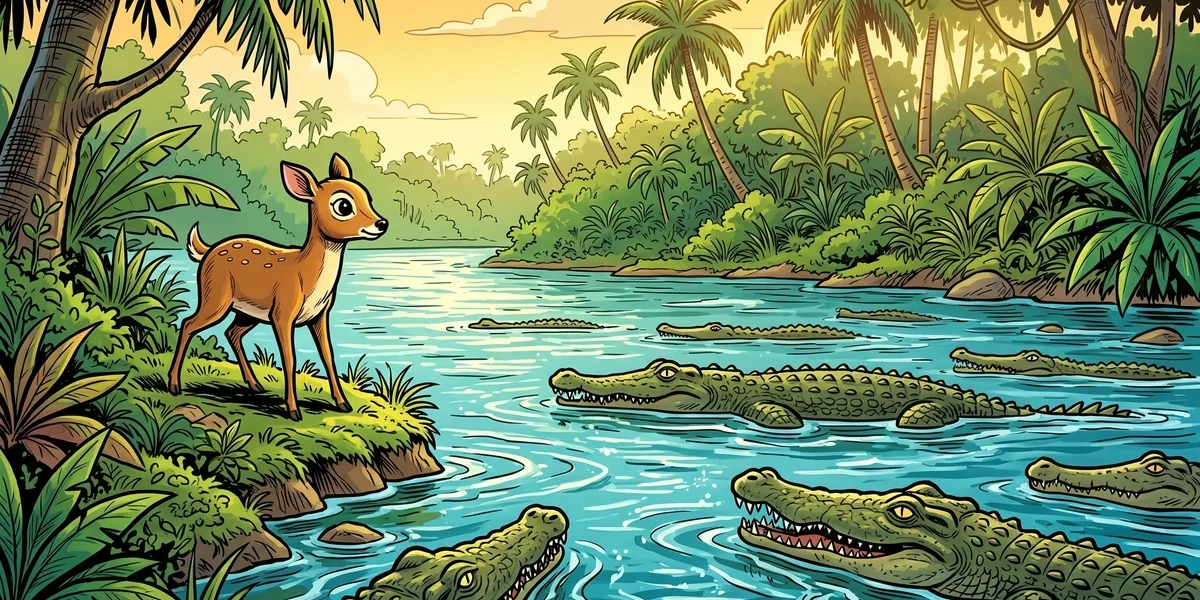
Kancil the clever mouse deer stands at a tropical river's edge, eyeing lush mango trees on the far bank
Ad Space (header)

In the trickster traditions of the Malay Archipelago, no figure is more celebrated than Sang Kancil — the Mouse Deer — whose tiny body and enormous cleverness have made him the protagonist of dozens of tales told across Malaysia, Indonesia, Brunei, Singapore, and the southern Philippines for at least a thousand years. The Kancil cycle belongs to the oldest stratum of Southeast Asian folk literature, rooted in the oral traditions of Austronesian-speaking peoples who spread across the maritime world of island Asia long before the arrival of Indian, Chinese, or Islamic cultural influence. Yet the Kancil tales are also deeply connected to the narrative traditions of India — the Panchatantra, the Jataka, and the Hitopadesha — that entered Southeast Asia with the Indianized kingdoms of Srivijaya and Majapahit from the first millennium CE onwards. The Mouse Deer who outwits the Crocodile is simultaneously an ancient Austronesian folk hero and a local avatar of the global trickster tradition.

Tiny mouse deer Kancil gazes at a sparkling river with crocodiles lurking beneath the surface
Kancil gazes longingly at the mango trees across the river.

The Story: Kancil and the River of Crocodiles

Sang Kancil lived in the deep forest of the Malay homeland, a creature of the forest understory whose small body — barely the size of a large cat — concealed a mind of extraordinary speed and inventiveness. One morning, Kancil came to the bank of a wide and swift river, on the far side of which grew a grove of mangoes, their ripe fruit visible and fragrant from where he stood. Between Kancil and the mangoes lay the river, and in the river, as Kancil well knew, lived a family of crocodiles — ancient, patient, enormously heavy, and always hungry.

Kancil stood on the bank and called out across the water: “O Crocodiles! The Raja of the Forest has ordered a census of all creatures in his kingdom. I have been sent to count you. Please come to the surface and arrange yourselves in a line from this bank to the far side, so that I may count you properly and report your number to the Raja!” The crocodiles, flattered to be the subjects of a royal census and perhaps aware that disobedience to the Raja was dangerous, surfaced and arranged themselves in a neat line across the width of the river. Kancil then walked across their backs, counting each one aloud — “One! Two! Three!” — and when he reached the far bank he turned and laughed: “I have counted you, indeed — I have counted you as stepping stones! The Raja sends his thanks!” And with that he leapt into the mango grove, leaving the crocodiles bellowing with rage at the surface of the river, their great jaws snapping at empty air.

Kancil calls out to the crocodiles, lining them up to count them across the river
Kancil tricks the crocodiles into lining up by offering to count them for the king.

The Malay-Indonesian Kancil Cycle: A Thousand-Year Tradition

The tale of Kancil and the Crocodile is not a single story but a type — one episode in an enormous cycle of Kancil tales that has been documented across the entire Malay-speaking world and deep into the Indonesian archipelago. The Malay literary tradition preserved Kancil stories in written form as early as the fifteenth century; the Hikayat Pelanduk Jenaka (“The Tale of the Clever Mouse Deer”), a Malay prose collection of Kancil episodes, circulated widely across maritime Southeast Asia in manuscript copies. Parallel Kancil traditions exist in Javanese (where the mouse deer is called Kancil in Javanese as well), Sundanese, Balinese, Bugis, and other Indonesian literary traditions, each adding local episodes and local coloring to the core cycle.

The mouse deer (Tragulus kanchil in Malay, one of the world’s smallest ungulates) is the perfect vehicle for the trickster archetype in the Southeast Asian forest context. It is prey, not predator — small, vulnerable, with no natural weapons. Its survival depends entirely on quickness of movement and quickness of mind. In choosing the mouse deer as the central trickster figure, Malay folk tradition has done something psychologically profound: it has made intelligence, not physical power, the supreme survival trait. Every child who hears the Kancil stories absorbs this lesson: size and strength can be outwitted by a clever enough mind. This message had particular resonance in a world where ordinary people — small, often powerless — faced large and dangerous forces.

The crocodile, as Kancil’s primary antagonist in many tales, is equally well-chosen. Crocodiles are real and deadly presences in the rivers of the Malay world; they represent brute power, dangerous appetite, and a kind of ancient, mindless ferocity. By repeatedly outwitting the crocodile, Kancil demonstrates that intelligence is not just morally superior to brute strength but practically more effective. The crocodile’s size, teeth, and ancient power count for nothing against Kancil’s quicker mind.

A bridge of crocodile backs stretches across the river as Kancil begins to cross
The crocodile bridge – Kancil’s path to freedom and mangoes.

Indian Connections: Panchatantra, Jataka, and the Trickster in Asian Tradition

The Kancil tradition did not develop in cultural isolation. From the first millennium CE, the Malay world was deeply penetrated by Indian literary and religious culture through the Indianized kingdoms of Srivijaya (centered in Sumatra, ca. 7th-13th centuries CE) and later Majapahit (Java, 13th-15th centuries CE). With Indian religious culture came Indian literary forms — the Panchatantra, the Jataka tales, the Hitopadesha — all of which feature animal fables as vehicles for moral and political teaching. The Panchatantra in particular, composed in Sanskrit and translated into Middle Persian, Arabic, Syriac, Greek, and dozens of other languages, is the world’s most widely translated animal fable collection, and its influence on Southeast Asian folk literature has been profound and extensively documented.

The specific narrative motif of the Crocodile Bridge episode — in which a small, clever animal tricks crocodiles (or similar dangerous water creatures) into forming a bridge — has close parallels in the Jataka tales of the Buddhist canon. Jataka No. 208 (Kacchapa Jataka) and related tales feature the Bodhisatta (the future Buddha in a previous animal birth) outwitting dangerous creatures through cleverness rather than force. The Jataka tradition was transmitted widely across Southeast Asia with the spread of Buddhism, and Kancil’s trickster intelligence shows the influence of the Jataka’s celebration of wisdom as the highest virtue. In the Theravada Buddhist kingdoms of mainland Southeast Asia — Thailand, Cambodia, Myanmar — analogous trickster-animal traditions developed in close dialogue with the Jataka cycle.

The ATU (Aarne-Thompson-Uther) tale-type index classifies the “counting as bridge” motif under several related categories, including elements of ATU 1250 (Counting Souls) and the broader trickster-outwits-stronger-creature family. Folklorists have documented this tale-type across South Asia, Southeast Asia, East Africa, and Native North America — suggesting that the basic narrative logic of wit defeating brute force is so fundamental that it arises independently in multiple cultures and also spreads through contact and trade.

Kancil the mouse deer laughs triumphantly on the far bank as angry crocodiles snap behind him
Victory! Kancil laughs at the outwitted crocodiles from the safety of the far bank.

The Social and Political Dimensions of the Kancil Tales

Scholars of Malay literature, from the nineteenth-century Dutch and British colonial collectors to contemporary Malaysian and Indonesian folklorists, have read the Kancil cycle as a form of social commentary — specifically, as a literature of the weak speaking back to the powerful. In the traditional hierarchical societies of the Malay world, where sharp distinctions of status between the aristocracy (rajas, nobles) and the common people (rakyat) structured all social life, the Kancil tales offered ordinary people a fantasy of cleverness overcoming power. Kancil routinely tricks not only crocodiles but also elephants, tigers, human rulers, and even the Raja himself — and gets away with it. His impunity is part of the genre’s pleasure: in stories, at least, the clever small creature can humiliate the powerful large one.

This social reading of the Kancil tradition has been influential in modern Malaysian and Indonesian national culture. In the post-independence period, both countries have drawn on Kancil as a symbol of resourceful, intelligent self-determination — a small nation or individual making its way in a world of larger, more powerful forces through cleverness rather than direct confrontation. Kancil appears on Malaysian currency designs, in children’s education programs, in national literature, and as a brand name (the Perodua Kancil automobile was Malaysia’s most popular compact car). In Indonesia, Kancil stories have been incorporated into national cultural heritage curricula. The trickster mouse deer has become a symbol of the national character — small but smart, humble but capable of outwitting the great.

The Moral: Intelligence as the Highest Power

At the heart of every Kancil story is a moral proposition that runs counter to the usual logic of power: that intelligence — quick, adaptive, creative intelligence — is the most powerful force in the natural and social world. Kancil does not defeat the crocodile by becoming stronger; he defeats it by thinking faster. The lesson is not that the weak should meekly accept their weakness but that weakness itself, when combined with sufficient cleverness, becomes a form of strength invisible to those who only understand power in terms of size and force.

Malay: “Akal lebih tajam daripada pedang.” (Jawi: عقل لبيه تاجم داريڤد ڤدڠ)

— Traditional Malay proverb, the animating wisdom of the Kancil cycle: “Wit is sharper than a sword.” This saying, carried through the oral tradition of the Malay world for centuries, encapsulates why Sang Kancil has been the beloved hero of Southeast Asian children’s literature across a dozen cultures and a thousand years.

The Kancil moral is also a moral about honesty — or rather, about the ethics of necessary deception. Kancil lies to the crocodiles, and the story presents this as not merely excusable but admirable. This reflects a tradition of ethical thought, present in the Panchatantra as much as in the Malay oral tradition, that distinguishes between harmful deception (lying to exploit or harm the innocent) and protective deception (using wit to survive against predatory power). Kancil never deceives the harmless; he deceives only those who would eat him. The trickster’s ethics are situational: cleverness in the service of survival is virtue, not vice.

Why This Story Has Lasted: The Trickster’s Universal Appeal

The Mouse Deer and the Crocodile has been told continuously for at least a millennium across the Malay-Indonesian world, and its survival is not accidental. The story fulfills a function that every human society requires: it gives the small and vulnerable a template for surviving in a world dominated by larger and more powerful forces. In every generation, children who hear Kancil’s stories internalize the lesson that brains matter more than brawn — a lesson that remains relevant regardless of the century, the culture, or the specific dangers faced.

The tale has also survived because of its narrative perfection. It is brief, clean, and complete: danger established, solution invented, trick executed, escape achieved. There is no wasted material, no unnecessary character, no narrative loose end. This economy of storytelling — which the Panchatantra tradition calls niti wisdom, practical intelligence expressed in compact narrative form — makes the Kancil story easy to tell, easy to remember, and infinitely retellable across generations, languages, and cultural contexts. As long as there are rivers, and as long as there are dangers on the far bank and cleverness on this one, Sang Kancil will make his crossing, and the crocodiles will bellow with impotent rage at the empty air.

Ad Space (in-content)
Ad Space (after-content)

Get a New Story Every Week!

Join thousands of parents and teachers who receive our hand-picked folk tales every Friday. Stories with morals your kids will love.

Free forever. No spam. Unsubscribe anytime.