Little Anklebone
Little Anklebone: Once upon a time there was a little boy who lost his parents; so he went to live with his Auntie, and she set him to herd sheep. All day long
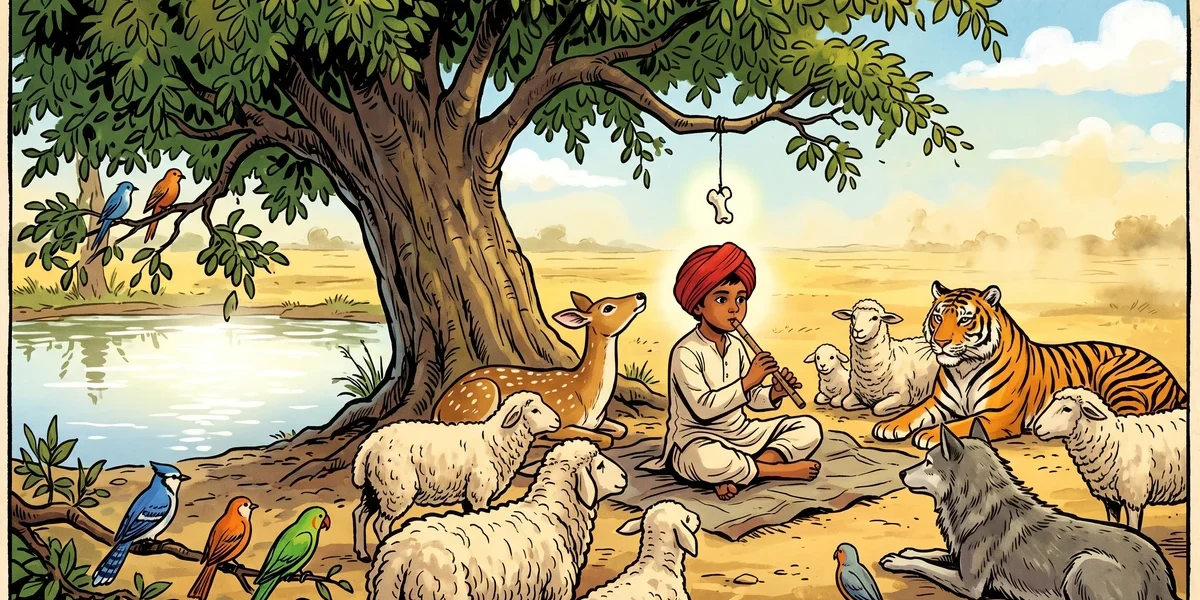
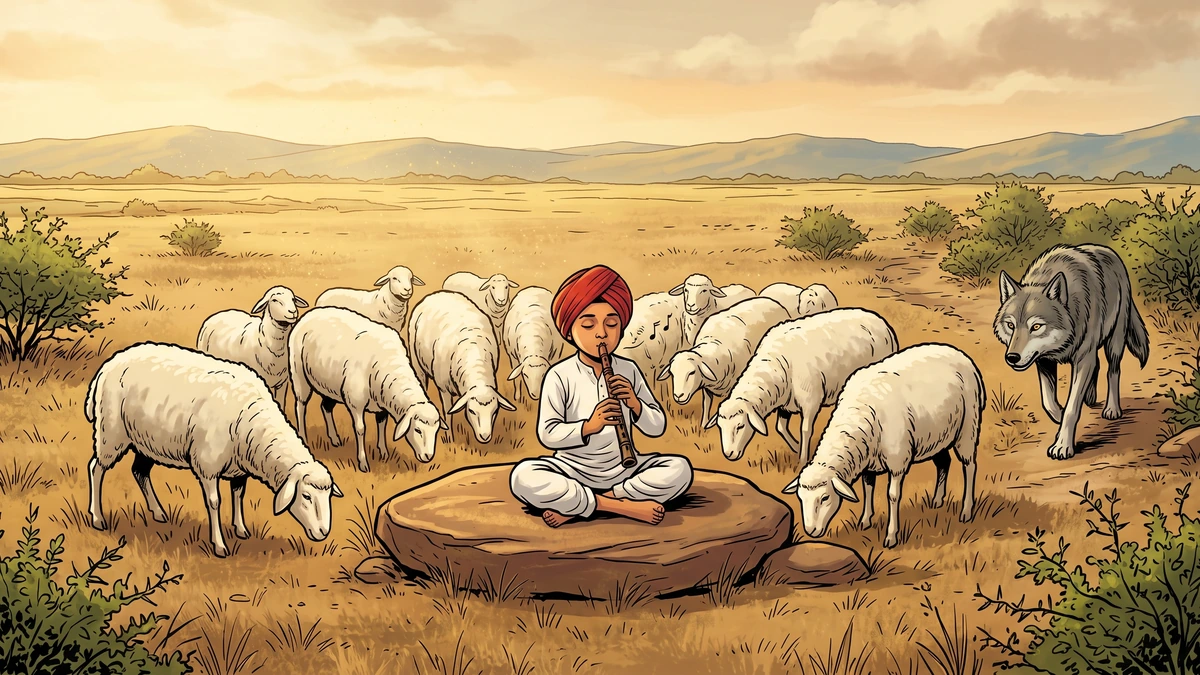
“Little Anklebone” is one of the strangest and most haunting stories in the Punjabi folk repertoire — a tale in which a small shepherd boy is eaten by a wolf, and yet, somehow, the story does not end there. A single bone, hung in a tree, becomes the hero. It plays a pipe so sweetly that birds of the air, beasts of the forest, and fishes of the pond gather to listen. A pond of water turns to a pond of milk. Robbers are routed. A king’s pursuit fails. And the small voice that pipes from a tree on the open plain becomes, in the imagination of Punjabi cattle-drovers, a kind of guardian of the wilderness — a tiny, persistent music that the world cannot silence and cannot capture.
The story was recorded by Flora Annie Steel in Tales of the Punjab Told by the People, first published in London by Macmillan in 1894, with scholarly notes by Major R. C. Temple and illustrations by J. Lockwood Kipling (father of Rudyard Kipling). Steel’s annotation locates the tale precisely: it was current in the Bâr, the dry pastoral wilds of the Gujrânwâlâ District of the Punjab, and was told among the children of cattle-drovers. Temple, comparing the tale to Grimm’s “The Singing Bone” (KHM 28), classified it as belonging to the great international tale-type later catalogued as ATU 780, “The Singing Bone”, in which a victim’s remains continue to speak, sing, or testify after death. But “Little Anklebone” is no simple murder-revealed-by-music tale: it is gentler, more pastoral, and ends not with retribution but with quiet refusal. The bone does not accuse the wolf. It chooses, instead, to become a small, persistent music in the empty plain.
The Boy of the Bâr
The story opens in a landscape that any Punjabi child of the late nineteenth century would have recognised at once — the Bâr, the open scrub plain that stretched between the Chenab and the Ravi. There, an orphaned boy lives with his Mâsî, his maternal aunt, who has taken him in and set him to herd sheep. The Punjabi word for the boy in Steel’s source manuscript is Gîrî, a diminutive of gittâ, “anklebone,” and in the original telling he calls himself Gitetâ Râm — Anklebone-Ram, a half-affectionate, half-prophetic nickname. R. C. Temple notes that this is “an interesting instance of the process of the formation of Panjâbî proper names”: the boy is named for the very bone that will outlive him.
Day after day, barefoot, he wanders the pathless plain with his flock and plays his tiny shepherd’s pipe from morning until evening. The pipe is not a poetic flourish. In Punjabi pastoral life, the shepherd’s reed pipe — the algoza or bansurî — was a working instrument: it kept the boy company, soothed restless animals, and let other shepherds know where their friends were grazing. The detail that a small orphan, alone in a vast landscape, makes music is the story’s first quiet assertion of his worth. He is not weeping. He is not running away. He is keeping the flock and keeping the song.
Then the wolf arrives. In the Bâr, wolves were not symbolic; they were a real and constant threat to flocks and sometimes to children. The wolf’s question — “Little boy! shall I eat you, or your sheep?” — sounds, to a modern ear, like a riddle out of a darker fairy tale. To a Punjabi cattle-drover’s child, it had a more practical resonance: the wolf is bargaining, and any bargain in the Bâr was a thing to be referred home. The boy’s polite reply, “I don’t know, Mr. Wolf; I must ask my Auntie,” is not naivety. It is the proper conduct of a child who knows that decisions of property and life belong to the household head, not to him.
The Bargain Kept
The Mâsî’s verdict — sharp, immediate, devastating — is the story’s moral pivot. She looks at “the wee little shepherd, and at the fat flock,” and says, “Which shall it be? — why, you, of course!” In four small words she chooses property over kin, livestock over life. Steel’s recording leaves the line unsoftened. There is no sigh, no second thought, no scene in which the auntie repents. The story refuses, in this moment, to perform sentimentality. The Bâr is a poor country, and a poor woman with a fat flock has weighed the orphan against the sheep and found him lighter.
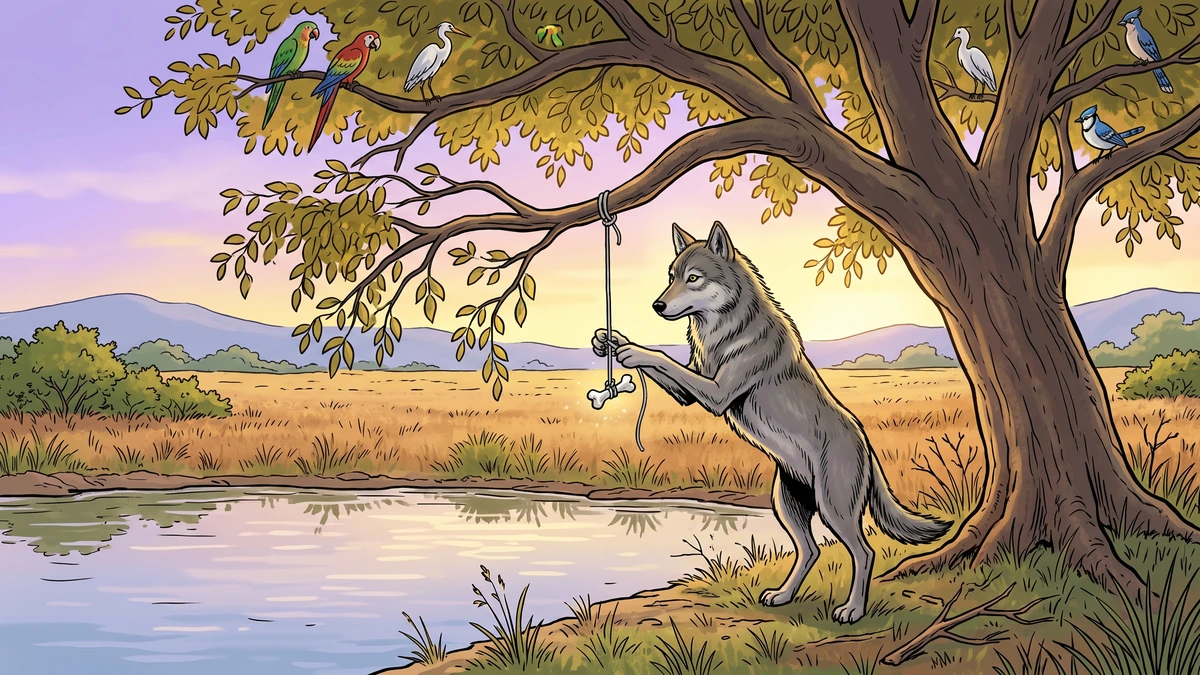
What follows is the most extraordinary passage in the tale. The boy, accepting the verdict, returns the next morning to the wolf and reports it: his auntie says you are to eat me. The wolf, “savage as wolves always are, could not help having just a spark of pity for the tiny barefoot shepherd who played his pipe so sweetly,” and asks if there is anything he can do for the boy after the meal is done. The request is small and oddly precise. After the bones are picked, the wolf is to thread the anklebone — the gîrî — on a string and hang it on the tree that weeps over the pond. The boy does not ask to be spared. He does not curse his auntie. He arranges for his own continuance in the only form he can imagine: a small bone, swinging in the wind, on the only tree on the plain.
The tree itself is a botanical specific. R. C. Temple identifies it as the ban, Salvadora oleoides, the toothbrush tree of the Punjab forests — a hardy, drooping evergreen that thrives in saline, dry country, often the only shade for miles. To hang an anklebone on a ban by a pond was, in effect, to mark a place: a child’s small relic in the one shade-giving tree on a featureless plain. In a landscape without churches, without graveyards, without monuments, the ban tree becomes a kind of impromptu shrine. The wolf keeps the bargain. The bone is hung. It “danced and swung in the sunlight,” and the open plain, which has just consumed a boy, now keeps a small, swinging memorial of him.
The Robbers, the Treasure, and the Milken Pond
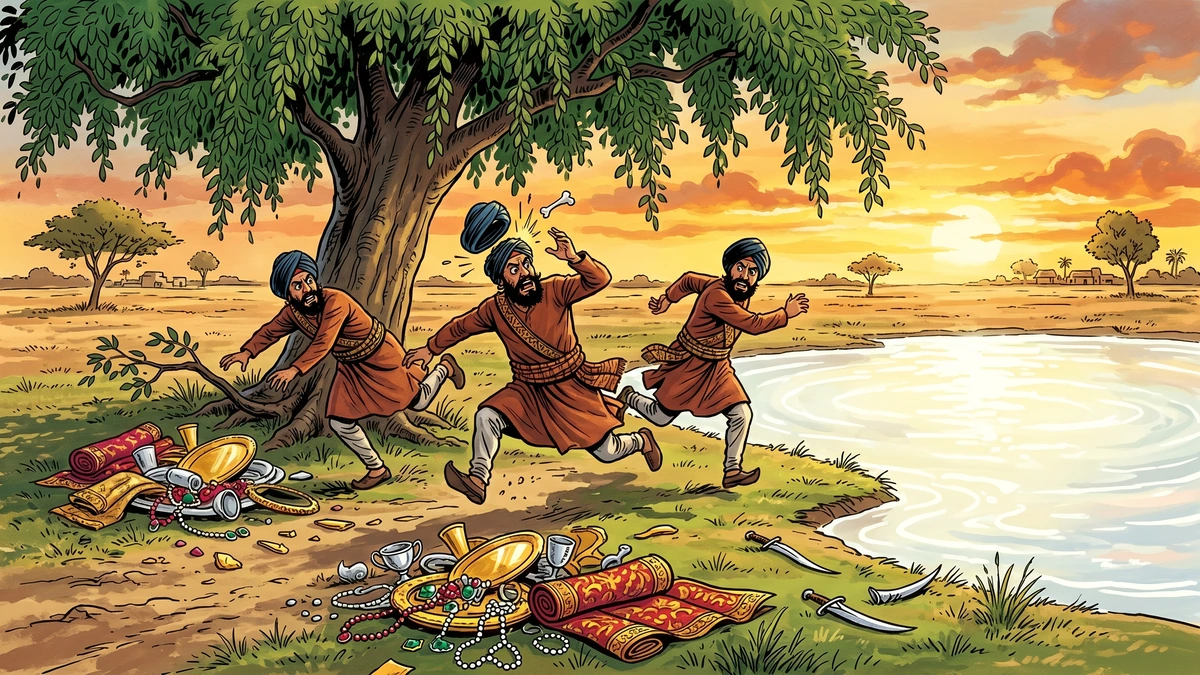
From this point, “Little Anklebone” turns from elegy to wonder. Three robbers, having just plundered a palace, sit beneath the ban tree to divide their spoil. They arrange the gold dishes, the precious jewels, and the costly stuffs into three heaps. At the very moment a jackal howls — and Steel’s narrator pauses to instruct the listener: “you must know that thieves always use the jackal’s cry as a note of warning” — Little Anklebone’s thread snaps. He falls plump on the head of the chief robber, who, taking the small impact for a thrown stone, shouts, “Run! run! — we are discovered!” and the three of them bolt away across the plain, leaving the treasure to the bone.
“Now,” said Little Anklebone to himself, “I shall lead a fine life!”
It is one of the most charming sentences in Punjabi folk literature. There is no grief in it, no resentment, no plotting against the wolf or the auntie. The bone has been given, by accident or providence, a treasure and a tree and a pond, and he simply intends to enjoy them. He gathers the spoil, sits beneath the drooping ban, and plays a new shepherd’s pipe so sweetly that “all the beasts of the forest, and the birds of the air, and the fishes of the pond came to listen to him.”
The marvel deepens. He sets out marble drinking-troughs — Steel’s translator’s note specifies the original word as daurâ, a wide-mouthed earthen vessel and, in palace usage, a marble drinking-trough for animals — around the pond. In the evenings, the does, the tigresses, and the she-wolves come to be milked. He drinks his fill and pours the rest into the pond, until the pond itself becomes a pond of milk. The image is among the most striking in any Indian folk tale: a small bone, on a tree, beside a pond of milk, surrounded by birds and beasts and fishes, all listening to a pipe that should not, by any natural law, be playing at all.
The pond-of-milk motif has deep roots in South Asian religious imagination. Sanskrit cosmology preserves the kshîra-sâgara, the Ocean of Milk, churned by gods and demons in the Mahâbhârata and the Bhâgavata Purâna to produce the elixir of immortality. Vaishnava devotional traditions speak of gokul, the cowherd realm where milk and music belong together, and where Krishna’s flute draws creatures into a circle around him. “Little Anklebone,” recorded among Punjabi cattle-drovers, retells this dream of a milk-rich, music-quieted world in pastoral miniature. The Krishna echo is unmistakable: a small piper, beneath a tree, surrounded by listening creatures, with milk as the visible sign of grace.
The Pipe That Cannot Be Caught
The fourth and final movement of the story is a refusal. An old woman, passing with her water-jar, hears the pipe, follows the sound, and finds the milken pond. Anklebone calls down from the tree — “Fill your jar, mother! All drink who come hither!” — and she fills it and goes on her way. On the road she meets the King of that country, a-hunting and lost in the pathless plain, half dead with thirst. He drinks her milk, hears her tale, and decides at once that he must have the tiny piper, “if I die for it!”
The King’s chase is the story’s great refusal. The bone runs. He hides among the briars and thorns. The King, scratched and bleeding, will not give up. At last he catches the small piper in his hand — and it is at this moment that the world itself rises in protest. The clouds above thunder and lighten. The does below low for their absent milker. And from Anklebone’s own small voice comes a verse that R. C. Temple preserves in the original Punjabi:
Kyûn garjâe badalâ garkanâe?
Gaj karak sâre des;
Ohnân hirnîân de than pasmâe:
Gitetâ Râm gîâ pardes!“Why echo, O thundering clouds? / Roar and echo through all the land; / The teats of the does yonder are full of milk: / Gitetâ Râm has gone abroad!”
It is, in Punjabi pastoral verse, a small but perfect lament: clouds rolling overhead, does waiting unmilked in the dusk, and a piper carried out of his country. The King hears it. He looks down at what he has caught, and Steel’s sentence is exact: “he saw it was nothing but a bone after all.” Pity fills him. He lets the bone go, and Little Anklebone runs back to his seat under the tree by the pond. “And there he sits still, and plays his shepherd’s pipe, while all the beasts of the forest, and birds of the air, and fishes of the pond, gather round and listen to his music. And sometimes, people wandering through the pathless plain hear the pipe, and then they say, ‘That is Little Anklebone, who was eaten by a wolf ages ago!'”
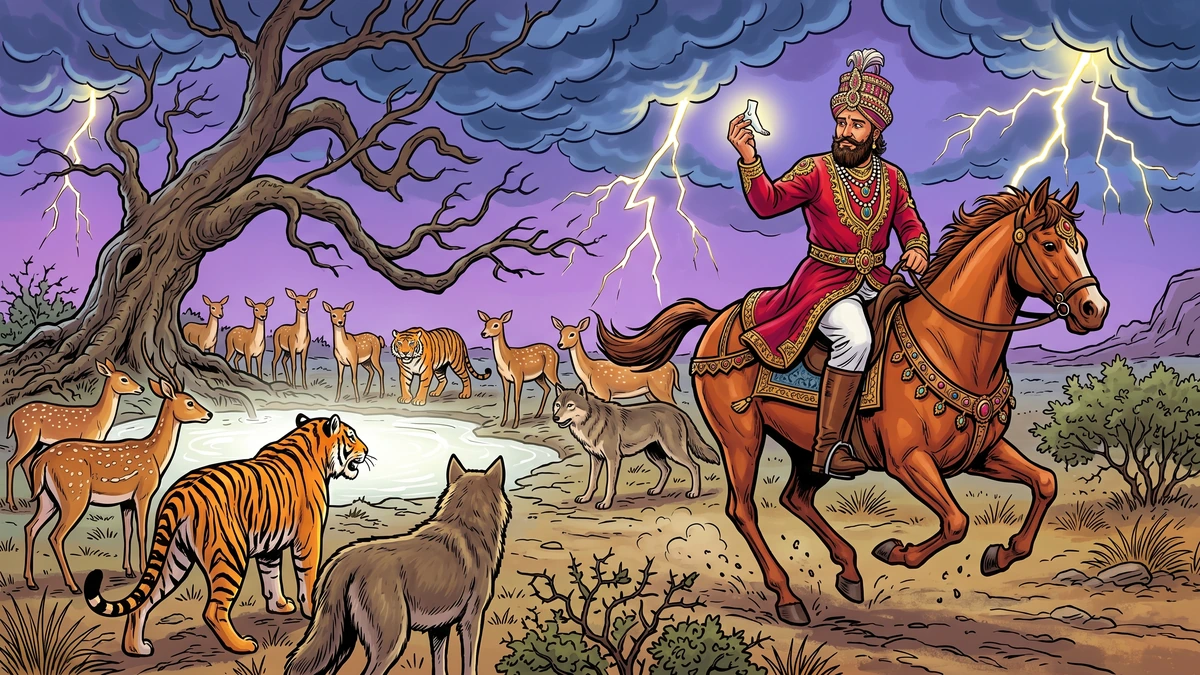
The ending is one of the most original in the entire Indian folk corpus. The villain — the wolf — is not punished. The auntie is never confronted. There is no court, no sword, no marriage to a princess, no restoration of the boy to flesh. The story refuses the consolations both of justice and of resurrection. What it offers instead is a small, persistent music in a place where music does not belong, a pond of milk in a country of dust, and the conviction — passed quietly from cattle-drover to cattle-drover, from grandmother to grandchild — that the smallest lives leave behind a sound the world cannot quite drown out.
Moral
The moral of “Little Anklebone” is not the obvious one — it is not a warning against cruel guardians, nor a lesson in revenge. The story refuses both. Its quieter teaching is this: what is small, given freely and without bitterness, becomes greater than what tried to consume it. The boy is given up, but he gives himself; the wolf eats him, but cannot keep him; the auntie chooses property, but ends with neither boy nor music; the King hunts the piper, but finds in his hand only a bone. The treasure of the robbers becomes the bone’s; the pond of water becomes a pond of milk; the lonely plain becomes a court of birds and beasts and fishes. Every act of seizure in the story shrinks the seizer; every act of generosity expands the giver.
R. C. Temple, in his note on the tale, suggests that “the story seems to point to a belief in some invisible shepherd, a sort of Spirit of the Bâr, whose pipe may be heard.” That, finally, is the lesson Punjabi cattle-drovers told their children to keep: that even in the harshest country — orphaned, eaten, hung in a tree — a kind heart and a steady song outlast the things that tried to take them. Or, as the Punjabi original sings of the small piper carried away:
Gitetâ Râm gîâ pardes!
“Gitetâ Râm has gone abroad!” — and yet the music remains.
Why This Story Has Lasted
“Little Anklebone” has lasted for the same reason it puzzled R. C. Temple in 1894: it is unique. Among the dozens of Indian folk tales Steel recorded — of clever wives, of greedy kings, of animal fables in the Panchatantra mode — this one stands alone. It is not a moral fable in the Sanskrit didactic tradition; it is not a heroic romance like the Raja Rasalu cycle that fills the rest of Steel’s volume; and it is not, strictly, a Singing Bone tale of crime and disclosure. It is something stranger and softer: an elegy in pastoral disguise, a child’s prayer that the smallest things should not be lost. In its insistence that a bone may keep on piping, that a pond may keep on giving milk, that a song may outlast the singer, “Little Anklebone” speaks to anyone who has ever feared being forgotten — which is to say, to anyone at all.
The tale also lasted because of the company it kept. Tales of the Punjab Told by the People, illustrated by J. Lockwood Kipling and annotated by R. C. Temple, became one of the most influential English-language collections of Indian folklore of the colonial era. Through it, “Little Anklebone” reached generations of English-speaking readers — children at first, then folklorists, then comparative literature scholars who placed it beside Grimm’s “Singing Bone” and the Welsh and Scottish ballads of the talking corpse. But its truest home remained the Punjabi plain. Cattle-drovers still walked their beasts past the lone ban tree. The algoza still sounded in the dusk. And somewhere in the listening — in the dry wind, in the thunderhead before rain, in a small unaccountable music heard at the edge of the flock — Little Anklebone, a child of the Bâr eaten ages ago, was still playing.
For the modern reader, the story’s gift is the clarity of its small voice. In a culture saturated with stories of revenge and triumph, “Little Anklebone” tells a quieter and rarer truth: that kindness is a kind of immortality, that song outlasts violence, and that the smallest of things, given freely, can become the centre around which a whole world quietly arranges itself to listen.
Frequently Asked Questions
**Q: Why is this story important?**
You May Also Like
 Indian Folk Tales
All Ages
Indian Folk Tales
All Ages
A Lesson for Kings
A Lesson for Kings: Long ago, in the prosperous kingdom of Magadha, there ruled a mighty king named Brahmadatta. He was powerful, commanding vast armies and
 Indian Folk Tales
All Ages
Indian Folk Tales
All Ages
Why Brahma Cannot Eat in the Dark
Why Brahma Cannot Eat in the Dark: Among Hindûs, especially among Brâhmaṇs of the Madras Presidency - and I now see from personal observation that it is the
 Indian Folk Tales
Ages 6-8
Indian Folk Tales
Ages 6-8
The Legend of Mount Mayon: A Love Written in Stone and Fire
The Legend of Mount Mayon: A Love Written in Stone and Fire: In the Philippines, where the islands rise like emeralds from an azure sea, there stands a