The Goblin’s Magic Bat (Dokkaebi)
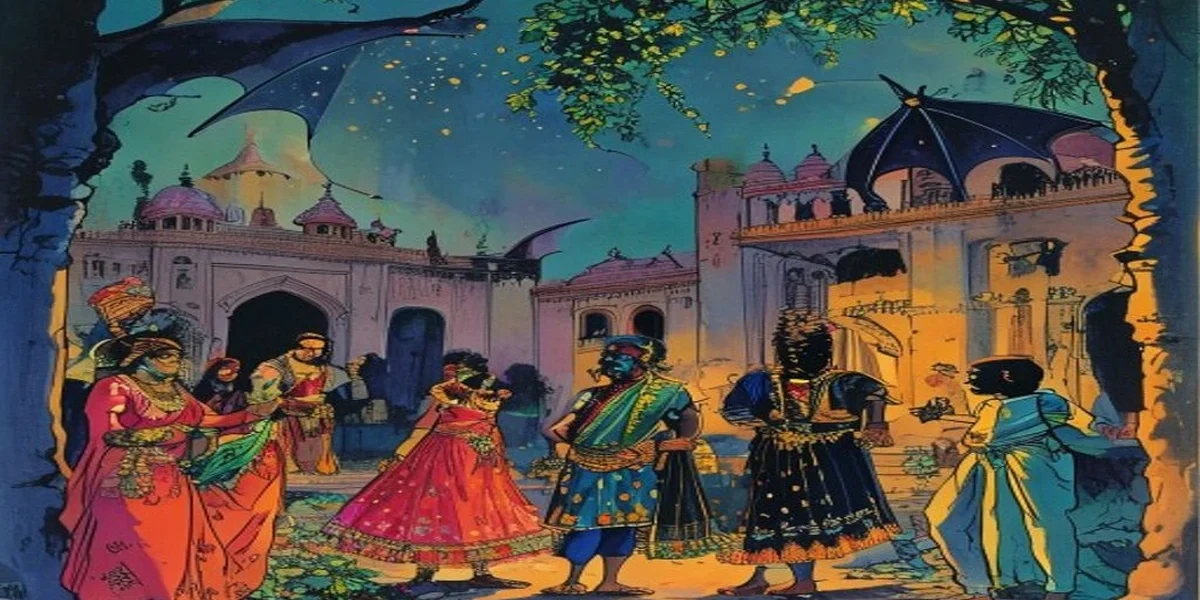
The Goblin's Magic Bat (Dokkaebi): In the mountains of Korea, where mist clung to the peaks like ancient dreams and the forest held secrets older than memory
Origin & Tradition
The Goblin’s Magic Bat belongs to the rich Korean tradition of dokkaebi (도깨비) tales — stories featuring Korea’s distinctive supernatural beings, which are neither demons nor gods but something closer to embodied vital force. Unlike the oni of Japanese tradition or the demons of Buddhist cosmology, the dokkaebi is characterised by its unpredictability, its delight in human company and human games, and its habit of wielding a dokkaebi bangmangi (도깨비 방망이, goblin club) that manifests whatever its wielder requests. Tales of this club form a sub-genre of dokkaebi folklore, and the pattern — generous person enriched, greedy person punished by the same mechanism — appears in dozens of regional variants with different specifics but identical structure.
Beat I — The Man Who Wasn’t Afraid
A poor farmer, cutting wood in the mountains at dusk, hears sounds from a ruined hut nearby. Rather than flee, he investigates — and finds a dokkaebi playing alone, swinging its club and calling out requests that materialise in a flash: rice, silk, gold coins, which appear and vanish as the dokkaebi tosses them away and calls for more. The dokkaebi is bored with its own abundance. What it wants is a companion.
The farmer sits down. They wrestle — the dokkaebi loves wrestling — and drink makkeolli (rice wine) together until late. The dokkaebi is delighted by a human who is not terrified of it. Before parting, as a gesture of genuine affection, it gives the farmer its bangmangi: “Whatever you need, say it aloud and tap the club. But use it sparingly — the club reads what you carry inside.”
The farmer takes the club home. He taps it gently and asks for enough rice to feed his family through winter. Rice appears — exactly enough. He does not ask again until the rice is gone.
Beat II — The Neighbour Who Heard
A wealthy neighbour hears what happened and determines to acquire a bangmangi of his own. He goes to the ruined hut, finds the dokkaebi, and does what the farmer did — except that he is terrified throughout, his friendliness performed rather than felt, his wrestling halfhearted. The dokkaebi, sensitive to the quality of company it keeps, gives him a club anyway — not out of genuine warmth but because the dokkaebi is curious about what will happen.
The neighbour runs home and begins immediately: gold, silk, warehouses full of grain, a new house, a fleet of horses. Each tap produces what he names, but each arrival reveals the inadequacy of the previous request — there is always something more to want. He taps through the night. By dawn the club is tapping on its own, producing not what he asks but the inverse: his gold disappears, his silk rots, his new house develops cracks, his horses bolt. He taps faster, asking for the losses to stop, and the club accelerates. By morning he has less than he started with.
Beat III — The Dokkaebi as Numinous Amplifier
Korean folk tradition is careful about what the dokkaebi is and is not. It is not a moral authority — it does not judge the neighbour and decide to punish him. It is a concentration of gi (기, vital force), and its bangmangi is a technology that works by resonance with the gi of its wielder. What you carry into the club’s operation determines what the club amplifies. The farmer carries a sim (heartmind) oriented toward sufficiency — he has always wanted enough rather than more-than-enough — and the club resonates with that orientation. The neighbour carries a sim oriented toward accumulation beyond any possible use, and the club resonates with that too: it produces abundance that immediately reveals itself as inadequate, which produces the next request, which produces the next inadequacy, in an accelerating spiral that ends in collapse.
This is the dokkaebi’s characteristic mode: not retribution but revelation. The club does not punish the neighbour for greed; it shows him what greed actually is when given unlimited power to express itself. Unlimited accumulation without a satisfaction threshold is not a path to happiness — it is a closed loop that feeds on itself. The dokkaebi is curious about this, which is why it gave the club to someone it knew would demonstrate the pattern clearly.
Beat IV — Abundance as Diagnostic
The tale makes an observation that Korean audiences across centuries have recognised as true: how a person responds to sudden abundance is not shaped by the abundance — it is shaped by what the person was already carrying. The farmer, given unlimited access, requests exactly what he needs and stops. This is not virtue performed for an audience; it is the natural expression of a sim that was already calibrated toward sufficiency. The neighbour, given the same access, discovers that no amount satisfies him, which is not a new problem the club created but an old problem the club made visible.
The dokkaebi bangmangi is therefore a diagnostic instrument as much as a wish-fulfilling device: it shows you what you already are by giving you everything you say you want. This is also why the dokkaebi gives the club to the neighbour with curiosity rather than reluctance — it wants to see what the human carries, because understanding what humans carry is the dokkaebi’s primary interest in the species.
“Wealth given freely to the generous multiplies; wealth seized by the greedy reverses — not because fortune is moralistic but because what you carry into abundance reveals the quality of what you already are, and the bat only amplifies that.”
Why This Story Lasted
The tale endures because the dokkaebi is an irresistible figure — chaotic, funny, genuinely fond of humans, impossible to categorise — and because its club articulates something people have always known: that more of what you have does not produce more satisfaction if the satisfaction was never what you actually had. The dokkaebi bangmangi is a folk-tradition thought experiment about what unlimited resources reveal about the person who holds them.
The Dokkaebi in Korean Culture
The dokkaebi appears throughout Korean art, literature, and contemporary popular culture — most recently in a popular 2016 television drama that reframed the goblin as a tragic immortal figure. In traditional folk belief, dokkaebi were associated with objects that had absorbed enough human use and vital force to develop consciousness — old brooms, worn tools, discarded household items. The bangmangi (goblin club) is typically depicted as a gnarled stick studded with spikes, and it appears in children’s cartoons, brand logos, and sports mascots across Korea.
Frequently Asked Questions
What is the moral of The Goblin’s Magic Bat?
The club amplifies what its wielder already carries. Sufficiency-minded people produce sufficiency; accumulation-driven people produce an accelerating spiral that ends in collapse. The story’s point is not that greed is punished but that unlimited access to what you want reveals whether what you want can ever be enough — and for some people, it cannot.
What is a dokkaebi and how does it differ from Western goblins?
The dokkaebi is a Korean supernatural being born from objects that have absorbed sufficient human vital force. Unlike Western goblins (malevolent tricksters) or Japanese oni (demons of punishment), the dokkaebi is characterised by playfulness, genuine fondness for humans, and a chaotic energy that is neither good nor evil — it is curious, strong, and operates by its own logic of resonance with human gi (vital force).
Why does the dokkaebi give the club to the neighbour if it knows what will happen?
Because the dokkaebi is curious. Understanding what humans carry inside — and what happens when that interior orientation is given unlimited expression — is the dokkaebi’s primary interest in human beings. It gives the club not to punish but to observe. The collapse the neighbour experiences is not the dokkaebi’s intention; it is its experiment.
What does the dokkaebi bangmangi symbolise?
As a narrative device, the bangmangi is a diagnostic tool: it reveals the quality of the heartmind (sim) that wields it by amplifying that quality without limit. As a cultural object it represents the Korean folk-tradition understanding of gi (vital force) — the principle that all things, including tools and objects, can accumulate and express the energy of human use and intention.
How does this tale differ from the Heungbu and Nolbu story?
Both involve generous and greedy figures receiving different outcomes from the same mechanism. The key distinction is the agent of differentiation: in Heungbu-jeon, the swallow’s gourds respond to the quality of the original act (genuine healing vs. deliberate breaking); in the dokkaebi tale, the club responds to the quality of the wielder’s ongoing sim (sufficiency-orientation vs. accumulation-drive). One story is about the ethics of action; this one is about the structure of desire.
You May Also Like
 Korean Folk Tales
Ages 6-8
Korean Folk Tales
Ages 6-8
The Brave Magistrate
A brave magistrate catches a thief who steals from homes. By showing courage and compassion, he discovers the thief's sad story.
 Korean Folk Tales
All Ages
Korean Folk Tales
All Ages
Cheung Puk-Chang, The Seer
Cheung Puk-Chang, The Seer: The Yol-ryok Keui-sul, one of Korea’s noted histories, says of Cheung Puk-chang that he was pure in purpose and without selfish
 Korean Folk Tales
All Ages
Korean Folk Tales
All Ages
The Mirror That Made Trouble
The Mirror That Made Trouble: The city of Seoul lies near the Han river, which flows all the way across Korea from the high mountains to the level sea. The