Old Timber Top
In Kang Wen, River Meadow province, forest fairies and Old Timber Top teach that greed and the desire to conquer nature lead only to loss and destruction.
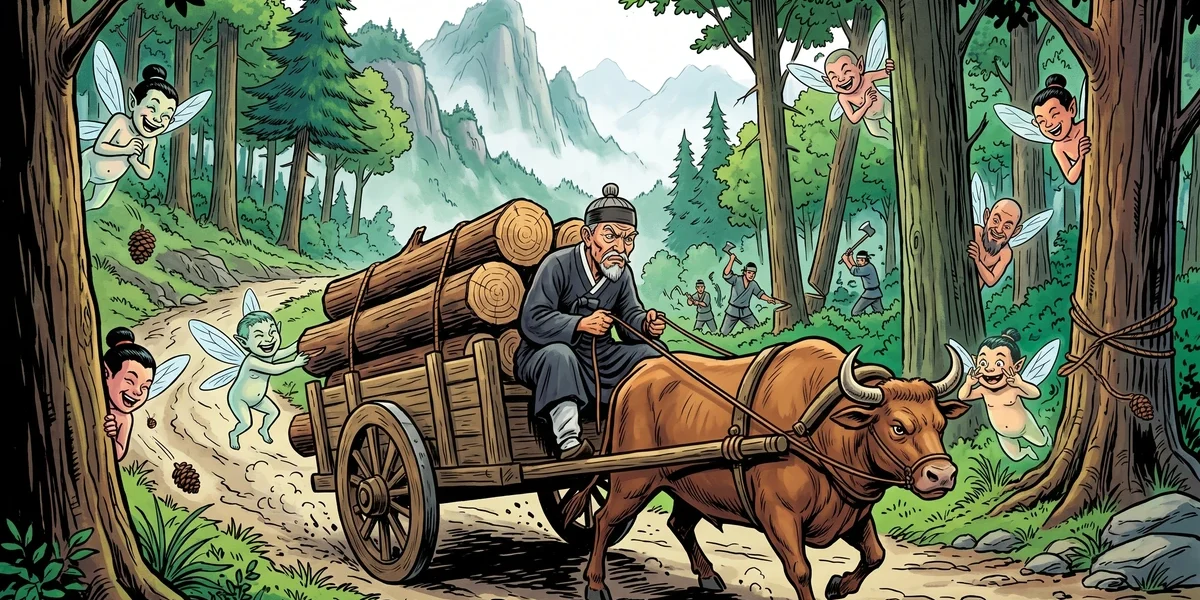
The Man Whose Head Would Not Turn
Korean village storytelling has always had a particular fondness for the figure of the obstinate elder — the old man whose principles are so solidly maintained that they have calcified into something resembling furniture. These characters are not villains; they are beloved fixtures of the community, as reliable and as immovable as the great pine at the village entrance. Their stories are told with affection and with laughter, and the laughter is not cruel. It is the laughter of a community that understands the particular difficulty of living alongside someone whose convictions have turned to timber — and that has developed the particular wisdom of finding ways around the obstruction while leaving the timber standing.
Old Timber Top — the name Korean storytellers gave to the archetypal figure of the unyieldingly rigid elder — is this character at his most fully developed. His story explores what Korean folk tradition understood as the distinction between two things that can look very similar from outside: gojibi (고집이), principled stubbornness that holds to genuine values, and wanggoham (완고함), inflexibility so total that it damages the relational fabric it was originally meant to protect. The village around Timber Top has learned, over decades, exactly where that line falls in his particular case. Their methods of navigation are the story’s real subject.
Beat I — Old Timber Top and His Principles
Old Timber Top had lived in his village for seventy years and had formed his opinions about how things should be done during the first twenty of them. He had then spent the remaining fifty years applying those opinions with complete consistency to every situation that arose. He was not cruel or selfish — his principles were, for the most part, reasonable ones. He believed that promises should be kept, that older people should be treated with respect, that debts should be repaid promptly, and that the morning should begin with the ancestral rites performed correctly before any other business was attended to. On these points he was unwavering, admirable, and frequently right.
His difficulty was that he applied the same unwavering consistency to opinions that were somewhat less reasonable. He believed that the direction in which rice should be stirred during cooking was fixed and inviolable. He believed that visitors should arrive at the precise hour they had stated and not a moment earlier or later. He believed that the path between his house and the village well ran exactly where it had run when he was young and that alterations to it, however slight and however practical, constituted a form of cosmic disorder. He also believed, most crucially, that once he had expressed an opinion on any matter — however trivial — changing it was a form of dishonesty.
This last conviction was what his neighbours called his timber quality: once a position had been taken, it was load-bearing structure. It could not be adjusted without the whole edifice coming down. The man himself experienced this as integrity. His neighbours experienced it as a source of exhausting entertainment.
Beat II — The Episodes That Defined Him
The tales told about Old Timber Top invariably follow the same comic architecture: a situation arises that any reasonable person could resolve by the simple expedient of minor flexibility; Timber Top instead applies his principles with complete rigidity; a problem results; the community finds an oblique solution that both resolves the problem and preserves Timber Top’s sense that his position was never actually challenged.
In one famous episode, Timber Top had declared on a Monday morning that the following Saturday would be a fine day for threshing. By Friday afternoon it was clear to everyone — including Timber Top, though he would not say so — that Saturday would bring heavy rain. The neighbours needed to thresh before the rain arrived; waiting for Saturday would ruin the grain. Timber Top, who had committed to Saturday, could not agree to Thursday. He was asked if he would mind if the neighbours borrowed his threshing floor to do some of their own threshing on Thursday evening, purely for their own convenience, and if he happened to notice that this also disposed of his own grain in the same motion, he should feel free to consider it an accident. Timber Top sat inside his house on Thursday evening, heard the sounds of threshing, and said nothing. Saturday came. It rained. Timber Top observed that the grain was already threshed and that this was as he had intended.
In another episode, Timber Top had quarrelled with a neighbour over the exact boundary between their vegetable plots — a disagreement of perhaps two handspans of earth — and had declared, with full finality, that he would sooner leave the disputed strip uncultivated than concede a single inch. The strip lay bare for two seasons while both plots produced everything else generously around it. A third neighbour, on a visit, casually planted the strip with gourds, explained that he was simply using unused ground as any sensible person would, and offered to split the harvest equally between Timber Top and his opponent. Both accepted. The original dispute was never mentioned again. The strip produced fine gourds. No one had conceded anything.
Beat III — The Community Wisdom of Circumnavigation
What makes these stories more than simple mockery of an obtuse old man is the quality of the community’s response to Timber Top’s rigidity. They do not attempt to change him. They do not lose patience with him, or exclude him from community life, or treat his obstinacy as a problem to be solved by confrontation. They work around him — with considerable ingenuity, and with a care for his dignity that the solutions are specifically designed to protect. Each workaround is constructed so that Timber Top’s stated position is technically never violated. He never had to admit he was wrong. He never had to bend. The community bent on his behalf, found the path that led to the same practical destination while leaving his position intact, and continued to include him fully in the village’s life.
This approach reflects a distinctly Korean folk understanding of community maintenance. The village is not a collection of individuals who interact contractually — it is a web of relationships with deep history, shared labour, and accumulated obligation. A person like Timber Top cannot simply be reasoned into flexibility; his character is fixed, as his neighbours have understood for decades. The question is not how to change him but how to remain in genuine relationship with him as he is. The answer the community finds is creative accommodation — a form of care expressed through the willingness to do the extra work of finding the oblique path so that a rigid person can remain a full member of the community without either changing or being excluded.
Korean folk tradition sees this communal flexibility as a form of jeong (정) — the deep relational warmth that sustains long-term community bonds. Jeong is not a sentiment but a practice: the accumulated small acts of accommodation, patience, and continued inclusion that constitute a genuine relationship over time. The community’s elaborate workarounds for Timber Top are expressions of jeong, as much as any more obviously tender gesture. They say: you are impossible, and we have no intention of going anywhere.
Beat IV — What Timber Top Gave Back
The stories of Old Timber Top are not purely comic at his expense. They also record what his rigidity, at its best, gave the community. When there was pressure from outside — from a tax collector pushing for more than was owed, from a stronger village trying to encroach on shared fishing rights, from a merchant proposing terms that would disadvantage the whole community over time — Timber Top was the person the village put forward to negotiate. Not because he was clever or diplomatic — he was neither — but because he was incapable of being moved by social pressure, flattery, or implied threat. He had one position, arrived at by his own lights, and he held it. No amount of charming argument or implied social consequence could shift him. In these situations, the very quality that made him exhausting in domestic matters made him formidable in adversarial ones.
His neighbours understood this. The man who drove them to creative extremes over two handspans of vegetable plot was the same man they relied on to hold the line when the line mattered. His timber quality was not merely comic inconvenience; it was a genuine community asset when properly deployed. The village that had learned to work around him had also learned when not to — when to place him precisely in the path that needed an immovable object.
“The man whose head is timber cannot be bent by wind. Plant him where the wind is trouble.” — Korean village saying about the use of stubborn elders
Old Timber Top lived to a great age, which surprised no one — his type always does, sustained by the completeness of their convictions. He died, it is said, certain that everything he had always believed was exactly correct, and that the community’s various accommodations over the decades had been evidence of his neighbours’ good sense in recognising this. His neighbours, who knew differently, said nothing. They were experts, by then, at finding the path that left a good man’s dignity intact.
Frequently Asked Questions
What is the moral of Old Timber Top?
The story holds two complementary morals. For the individual: principled consistency is admirable, but consistency that severs community is a vice disguised as a virtue. The person whose positions are truly load-bearing structure — incapable of even minor adjustment without total collapse — has confused integrity with inflexibility. For the community: the right response to such a person is not confrontation or exclusion but creative accommodation that preserves both the relationship and the difficult person’s dignity. A community that can do this demonstrates a more sophisticated understanding of jeong than one that simply excludes those who are hard to manage.
What happens in Old Timber Top?
Old Timber Top is an elder in a Korean village whose principles are entirely fixed and who cannot change any stated position without feeling his integrity has been compromised. The story follows a series of comic episodes in which his rigidity creates practical problems — disputed boundaries, scheduling conflicts, minor domestic standoffs — that the community resolves through oblique workarounds specifically designed to achieve practical outcomes while leaving Timber Top’s stated position technically intact. The story also records the occasions when his inflexibility proves genuinely valuable — negotiations with outside parties who cannot move him — and reflects on the particular form of jeong that sustains relationships across the difficulty of unchangeable character.
What does gojibi mean in Korean culture?
Gojibi (고집이) refers to a person characterised by stubborn tenacity — someone who holds their positions firmly and is difficult to persuade once committed. In Korean folk tradition the term is ambivalent: gojibi in the service of genuine principle is respected as a form of integrity, while gojibi applied indiscriminately to trivial matters or maintained past the point of communal usefulness is a subject of gentle comedy. The distinction between productive stubbornness and destructive rigidity (wanggoham) is a recurring theme in Korean folk tales involving elder characters.
What role do comic folk tales play in Korean village culture?
Comic folk tales — particularly those featuring recognisable social types like the obstinate elder, the clever servant, the pompous official, and the wise fool — served multiple functions in Korean village oral culture. They provided entertainment at communal gatherings and seasonal festivals. They encoded social wisdom about managing difficult personalities and maintaining community cohesion. They offered a culturally sanctioned space for gentle critique of authority figures (the obstinate elder, the strict father-in-law) that more direct communication would not permit. And they preserved character wisdom across generations — the understanding of human types and their proper management that any functioning community needs and that cannot easily be transmitted through formal instruction.
How does jeong function in this story?
Jeong (정) — the deep relational warmth and accumulated attachment that sustains Korean communal bonds — is expressed in this story not through tender sentiment but through practical accommodation. The community’s elaborate workarounds for Timber Top’s rigidity are acts of jeong: they represent the willingness to do extra work to keep a difficult person fully included in the community’s life, to protect his dignity even while circumventing his obstruction, and to maintain the relationship over decades without requiring him to be someone he is not. Jeong in Korean folk tradition is a practice of sustained inclusion rather than a feeling — the cumulative doing of what is needed to hold people together across the genuine difficulties of their characters.
You May Also Like
 Korean Folk Tales
Ages 9-12
Korean Folk Tales
Ages 9-12
The Fairy and the Woodcutter
The Fairy and the Woodcutter: In a valley surrounded by mountains that touched the clouds, there lived a woodcutter named Jin-soo who worked tirelessly to
 Korean Folk Tales
Ages 9-12
Korean Folk Tales
Ages 9-12
The King Of Yom-Na (Hell)
The King Of Yom-Na (Hell): [Pak Chom was one of the Royal Censors, and died in the Japanese War of 1592.] In Yon-nan County, Whang-hai Province, there was a
 Korean Folk Tales
Ages 9-12
Korean Folk Tales
Ages 9-12
The Snake’s Revenge
The Snake's Revenge: There lived in ancient days an archer, whose home was near the Water Gate of Seoul. He was a man of great strength and famous for his