The Old Woman Who Became A Goblin
<p>An irreverent old woman’s mockery of a scholar invites shamanic judgment and supernatural transformation.</p>
Origin & Tradition
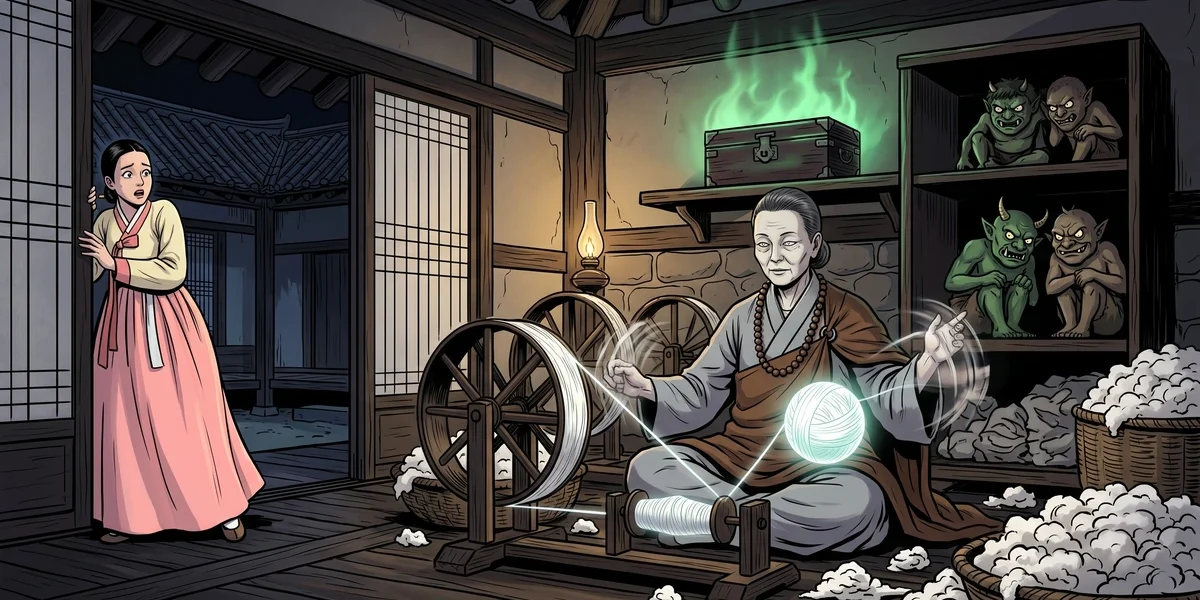
“The Old Woman Who Became a Goblin” belongs to the Korean tradition of dokkaebi iyagi (도깨비 이야기, goblin stories) but approaches the dokkaebi figure from an unusual direction: not as a creature encountered in the wild or in an abandoned house, but as a person in the process of becoming one. Korean folk cosmology’s understanding of the dokkaebi (dokkaebi, 도깨비) is distinctive in world folklore: unlike most goblin traditions, which treat supernatural beings as a separate category of entity from humans, the Korean dokkaebi is often understood as arising from the concentration of human vital energy (gi, 기, 氣) in objects or persons that have absorbed enough of it over sufficient time to develop a kind of autonomous spiritual presence. Old objects that have been used intensively for generations—brooms, pestles, clubs—can become dokkaebi when the accumulated human energy in them reaches a threshold. And very old people, who have spent decades concentrating their particular life-energy through their specific way of being in the world, can approach the same threshold from the other direction. The old woman of this story crosses it. Her transformation is neither reward nor punishment but the natural consequence of becoming, over a very long life, too concentrated and too particular a form of human energy to remain contained in ordinary human form.
Beat I — The Old Woman’s Life-Energy
The old woman is, by the time the story opens, very old indeed: old enough that her age has become a village landmark, a reference point in the way that geographical features are reference points. She has outlived her husband, her children, and most of her grandchildren; she exists in the village as something between a social participant and a force of nature. Her particular qualities—accumulated over decades into a kind of caricature of themselves—are vividness: she is the most opinionated person in any room, the loudest voice in any dispute, the most generous giver of food and the most vigorous taker of offence, the keeper of grudges that younger people have forgotten and the source of blessings so emphatic that they function almost as commands to fortune. She is exhausting and beloved in roughly equal measure.
Her gi—her vital energy—has the quality that Korean folk tradition recognizes as the specific condition for dokkaebi emergence: it has become too specific. Most human gi is mixed, temperate, distributed across many qualities and orientations. The old woman’s has concentrated itself, through decades of intensely lived particularity, into something very dense and very singular. Her anger is not ordinary anger; it is old anger, aged in the vessel of a very specific personality for a very long time, and it has developed a potency that younger people’s anger does not have. Her warmth is not ordinary warmth; it is ancient warmth, carrying the memory of every fire she has ever built and every person she has ever warmed. She is, in the folk cosmological sense, becoming a dokkaebi while still in human form—and the transformation, when it comes, is less a change than a recognition.
Beat II — The Threshold Crossed
The transformation does not happen dramatically. The village notices, over the course of a winter and a spring, that the old woman has become somewhat more than she was. Her presence in a room creates a quality that people notice before they see her. Her voice has acquired a resonance that carries around corners. Objects in her immediate vicinity behave with a slight autonomy: her wooden spoon is always in her hand before she reaches for it; the fire in her hearth catches immediately when she approaches it; small animals approach rather than flee. None of these things are frightening; they are the natural expression of a gi concentration that has reached the dokkaebi threshold.
When the transformation becomes complete—again without drama, more like the final stage of something long in process than like an event—the old woman is still recognizably herself: opinionated, warm, vigorous, capable of both magnificent generosity and spectacular anger, with the specific personality that the village has known for six decades. What has changed is her form of existence rather than her character. She is still present in the village; she still involves herself in disputes and still dispenses advice and food with equal liberality. She is simply now doing it as a dokkaebi rather than a human being, which means she is slightly more effective at the things she was always doing and slightly less constrained by the physical limitations that human form had imposed on her concentrated energy.
Beat III — Gi Concentration and the Dokkaebi Threshold
The Korean folk cosmological understanding of dokkaebi emergence rests on a principle that connects to broader East Asian theories of vital energy (gi/chi/prana): that energy concentrated in a particular form or vessel over sufficient time develops autonomous properties. The broom that sweeps a household floor for three generations has absorbed so much directed human energy that it develops the capacity to direct itself. The pestle that pounds grain for fifty years has absorbed the rhythm and intention of fifty years of pounding until the rhythm and intention persist without the human hand. This is not metaphor in Korean folk tradition; it is description of a process that the tradition understood as real and that it treated with a mixture of respect and precaution.
For human beings, the equivalent process operates through the accumulation of gi in the body and personality over a very long life. Most people do not live long enough or intensely enough for their gi to reach the dokkaebi threshold; it dissipates at death in the ordinary way, leaving behind whatever karmic residue determines the next rebirth. But someone who has lived with extraordinary intensity and particularity for a very long time may concentrate their gi to the point where the threshold is approached while they are still living. The transition from this threshold state to actual dokkaebi existence is less like death and transformation than like—the folk tradition reaches for the analogy of water reaching boiling point: a change in state that follows naturally from an accumulation that has finally become sufficient.
The old woman’s dokkaebi nature is characteristically Korean in its qualities: she is mischievous rather than malevolent, powerful but not invincible, connected to specific places and relationships rather than generic or universal. Her dokkaebi energy is the energy of her specific personality amplified beyond human constraints—she is more fully herself as a dokkaebi than she could be as a human, because the human form was becoming insufficient for containing what she had become.
Beat IV — The Moral and Its Reach
The village’s relationship with the old woman as dokkaebi is, after the initial adjustment, largely continuous with its relationship with her as a human. She is still the most vivid presence in the community; she still involves herself in everyone’s business; she still gives and takes offence with equal vigour. The difference is that her advice is now taken more seriously (she has access to information that human perception cannot collect), her blessings are more effective (her gi concentration gives them real force), and her anger is more carefully avoided (for the same reason). The community has lost a difficult old woman and gained a difficult local dokkaebi, and the net effect on daily life is remarkably similar.
The tale’s moral is perhaps the most gently subversive of the three transformation stories: unlike the pig (who became what his worst quality was) and the fish (who became what his best quality had been cultivated toward), the old woman becomes what she simply was—concentrated to the point of overflow. The story does not evaluate her. It does not say her transformation was deserved or undeserved, punishment or reward. It says: she was too much of herself for human form to hold indefinitely, and the form that could hold her is the form she now inhabits. This is an unusual kind of moral statement—it is descriptive rather than prescriptive, accepting rather than evaluative—and it is perhaps the most realistic of the three: most people are not primarily instances of their worst quality or their best cultivated quality, but simply instances of themselves, accumulated over time into something more particular than when they started.
“The very old do not simply age; they distill. What remains at the end is more concentrated than what began, and concentration, taken far enough, changes the nature of the vessel required to contain it.”
— Korean folk saying associated with the dokkaebi tradition and the spiritual significance of extreme old age
Why This Story Has Lasted
“The Old Woman Who Became a Goblin” endures because it offers something rare in transformation folklore: a transformation that is neither punishment nor reward but simply what happens when a person becomes, over a very long and very vivid life, too much themselves for ordinary human form to accommodate. The story treats this without horror and without sentimentality; it is not a tragedy and not a triumph. It is simply the natural conclusion of a life lived with sufficient intensity and particularity. Audiences respond to this because it is honest in a way that punitive and rewarding transformation stories are not: most people, at the end of a long life, are primarily instances of themselves rather than instances of their worst fault or their highest virtue, and the story’s refusal to evaluate gives it a realism that the more moralistic transformation tales cannot match.
The Korean Dokkaebi and Gi Concentration
The Korean dokkaebi (도깨비) is one of the most culturally distinctive supernatural beings in East Asian folklore, differing from Japanese oni, Chinese demons, and Western goblins in its origin principle: dokkaebi arise from the concentration of human vital energy (gi, 기) in objects or, rarely, in persons that have absorbed sufficient human energy over sufficient time. Classic dokkaebi-generating objects include brooms, mortars, pestles, clubs, and other implements of sustained domestic labor. The energy absorbed through years or generations of directed human use eventually achieves autonomous expression, producing a being that is characteristically playful, powerful in specific domains, connected to particular places and relationships, and possessed of a personality shaped by the energy that created it. Dokkaebi are neither good nor evil in Korean folk tradition; they are vivid, particular, and consequential in the way that concentrated energy is always consequential. The transition from human to dokkaebi—as in “The Old Woman Who Became a Goblin”—represents the same process operating from the inside rather than the outside: a human person whose particular life-energy has reached the concentration threshold through the intensity and duration of their living.
Frequently Asked Questions
- What is the moral of “The Old Woman Who Became a Goblin”?
- That a very long, very vivid, very particular life can concentrate a person’s essential nature to the point where human form is no longer an adequate vessel for it. The old woman’s transformation is neither punishment nor reward but the natural consequence of having been, over decades, too concentrated and too particular a form of human energy to remain contained in ordinary flesh. The story accepts this without evaluating it, which is its most honest quality.
- What happens in “The Old Woman Who Became a Goblin”?
- A very old, very vivid village woman—opinionated, warm, exhausting, beloved—gradually crosses the threshold into dokkaebi existence over the course of a winter and spring, as her accumulated vital energy reaches a concentration that human form can no longer contain. The village’s relationship with her as dokkaebi is largely continuous with its relationship with her as human: she is still the most vivid presence in the community, still involved in everyone’s business, still giving and taking offence with equal vigour. The net effect on daily life is remarkably similar, with her advice now more accurate and her blessings more effective.
- What is a dokkaebi in Korean folklore?
- The dokkaebi (도깨비) is a Korean supernatural being that arises from the concentration of human vital energy (gi) in objects or persons over time. Unlike Western goblins or Japanese oni, dokkaebi are not a separate category of creature from humans; they are what certain kinds of accumulated human energy become when the concentration reaches a threshold. Dokkaebi are typically playful rather than malevolent, connected to specific places and relationships, and possessed of personalities shaped by the energy that created them.
- How does the old woman’s transformation differ from the pig and fish transformations?
- The pig transformation (P-524) is punitive revelation: it makes visible the hidden dominant fault that was always operating beneath social performance. The fish transformation (P-527) is culmination: it expresses the highest quality that a lifetime of conscious practice has developed. The old woman’s transformation is neither: it is simply natural overflow, the consequence of becoming too much of oneself—not one’s worst quality or one’s best, but simply the full concentration of one’s particular nature—for ordinary human form to continue containing.
- Why does Korean folk tradition treat the dokkaebi as arising from accumulated human energy?
- Because Korean folk cosmology, shaped by the convergence of indigenous animism, Chinese gi theory, Buddhist consciousness doctrine, and Taoist vital-energy thought, understood the world as permeated by energy that accumulates in objects and persons through sustained directed use. This accumulated energy is not spiritually neutral; it carries the pattern of the intention and personality that directed it, and when it reaches sufficient concentration it develops autonomous expression. The dokkaebi is the most familiar folk narrative expression of this cosmological principle, and its origin in human energy gives it the characteristically human qualities—personality, humor, connection to specific relationships and places—that distinguish it from purely non-human supernatural beings.
You May Also Like
 Korean Folk Tales
Ages 9-12
Korean Folk Tales
Ages 9-12
The Geomancer
The Geomancer: [Yi Eui-sin was a specialist in Geomancy. His craft came into being evidently as a by-product of Taoism, but has had mixed in it elements of
 Korean Folk Tales
Ages 6-8
Korean Folk Tales
Ages 6-8
The Tiger and the Dried Persimmon: Courage Found in Unexpected Places
The Tiger and the Dried Persimmon: Courage Found in Unexpected Places - a folk tale retold for young readers with a clear moral, simple words, and the...
 Korean Folk Tales
All Ages
Korean Folk Tales
All Ages
The King Of The Sparrows
The King Of The Sparrows: The Korean children are awakened every morning by the twittering of the sparrows. These little birds build their nests among the