The Woodman and the Mountain Fairies
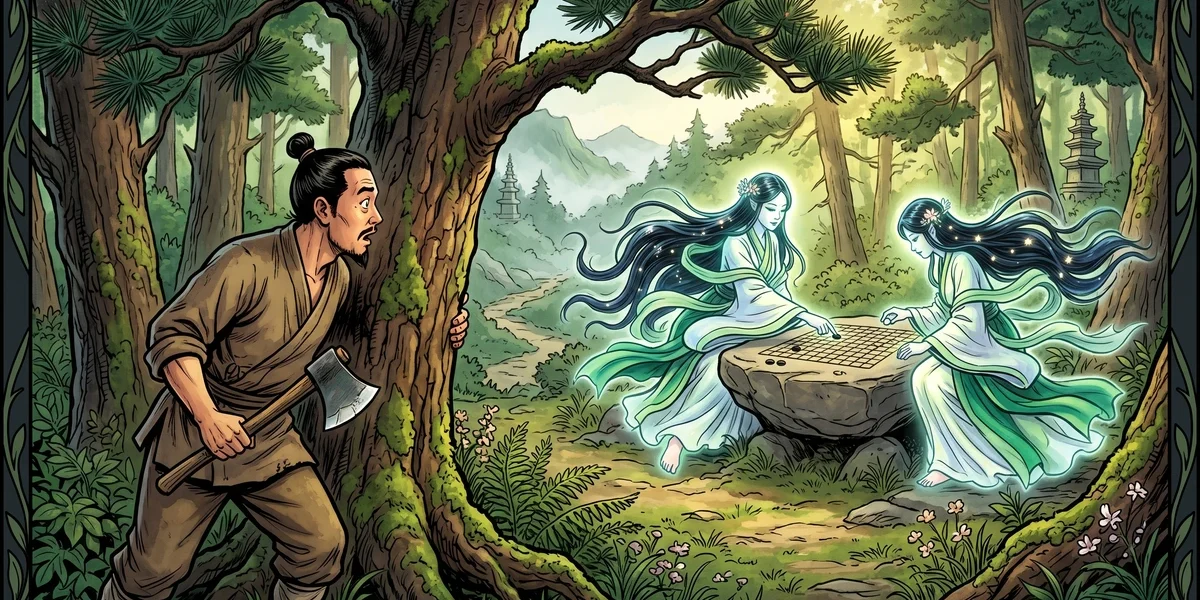
A woodcutter climbs the mountain to cut fuel and stops to watch two long-haired fairies playing a board game on flat stones, quite forgetting the time.
More than five hundred years ago, in a northern village near Pyongyang, there lived a woodcutter named Keel Wee. He had a sturdy bull that carried the firewood he cut each day on the mountains, which he sold in the village main street at the market held every fifth day. The bull could carry a load of sticks and brushwood piled many feet above its head and tied down with ropes, so that from a distance nothing could be seen of it but its legs. Huge as it was, it was the gentlest creature you could imagine. It had been taken from its mother when it was only a week old and raised in the house with the girls and boys, so the children loved the big fellow and played with it as if it were one of them, or at least a pet dog. Only the puppy who lived in the house with them was as great a favorite.
One fine summer morning Keel Wee left the bull at home and went up the mountain to cut enough wood to load and bring down another day. As she called goodbye, his wife told him to be sure to be home for supper, for their eldest son had gone fishing and was expected to bring back a good string of perch.
Keel Wee shouldered his axe and set off up the mountain path. He had to go a long way, for around his village the trees had long since been cut down, and every year the woodcutters had to search farther afield for fuel.
When he came to a clearing in the woods, he got ready to swing his trusty axe. He was just about to take off his big hat and his outer coat and set to work when he noticed two fairylike beings some distance away. They had long hair and looked very wise, and they were dressed in the style of the Zhou dynasty of two thousand years before. They sat on stones, playing a board game.
The woodcutter came closer, standing respectfully, and as he watched, he grew interested in the players’ moves. Far from being bothered by a stranger, the two fairies seemed to invite him with a wink to watch. Feeling quite proud of the honor, Keel Wee leaned his chin on his axe handle and became so wrapped up in the game that he grew quite excited. Forgetting his manners, he reached out his right hand to move one of the pieces. At once the fairy nearest him rapped his fingers for his cheek and pushed his arm away. Then, without a word, the fairy took something like a persimmon seed from his pouch and put it into the woodcutter’s mouth, and after that all three were perfectly quiet.
Hour after hour the game went on, and the players grew more and more absorbed. Keel Wee never blinked, so hard did he stare at the yellow board covered with black and white stones. Several times, when he thought he saw how the fairy on his right could win or how the one on his left could make a better move, he wanted to say so, but when he tried to move his tongue, he found he could not speak or make a sound. He felt as though he were in a dream.
Still, he grew more and more caught up in the game and made up his mind to see it to the end and find out who would win. He forgot that for mountain spirits there is no night or morning, nor any passing of hours, and that they care nothing for clocks or bells, for in fairyland there is no time. All the while Keel Wee leaned on the stout axe handle, gripping it with both hands under his chin. He paid no attention to the sun or stars, to daylight or darkness, and he felt no hunger.
Suddenly the wooden handle of his axe seemed to crumble to dust, and his chin dropped. He had lost his prop. Down went his head, and forward he fell, tumbling right over the board, upsetting the game and scattering the round stones in all directions.
Waking as if from sleep and thoroughly ashamed of his rudeness, he tried to pick himself up and humbly apologize for the accident he had caused. He expected a good scolding. But when he looked up, the fairies were gone. There was no sign of them, or of the board and stones, or that they had ever been there, except that when he laid his hand on the flat stones they had used as seats, they were still warm.
But where was his axe handle, and what had happened? He had left home straight from the barber’s, with his face clean-shaven, yet when he put his hand to his chest, he found a long white beard. The iron head of his axe lay there, but rusty and half buried in the earth. He had been wearing one of those huge farmer’s hats that, turned upside down, could hold a bushel or two of turnips, and that spread over the shoulders like a roof when tied on. Where was it? He looked about and found only a few bits of its frame, for the rest had rotted away long ago.
He found that his joints were stiff and he felt like an old man. His clothes were in rags, his hemp sandals were gone, and long nails like birds’ claws had grown on his fingers and toes. His hair had burst its topknot string and hung down his back, gray and white.
Wondering what it all meant, Keel Wee hobbled down the mountain to the road into his village’s main street. The rocks and hills, the rivers and streams were all there, but how everything had changed! The two carved wooden guardian posts, a man’s face and a woman’s, with painted white teeth and wooden ears nailed on, that he remembered at the entrance to his village, were gone. In their place was a line of tall, thick poles with iron wire stretched from one to the next for miles. He found out later that these were called lightning-thread trees; they were telegraph poles. Instead of the rambling thatched houses and yards fenced off with hanging mats, there stood a strange office of painted wood, and through its openings he saw young Korean men in odd clothes tapping at curious clicking machines.
Curious, he went up to get a closer look, and something bumped his nose and nearly knocked him over. He tried again and squashed his face so hard that his nose was nearly broken and his lips were knocked against his teeth until they swelled. Feeling with his hands, he touched something hard that he could see right through. Just then a young man inside shouted at him in Korean, “Hey, mountain grandpa, leave that glass alone!” Glass? What was glass? But Keel Wee still could not speak.
He had hardly caught his breath when he saw a house on wheels rolling straight at him along two shining iron lines in the street. Nothing was pulling or pushing it, no horse, no donkey, no bull, no man, but above it was a long pole that touched what he took to be a string, though it was an iron wire, and at the end of the pole something like a squirrel seemed to be spinning round and round and pushing the house along. Inside, behind more of that glass, sat a dozen or so Koreans. The whole thing nearly ran him over as it thundered past, and his mouth fell open in amazement, while a man on the back shouted rudely, “Hey, old goblin, where did you get that pumpkin mouth? Watch out or you’ll swallow the moon! Get out of the way of the streetcar!”
The conductor was making fun of the poor old fellow because he looked just like one of the masked players who, on New Year’s Eve, amuse and scare the children by wearing huge round masks of the goblins who were said to have lived in the mountains long ago. These masks are shaped like melons, with holes cut for eyes, nose and mouth, rather like the pumpkin faces American children carve at Halloween.
That was just the trouble. With his tattered clothes, his long hair hanging down his back and his white beard flowing over his chest, leaning on a long white stick as he hobbled along, the woodcutter looked like one of the wild mountain folk of the old stories. Nurses and grandmothers used them to scare naughty children, and few people in the towns had ever really seen one, any more than they had seen the tigers that lived farther off in the hills. Wherever Keel Wee went, the children laughed, the big dogs barked and the little ones ran away. Even the bulls bellowed, the donkeys balked and the pigs squealed.
More and more bewildered, Keel Wee made his way farther into the town. He saw that the men no longer wore topknots and the youths no longer wore the long braid down their backs that showed they were not yet married. Some rough boys, thinking he was a country bumpkin who had mixed up the season, jeered, “Hey, hermit, do you think it’s New Year’s Eve?”
Keel Wee thought he had better ask some questions. He saw a dignified gentleman in a black, broad-brimmed hat and flowing white clothes coming down the street toward him, and he bowed nearly to the ground. As he did, the seed the fairies had put in his mouth fell out, and his tongue was free. “Honored sir,” he said, “can you tell me where to find the humble hut of my wife and children? She was the daughter of Gee Kim, and your lowly servant is Keel Wee.”
The gentleman, whose dress showed he was a scholar of rank, looked long and hard at him to be sure he was not being mocked by some jester or trickster. Then he cried, “Heavens, man, are you a spirit from the mountains? You speak the way people spoke in these parts five hundred years ago. There was such a family here in those days, but the head of it, a woodcutter who sold firewood, is said to have gone up into the mountains and been eaten by a tiger. Ten or more generations of his descendants lie buried in the graveyard over there.”
“Please, kind sir, tell me what has happened here since King Wang died,” said Keel Wee. “It was in his reign that I was born and lived in this village.”
Still watching him, half expecting him to jump out of his rags and announce it was all a joke, the kindly gentleman told him the story of Korea over the past five hundred years. There had been many kings. Armies from the north and later from Japan had invaded the land. A great war between Japan and China had been fought, and it had only just ended. Now people rode in streetcars, talked over wires hundreds of miles long and traveled on iron rails as fast as a flying dragon, pulled by a steel horse that drank water and ate wood and burning black stones. In a word, Korea was in a new age.
This was too much for Keel Wee. He understood at last that he had lived ten times as long as most men. He hobbled to the graveyard and stumbled among the mounds until he found his family’s plot, where his wife and children lay.
The next morning all that could be found of Keel Wee was some dust, a few rags and a great deal of long white hair. Yet when they buried him, strange flowers sprang up around and over his grave, flowers no one had ever seen in city or village, the kind that bloom only high on the mountains.
About this story
“The Woodman and the Mountain Fairies” is retold from William Elliot Griffis’s Korean Fairy Tales (1922). Its central image is a woodcutter’s axe handle rotting while he watches supernatural players. Like Rip Van Winkle, he returns to familiar ground after the people he knew have gone.
Griffis gives Keel Wee a changed world of telegraph wires, glass windows and electric streetcars. These inventions belong to the tale’s compressed contrast between past and present; its five-hundred-year leap is not a precise chronology of one town. Griffis calls the board and pieces “checkers,” so this retelling leaves the game unnamed.
Read the original: Korean Fairy Tales (Project Gutenberg)
Suggested for ages 9–12 with an adult: Keel Wee returns to find his family long dead and himself at the end of his life.
Two clocks in one scene
The seats are still warm, yet the axe handle has rotted. Those details put the players’ recent presence beside the years that have passed outside the game. The seed also matters: Keel Wee cannot speak until it falls out. His absence is more than an ordinary failure to watch the time.
At home, the strangers see an odd-looking old man where he expects family and neighbours. Their jokes make his bewilderment worse. Only the scholar listens long enough to recognise the old language and explain the change.
Arrange the evidence
List the warm seats, ruined axe, long hair, telegraph poles and family graves in the order Keel Wee encounters them. Mark which clues suggest a short absence and which reveal a long one. Then write a considerate reply the conductor could have given instead of mocking him.
Talk about it
- How did Keel Wee first begin to realize that a very long time had passed?
- Why did everyone in the town laugh at him or run away?
- Which of the new inventions would have surprised you most if you were Keel Wee?
Related stories
- The Magic Peach — another Korean tale where a thousand years go by
- The Mirror That Made Trouble — another country fellow amazed by the wonders of the city
- The Sky Bridge of Birds — another tale of heavenly beings from Griffis
Frequently Asked Questions
Who is Keel Wee?
What did Keel Wee see on the mountain?
What happened when Keel Wee came home?
How does the story end?
You May Also Like
 Korean Folk Tales
Ages 9-12
Korean Folk Tales
Ages 9-12
The Geomancer
A hungry geomancer repays a mourner’s bowl of porridge with a perfect grave site, warning him that in ten years he must send for him in Seoul.
 Korean Folk Tales
Ages 9-12
Korean Folk Tales
Ages 9-12
The Visit of the Man of God
Hiding among the trees, a woodcutter watches a shining warrior from heaven threaten to flood the land while a Buddhist monk begs him for mercy.
 Korean Folk Tales
Ages 9-12
Korean Folk Tales
Ages 9-12
Fancha and the Magpie
A Manchu emperor who wants heavenly ancestors hears an old storyteller’s tale of three sky maidens, a magpie’s red fruit and a boy saved in a forest.