The Magic Peach
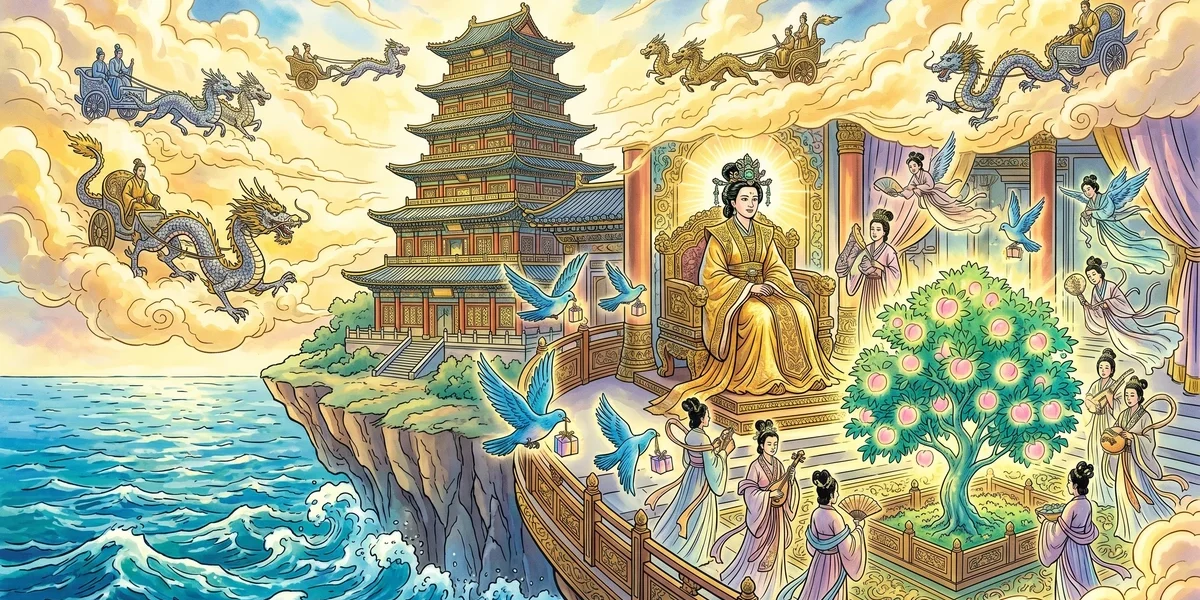
The Magic Peach: Out on the ocean, so far away that no ship ever sailed there, is an island on which stood the seven storied palace of the royal lady, Su Wang
Origin & Tradition
“The Magic Peach” draws on one of the most deeply rooted symbolic traditions in Korean and broader East Asian folk cosmology: the association of the peach (boksunga, 복숭아) with immortality, celestial blessing, and the gifts of the spirit world. The celestial peach garden (sinseon bok-sunga-won, 신선 복숭아원), adapted from the Chinese pantao (蟠桃) tradition—where the Queen Mother of the West maintains an orchard whose fruit confers immortality on those permitted to eat it—entered Korean folk cosmology through Buddhist and Taoist transmission and became thoroughly naturalized by the Goryeo dynasty (918–1392). The peach in Korean protective ritual also carries a separate function: peach-wood branches and peach-talisman carvings were standard instruments for warding off evil spirits, giving the fruit a dual character as both longevity-gift and spiritual weapon. Stories about magic peaches engage both dimensions, using the fruit as a vehicle for exploring the relationship between extraordinary gift and the character of the recipient. The central question such stories ask is not merely “what does the peach do?” but “who deserves to receive it, and what does their manner of using it reveal about whether they deserved it?”
Beat I — The Peach Encountered
A young man of modest means travels a mountain road during the heat of late summer. He is genuinely tired and genuinely thirsty: the details are specific rather than conventional, establishing that his need is real rather than theatrical. In a clearing off the main road he finds a peach tree of unusual beauty, bearing a single fruit that is not merely large but luminously perfect—its colour and fragrance unlike those of any ordinary peach. He recognises, with the instinctive folk knowledge that Korean rural tradition maintained about unusual natural phenomena, that this is not an ordinary fruit. He understands, in the particular way that protagonists of such stories understand important things, that taking it will have consequences.
He sits down next to the tree and considers. He is hungry and thirsty; the peach would address both. He is also aware that extraordinary fruit found in unusual circumstances in mountain clearings is not typically unguarded property. He waits. An old man appears from among the trees—either a spirit taking human form or a genuine mountain hermit of advanced cultivation; the narrative deliberately does not specify—and the young man, rather than taking the peach, asks the old man if he knows whose tree this is and whether the fruit is available. The old man examines him with evident interest, as though the question itself is being evaluated rather than merely answered.
Beat II — The Gift and Its Terms
The old man gives the young man the peach with a specific instruction: he may eat half of it now, for his immediate need, and he must carry the other half home without eating it, without selling it, and without giving it to anyone who asks for it out of curiosity or desire. He must give the other half only to someone who genuinely needs it in the same way he himself now genuinely needs the fruit—which is to say, someone whose need is real and whose manner of presenting that need is honest rather than strategic. The old man does not specify what the peach will do for either recipient; he simply gives these instructions and disappears into the trees.
The young man eats half the peach. Its effect is immediate and complete: his thirst vanishes, his fatigue resolves, and a quality of clarity settles over his perception that he has never experienced before. He understands, without being told, that he is carrying something of extraordinary value in the remaining half. The journey home becomes immediately more complicated: several people on the road, seeing the unusual fruit, ask to buy it or to taste a small piece. A wealthy merchant offers a large sum. An official implies that his authority entitles him to inspect the contents of travelers’ packs. A child cries for it. The young man refuses all of them—not rudely, but firmly, each refusal requiring him to hold the old man’s instruction against the immediate social pressure of the situation.
Beat III — Bokdeok and the Ethics of Celestial Gift
The concept of bokdeok (복덕, 福德)—accumulated fortune-virtue, the compound of good luck and good character that Korean folk tradition treated as jointly necessary for extraordinary gifts to arrive and to be used well—provides the theological framework for the magic peach story’s structure. The peach does not appear to the young man randomly; it appears at the intersection of real need and appropriate response. His genuine thirst makes him a legitimate recipient of the fruit’s relief. His recognition of its unusual nature, his restraint from taking it without inquiry, and his polite consultation with the old man demonstrate the character required to receive a celestial gift without misusing it.
The instruction to carry the second half home and give it only to genuine need is not merely a test of obedience; it is an extension of the same quality that earned him the fruit in the first place. The wealthy merchant who wants to buy it has no particular need; the official who implies authority has entitlement rather than need; the child’s desire is real but childish. None of these are the old man’s stipulated condition. Holding the instruction against each social pressure requires the young man to repeatedly exercise the same discrimination that distinguished him in the clearing: the ability to identify genuine need from performed need, and to honour genuine need rather than social authority or emotional appeal.
The Korean folk tradition’s treatment of celestial gifts consistently maintains this structure: the gift tests character at the moment of receipt and again at the moment of use. A person who receives a magic object and immediately exploits it for personal advantage has revealed that they are not the right recipient, regardless of how the object arrived in their hands. The true recipient—the person the story identifies as worthy—is the one who treats the gift as an obligation rather than a windfall, who asks what they are supposed to do with it rather than what they can get from it.
Beat IV — The Second Gift and Its Completion
The young man reaches his village and the recipient finds him, in the way that such things work in Korean folk narrative: a neighbor’s elderly parent has fallen gravely ill and ordinary remedies have failed, and the family’s genuine distress is visible throughout the village. The young man recognises genuine need meeting the old man’s description, offers the second half of the peach, and it is accepted. The elderly parent recovers in ways that the household’s physician cannot explain. The young man’s own lingering effect from the first half—the clarity of perception, the sustained physical wellbeing—does not fade with the completion of his instruction. The gift, used correctly, has compounded rather than spent itself.
The story closes without the old man’s reappearance or any formal confirmation that the young man has “passed” the test. The verification is structural rather than explicit: the gift’s continuation in him, and the healing it has produced in his neighbor, are sufficient evidence that its use was correct. Korean folk narrative characteristically resists explicit celestial endorsement—the cosmos does not announce its approvals; it simply continues to work in accordance with the principles that govern it, and people who are paying attention can read the results.
“The celestial peach comes to the right hand at the right hour; whether it stays or passes on depends entirely on what the hand does next.”
— Korean proverb associated with sinseon (immortal) gift narrative tradition
Why This Story Has Lasted
“The Magic Peach” endures because it encodes a mature understanding of extraordinary opportunity: that the arrival of an unusual gift is not the conclusion of a story but its beginning, and that what one does with the gift is both the test of worthiness and the continuation of whatever cosmic process brought the gift in the first place. The young man’s virtue is not heroic in any dramatic sense; it is the patient, repeated, socially costly exercise of a discrimination between genuine and performed need. This is a recognizable and demanding virtue, and the story’s conclusion—which withholds formal approval while confirming structural correctness—reflects a sophisticated understanding of how ethical conduct is verified in a world that does not issue certificates of moral accomplishment.
The Peach in Korean Symbolic Tradition
The peach (boksunga, 복숭아) carries a dual symbolic weight in Korean folk tradition. As an immortality fruit inherited from Chinese Taoist cosmology, it represents longevity, celestial blessing, and the gifts of those who have transcended ordinary human limitations. As a protective material, peach-wood branches (boksunga namu, 복숭아 나무) were used in Korean shamanic and folk ritual to ward off evil spirits, a use rooted in the belief that the tree’s celestial associations made it inhospitable to lower spiritual forces. Korean New Year and seasonal protective rituals frequently included peach-wood elements. Stories about magic peaches engage both traditions: the fruit as celestial gift belongs to the immortality-longevity tradition, while its protective qualities—its resistance to misuse or to the wrong hands—reflect the apotropaic tradition. A magic peach that cannot be used wrongly because it will not work for the wrong recipient is a narrative embodiment of the protective peach’s resistance to spiritual forces that lack the right relationship to its celestial origin.
Frequently Asked Questions
- What is the moral of “The Magic Peach”?
- That extraordinary gifts test character through the decisions they require rather than through the powers they confer. The young man’s worthiness is demonstrated not by the fact that he received the peach but by what he does with the second half: holding the old man’s instruction against sustained social pressure until he finds the genuine need it was meant to address. The gift compounds in a person who uses it correctly; in a person who uses it for advantage, it would simply spend itself.
- What happens in “The Magic Peach”?
- A young man tired and thirsty on a mountain road finds a single extraordinary peach on an unusual tree. Rather than taking it without inquiry, he waits and consults an old man who appears from the trees. The old man gives him the peach with the instruction to eat half for his immediate need and carry the other half to someone with genuine need equal to his own, refusing all requests based on desire or authority. He fulfils this instruction, giving the second half to a gravely ill neighbor’s parent who recovers, while his own benefit from the first half continues rather than fading.
- What does the peach symbolize in Korean folklore?
- The peach symbolizes immortality, longevity, and celestial blessing in Korean and broader East Asian folk tradition, derived partly from Chinese Taoist cosmology’s celestial peach garden where the Queen Mother of the West maintains trees whose fruit confers immortality. In Korean protective ritual, peach-wood also wards off evil spirits, giving the peach a dual character as both gift from the celestial realm and barrier against lower spiritual forces.
- Why does the young man refuse the wealthy merchant and the official?
- Because neither has genuine need of the specific kind the old man described. The merchant’s desire is real but strategic—he wants the fruit’s value rather than its relief. The official’s claim rests on institutional authority rather than need. The old man’s instruction specified need equal to the young man’s own at the moment he received the gift: genuine thirst, genuine fatigue, honest acknowledgment of it. Desire and authority are not need, and the discrimination between them is precisely what the instruction requires the young man to exercise.
- What is bokdeok and how does it apply here?
- Bokdeok (복덕, 福德) is the compound of accumulated fortune (bok) and virtue (deok) that Korean folk tradition treated as jointly necessary for receiving and properly using extraordinary gifts. The young man’s genuine need provides the fortune-component: the right time and place of need that brings him into contact with the peach. His patient restraint, honest inquiry, and sustained adherence to instruction provide the virtue-component: the quality of character that makes him able to use the gift correctly. Without both, the encounter would not have produced the story’s outcome.
You May Also Like
 Korean Folk Tales
Ages 9-12
Korean Folk Tales
Ages 9-12
Princess Bari
Princess Bari: In a kingdom surrounded by mountains and blessed by deep rivers, there lived a King and Queen who longed desperately for children. After many
 Korean Folk Tales
All Ages
Korean Folk Tales
All Ages
The Voice Of The Bell
The Voice Of The Bell: When Tai Jo, the great general and first King of Korea, founded a new dynasty, he moved the capital near the great river Han and
 Korean Folk Tales
All Ages
Korean Folk Tales
All Ages
The Boxed-Up Governor
The Boxed-Up Governor: A certain literary official was at one time Governor of the city of Kyong-ju. Whenever he visited the Mayor of the place, it was his