The Vision Of The Holy Man
The Vision Of The Holy Man: Yi Chi-Ham (Master To-jong). A story is told of him that on the day after his wedding he went out with his topo or ceremonial coat
Origin & Tradition
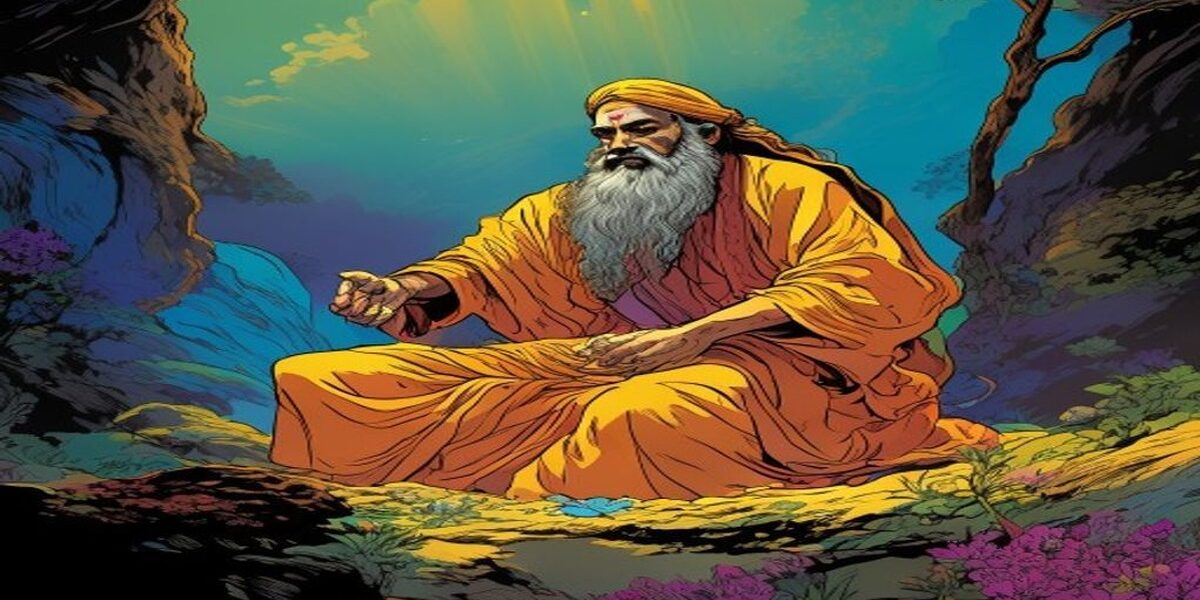
Tales of the holy man’s vision (성인의 영시, seong-in-ui yeongsi) occupy a distinctive place in the Korean folk-Buddhist narrative tradition — a tradition that flourished through the Joseon period despite official Confucian suppression of Buddhist institutions, surviving in the informal networks of mountain monasteries and village shamanic practice. The figure of the holy man (성인, seong-in) in these tales is defined not by institutional rank but by a quality of perception cultivated through sustained practice until it breaks through the ordinary limitations of sense-bound consciousness. His vision — the direct apprehension of reality that the Buddhist tradition calls cheongan (천안, 天眼, heavenly eye) — gives him access to dimensions of causality and consequence that ordinary human perception cannot reach. This story, preserved in multiple variants across the Gyeonggi and North Chungcheong monastic communities, explores what that access costs and what it requires.
Beat I — The Holy Man on the Mountain
The holy man had lived on the mountain for longer than anyone in the valley below could precisely remember. The eldest villagers had childhood memories of the figure moving along the high paths in the early morning, and their parents had spoken of him as already old when they were young. The monastery that should have housed him had been abandoned generations earlier; he continued his practice in the ruins, maintaining the practice schedule with the regularity of a man who had long since stopped distinguishing between the time of practice and the time of ordinary living.
The villagers brought him food when the harvest permitted — rice, dried vegetables, occasionally salted fish — and received in return something they valued more than gratitude: a quality of attention that left them feeling accurately seen. Not praised or advised — the holy man rarely offered either — but perceived without social framing, seen as what one was rather than what one’s position in the village hierarchy might suggest. People came away from brief encounters unsettled in a useful way, as though something slightly out of alignment had been quietly noticed, if not corrected.
He had not descended to the village in twelve years when the vision came. Nothing in the external circumstances of his practice had changed. But in the predawn sitting of an autumn morning, as the first suggestion of light began to differentiate the darkness outside the unglazed window opening, something in the ordinary quality of his concentration altered, and the vision arrived.
Beat II — The Content of the Vision
The tradition in which this story was preserved was appropriately reticent about the exact content of the vision. This reticence is itself theologically meaningful: the full content of a genuine cheongan breakthrough is understood, in Korean Buddhist folk tradition, to be literally inexpressible in ordinary language — not because the perceiver lacks skill in communication but because language is structured around the assumptions of ordinary consciousness, and perception that has broken through those assumptions arrives in forms ordinary language cannot accommodate.
What can be said: the vision concerned the valley village and the people in it. It concerned something in the causal structure of their situation — a pattern of choices and consequences, accumulated causes working toward specific effects — that ordinary village perception could not see because ordinary village perception was embedded in the situation rather than positioned outside it. The holy man saw from the outside what the villagers were living from the inside. He saw where their current path led.
The vision lasted for a duration bearing no simple relationship to clock time. When it ended and he returned to ordinary consciousness, he sat for a long time with what he had seen. Then he rose, put on his travel clothing, and descended the mountain for the first time in twelve years.
Beat III — Cheongan and the Ethics of Prophetic Knowledge
The concept of cheongan (천안, 天眼 — the heavenly eye) appears in Korean Buddhist thought as one of the six supernatural faculties (육신통, yukshinton) that advanced practice can cultivate: the ability to see past, present, and future clearly, and to apprehend the causal structure of reality beneath the surface of events. In the folk tradition it is treated with ambivalent respect: the holy man who has cheongan possesses something genuinely valuable but also genuinely dangerous, both to himself and to those around him.
The ethical problem cheongan creates in Korean folk narrative is the problem of what the possessor owes to those who lack it. Ordinary human communities function on the basis of shared uncertainty: because nobody knows with precision what causes will produce what effects, collective deliberation can approximate the right course closely enough to sustain viable social life. A being who perceives causal structure more clearly threatens this equilibrium not only when the perception is negative but also when positive — certainty about outcomes can disable the caution and effort that good outcomes actually require.
Korean Buddhist folk ethics navigated this through bangpyeon (방편, 方便 — skillful means, the Buddhist principle of calibrating the truth one shares to the capacity of the recipient to receive and use it). The holy man is not simply a truth-teller who reports what he sees; he is responsible for determining what portion of what he has seen can be communicated, in what form, to people operating at the level of understanding available to them. This makes his descent to the village not simply an act of prophecy but of translation — the difficult, imperfect, necessary work of rendering cheongan perception into terms that ordinary village consciousness can receive without being shattered.
The specific bangpyeon challenge here is temporal: the causal pattern he has seen is not immediately actionable but unfolds over time, with human choices at several points capable of altering the trajectory. To communicate the full vision would present a conditional future as a fixed one, removing the agency that could change the outcome. To communicate too little allows preventable suffering to proceed. The holy man’s task is to find the precise formulation that opens the possibility of different action without collapsing the uncertainty within which that action must be freely chosen.
Beat IV — The Moral and Its Endurance
The holy man came to the village elder — not to the headman who held formal authority, but to an old woman who had been a mudang in her active years and whose relationship with the non-ordinary dimensions of reality he recognized as the most receptive available. He sat with her for the better part of an afternoon, speaking in the indirect, parable-laden language that the bangpyeon tradition cultivated: stories that carried their teaching in the space between the literal and the figurative, leaving the recipient to locate the application themselves.
What the village did with what he communicated — the specific changes in behavior, the reorientations of collective attention — is less important in the tale’s transmission than the manner of the communication itself. The folk tradition preserved this story as a model of how prophetic knowledge should move from perceiver to community: with humility about what can be shared, with attention to the recipient’s capacity, with the understanding that the truth that cannot be received is not yet a gift, and with the recognition that preserving the recipient’s freedom to choose differently is more important than the completeness of the information transfer.
The holy man returned to the mountain the following morning. He did not say whether what he had seen would be averted, or whether the village’s response had been adequate. He had done what the vision obligated him to do — translated as carefully as he could — and what would come of that translation depended now on the village’s freedom, which was not his to direct.
“The man who has seen what others cannot see does not thereby gain the right to see for them. He gains only the harder obligation of helping them look.”
— Korean Buddhist monastic proverb, associated with cheongan traditions
Why This Story Lasted
Visions-of-the-holy-man tales persisted because they addressed the recurring social need to understand how unusual knowledge — whether prophetic, diagnostic, or simply more deeply informed than ordinary community awareness — should be handled for the community’s benefit. Every community has people who see more clearly in some domain than others: the experienced physician, the canny elder, the person whose unusual vantage point gives them access to information others lack. The holy man’s problem — how to communicate what he knows in ways that empower rather than paralyze, that open possibilities rather than foreclose agency — is the universal problem of expertise meeting community. The Buddhist framework of bangpyeon gave Korean audiences a vocabulary for this problem that remained useful long after the specific theological context had faded.
Cheongan in Korean Buddhist Folk Tradition
The six supernatural faculties (육신통, yukshinton) of Buddhist awakening practice — including cheongan (divine sight) and 숙명통 (knowledge of past lives) — appear throughout Korean Buddhist monastic literature and popular narrative. In the monastic tradition they are byproducts of deep concentration practice, to be noted and used with equanimity rather than sought as goals. In the folk tradition they are treated with complex ambivalence — as genuine powers whose possessors incur heavy responsibilities precisely because of the gap between what they can perceive and what the communities around them can receive. The bangpyeon tradition (skillful means) provides the ethical framework for navigating this gap: not by withholding truth but by calibrating its form to the recipient’s capacity for beneficial reception.
Frequently Asked Questions
What is the central moral of “The Vision of the Holy Man”?
The tale teaches that the gift of unusual perception carries with it the obligation of skillful communication — that seeing more clearly than others does not grant the right to see for them, but imposes the harder obligation of helping them look. The holy man’s descent to the village is an act of bangpyeon: finding the formulation of truth that opens the possibility of different action without collapsing the uncertainty within which that action must be freely chosen.
What happens in the story?
A holy man who has lived in mountain seclusion for decades experiences a cheongan vision concerning the valley village and the causal pattern of their situation. He descends the mountain for the first time in twelve years to communicate what he has seen to the community’s most receptive member — an old woman who was once a mudang. He speaks in the indirect language of bangpyeon, preserving the village’s agency, then returns to the mountain without guarantee of outcome.
What is cheongan and how does it function in this tale?
Cheongan (천안, 天眼) is the Buddhist faculty of divine sight — the ability to perceive past, present, and future clearly, and to apprehend causal structure beneath the surface of events. In Korean Buddhist folk tradition, it is treated as a byproduct of advanced practice rather than a goal. In the story, the holy man’s cheongan allows him to see from outside the situation what the villagers are living from within — the pattern of choices working toward specific consequences that ordinary embedded perception cannot see.
What is bangpyeon and why is it central to the story?
Bangpyeon (방편, 方便) is the Buddhist principle of skillful means — calibrating the truth one shares to the capacity of the recipient to receive and use it beneficially. The challenge is temporal: communicating a conditional future as though fixed removes the agency that could change it; communicating too little allows preventable suffering to proceed. Bangpyeon requires finding the precise formulation that opens possibility without closing freedom.
Why does the holy man communicate through an old former mudang rather than the village headman?
The choice of recipient is deliberately significant. The headman holds formal authority but operates within the village’s Confucian social framework — a framework that would tend to process the holy man’s communication through institutional categories that might distort it. The former mudang, whose practice had trained her in modes of perception adjacent to the holy man’s own, represents a more receptive channel: someone with experiential understanding of non-ordinary modes of knowledge, capable of receiving indirect, parable-laden language without demanding the literal directness that institutional authority tends to require.
You May Also Like
 Korean Folk Tales
Ages 6-8
Korean Folk Tales
Ages 6-8
The Sun and the Moon: A Mother’s Love Reaches Heaven Itself
The Sun and the Moon: A Mother's Love Reaches Heaven Itself: The Sun and the Moon: How a Mother’s Devotion Changed the Sky Forever In ancient times, when the
 Korean Folk Tales
All Ages
Korean Folk Tales
All Ages
Shoes For Hats
Shoes For Hats: Many centuries ago when Korea was named Chosen, or the Land of Morning Splendor, the island-kingdom out in the eastern sea, where the sun
 Korean Folk Tales
Ages 9-12
Korean Folk Tales
Ages 9-12
The Rabbit’s Liver
The Rabbit's Liver: In ancient times, when the boundaries between the human world and the spirit world were more permeable, the Dragon King of the Sea ruled