Shoes For Hats
Shoes For Hats: Many centuries ago when Korea was named Chosen, or the Land of Morning Splendor, the island-kingdom out in the eastern sea, where the sun
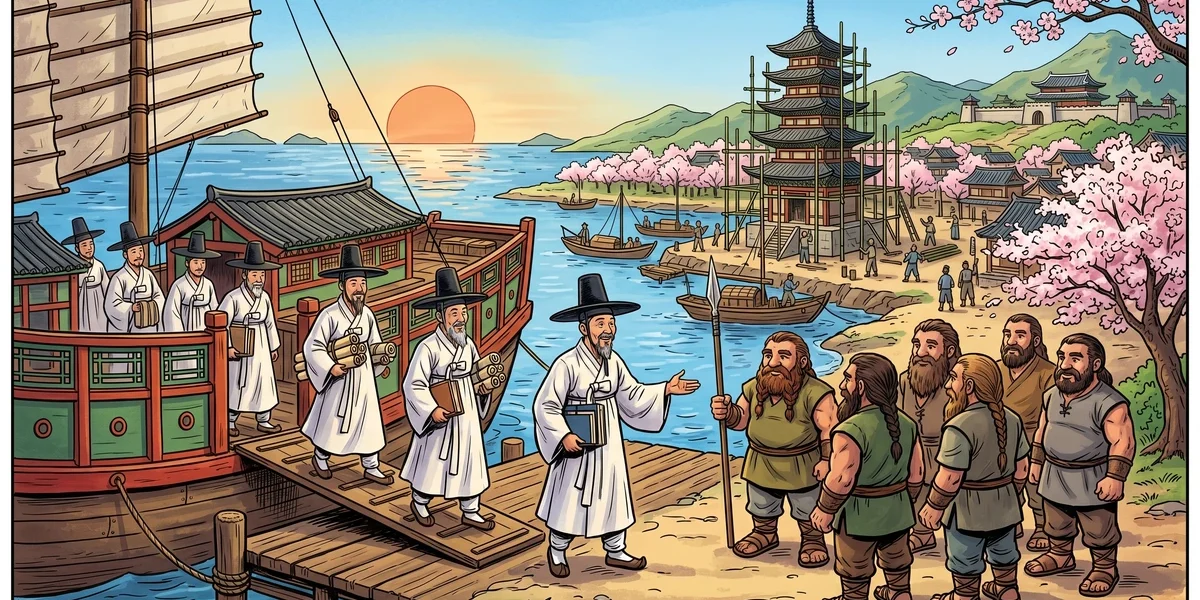
The Hat That Knew Its Place
In Joseon Korea, no object carried more concentrated social significance than the gat — the wide-brimmed black horsehair hat worn by male yangban (aristocrats). The gat’s quality, shape, height, and manner of wearing communicated a man’s social position before he opened his mouth. Different ranks wore different headwear. The absence of a proper hat placed a man outside the circles where the important conversations happened. The hat was, in a sense, the man’s social identity made portable and visible.
The shoe occupied the opposite position in Joseon’s symbolic geography — literally, as the lowest physical point of a dressed person, and figuratively, as the object in contact with the ground, with dirt, with the lowest social spaces. A person’s shoes revealed their station in a different register than their hat: the materials, the style, the condition of repair all communicated, but in the register of practical circumstance rather than social aspiration.
The folk tale of Shoes for Hats takes this charged symbolic terrain and applies to it the oldest tool of Korean comic tradition: inversion. What happens when the objects are in the wrong place? The story’s answer — delivered through a sequence of increasingly farcical social misreadings — is one of the most elegant pieces of social critique in the Korean comic repertoire.
Beat I — The Merchant and His Scheme
A travelling merchant arrived in a provincial market town with a cart of shoes — fine ones, better quality than the town usually saw — and found the market glutted. There were more shoes than buyers, and prices were being driven down by competition. The merchant needed to sell his inventory but could see no way to do so at a fair price in the conventional shoe market.
He went instead to the hat sellers’ row and proposed a trade: he would exchange a pair of his finest shoes for a hat of equivalent quality. The hat sellers, puzzled, asked why. The merchant explained, with apparent seriousness, that he had heard shoes were being used as headwear in the capital this season — that a new fashion among the highest aristocracy involved wearing specially constructed shoes atop the head, as a statement of cultivated unconventionality. The hat sellers, instantly attentive to anything involving the capital’s fashions, asked for details. The merchant provided them, with magnificent specificity: the left shoe was worn on the right side of the head, he explained, slightly tilted, in a manner that communicated studied elegance. The right shoe was not worn at the same time but carried in the hand until needed.
The hat sellers were uncertain. But uncertainty about capital fashion was, in Joseon, a deeply uncomfortable state — to be behind was to be exposed as provincial. Several agreed to the trade. Word spread. By the end of the day the merchant had exchanged his entire inventory of shoes for hats — which he then sold, in the hat market, at the price hats commanded.
Beat II — The Town That Wore Shoes on Its Head
The following market day revealed the consequences. Several of the hat sellers — having traded their inventory for the shoes they expected would make them fashionable — had worn the shoes on their heads, as the merchant had instructed, to demonstrate their awareness of the capital’s current taste. They had told their neighbours and families. Some of the neighbours, not wanting to be left behind, had acquired shoes for this purpose themselves.
The result was the most comic scene the market town’s collective memory would preserve for generations: a row of merchants and some of their customers wearing shoes on their heads with expressions of concentrated dignified certainty, while the rest of the town observed with expressions ranging from bewilderment to barely suppressed laughter. No one was willing to be the first to say that shoes on the head looked ridiculous, because the people wearing them were the same people whose opinion on such matters usually set the local tone.
The situation resolved itself only when a young boy — who had not yet learned the social rules about when laughter was appropriate — pointed and laughed with the full-bodied freedom of someone who has not yet been taught to suppress the obvious. His laughter was contagious, and once it had spread far enough, the shoes came off the heads and the dignity of those who had worn them retreated behind a wall of retrospective claims that they had known all along it was a joke.
Beat III — What the Inversion Revealed
The Shoes for Hats story belongs to a rich Korean comic tradition — most fully expressed in the talchum mask dance performances at seasonal festivals — that used physical inversion and absurdist displacement to expose the conventional foundations of social hierarchy. Talchum performances regularly featured characters wearing masks and clothing associated with social roles different from the wearers’ actual status, and the comedy of the disparity — the monk behaving as a layabout, the aristocrat being outwitted by a servant, the serious scholar reduced to slapstick — carried a consistent implicit argument: the authority attached to these roles and the objects associated with them is a social convention, not a natural fact.
The shoe-for-hat episode makes this argument with particular economy. The hat’s prestige derives entirely from the social agreement that associates it with high status. The shoe’s lowliness derives from the social agreement that associates it with low status. These associations are so thoroughly internalised that they feel natural — obvious — to those who live within them. What the merchant demonstrates is that the associations are entirely portable: a sufficiently confident claim that the prestige arrangement has changed is enough to move educated adults with genuine social ambitions to place shoes on their heads in public and insist, with concentrated dignity, that this is the correct thing to do.
The social machinery that normally regulates which objects belong where — the machinery of fashion authority, capital-prestige, and the anxiety of provincialism — is precisely what the merchant weaponises. He does not argue that shoes are prestigious. He simply claims that those in the know have already recognised this, placing his targets in a position where disagreement risks marking them as behind. The hat sellers who trade for shoes are not foolish people; they are operating entirely rationally within the logic of a system in which fashion authority flows from the capital and provincial lag is a real social cost. The absurdity is in the system, not in the individuals.
Beat IV — The Boy’s Laughter and What It Proved
The resolution through a child’s unguarded laughter is the story’s most philosophically precise element. The adults who observed the shoe-headed merchants could see perfectly well that something was wrong — the visual incongruity was not subtle. But they applied, automatically, the social calculus that makes adults hesitate before contradicting the publicly demonstrated confidence of people whose opinions usually matter: what if they are right and I simply don’t understand yet? The child, who has not yet learned this calculus, responds to what he actually sees. His laughter is, in this sense, the most accurate response available.
Korean comic folk tradition privileges this kind of unguarded accuracy. The child, the fool, and the drunk are its most trusted truth-tellers — figures whose social positioning outside the conventions of adult status-maintenance allows them to say what the conventions are arranged to prevent being said. The boy’s laughter does not explain anything, does not argue anything, does not deconstruct the status symbolism of hats and shoes. It simply responds honestly to the visible reality, and that honest response is sufficient to dissolve the collective pretence that had been sustaining a row of dignified adults in their shoe-hats.
“The hat knows it is a hat. The shoe knows it is a shoe. The man who confuses them does not make the shoe a hat — he only reveals that he could not tell the difference.” — Korean market proverb
The story of Shoes for Hats has stayed alive in Korean oral tradition because the comic mechanism it dramatises — the exploitation of status anxiety to make people perform obvious absurdities with straight faces — remains recognisably applicable to social situations that have nothing to do with shoes or hats. Fashion, prestige, and the anxiety of being seen as provincial or uninformed continue to generate the specific social vulnerability the merchant exploited. The boy’s laughter continues to be the correct response to its most egregious expressions. And the merchant — who understood the system better than its participants did and used that understanding to his advantage — continues to be the figure the tradition views with a complicated admiration: simultaneously the satirist who exposed the system’s absurdity and the opportunist who profited from it.
Frequently Asked Questions
What is the moral of Shoes For Hats?
The story’s moral is that the prestige attached to status symbols — hats, shoes, any object whose social meaning is entirely conventional — is entirely borrowed from the social agreement that upholds it, and that agreement is more fragile than it appears. A sufficiently confident false claim about fashion authority can move rational adults to perform obvious absurdities in public. The system’s vulnerability is the status anxiety it generates: the fear of being seen as behind is the crack through which the merchant’s lever enters. The story also suggests that the most reliable antidote to this vulnerability is the child’s unguarded honesty — the willingness to respond to what is actually visible rather than to what social convention says one should see.
What happens in Shoes For Hats?
A travelling merchant, unable to sell his shoes in a glutted market, invents a fashion trend: shoes worn on the head, allegedly current among the capital’s highest aristocracy. He exchanges his entire shoe inventory for hats with credulous hat-sellers eager not to miss a capital fashion. The hat-sellers wear shoes on their heads at the next market day to demonstrate their sophisticated awareness. The absurdity is visible to everyone but naming it risks marking the observer as the one who doesn’t understand. A young boy, free from this social calculus, laughs openly. His laughter spreads, the shoe-hats come off, and the convention collapses as suddenly as it was created.
What made the gat hat such a significant status object in Joseon Korea?
The gat (갓) was among the most symbolically loaded objects in Joseon material culture. Made of fine horsehair over a bamboo frame and worn exclusively by adult men of yangban status, it communicated its wearer’s social position, educational achievement, and family standing in ways immediately legible to all observers. The size, quality, and condition of a man’s gat signalled his specific status within the broader yangban category. To be seen without an appropriate hat was to be visually demoted. The hat’s prestige made hat-maintenance a genuine social obligation and hat-fashion a matter of serious concern for those whose social ambitions depended on appearing properly up-to-date.
How does comic inversion function as social critique in Korean folk tradition?
Korean comic folk tradition — particularly in the talchum mask dance performances and satirical pansori interludes — used physical inversion (wrong objects, wrong roles, wrong places) as a vehicle for exposing the conventional foundations of social hierarchy. By placing the wrong thing in the wrong position and observing the comedy of the disparity, the tradition asked its audience to notice that the rightness of the right position was a social construction rather than a natural fact. The festival context provided protective cover: the inversion was permissible because it was comedy, while the social analysis it carried could penetrate the defences that more direct critique would have encountered.
Why is the child’s laughter the resolution to the story?
The child’s unguarded laughter resolves the situation because it is the one response that bypasses the social calculus preventing the adults from naming the obvious. Adults apply, automatically, the question “what if they are right and I am the one who doesn’t understand?” before contradicting publicly demonstrated confidence. A child has not yet learned this calculus and responds honestly to what is visually present. In Korean comic folk tradition, the child, the fool, and the drunk are privileged truth-tellers precisely because their social position outside adult status conventions allows them to say what those conventions are arranged to prevent. The laughter is accurate, and its accuracy, once released, is contagious enough to dissolve the collective pretence.
You May Also Like
 Korean Folk Tales
Ages 6-8
Korean Folk Tales
Ages 6-8
The Old Woman Who Became A Goblin
<p>An irreverent old woman’s mockery of a scholar invites shamanic judgment and supernatural transformation.</p>
 Korean Folk Tales
Ages 9-12
Korean Folk Tales
Ages 9-12
The Geomancer
The Geomancer: [Yi Eui-sin was a specialist in Geomancy. His craft came into being evidently as a by-product of Taoism, but has had mixed in it elements of
 Korean Folk Tales
Ages 9-12
Korean Folk Tales
Ages 9-12
The Honest Witch
The Honest Witch: [Song Sang-in matriculated in 1601. He was a just man, and feared by the dishonest element of the Court. In 1605 he graduated and became a