The Great Stone Fire Eater
A hungry Fire Spirit and the South Wind burn down the king’s new palace in Seoul, and the king’s wise men try a dragon, a pond and a stone beast to stop him.
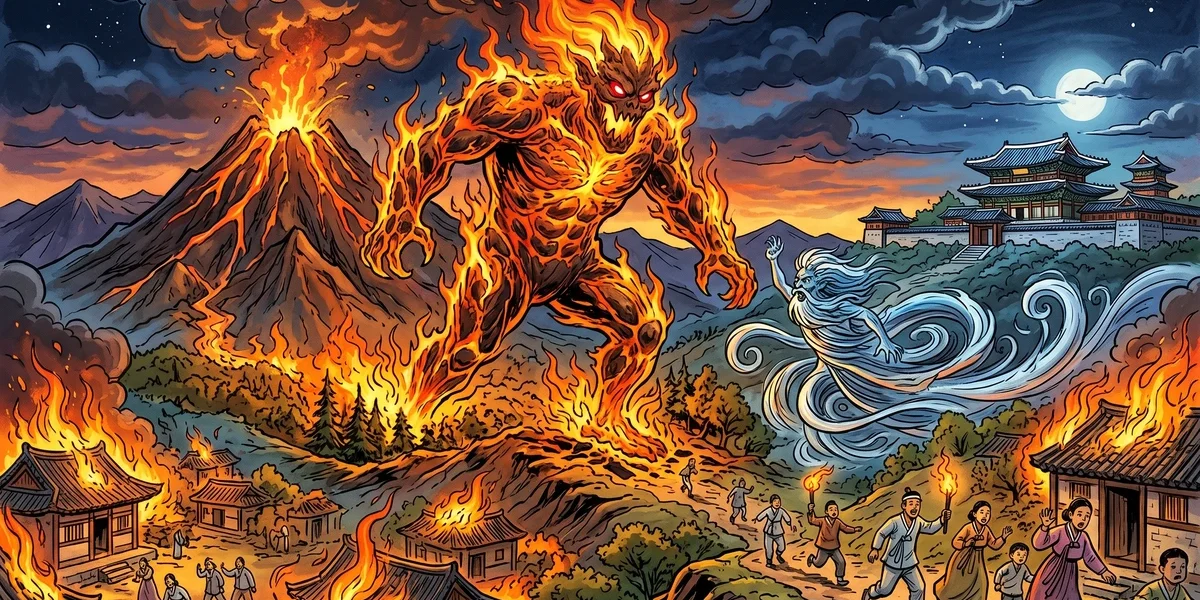
In Griffis’s fairy tale, a great Fire Spirit lives inside a mountain southwest of Seoul, the capital of Korea. He was always hungry, and he ate anything that would burn: trees, whole forests, dry grass, wood and whatever else he could grab. When there was nothing like that within reach, he ate stones and rocks. He loved the flames, but he spat out the hard bits as lava.
This Fire Monster spent most of his time in a huge volcano some way off but within sight of the capital. The people of the city watched smoke pour out of its crater by day, and from sunset to sunrise they saw red fire leap up until the whole sky seemed ablaze. Then, they said, the Fire Spirit was lighting up his palace. On cloudy nights the inside of the volcano glowed like a furnace, and the molten rock in the crater shone on the clouds, so that you could almost see into the monster’s belly.
But nothing tasted so good to the Fire Eater as the things people built, such as houses, stables and fences. The treat he longed for most of all was the royal palace. One day, looking out of his crater, he saw the king’s new palace rising in Seoul, gleaming like silver. He chuckled happily to himself.
“There’s a feast for me! I’ll just stroll out of my mountain and gobble up that tasty morsel. I wonder how the king will like that.”
But the Fire Spirit was in no hurry, for he was sure of his meal. He waited for his friend the South Wind to be ready to come along. “Let me know when you’re ready,” he told her, “and we’ll have a splendid blaze. We’ll go at night and have a merry dance before anyone can throw a drop of water on us. Don’t let the rain clouds find out about our picnic.” The South Wind promised gladly, for she always loved a frolic.
So when the sun had set and it was dark, the Fire Spirit climbed out of his rocky home and strode toward Seoul, with the South Wind prancing and capering beside him. The streets grew so gusty that nobody with a wide-brimmed hat dared go out for fear of losing it in a sudden puff. As for the men in mourning, who wear straw hats a yard wide and as deep as washtubs, they locked themselves indoors and played checkers.
When all the palace guards were asleep, the Fire Spirit was ready. “Blow your biggest blast,” he told the South Wind, “while I start nibbling the roofs of the smaller houses. That will sharpen my appetite for the palace, and then together we’ll eat the lot.”
The people of Seoul did not slide back their paper windows to see what was wrong until they heard a mighty roar and crackle. What a blaze! Red tongues of flame seemed to reach up and lick the stars. People who could see toward the palace thought the sun had come up, but soon the crash of falling roofs and great columns of smoke, flame and sparks told the terrible story. By the time the real sun rose, the great buildings were nothing but a flat stretch of ashes, and the wind had blown even the smoke away.
The king and the people of the palace, who had saved their lives by running fast, thought over their loss and began to plan how to stop the Fire Monster the next time he took it into his head to wander out and gobble up the king’s home.
A council of wise men was called. Many clever heads bowed in hard thought. Firemen, stonecutters, fortune-tellers, dragon tamers, geomancers and experts in preventing fires were all invited to advise on the best way to fight the hungry Fire Demon. After weeks of puzzling, they all agreed that a dragon should be brought over from China. If it was kept in a swamp and well fed, it would surely stop the Fire Imp from roaming too near Seoul, and it would know how to amuse the South Wind and talk her out of joining in the mischief.
So, at tremendous cost and trouble, one of China’s biggest dragons, which could make rain and spout tons of water at its enemies, was shipped over and kept in a swamp. It was given a royal medal, allowed to wear a string of amber beads over its ear, a horsehair hat and a nobleman’s belt, and fed all the turnips it wanted. In every way it was treated as the king’s favorite.
But it was no use. The money and the honors were wasted. The spoiled dragon made it rain far too often, until the land was soaked, and when it was told to stop, it sulked and neglected its duty. At last it grew fat and lazy, and one night, when the winds were out dancing, it fell asleep at its post.
Seeing his jailer caught napping, the Fire Imp leaped out of his volcano, rode swiftly to Seoul on the South Wind and in a few hours swallowed the royal palace a second time. The next day nothing was left but ashes, which the Fire Monster cared no more about than we care for nutshells when the nuts are eaten.
With big tears in their eyes, the king and his wise men met to think of a new plan. They were ready to see the Fire Imp drowned or eaten up, for he had swallowed the palace twice. They sent the Chinese dragon home, and this time they invited the well diggers as well as the fortune-tellers and stonecutters. For days the wise men studied maps, discussed geography, looked at the mountains, the valleys and the volcano and studied the winds. At last a man famous for his deep knowledge of wood and water, forests and rivers, pointed to a map and said, “The fire has clearly always come from the southwest, up this valley.”
“True, true!” cried all the wise men.
“Then let us dig a big, deep pond right in his path, a real man-made lake, for the Fire Monster to tumble into. That will put him out, and he will get no farther.”
“Agreed, agreed!” cried the wise men together. “Why didn’t we think of that sooner?”
All the skillful diggers of wells and ditches were summoned to the capital. They worked for weeks with shovels and spades and then let in water from the river until the pond was full, and everyone in Seoul went to bed sure that the king’s palace was safe at last.
But the Fire Imp saw that the dragon was gone and his chance had come, so he climbed out of his volcano and set off for another meal. This time the South Wind was busy elsewhere, so he went alone. When he came to the pond, he tumbled in and got so wet that by the time he reached the palace, he was chilled and nearly put out, and he managed to burn only half of it. So he went home growling and hungry.
The wise men were called together, and the first thing they did was to thank the chief well digger who had made the pond. The king summoned him and gave rank to him and his children, along with four rolls of silk, forty pounds of white ginseng, a tiger-skin robe, sixty dried chestnuts and forty-four strings of copper coins. Loaded with all this Korean wealth and honor, the man fell on his hands and knees and thanked His Majesty over and over.
Then they called the master stonecutter, the head of the guild, and asked whether he could carve a beast that could eat flames and was ugly enough to frighten off the Fire Imp. The master had long hoped to be asked to make just such a statue, but until then the king and court had feared it would cost too much.
So the order was given. A mighty block of white granite was cut from the heart of the mountains and brought to Seoul on rollers, pushed, pulled and hoisted by thousands of workers. Then, hidden behind canvas so that the Fire Imp would not find out, the workmen toiled with clinking hammers and chisels, until one day the Great Stone Flame Eater was ready to take his place for good in front of the palace gate, guarding the royal buildings and treasures.
The South Wind told the Fire Imp what the people of the capital were up to and warned him that he might be eaten, but he only laughed. “I’ll go and see for myself, anyway,” he said.
One night he crept quietly toward the city. He nearly drowned in the pond, but he plucked up his courage and went on until he was close to the king’s palace. Hearing him coming, the Great Flame Eater turned his head and licked his lips, ready to swallow the Fire Imp whole, as a toad swallows a fly.
One look at the hideous stone monster was enough for the Fire Imp. There on a high pedestal sat something never seen in heaven or on earth, with huge fireproof scales like a salamander’s, curly hair that no flame could singe and a mouth full of great fangs. It was ugly enough to give even a volcano spirit the shivers.
“Just think of those jaws snapping shut on me,” the Fire Imp said to himself, staring at the fangs. “I do believe that creature is half alligator and half turtle. I’d better go home. No dinner tonight!”
So with nothing but his icy stare, the Great Flame Eater frightened the Fire Imp away for good, and in the tale the palace never burns again. The narrator ends by inviting readers to imagine this guardian’s story when looking at a stone beast.
About this story
“The Great Stone Fire Eater” comes from William Elliot Griffis’s Korean Fairy Tales. It explains the stone guardian beasts that sat before the gates of the royal palace in Seoul, creatures known in Korea as haetae and believed to protect buildings from fire.
The story gives a fantastic explanation for guardian symbolism. Gwanak District’s account of Gwanaksan describes the association of haetae and a pond with symbolic protection against fire. Griffis’s erupting volcano and absolute protection belong to his invention, not a geographical or safety claim. Griffis gives the Fire Spirit a volcano for a home and the South Wind for a dancing partner, and he lets a pond, a well digger and a stonecutter succeed where a pampered dragon failed.
Read the original: Korean Fairy Tales (Project Gutenberg)
Best for all ages — a hungry fire spirit, a lazy dragon and a stone beast too ugly to face.
The pond is useful before the problem is solved
The palace still suffers damage after the pond is dug, but only half burns. The king recognises that partial improvement and rewards the well digger. The final statue then joins an existing barrier rather than replacing every earlier effort. The story gives practical workers a role alongside the court’s advisers, even though its protection ultimately works through fantasy.
Compare the three designs
Give the dragon, pond and statue a row each. Record what each is meant to do and what actually happens. Which result helps the next decision? Discuss the sequence as a story about trying and revising ideas; neither a statue nor the imagined pond is a real fire-safety plan.
Talk about it
- Why did the Chinese dragon fail to guard the palace?
- How did the pond help, even though it did not stop the fire completely?
- Why was the stone beast able to scare the Fire Imp away?
Related stories
- Prince Sandalwood, the Father of Korea — another Korean legend from Griffis
- Old Timber Top — another Griffis tale of Korean wonders
- The Magic Invasion of Seoul — another story of the old capital in danger
Frequently Asked Questions
What is the Fire Spirit in this story?
Does the pond work completely?
How does the statue succeed in the tale?
You May Also Like
 Korean Folk Tales
Ages 9-12
Korean Folk Tales
Ages 9-12
An Encounter with a Hobgoblin
A young captain moves into an empty house in Seoul, where a vanishing woman, a rain of hot coals and a goblin who flings him across Korea await him.
 Korean Folk Tales
Ages 9-12
Korean Folk Tales
Ages 9-12
Yun Se-pyong, the Wizard
A wizard so feared that his own family keeps away sets out to rid Seoul of a rival magician, who hides from him by turning into a beetle under a crock.
 Korean Folk Tales
Ages 9-12
Korean Folk Tales
Ages 9-12
The Vision of the Holy Man
On a calm night in a fishing village, a wandering holy man stares out to sea and warns the merchant To-jong that a giant wave will strike within hours.