Cheung Puk-Chang, The Seer
Cheung Puk-Chang, The Seer: The Yol-ryok Keui-sul, one of Korea’s noted histories, says of Cheung Puk-chang that he was pure in purpose and without selfish
Origin & Tradition
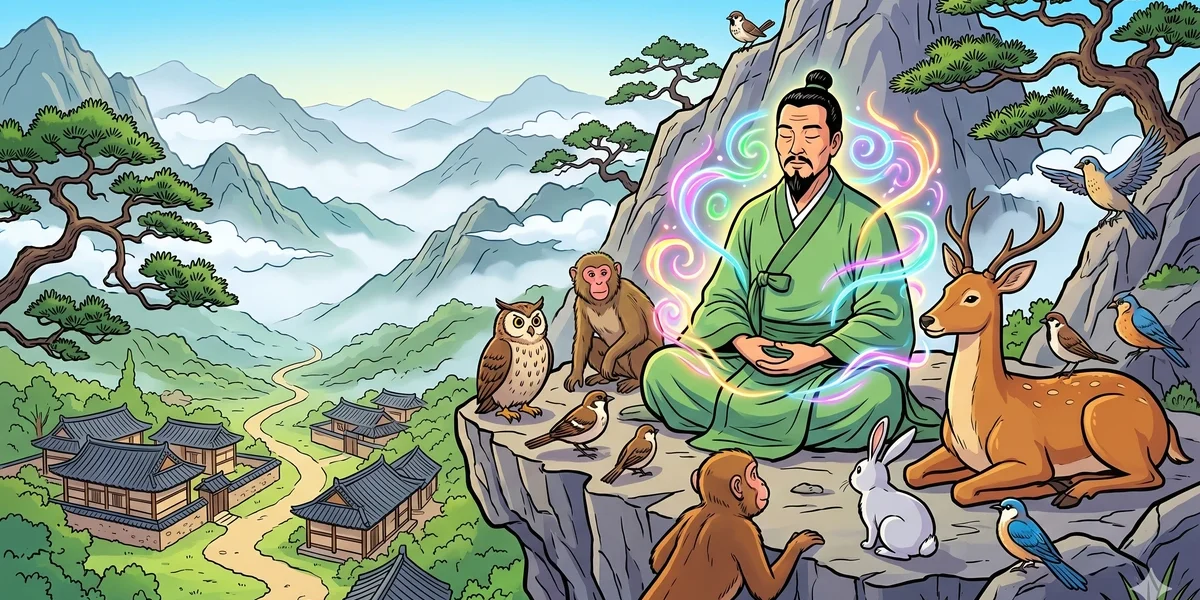
Cheung Puk-Chang, the Seer is based on the historical and legendary figure of Jeong Yeom (정렴, 1506-1549), a scholar-official of the Joseon Dynasty whose extraordinary abilities in divination, geomancy, medicine, and prognostication made him one of the most celebrated seers in Korean history. He is known as Buk-Chang (북창, North Window) after the northern window of his study from which he is said to have conducted his astronomical and divinatory observations. In Confucian Korea, where the rational administration of the state through classical scholarship was the dominant official ideology, men like Jeong Yeom occupied an ambiguous position: too learned and too well-born to be dismissed as mere folk diviners, too deeply engaged with the non-rational dimensions of fate and cosmic pattern to be entirely comfortable within orthodox Confucian categories. Their stories — collected in the uncanny-tale genre of Joseon prose fiction — explore the specific condition of the person who sees more clearly than the surrounding world can accommodate, and who must live with that clarity.
Beat I — The Seer’s Gift and Its Weight
Jeong Yeom / Cheung Puk-Chang demonstrated his unusual perceptual capacities early. The accounts preserved in Joseon literary collections record that he could read the signs of fate in a person’s physiognomy, in the arrangement of the heavenly bodies at their birth, in the quality of the gi (기, vital energy) that surrounded a place or person. He was consulted by those who wished to know whether their sons would pass the examination, whether a proposed marriage was auspicious, whether a particular site was suitable for a house or a grave. He answered, when the signs were clear, with precision.
The weight of this gift was specific: he could not always answer what he perceived when the answer was bad news for the person asking. The seer’s social position requires navigating constantly between the obligation to honesty — to report what the signs actually say — and the obligation to compassion, which recognises that some knowledge damages the person who receives it more than ignorance would. Jeong Yeom’s reputation in the tradition is for finding ways to deliver difficult truths that allow the recipient to prepare without being destroyed: the timing of a death communicated indirectly through the arrangements one should make; the failure of an examination attempt framed as advice about the more auspicious second attempt.
This navigation — between what is seen and what can usefully be said — is the seer’s daily practice, and it requires a form of wisdom that the divination system itself does not provide. The sajupālja (사주팔자, four pillars of fate — the year, month, day, and hour of birth, each associated with two of the Heavenly Stems and Earthly Branches) tells the trained reader what pattern the person’s fate takes; it does not tell the reader what to do with that knowledge.
Beat II — The Diviner’s Paradox
The most philosophically interesting dimension of Cheung Puk-Chang’s stories is what might be called the diviner’s paradox: the person who can read fate most clearly is also the person most constrained by it. Knowing what will happen does not allow the seer to change it — in the Korean divination tradition, fate has the character of pil-un (필운, necessary fate, inevitable karmic pattern), a structure that perception clarifies but cannot alter. The seer sees the necessity; they cannot undo it.
This creates a specific experiential condition. An ordinary person moving through their life encounters fate from the inside — they experience events as they arrive, without advance notice, with the full capacity for surprise, hope, and denial that ignorance allows. The seer encounters fate from outside: they see the pattern before entering it, watch themselves and others moving toward outcomes they have already perceived, and must engage with daily life while carrying the knowledge of its shape.
Cheung Puk-Chang is reported to have known the date of his own death with precision. He made his preparations calmly, arranged his affairs, said his farewells at the appropriate moment, and died as foreseen. This is the Korean tradition’s ideal image of the seer’s relationship to fate: not the tragic foreknowledge of the Greek seer who is cursed to be disbelieved (Cassandra), not the desperate attempt to circumvent what has been seen (Oedipus), but the calm preparation for what cannot be changed. The knowledge becomes a gift rather than a curse when the response is equanimity rather than resistance.
Beat III — An-Bun-Ji-Myeong: Contentment Within One’s Allotted Portion
The Korean concept that organises Cheung Puk-Chang’s relationship to his own fate is an-bun-ji-myeong (안분지명, literally “to rest peacefully within one’s allotted portion/fate”) — a phrase that combines the ideas of contentment within one’s portion (an-bun, 안분) and knowledge of fate’s necessity (ji-myeong, 지명, knowing fate/mandate). It is related to, but distinct from, simple resignation: an-bun-ji-myeong is not the passive acceptance of the defeated but the active, cultivated orientation of the person who has fully understood the difference between what can be changed and what cannot, and has organised their energy accordingly.
This concept has deep roots in Korean Confucian thought. Confucius himself was described as zhi-ming (知命, knowing fate/mandate) — a quality he regarded as the achievement of the person of fifty, someone who had lived long enough to understand the shape of their own situation within the larger pattern of necessity. In the Korean appropriation of this concept, an-bun-ji-myeong became associated with a specific emotional quality: a settled, untroubled relationship to one’s circumstances that is not indifference but peace — the peace of someone who has stopped fighting the structure of the situation and is free, within that structure, to live well.
For a seer like Cheung Puk-Chang, this quality is both more necessary and more achievable than for ordinary people. More necessary because the clarity of what he perceives could, without equanimity, produce unbearable anxiety — the knowledge of every person’s eventual fate is not easy to carry. More achievable because the same clarity that shows him the pattern of necessity also shows him the space within that pattern where genuine choice and genuine quality of life remain possible. He sees both the necessity and the freedom within the necessity, and an-bun-ji-myeong is his orientation toward the whole.
A signature story in the Cheung Puk-Chang tradition illustrates this. He is asked by a high official to read the fate of the official’s son, who is preparing to sit the state examinations. He reads the sajupālja and sees that the son will not pass — not in this attempt, not in several subsequent ones; his fate lies in a different direction than the one his family has planned. He communicates this in a way that allows the family to prepare for a different future without requiring them to abandon hope immediately. The official, years later, confirms that this was exactly so. Cheung Puk-Chang does not celebrate his accuracy; he receives the confirmation with the equanimity that characterised the reading itself.
Beat IV — The Seer in Joseon Society: Between Orthodox and Unorthodox Knowledge
Cheung Puk-Chang’s position in Joseon Dynasty society illuminates a tension that ran through Korean intellectual life from the 15th century onward: the relationship between the official Confucian epistemology — rational, textual, this-worldly, deeply suspicious of superstition — and the vast body of cosmological, divinatory, and shamanistic knowledge that continued to organise a large portion of Korean life at every social level, including the court. The Neo-Confucian orthodoxy that governed Joseon’s official institutions had little room for divination as a legitimate knowledge system; the actual practice of government, agriculture, medicine, and family life depended on it continuously.
Jeong Yeom’s historical position — well-born, classically educated, a credentialed member of the Joseon gentry class — allowed him to practice divination with a legitimacy that neither purely shamanistic practitioners nor purely orthodox Confucian officials could claim. He was too orthodox to be dismissed as superstitious, too clearly gifted to be explained entirely within orthodox categories. This liminal position is exactly where the most interesting knowledge tends to accumulate: at the boundary between what can be officially acknowledged and what is practically indispensable.
His stories have been preserved because they demonstrate something that the orthodox tradition could not quite say but could not quite deny: that pattern, necessity, and the shape of fate are real features of the world, that careful attention and cultivated perception can access them, and that the person who combines such access with genuine equanimity and compassion serves their community in ways that rational administration alone cannot.
“He knew when he would die and prepared for it as one prepares for a journey — with calm, with arrangement, with farewells at the right moment. This is what the seer’s gift produces, properly received: not terror but readiness.”
— From the tradition of Jeong Buk-Chang, Joseon Dynasty Korea
Why This Story Has Lasted
Cheung Puk-Chang’s stories have persisted because they address a question that every person who lives long enough to understand something about fate’s structure must eventually face: what is the right relationship to necessity? The Korean answer — an-bun-ji-myeong, contentment within one’s allotted portion — is not a counsel of passivity but of wisdom: the capacity to distinguish between what can and cannot be changed, to organise energy accordingly, and to live well within the structure of what is given. The seer who knows the date of his own death and prepares for it calmly is an extreme demonstration of this capacity — and extremes clarify the ordinary cases. Most of us encounter small versions of the diviner’s paradox throughout our lives: moments when we see clearly what is coming and must decide whether to resist or to prepare. Cheung Puk-Chang’s answer is that preparation — done with care and without drama — is the wiser response.
Frequently Asked Questions
Who was Cheung Puk-Chang (Jeong Buk-Chang) in Korean history?
Jeong Yeom (정렴, 1506-1549), known as Buk-Chang (북창, North Window) after his study’s northern window, was a historical Joseon Dynasty scholar famous for extraordinary abilities in divination, geomancy, medicine, and prognostication. A member of the gentry class with a classical Confucian education, he occupied a liminal position between official rationalist orthodoxy and the vast tradition of divinatory knowledge that continued to organise Korean life at every social level. His stories were preserved in Joseon uncanny-tale collections and have shaped the cultural image of the Korean seer.
What is sajupālja (사주팔자) and how did Cheung Puk-Chang use it?
Sajupālja (사주팔자, four pillars eight characters) is the Korean divination system based on the year, month, day, and hour of a person’s birth, each expressed in terms of the Heavenly Stems and Earthly Branches that compose the traditional East Asian calendar system. Each pillar consists of two characters, producing eight characters in total, whose interactions reveal the pattern of a person’s fate: their personality, the shape of their relationships, the timing of fortunate and difficult periods, and the overall arc of their life. Cheung Puk-Chang read these patterns with unusual accuracy and used them to advise on examination timing, marriage compatibility, and site selection.
What is the diviner’s paradox?
The diviner’s paradox is the condition of knowing fate without being able to change it: the seer who perceives necessity is not freed by that perception but is constrained by it, required to carry the knowledge of outcomes that others will encounter as surprises. Ordinary people experience fate from inside — with surprise, hope, and denial. The seer experiences fate from outside — seeing the pattern before entering it. The Korean tradition’s answer to this paradox is an-bun-ji-myeong: the cultivated equanimity that allows the seer to live well within the structure of what is given, without being paralysed by clarity about what cannot be changed.
What is an-bun-ji-myeong (안분지명)?
An-bun-ji-myeong (안분지명, “resting peacefully within one’s allotted portion/fate”) is the Korean concept of cultivated contentment within one’s circumstances — not the passive resignation of defeat but the active, developed orientation of the person who has understood what can and cannot be changed and organised their energy accordingly. It combines an-bun (contentment within one’s portion) with ji-myeong (knowing fate/mandate). In the context of the seer’s story, it is the quality that transforms the knowledge of fate from a curse into a gift: the seer who knows what is coming and prepares with equanimity lives better than the person who knows what is coming and spends their energy in futile resistance.
How did Joseon Dynasty Korea reconcile Confucian rationalism with divination practice?
Officially, Neo-Confucian orthodoxy — which governed Joseon’s institutions from the 14th century onward — was deeply suspicious of divination, geomancy, and shamanistic practice as superstitious interference with rational governance. In practice, divination was used continuously at every social level including the court: for site selection, examination timing, marriage compatibility, and the timing of major decisions. Figures like Jeong Yeom/Cheung Puk-Chang occupied the productive tension between these two positions — too orthodox to be dismissed, too clearly gifted to be explained away. Their stories have been preserved precisely because they made visible the knowledge that official discourse could not quite acknowledge but could not afford to ignore.
You May Also Like
 Korean Folk Tales
All Ages
Korean Folk Tales
All Ages
Fancha And The Magpie
A thousand years ago, Fancha and a magpie form an unlikely partnership, using wisdom and courage to overcome tyranny and restore justice through clever means.
 Korean Folk Tales
Ages 9-12
Korean Folk Tales
Ages 9-12
The King Of The Flowers
The King Of The Flowers: Korea is the land of beautiful scenery and lovely flowers. Snow white and ruby red are their chief colors. In the spring time when the
 Korean Folk Tales
All Ages
Korean Folk Tales
All Ages
Hong Kil Tong
Hong Kil Tong: OR, THE ADVENTURES OF AN ABUSED BOY. During the reign of the third king in Korea there lived a noble of high rank and noted family, by name Hong.