A Visit From The Shades
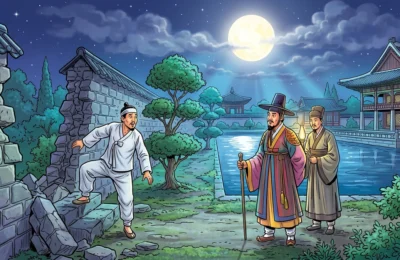
A Visit From The Shades: (The story of meeting his mother’s ghost is reported to be of this man.) Choi Yu-won matriculated in 1579 and graduated in 1602

Origin & Tradition
A Visit from the Shades belongs to the extensive Korean tradition of ancestral ghost narratives — stories in which the dead return to the world of the living because they carry something unresolved, something that cannot be set down without the participation of those who remain. The Korean word for ghost — gwisin (귀신) — encompasses a range of returning spirits, but the most culturally significant are those who died carrying han (한, 恨): the distinctly Korean emotional complex of deep accumulated grief, resentment, unfulfilled longing, and sorrow that has no ordinary outlet. Han is not simply sadness or anger; it is what accumulates when circumstances — unjust death, unfulfilled vow, unrequited love, unacknowledged sacrifice — prevent normal emotional processing and resolution. The dead who carry han cannot rest; they return to seek what their living circumstances denied them. These narratives are rooted in the same soil as Korean shamanic practice (musok, 무속), where the shaman’s role includes facilitating communication between the living and the dead, releasing han through ritual, and allowing the departed to finally move on.
Beat I — The Shade Arrives
In the deep of night — always the deep of night, when the boundary between the living world and jeoseung (저승, the realm of the dead) is most permeable — a presence is felt in the household. It might be the rustle of clothing in an empty room, a smell associated with someone who is gone, a shadow that moves against the logic of available light. The family member who perceives it — often a spouse, a sibling, or a child of the deceased — does not immediately comprehend what they are encountering. The initial perception is ambiguous: not yet clearly supernatural, still within the range of what exhaustion or grief might produce.
Then the figure becomes visible. In Korean ghost-narrative convention, the gwisin appears in the form the person wore at death or in the clothing they most associated with: a woman who drowned appears with wet hair; a man who died in winter wears the coat he had on; a child who died in illness looks as she looked in her last hours. The appearance is not monstrous — it is painfully familiar. This is a person who was known, loved, mourned. The terror of the encounter is not the otherness of the shade but its nearness, its recognisability, the specific quality of presence that the mourner had given up hope of feeling again.
The shade does not speak immediately. It stands. It looks. This looking is itself a communication — the intensity of it carries everything that han contains: the need to be seen, the need to be recognised, the need to have something acknowledged that was denied in life or at the moment of death.
Beat II — The Unfinished Business
When the shade speaks, it speaks of specifics. This is crucial to the Korean ghost-narrative tradition: the returning dead do not haunt in vague atmospheric distress but arrive with particular, nameable grievances and requests. A mother who died before seeing her daughter married returns to attend the wedding ceremony, hovering at the edge of the celebration before her daughter perceives her and weeps. A husband who was falsely accused and died in prison returns to ask his wife to clear his name in the village records. A sibling who died in poverty returns to ask that their burial site be properly maintained so that their spirit has a settled home.
The specificity of these requests is philosophically significant. Han in Korean thought is not a generalised spiritual malaise; it is always the accumulation of specific unresolved particulars — this vow, this debt, this relationship, this injustice. The shade’s requests are the list of those particulars, made audible by the extremity of death. What could not be said or done in life becomes urgent after death because death has removed all the ordinary mechanisms of resolution — time, effort, the possibility of return — except this one: the visit.
In the story most commonly associated with this title, a recently deceased person returns to their household within the forty-nine day period following death — the Buddhist-influenced liminal period during which the soul is understood to still be in proximity to the living world, before it has fully entered jeoseung. The shade arrives not to frighten but to complete: there is a letter undelivered, a debt of kindness unacknowledged, a child who does not yet know how beloved they were. The living family member who receives the visit must decide whether to engage or flee — and the tradition is clear that engagement is the correct response, because the shade is not a threat but an obligation.
Beat III — Han and Its Resolution
Han (한, 恨) is one of the most discussed concepts in Korean cultural studies — a term that resists clean translation because it encompasses a range of experiences that Western emotional vocabulary splits into separate categories. Han is grief that has been suppressed under social obligation; it is resentment that cannot be expressed because the power differential is too great; it is longing for what was lost that has no adequate mourning ritual; it is the sorrow of unfulfilled potential and unrealised aspiration accumulated over a lifetime, or over generations. Scholars of Korean culture — most famously the theologian Suh Nam-Dong and the literary critic Kim Yeol-Kyu — have argued that han is not merely an individual psychological state but a collective cultural condition, the accumulated emotional residue of centuries of external pressure (foreign invasions, colonial occupation, internal political violence) on a people whose expressive culture developed partly as a vehicle for its release.
In the ghost-story tradition, han operates at the individual level: the specific shade who returns carries the specific han accumulated in their specific life and death. The resolution of han requires what Korean shamanic tradition calls han-puri (한풀이, the releasing/untying of han) — the specific act of acknowledgment, expression, and ritual completion that allows the accumulated grief to discharge. Han-puri is not simply catharsis; it is the completion of an interrupted process. The shade who died with an undelivered message has han; the delivery of the message is han-puri. The shade who died unjustly accused has han; the clearing of their name is han-puri. The shade who died without knowing they were loved has han; the spoken acknowledgment of that love is han-puri.
The living family member who receives the shade’s visit is therefore not merely a passive recipient of supernatural phenomena; they are the instrument through which han-puri becomes possible. The shade cannot release its own han — that is why it returned. The living person’s willingness to engage, to hear, to do what the shade asks, is the condition under which the dead can finally rest. This gives the encounter its moral structure: it is not an invasion but an appeal, and the appropriate response is compassionate attention rather than terror.
Beat IV — The Permeable Boundary and the Obligation of the Living
Korean folk religious thought — rooted in shamanic practice but inflected by Buddhist and Confucian elements absorbed over centuries — understands the boundary between the living and the dead as permeable rather than absolute. Jeoseung is not a sealed realm from which no communication is possible; it is a different mode of existence that is adjacent to the living world, accessible through dreams, through shamanistic ritual (gut, 굿), and — in folk narrative — through the forty-nine day liminal period when the recently dead have not yet fully departed.
This permeability is not threatening in Korean folk cosmology but structurally necessary: the living and the dead remain in relationship, and that relationship has obligations running in both directions. The living owe the dead ritual acknowledgment through the ancestral rites (jesa, 제사) performed at regular intervals — the preparation of food, the burning of incense, the recitation of names, the maintenance of the grave site. The dead owe the living their protection, guidance, and the release of their own han so that it does not spill over into misfortune for the household. The ghost story is, in this framework, a narrative about what happens when this relationship breaks down — when the living have failed to perform their obligations or when the dead carry han so acute that the ordinary ritual channels are insufficient.
The shade’s visit, frightening as it is, is ultimately an act of trust: the dead return to those they loved, not to strangers. The specific person who receives the visit is the one whom the shade trusts to hear and respond. This is why the Korean ghost narrative so often involves intimate family relationships — spouse, parent, sibling, child — rather than strangers. The shade crosses the boundary between jeoseung and the living world precisely because the person on the other side of that boundary matters enough to return for.
“The dead do not return to frighten us but to finish what they could not finish — the word not spoken, the debt not cleared, the love not confirmed. Our task is to hear them and to do what only the living can do for those who are no longer living.”
— Distilled from the Korean ancestral ghost-narrative tradition
Why This Story Has Lasted
Ghost stories of the Korean variety have persisted because they take death seriously as an interruption rather than a completion — and they insist that the living have a continuing obligation to the dead that does not end at the grave. The concept of han gives the returning shade moral weight: it is not a malevolent entity to be exorcised but a person whose suffering was real, whose unfinished business is legitimate, and whose peace depends on what the living are willing to do. The ritual culture of jesa and the shamanic tradition of gut continue to carry this understanding in living practice, and the ghost stories refresh it at the narrative level in every generation that encounters them. To fear the shade is to miss the point; to hear it is to participate in one of the most ancient human practices: keeping faith with the dead.
Frequently Asked Questions
What is “han” (한) in Korean culture and why do ghosts carry it?
Han (한, 恨) is a distinctly Korean emotional complex encompassing deep accumulated grief, resentment, unfulfilled longing, and sorrow that has no ordinary outlet. It accumulates when circumstances — unjust death, unfulfilled vow, unrequited love, unacknowledged sacrifice — prevent normal emotional processing and resolution. In Korean ghost-narrative tradition, the dead who carry han cannot rest because their han has no internal mechanism for release; they must return to the living to complete the specific interrupted processes — the undelivered message, the uncleared debt, the unspoken love — whose completion will release what they carry.
What is han-puri and why is it important?
Han-puri (한풀이, literally “untying/releasing of han”) is the specific act of acknowledgment, expression, and ritual completion that allows accumulated han to discharge. It is central to Korean shamanic practice: the shaman (mudang) facilitates han-puri during ritual ceremonies (gut) by giving voice to the dead’s unresolved grief and creating the conditions under which it can be expressed, heard, and released. In folk narrative, han-puri occurs when the living person who receives the shade’s visit does what the shade asks — delivers the message, clears the name, speaks the love — completing the interrupted process that death had left unfinished.
Why do Korean ghosts return to family members specifically?
In Korean folk cosmology, the shade returns to those who mattered enough to return for — typically the people with whom the most significant unresolved relationships existed: spouse, parent, sibling, child. The visit is an act of trust, not aggression: the dead cross the boundary between jeoseung (저승, the realm of the dead) and the living world because the person on the other side is the one who can complete what needs completing. The ghost story’s moral structure depends on this intimacy: the shade is not a threat to be expelled but an appeal to be heard, and the person receiving it has both the capacity and the obligation to respond.
What are jesa (제사) and how do they relate to ghost stories?
Jesa (제사, ancestral memorial rites) are rituals performed by Korean families to honour deceased ancestors at regular intervals — on death anniversaries, during major holidays (Chuseok, Seollal), and at specific transitional moments. They involve the preparation of food offerings, the burning of incense, the bowing before photographs or memorial tablets, and the recitation of the ancestors’ names. Jesa is understood as the living’s fulfilment of their obligation to the dead: regular acknowledgment, sustenance, and memory. Ghost narratives dramatise what happens when this relationship breaks down — when han accumulates because the ordinary ritual channels are insufficient or have been neglected.
Is the jeoseung (저승) in Korean tradition similar to Western concepts of the afterlife?
Jeoseung (저승, the realm of the dead) in Korean folk cosmology is not a sealed, permanent realm like the Christian heaven or hell. It is understood as adjacent to the living world — accessible through dreams, shamanic ritual, and the liminal period following death. The boundary is permeable rather than absolute, and the relationship between living and dead involves ongoing mutual obligation. This differs significantly from Western concepts of a heaven or hell from which no communication is possible: in Korean thought, the dead remain members of an extended community that includes the living, and the peace of both depends on the health of that relationship.
You May Also Like
 Korean Folk Tales
Ages 6-8
Korean Folk Tales
Ages 6-8
A Story Of The Fox
A Story of the Fox: Ancient Wisdom About Cleverness and Magic In the ancient lands of Asia, storytellers have always known something special about foxes. These
 Korean Folk Tales
Ages 9-12
Korean Folk Tales
Ages 9-12
The Rabbit’S Eyes
The Rabbit’S Eyes: There was trouble down in the fish world under the waves. Indeed, every creature with fins and a tail was in distress, for the king of the
 Korean Folk Tales
All Ages
Korean Folk Tales
All Ages
The Fortunes Of Yoo
The Fortunes Of Yoo: There was a man of Yong-nam, named Yoo, who lived in the days of Se-jong. He had studied the classics, had passed his examinations, and