The Rabbit’s Eyes
When the King of the Fishes swallows a fishhook, the sea doctors decide only a rabbit’s eyes can cure him, and Dr. Turtle is sent ashore to fetch one.
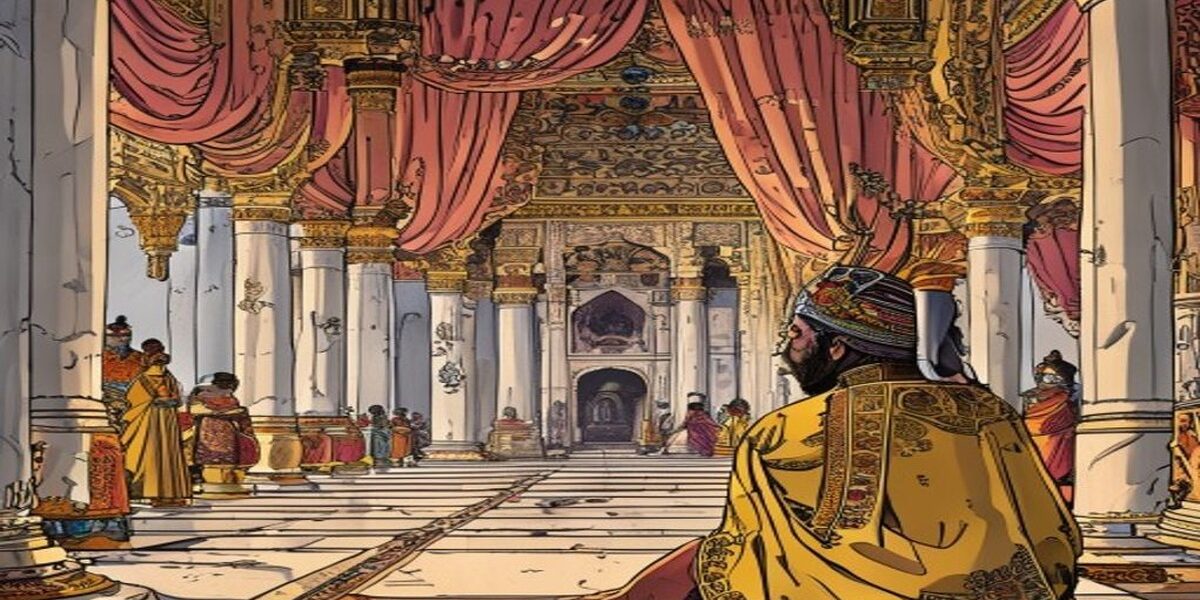
There was trouble in the fish world under the waves. Every creature with fins and a tail was upset, because the King of the Fishes had a terrible pain in his mouth. This is how it happened.
One day, as he swam about outside his palace, the King of the Fishes saw something dangling in the water that looked good to eat, and His Majesty gulped it down at once. Oh, horrors! It was a fishing hook, baited by fishermen in a boat up on the surface, and it caught fast in his gills. The King jerked himself free and the line snapped, but the hook stayed behind, giving him a fever and a great deal of pain.
How could they get the iron out and make His Majesty well? Every wise creature in the ocean, from the turtle to the little gudgeon and from the stickleback to the whale, was summoned to the palace to see what could be done. Many wise heads nodded, many eyes blinked and many fins wagged as the sea doctors talked it over in council.
The turtle was thought the most learned and skilled of them all. He felt the King’s pulse and peered down his throat again and again before he would say what the trouble was or write out a cure. At last, after talking it over with the other doctors, the ones with fins and tails and the ones with scales and shells, they decided that nothing less than a warm poultice made of a rabbit’s eyes would loosen the hook and end His Majesty’s suffering.
So Dr. Turtle was sent to the seashore to invite a rabbit down to the world under the sea, so that they could make a poultice of his eyes and put it on the King’s throat.
When he reached the beach at the foot of a high hill, Dr. Turtle looked up and saw Mr. Rabbit out of his burrow, taking a stroll along the edge of the forest. Dr. Turtle waddled across the sand and partway up the hill, climbing hard until he puffed and panted, but he still had breath enough to call out a good morning to Brother Bunny. The rabbit very politely said good morning back.
“Hot day,” said Dr. Turtle, pulling out his handkerchief to wipe his horny forehead and clean the sand from his claws.
“Yes, but the view is so fine, Dr. Turtle, that you must be glad to be out of the water to see such lovely mountains,” said the rabbit. “Isn’t Korea a wonderful country? There’s no land in the world as beautiful as ours. The mountains, the rivers, the seashore, the forests, the flowers—”
If Dr. Turtle had let the rabbit go on praising his country, he would have forgotten all about his errand. But he thought of the poor Fish King with the cruel hook in his mouth, and he broke in. “Oh, yes, Brother Bunny, the scenery up here is very pretty, but it can’t compare with the gems and jewels, the trees and flowers, the sweet scents and all the lovely things in the world under the sea.”
The rabbit pricked up his ears. This was news to him. He had never heard that there was anything under the water except ordinary fish and seaweed, and when those rotted and washed up on the beach, they certainly didn’t smell sweet. Now he was hearing something quite different, and his curiosity was roused. “How interesting, my friend,” he said. “Tell me more.”
So Dr. Turtle described wonderful mountains and valleys on the floor of the deep sea, covered with rare water plants of red, orange, green, blue and white, with trees of gold and silver and flowers of every color and the most delightful perfume.
“You amaze me,” said Brother Bunny, more interested than ever.
“Yes, and all sorts of good things to eat and drink, with music and dancing and everything nice. Come and be our guest. Our King has sent me to invite you.”
“May I really come?” asked Brother Bunny, delighted.
“Yes, right now. Climb on my back, and I’ll carry you.”
So the rabbit ran and the turtle waddled down to the water’s edge. “Now hold tight to the front of my shell,” said Dr. Turtle. “We’re going under.”
Down, down beneath the blue waves they sank, until they came to the King’s palace. There the rabbit found that everything the turtle had said was true. The colors and the rich jewels were just as he had described. Dr. Turtle introduced Brother Bunny to some of the princes and princesses of the kingdom, who showed their guest the sights and treasures of the palace, while Dr. Turtle went off to tell the council of doctors that his mission had succeeded.
But while Mr. Rabbit was enjoying himself and thinking this was the most marvelous place in the world, he overheard some talk and found out why he had really been brought there and treated with such honor. Horrified at the thought of losing his eyes, he made up his mind to save them and play the turtle a clever trick, but he said nothing of it to anyone.
So when the royal officers politely informed him that he must give up his eyes to cure the King, Brother Bunny replied just as politely. “I am truly sorry His Majesty is ill, and you must forgive me for not helping him at once. You see, the eyes in my head right now aren’t my real ones. They’re only crystal. I was afraid the salt water would hurt my sight, so I took out my ordinary eyes, buried them in the sand and put in these crystal ones, which I always wear in very dusty or wet weather.”
The officers’ faces fell. How could they break this news to His Majesty?
Brother Bunny seemed truly sorry for them. “Oh, don’t worry,” he said. “Just let me go back up to the beach. I’ll dig them up and come straight back in time to make the poultice.”
So he climbed onto Dr. Turtle’s back, and soon they were out of the water and on dry land. In a flash, the rabbit jumped off and scampered away toward the woods, showing nothing but his cotton tail, and soon he was out of sight.
Poor Dr. Turtle wept, and then he swam slowly home to confess how a rabbit had outwitted him.
About this story
“The Rabbit’s Eyes” is from William Elliot Griffis’s Korean Fairy Tales (1922). It is a version of the Korean turtle-and-rabbit story, also known as Sugungga or Byeoljubujeon, in which the Dragon King of the sea needs a rabbit’s liver to cure his illness. In Griffis’s telling, the liver has become the rabbit’s eyes and the Dragon King a fish king.
Compare this escape with the Indian story of a monkey who claims to have left his heart in a tree. Both use the supposed removal of a vital organ to persuade a captor to make a return journey; the similarity alone does not establish which telling came first.
Read the original: Korean Fairy Tales (Project Gutenberg)
Suggested for ages 9–12 with an adult available: includes a plan to remove Rabbit’s eyes, which he escapes before it is carried out.
A beautiful invitation with a hidden purpose
The underwater sights really are splendid, so Rabbit cannot detect the danger merely by checking whether Turtle’s descriptions are true. What is missing is the reason for the invitation. Once he overhears the plan, Rabbit exploits the court’s own readiness to believe an extraordinary cure: he claims his real eyes can be left elsewhere and collected.
Read the invitation twice
Divide a page into “What Turtle describes” and “What Turtle leaves out”. Add details from the journey and the conversation Rabbit overhears. Write an honest version of the invitation, then explain why Rabbit would answer it differently.
Questions to ask
- How did Dr. Turtle get the rabbit to come under the sea?
- What trick did the rabbit play to escape?
- Was it fair of the sea creatures to trick the rabbit? Why or why not?
Related stories
- The Monkey and the Crocodile — a tale using a similar escape trick
- The Unmannerly Tiger — another small creature outwits a big one
- The Sky Bridge of Birds — another Korean tale from Griffis
Frequently Asked Questions
Why do the sea doctors want the rabbit?
How does Rabbit discover the danger?
How does he escape?
You May Also Like
 Korean Folk Tales
Ages 9-12
Korean Folk Tales
Ages 9-12
The King of Yom-na (Hell)
Spirit soldiers carry off a sick scholar to the judgment hall of the underworld, only for the King there to find that they have arrested the wrong man.
 Korean Folk Tales
Ages 9-12
Korean Folk Tales
Ages 9-12
Cheung Puk-chang, the Seer
A brilliant scholar who learns any language at a hearing tells his worried aunt exactly where her overdue servant is, and why he is being beaten.
 Korean Folk Tales
Ages 9-12
Korean Folk Tales
Ages 9-12
Yun Se-pyong, the Wizard
A wizard so feared that his own family keeps away sets out to rid Seoul of a rival magician, who hides from him by turning into a beetle under a crock.