Ta-Hong
Ta-Hong: [Sim Heui-su studied as a young man at the feet of No Su-sin, who was sent as an exile to a distant island in the sea. Thither he followed his master
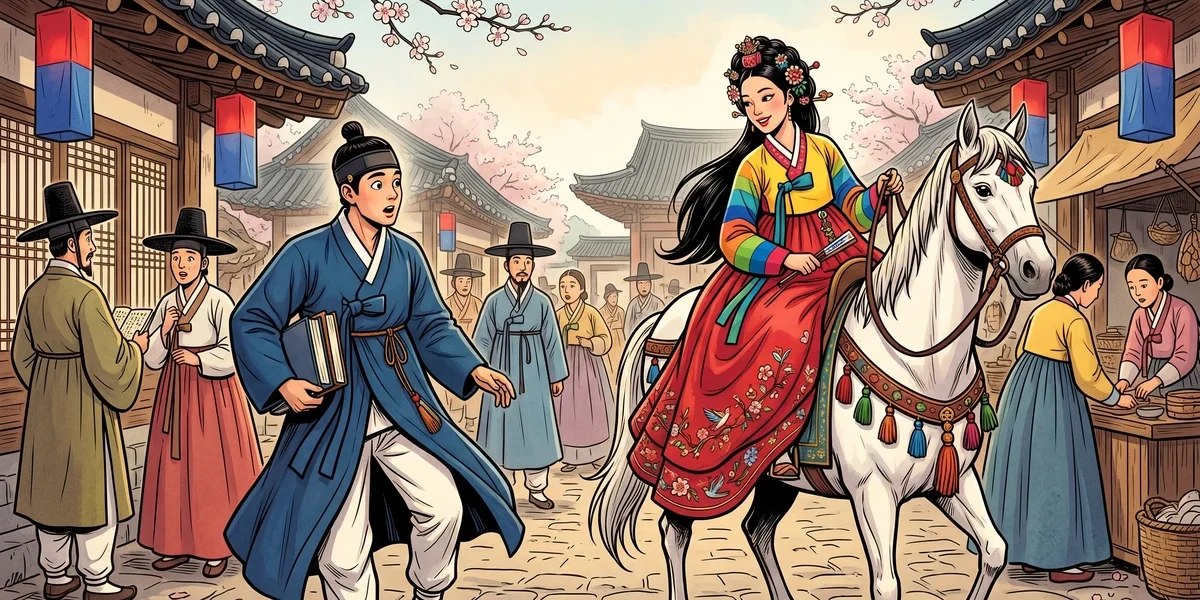
The Girl Whose Name Held
Ta-Hong was the kind of person who appeared, at first, to be made entirely of softness: quiet voice, careful movements, the particular stillness that in Korean folk tradition is associated with a person who has arranged their inner world before they enter any room. She was not the most beautiful girl in the district, nor the most accomplished in the social arts that Joseon measured girls by. What she had was a quality for which the ordinary vocabulary of virtue is inadequate: something that the old Korean word jeol (절) approaches, without quite naming fully.
Jeol is translated variously as fidelity, moral integrity, chastity, or constancy. But its deepest meaning is structural: it refers to the quality that allows a person to remain who they fundamentally are when external pressure — social, emotional, material, physical — works to reshape them into something else. The bamboo has jeol: it bends in the wind but does not break, and when the wind passes it is still bamboo, still upright, still exactly itself. Ta-Hong had this quality, and the story of her life is the story of how that quality was tested and what the testing revealed about the difference between mere flexibility and genuine integrity.
Beat I — The Household and What It Required of Her
Ta-Hong grew up in a household where the demands on her were structured by multiple overlapping authorities: her parents’ expectations, the village’s social conventions, the particular requirements of a Joseon-era girl’s existence in which most important choices were made by others on her behalf. She navigated these demands with the specific combination of compliance and inner reservation that characterised the most capable young women of her era: she did what was asked of her without protest and maintained, in the interior spaces of her life, the values and commitments that were entirely her own.
She had formed, early and without particular drama, a set of attachments that she understood as constitutive of who she was. A promise she had made. A loyalty she had undertaken. A relationship she had chosen to value. These were not spectacular commitments; they had not been tested. They existed, quietly, as the architecture of her inner life. She did not speak of them often because there was no need to — they were not under threat, and the person who continually announces their commitments often does so because they are less certain of them than they appear.
The test, when it came, arrived through the mechanism that Korean folk tales most often deploy for this purpose: a change in the household’s circumstances that introduced new pressures, new authorities, and new demands that directly conflicted with the inner architecture she had built. The specifics vary by version of the tale — sometimes a new authority figure, sometimes a change in family fortune, sometimes an external party whose interests would be served by Ta-Hong becoming someone other than who she had committed to being. What all versions share is the escalating pressure: first the request, then the demand, then the coercion, then the punitive consequence.
Beat II — The Pressure and How It Worked
The pressure came in stages, as pressure in these tales always does. First the suggestion, framed as practical wisdom: the situation has changed; the old commitments no longer apply; a sensible person would adapt. Ta-Hong listened, acknowledged the changed situation, and confirmed that her commitments remained what they were. Second the argument: the commitments she was holding were unreasonable given the circumstances; those who depended on her needed her to be flexible; her rigidity was selfish. She listened again, felt the genuine weight of the argument — the portion of it that was true — and confirmed again. Third the threat: there would be consequences for her continued refusal. She said: yes, she understood.
What Ta-Hong demonstrates in this sequence is not the absence of fear. She felt the threat. She felt the social weight of the authorities pressing on her. She felt the specific loneliness of a person who holds a position that no one around them is supporting and several are actively working against. Korean folk tradition is precise about this: jeol is not the absence of feeling but the maintenance of commitment despite feeling. The person who experiences no pull toward compliance is not demonstrating integrity; they simply lack the social sensitivity that makes the pressure real. Ta-Hong felt the pull. She held anyway.
The punitive consequences, when they came, were real. This is the part of the Ta-Hong story that Korean storytellers preserve most carefully: the willingness to suffer the actual costs of maintained commitment, without catastrophising them into something more dramatic than they are or minimising them into something manageable. She was diminished in the community’s estimation. She lost material comforts. She endured a period of isolation. None of these things changed what she was committed to.
Beat III — Jeol and the Question of Ontological Coherence
The concept of jeol in Korean tradition is sometimes understood too narrowly as a virtue of women specifically — associated with sexual fidelity, with the resistance to remarriage after widowhood, with the specific demands that a patriarchal social order placed on female conduct. This narrowing misrepresents the concept’s deeper meaning. Jeol in its fullest sense is a quality of structural coherence available to any person who has formed genuine commitments and maintained them under pressure.
The deeper claim that jeol makes is ontological: it concerns the question of who a person is. A person who abandons their essential commitments under sufficient pressure has not merely done something wrong — they have become, in a meaningful sense, someone other than who they were. The commitments constituted their identity; their abandonment dissolves that identity and replaces it with something more pliable, more responsive to external pressure, but less definitively a self. This dissolution may be comfortable — the pressure stops, the social penalties recede — but the cost is the specific kind of coherence that comes from being recognisably yourself across changing circumstances.
Korean folk tradition understands this through the bamboo image that appears in classical Korean poetry and painting: the bamboo bends in the storm but does not break, and when the storm passes it is still itself, still upright, still the same bamboo. The pine is similarly invoked: it does not change colour in winter. These are not images of rigidity — the bamboo bends — but of structural integrity: the quality of returning to one’s essential form after whatever pressure has been applied. Ta-Hong’s jeol is this quality. She bends — she feels the pressure, she adjusts her expression of her commitments to navigate the circumstances — but she does not break, does not dissolve, does not become the person external pressure is trying to make her into.
Beat IV — What the Maintenance of Jeol Produced
The restoration that follows the testing period in the Ta-Hong story is not presented as magical compensation but as the natural consequence of a person’s character becoming, over time, legible to those around them. The pressure had been real; the consequences had been real; the isolation had been real. And then, as circumstances shifted — as the authority that had been pressing on her changed, or was removed, or was itself tested and found wanting — the quality that had kept Ta-Hong who she was became visible in a way that changed how the community regarded her.
This is the specific form of recognition that jeol earns: not spectacular praise or dramatic vindication, but the slow accumulation of trust that comes from having demonstrated, under conditions that made compliance the easier path, that one is who one says one is. The community around Ta-Hong had watched her tested. They had seen what she maintained under pressure. They now knew, in the way that observation generates knowledge that argument cannot, that she was a person whose commitments could be relied upon. This knowledge changed her position — not by making her wealthy or powerful, but by making her someone whose word, whose presence, whose care meant something specific and reliable in a world where reliability of this kind is rare.
“Pressure shows what a person is made of. Ta-Hong showed she was made of something that did not dissolve when tested.” — Korean village commentary on the tale
The story of Ta-Hong has circulated in Korean oral tradition because the quality it embodies — the capacity to remain who one fundamentally is through the full weight of external pressure to become otherwise — is both universally valued and genuinely rare. Most people, at some point, dissolve under sufficient pressure: become who the situation demands rather than who they actually are, abandon commitments when the cost of maintaining them becomes real. This dissolution is often framed, at the time, as wisdom or adaptation. Ta-Hong’s story proposes that there is a quality of the self — the jeol quality, the bamboo quality — that is worth more than the comfort its dissolution would provide, and that the person who maintains it under pressure has demonstrated something that the person who never faced the pressure cannot claim.
Frequently Asked Questions
What is the moral of Ta-Hong?
The story’s central moral is that fidelity to essential commitments under sustained external pressure is not stubbornness but the rarest form of integrity — the quality that allows a person to remain recognisably themselves through circumstances designed to reshape them. The cost is real: isolation, social penalty, material loss. But the person who pays that cost demonstrates something that cannot be demonstrated any other way: that their commitments are constitutive of who they are rather than instrumental positions held only while convenient. The trust this demonstration earns is a different kind of value than any the compliance would have produced.
What happens in Ta-Hong?
Ta-Hong, a young Korean woman with deeply formed inner commitments, faces escalating external pressure to abandon them: first through suggestion, then argument, then coercion, then punitive consequence. She endures a period of real difficulty — social isolation, material loss, diminishment in the community’s estimation — without changing the essential commitments that are under pressure. As circumstances shift and the pressuring authority changes or is removed, the quality of Ta-Hong’s character becomes legible to those around her in a way that changes her position in the community — not through dramatic vindication but through the accumulation of trust that comes from having been seen, clearly, under conditions that revealed what she was made of.
What does jeol mean in Korean tradition?
Jeol (절) is a layered Korean concept most precisely translated as structural fidelity or moral integrity — the quality of remaining who one fundamentally is across changing circumstances and under external pressure. It encompasses loyalty, constancy, and what might be called ontological coherence: the capacity to return to one’s essential form after whatever pressure has been applied, as bamboo returns to upright after bending in wind. Korean classical poetry and painting use the bamboo and pine as symbols of jeol because both maintain their essential character through conditions that other plants cannot survive. Jeol in its narrowest historical application was associated with female fidelity in Joseon’s patriarchal order, but its deeper meaning is a quality of structural integrity available to any person who has genuine commitments and maintains them under pressure.
How does Ta-Hong’s story relate to other Korean fidelity narratives?
Ta-Hong belongs to a cluster of Korean folk and literary narratives centred on the figure of the person who maintains essential commitments against pressure that most people would find impossible to resist. The most celebrated example is Chunhyang from Chunhyangjeon, who refuses a corrupt official’s demands despite imprisonment, maintaining her loyalty to her love across conditions designed to break her. These narratives share a structural pattern: the commitment formed, the pressure applied through escalating stages, the real cost paid, and the eventual recognition earned through demonstrated constancy. The specific social circumstances vary — romantic loyalty, political fidelity, filial devotion — but the quality being celebrated is consistently jeol in its broadest sense.
Why do Korean folk tales so often celebrate fidelity under pressure?
Korean folk tales’ consistent celebration of jeol reflects both Confucian ethical values — which placed the maintenance of proper relationships above individual comfort — and the specific historical experience of Korean communities, which faced repeated external pressures (foreign invasions, internal political instability, social hierarchies that could arbitrarily disrupt individual lives) that made the capacity to remain oneself under pressure a practically necessary virtue. The person with jeol — whose commitments could be relied upon regardless of circumstance — was also the person the community could count on when circumstances made reliability most necessary. The celebration of this quality in folk narrative was therefore not merely moral instruction but practical community investment in a virtue the community needed its members to possess.
You May Also Like
 Korean Folk Tales
Ages 9-12
Korean Folk Tales
Ages 9-12
The King Of Yom-Na (Hell)
The King Of Yom-Na (Hell): [Pak Chom was one of the Royal Censors, and died in the Japanese War of 1592.] In Yon-nan County, Whang-hai Province, there was a
 Korean Folk Tales
Ages 9-12
Korean Folk Tales
Ages 9-12
The Honest Witch
The Honest Witch: [Song Sang-in matriculated in 1601. He was a just man, and feared by the dishonest element of the Court. In 1605 he graduated and became a
 Korean Folk Tales
Ages 6-8
Korean Folk Tales
Ages 6-8
Cursed By The Snake
A proud magistrate kicks over a sacred snake and learns that nature — and the spirit in it — always remembers.