How Raja Rasalu’s Friends Forsook Him
The carpenter's son defeats a snake during the first watch, but Rasalu faces a far greater horror. His companions ask to return home, and he lets them go.
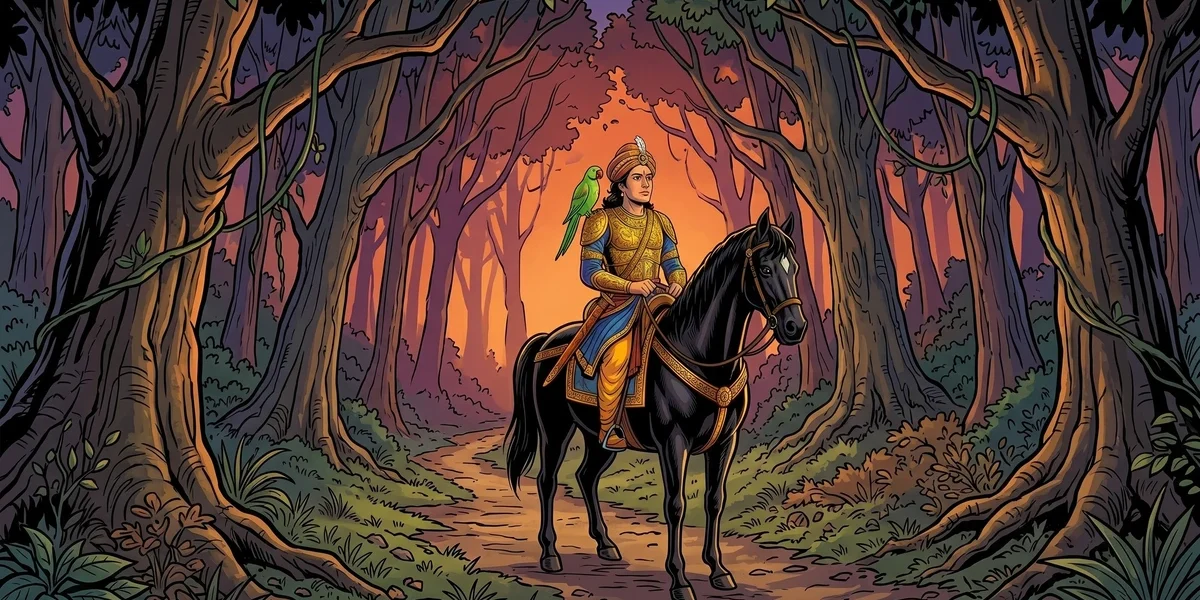
On the first day of his journey Raja Rasalu travelled a long way, until he came to a lonely forest, where he stopped for the night. It was a wild place and the night was dark, so he decided they should keep watch. He split the night into three watches: the carpenter’s son took the first, the goldsmith’s son the second and Rasalu himself the third.
The goldsmith’s son made his master a bed of clean grass. He was afraid the prince might feel low after leaving his comfortable palace life, so he cheered him with a little rhyme: until now you slept on the softest quilts, and tonight your bed is grass, but don’t be sad if fortune frowns, because brave hearts take no notice.
While Rasalu and the goldsmith’s son slept, a snake came out of a thicket nearby and crept towards them. “Who are you, and why have you come here?” asked the carpenter’s son. “I have destroyed everything for twelve miles around!” said the snake. “Who are you, to dare to come here?”
The snake attacked the carpenter’s son, and they fought until the snake was dead. Then he hid the body under his shield and said nothing about it to the others, because, like the goldsmith’s son, he was afraid the prince might lose heart.
When it was Rasalu’s turn to keep watch, a dreadful, nameless horror came out of the thicket. Rasalu walked straight up to it and cried, “Who are you, and what brings you here?” “I have killed everything for thirty-six miles around!” it answered. “Who are you, to dare to come here?”
Rasalu drew his mighty bow and shot it with an arrow. It fled into a cave, and the prince followed. They fought long and hard, until at last the horror died, and Rasalu came back and kept watch in peace.
In the morning Rasalu woke his companions, and the carpenter’s son proudly showed the snake he had killed. “That is only a small snake,” said the raja. “Come and see what I killed in the cave!”
When the two young men saw the terrible creature Rasalu had slain, they were so frightened that they fell on their knees and begged to go back to the city. “Mighty Rasalu, you are a raja and a hero, and you can fight such horrors,” they said. “We are ordinary people. If we follow you, we shall certainly be killed. These things are nothing to you, but they are death to us. Let us go!”
Rasalu looked at them sadly and told them to do as they wished. Then he spoke a verse: flowers do not always bloom, the kind rain does not last, youth and strength stay only a little while, and every life must end; yet a king is still a king without his courtiers, and even alone and homeless in a strange land, a head that heaven has crowned does not bow.
So his friends left him, and Rasalu travelled on alone.
Where this story comes from
This is one chapter of the Punjabi legend of Raja Rasalu, as Flora Annie Steel retold it in Tales of the Punjab. In the book it comes straight after Rasalu leaves his father’s city with his two companions and just before he rides on alone to Nila city and the giants. R. C. Temple’s notes give the Punjabi verses. His conjecture linking the serpent to a human group is a historical interpretation, not established evidence about any present-day community.
On this site you can follow the legend from Raja Rasalu.
Read the original: Flora Annie Steel, Tales of the Punjab (Project Gutenberg)
Best for ages 9–12 — a short, brave chapter from a hero legend, with monster fights told quickly and without gore.
A closer reading
Both companions try to protect Rasalu’s spirits before they seek their own safety: one prepares a bed and offers reassurance, while the other fights a dangerous snake and initially hides the evidence. Their departure therefore cannot fairly be reduced to abandoning him at the first difficulty.
Rasalu’s comparison makes the carpenter’s feat seem small, but the scale of his own opponent reveals a danger his friends cannot reasonably expect to survive. They state that limit and ask to leave. He is sad, yet permits it. The closing verse sustains his identity without requiring others to share a risk beyond their capacity.
The episode narrows the travelling group for the next adventure while exposing a tension in heroic friendship: courage is not identical ability, and loyalty need not mean following someone into every danger.
Try this with the story
List each companion’s helpful action before the request to leave. Then write two versions of a departure description, one using ‘cowardice’ and one using ‘recognizing limits.’ Decide which has stronger support in the events and where uncertainty remains.
Think about it
- What care do the companions show before deciding to return?
- Why does seeing Rasalu’s opponent change their judgment?
- How does Rasalu respond to their request?
- What does his final verse preserve when companionship ends?
You may also like
- Raja Rasalu — an overview of the legend
- How Raja Rasalu Became a Jogi — a later chapter of the legend
- The Son of Seven Mothers — another Punjabi tale from Steel
Frequently Asked Questions
Who fights during the night?
Why do the companions leave?
How does the episode fit the sequence?
You May Also Like
 Indian Folk Tales
Ages 9-12
The Charmed Ring
A merchant's son spends all his money saving a dog, a cat and a snake, and when his magic ring is stolen, the cat and the dog set out to bring it back.
 Indian Folk Tales
Ages 9-12
Prince Wicked and the Grateful Animals
A man rescues a prince and three animals from a flood. The animals honour their promises, but the new king remembers the rescue with resentment and tries to silence him.
 Indian Folk Tales
Ages 9-12
Prince Half-a-Son
A prince mocked for his unusual body uses magic and careful listening to survive his brothers' attacks, while the tale exposes their envy and the court's prejudice.