The Interesting Journey
The Interesting Journey: Once upon a time, a little boy named Rohan lived near the foot of the Mt. One day Rohan’s dad woke up bright and early and woke up

The Interesting Journey is a modern hybrid Indian children’s wisdom-tale of the kind anthologists call a literary folk-fusion: an early-twenty-first-century composition by the Mumbai children’s storytelling collective Tell-a-Tale that grafts a Celtic-Irish revenant — the wailing bean sídhe — onto an Indian Himalayan trek, then resolves the encounter through the unmistakably Indian dharmic logic of karuṇā (compassion). The result is a tale that has become a quiet staple of urban Indian bedtime reading: a boy named Rohan, climbing toward Mount Everest with his father, learns that kindness offered to what frightens us is the only currency that actually buys safe passage.
To read this story well is to read it twice — once as a thrilling adventure on a freezing mountain, and again as a small comparative-folklore experiment, deliberately stitching together motifs that scholars have catalogued for over a century: the banshee from Irish oral tradition (Lady Wilde, Ancient Legends of Ireland, 1887; W. B. Yeats, Fairy and Folk Tales of the Irish Peasantry, 1888; Patricia Lysaght, The Banshee: The Irish Death-Messenger, 1986), the riddle-quest of Indian dharma literature (the Yaksha Praśna in the Mahābhārata, Vana Parva 313), and the Aarne–Thompson–Uther tale-type ATU 480 The Kind and the Unkind Girls in which a supernatural hag rewards those who treat her with respect (Stith Thompson, The Folktale, 1946; Warren Roberts, The Tale of the Kind and the Unkind Girls, FFC 195, 1958; Hans-Jörg Uther, The Types of International Folktales, FFC 284, 2004).
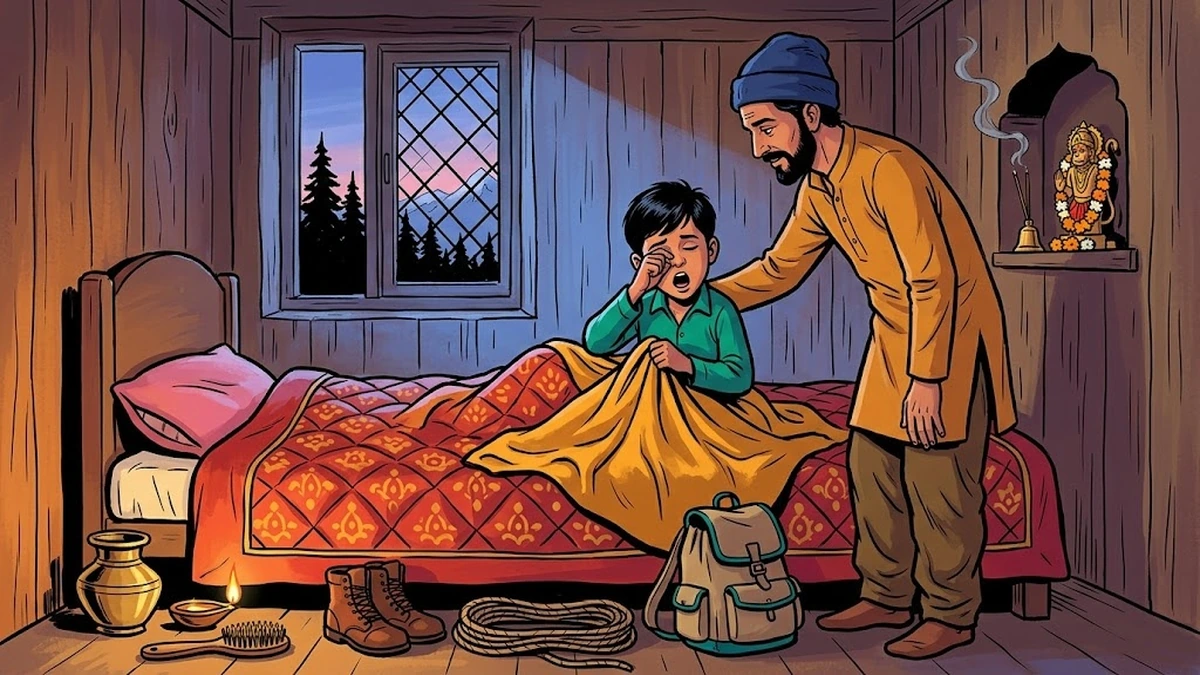
An Early Morning at the Foot of the Mountain
The story begins, as so many Himalayan adventures do, in the cold blue hour before sunrise. Rohan, a boy who lives with his father in a small wooden home at the foot of Mount Everest — the great peak the Sherpas call Chomolungma, “Goddess Mother of the World” — is shaken awake by his father’s hand. He groans, tosses, drags himself out from under the heavy quilt, and is sent to brush his teeth, comb his hair, and lace up his climbing boots. Only when he is fully ready does his father tell him: “We are going on a trek to Mount Everest.”
This opening beat is small but doctrinally exact for the Indian moral imagination. The child is not asked whether he wants to go; he is told. In the śiṣya–guru pattern that governs nearly every traditional Indian initiation tale — the Upaniṣads, the Buddha’s first sermon at Sarnath, the guru-pūrṇimā custom — the journey toward wisdom is begun by the elder, not the seeker. The pupil’s only freedom is in how he answers the call. Rohan answers it sleepily, as any real child would, and the tale rewards us for that human truth: the hero of an Indian wisdom-quest does not begin heroic. He begins yawning.
The first paragraph is also doing geographical work that an attentive reader should not miss. By placing the family at the very foot of Everest, the storyteller invokes the pan-Indian and pan-Tibetan idea of the mountain as axis mundi, the cosmic pillar where the human world meets the divine. The Sanskrit poets called Mount Meru the centre of the universe; the Skanda Purāṇa places the abode of Śiva on Kailāsa; the Tibetans regarded the high peaks as the seats of the yul-lha, country-protecting gods. To climb out of the valley, in this literature, is always to climb out of the ordinary. Rohan does not yet know it, but the moment his boot crosses the threshold of his father’s house he has crossed a threshold of a much older kind.
The Cottage with the Eerie Smoke
Father and son climb. The wind blows cold on their faces. After a long while they see, in the distance, a small cottage whose chimney releases a column of smoke so dense and grey that it seems to colour the clouds themselves. They decide to step inside to rest — and the moment they cross its doorway, a long, thin, unearthly cry rises from somewhere in the rafters. The cry of a bean sídhe.
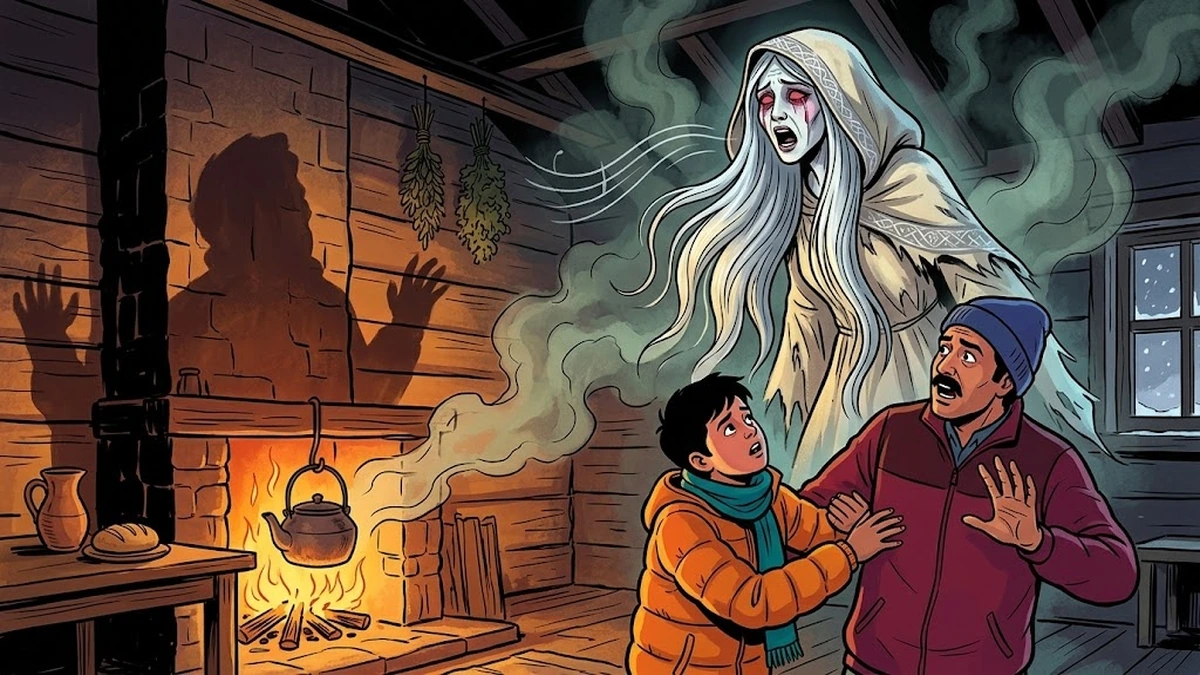
It is at this point that the tale’s cross-cultural literary character becomes openly visible. The bean sídhe — anglicised as “banshee” — is one of the most precisely documented figures in Western European folklore. From Lady Wilde’s Ancient Legends (1887) through Patricia Lysaght’s exhaustive 1986 monograph, she is consistently described as a solitary female wailing-spirit attached to certain old Irish families, glimpsed combing long silver hair (Lysaght 1986, ch. 3), her keening (caoineadh) a portent of imminent death in the household. She is not malevolent in the demonic sense; she is a death-messenger, a creature of grief rather than malice. The motif index records her under Stith Thompson E402.1.1.3 (“ghost cries and screams”), F234.1.4 (“fairy in form of woman”), and M341 (“death prophesied”).
The Tell-a-Tale storyteller has chosen this figure deliberately, and the choice is interesting. India is not short of female wailing-spirits of its own — the cuḍail of Punjab and Haryana, the chudel of Gujarat, the pichal-peri of the Gilgit-Baltistan high country, the dākinī of Tibetan-Buddhist border folklore. Any of these would have served. By naming the apparition a banshee, the author deliberately marks the encounter as foreign: the boy and his father have not met one of their own ancestral ghosts but a stranger from another world’s mythology. This sets up the moral argument the story is about to make. Karuṇā directed at the familiar is easy; karuṇā directed at the unrecognised, the alien, the un-Indian creature crying in your hill cottage — that is the harder, more interesting test.
Rohan’s father knows the word banshee; he is plainly the carrier of the family’s inherited fear-knowledge. Rohan does not. The dialogue that follows is the tale’s first true folktale beat: the parent is asked to name the monster, and the parent — temporarily — cannot. “Rohan’s father opened his mouth to answer but no words came out.” This silence is an old motif, catalogued under Stith Thompson C420 (“tabu: speaking of secret things”) and D2072 (“magical paralysis”): the supernatural enforces its own concealment. Father and son flee down the slope, and only when they are running does the father find his voice and begin to tell the story-within-the-story.
The Inset Tale: A Banshee Already Seen
The embedded narrative the father tells while running is a small classical example of frame-tale architecture, the structural device that gives Indian narrative literature so much of its texture. From the Pañcatantra through the Kathāsaritsāgara of Somadeva (eleventh century) to the Tūtī-nāmā of Ziya’ al-Din Nakhshabī (c. 1330), the inset tale is the engine of Indian moral instruction: a character pauses the main action to recite a remembered story, and that recited story supplies the missing wisdom for the present crisis. Stith Thompson catalogues it as Z11 (“endless tale”) and the broader category P210 (“father’s instructive tale”). Vladimir Propp, working with a Russian corpus, reached an equivalent conclusion — the older character “tells what should be told” at the moment of greatest narrative pressure (Propp, Morphology of the Folktale, 1928, function X).
The inset is short and very classical in shape. “One day,” the father says, “I was walking with my friend and his dad. We were passing a house with creepers all over it. My friend’s father told us — ‘the house we are passing now is the house where I saw a lady with weeping red eyes and silver sleek hair.’ I ran home and told my grandmother about this. She knew in a jiffy that the lady was a banshee. She asked me if the lady was pointing towards any house. I nodded my head violently. She told me someone is going to die in that house.” Rohan asks the obvious question — did anyone die that day? — and his father answers: “Yes. Dave, the head of the family staying in that house, died that day. They were hard times for them.”
This is, point for point, an Irish banshee anecdote of exactly the kind Lady Wilde and Yeats collected. The “lady with weeping red eyes and silver sleek hair” is the canonical visual description (Lysaght 1986, pp. 79–94); the grandmother as folk-knowledge gatekeeper recapitulates the figure of the Irish seanchaí; the banshee’s gesture of pointing at a doomed house matches the Munster and Connacht traditions almost verbatim. The Indian touch comes in the cadence — the interrogating grandmother, the violently-nodding child, the unhurried fatalism of “they were hard times for them” — but the underlying anecdote is a faithful borrowing.
The Blizzard, the Prayer, and the Two Fairies
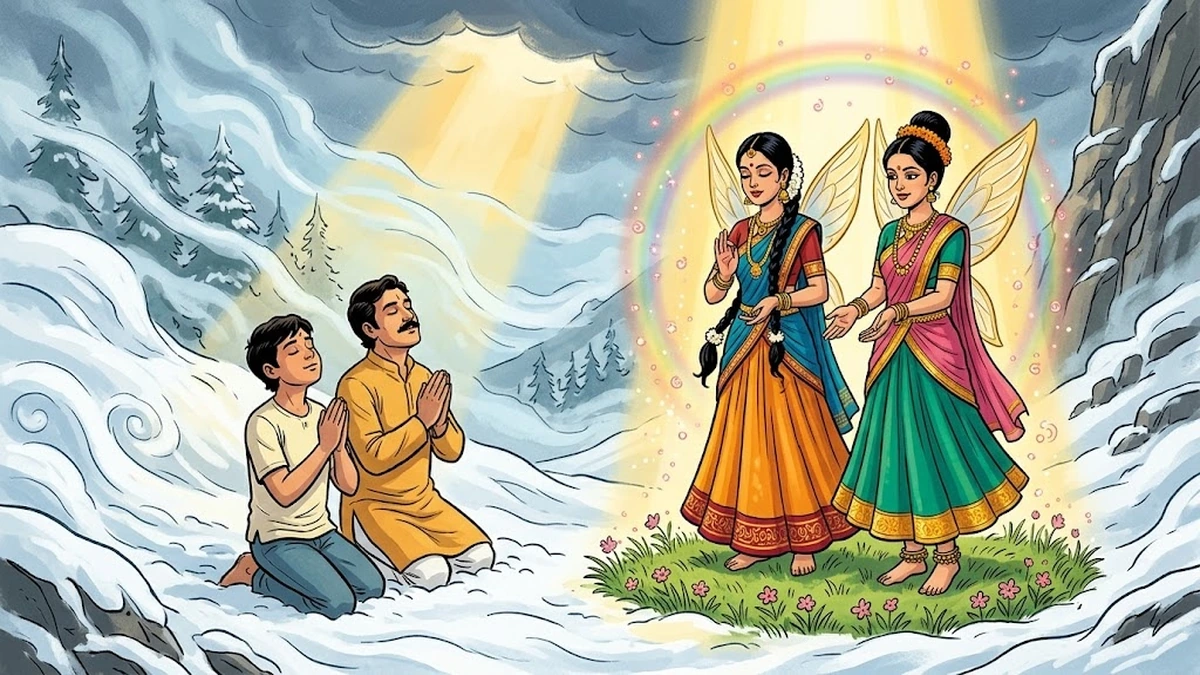
While the father is finishing his story, the weather worsens. A blizzard sweeps down off the high snowfields. Visibility collapses. The path forward becomes impassable; the path backward leads to the cottage and the banshee. Rohan and his father are caught in what folklorists call the stark choice, the narrative bottleneck that forces the supernatural to intervene (Stith Thompson, Motif-Index, N810, “supernatural helpers”). They kneel in the snow and pray.
The intervention takes a deliberately Indian form. They open their eyes to find two fairies standing before them. In the Pañcatantra, the Kathāsaritsāgara, and the Buddhacarita, the fairy equivalents are the vidyādharī and the yakṣī, female sky-beings who possess wisdom and grant boons. The number two is iconographically common in Indian sacred art: the dual devī of Hindu temple iconography, the nāgakannika pair carved on Sanchi torana lintels, the twin apsarā of Ajanta cave paintings. The fairies do not solve the problem directly. They give Rohan a riddle:
“When you follow your heart, you are led to me.”
Riddle-as-test is one of the deepest, oldest narrative devices in Indian wisdom literature. The Yaksha Praśna in the Mahābhārata (Vana Parva 313) is the locus classicus: Yudhiṣṭhira is interrogated by a yakṣa at a poisoned lake and must answer riddles about dharma to revive his brothers. The Vetāla-pañcaviṃśati (Twenty-five Tales of the Vetāla) of Somadeva, c. 1070, is built entirely on riddles posed to King Vikramāditya. The Aarne–Thompson–Uther index catalogues this as ATU 851 The Princess Who Could Not Solve the Riddle, with deep parallels in ATU 875 The Clever Farm Girl and the Indian-origin ATU 922 Shepherd Substituting for Priest Answers the King’s Questions. Stith Thompson registers the basic motif under H540 Propounding of riddles and H561 Clever interpretations.
The two fairies vanish, leaving father and son alone in the snow with the riddle. Rohan thinks for a moment, then jumps up. “I got it. The answer is LOVE.” The fairies’ wording — when you follow your heart, you are led to me — is essentially a versified definition of prema, the Sanskrit term for selfless love that the Bhāgavata Purāṇa (X.29–33) places above even bhakti. The boy proposes to give the banshee pure honey from his pack and fresh flowers gathered from the forest. He runs into the trees, gathers what the wild offers, and runs back.
The Banshee Receives the Gifts
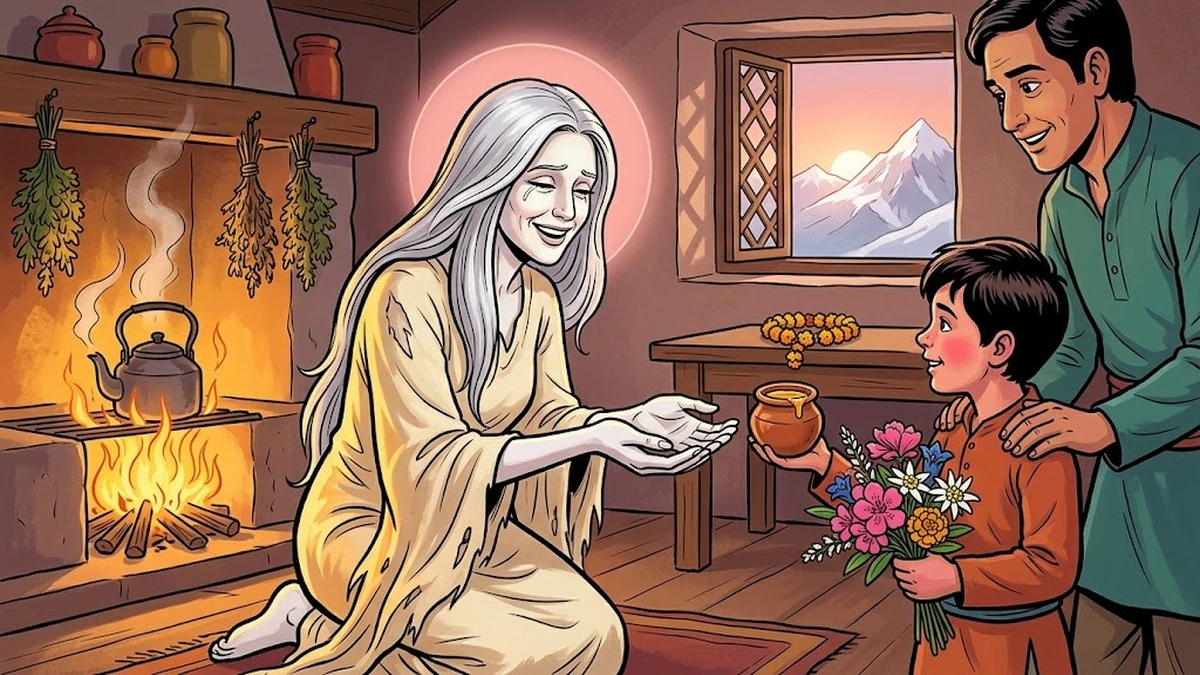
The climax is performed in three small movements that any oral storyteller could deliver in a single breath. Rohan and his father return to the cottage. They call out to the banshee. They place the honey and the flowers in front of her. The banshee — silver-haired, weeping-eyed, ancient — takes the gifts. And then she smiles.
“Thank you so much,” she says. “I am sorry for haunting you. Please forgive me. I just thought that you think I am ugly and repulsive.” Rohan answers, simply: “So you do have a loving heart.” The story ends there — no further explanation, no further reward, no return to the climb. The banshee is no longer a death-messenger. She is, as the boy now sees, a lonely creature who haunted because she had been refused recognition.
This is the structural fingerprint of Aarne–Thompson–Uther tale-type 480, the Kind and Unkind Girls family — almost universally attested across Eurasia, recorded everywhere from the Brothers Grimm’s Frau Holle (KHM 24, 1812) to Charles Perrault’s Les Fées (1697), to Indian variants in Mary Frere’s Old Deccan Days (1868) and Maive Stokes’s Indian Fairy Tales (1880, “The Bear’s Bad Bargain” envelope). In the canonical pattern, a supernatural female being — old, ugly, despised — tests the courtesy of those who pass her, rewarding kindness with magical gifts and punishing cruelty with curses. Stith Thompson indexes the pattern under Q2 Kind and unkind, Q40 Kindness rewarded, and D1840.1 Magic immunity from harm by good behaviour. Roberts (1958) catalogued nine hundred variants in his FFC 195 monograph; Uther (2004) confirms the type as one of the four most widely distributed in world folklore.
What the Tell-a-Tale composition contributes — the small but real innovation that makes this version worth its place in modern Indian children’s literature — is the substitution of the ATU 480 donor-hag by an explicitly Celtic banshee, then the resolution of that encounter not by service or chore (the European pattern, where the kind girl combs the hag’s hair or fluffs her feather-bed) but by riddle in the Indian wisdom-tale pattern. The fairies pose; the boy interprets; the gift follows the interpretation. The climax is therefore Indian-Celtic at its core: a banshee, healed by karuṇā, decoded through a riddle.
Moral
The story’s moral is openly stated in the boy’s last line and is one of the oldest in Indian wisdom literature: compassion turns enemies into kin. The Dhammapada, verse 5, gives the canonical formulation in Pali:
“Na hi verena verāni — sammantīdha kudācanaṃ; averena ca sammanti — esa dhammo sanantano.”
(“Hatred is never appeased by hatred in this world. By non-hatred alone is hatred appeased. This is an eternal law.”) — Dhammapada I.5
The Bhagavad Gītā echoes the same teaching at XII.13: adveṣṭā sarva-bhūtānāṃ maitraḥ karuṇa eva ca — “the one who hates no being, who is friendly and compassionate to all”. The Tamil Tirukkuṟaḷ (chapter 8, “kindness”) makes it the second pillar of human worth, after aṟam itself. And the Hitopadeśa opens its first book, Mitra-lābha, with the same conviction expressed as a couplet on friendship as the supreme reward.
What the boy in the story discovers is something a child can carry away in a single phrase: the frightening thing is often only lonely. Honey and flowers — the simplest offerings any Indian child knows from temple pūjā — are enough to convert a haunting into a gift.
Why This Story Has Lasted
This is, technically, a young story — its earliest published Tell-a-Tale appearance can be traced only to the early 2010s, decades younger than the Pañcatantra it borrows from and centuries younger than the banshee corpus it grafts on. But it has lasted anyway, in the small steady way that modern Indian children’s reading lasts: passed between parents and children at bedtime, photocopied into school readers, retold at urban Indian English-medium primary classrooms where children meet both Sanskrit śloka and Irish ghost in the same week.
It has lasted because it does something the older folk material cannot quite do on its own. The Pañcatantra teaches statecraft to princes; the Jātaka teaches detachment to monks; the banshee corpus teaches Irish families to remember their dead. None of these, individually, is shaped for the specific moral universe of a present-day Indian child whose imagination has already absorbed both Hanuman and Harry Potter. The Interesting Journey is shaped for that child precisely. It honours the comparative imagination — refusing to pretend that Indian and Celtic mythologies must remain separate — and resolves the encounter with a value (karuṇā) that belongs to the Indian tradition without being parochial about it. A banshee in the Himalayas is not a mistake; it is a small, sincere argument that compassion is portable across cosmologies.
That, more than anything else, is what makes this short tale worth keeping in the canon of Indian folktales for modern readers. It teaches a child that the strange creature crying in the dark is, very often, a creature waiting to be offered honey.
Attribution & Sources: The Interesting Journey is a modern hybrid Indian children’s wisdom-tale composed by the Mumbai-based collective Tell-a-Tale in the early 2010s. Its banshee figure draws on Lady Wilde’s Ancient Legends of Ireland (1887), W. B. Yeats’s Fairy and Folk Tales of the Irish Peasantry (1888), and Patricia Lysaght’s The Banshee: The Irish Death-Messenger (1986). Its riddle-quest structure draws on the Indian wisdom-tale tradition: the Yaksha Praśna in the Mahābhārata Vana Parva 313, Somadeva’s Vetāla-pañcaviṃśati (c. 1070), and the Kathāsaritsāgara. The kindness-rewarded structure maps to Aarne–Thompson–Uther tale-type 480 The Kind and the Unkind Girls (Roberts, FFC 195, 1958; Uther, FFC 284, 2004), with Stith Thompson motifs Q2, Q40, D1840.1, E402.1.1.3, F234.1.4, M341, H540, H561.
You May Also Like
 Indian Folk Tales
Ages 9-12
Indian Folk Tales
Ages 9-12
How Raja Rasalus Friends Forsook Him
On the first night out of Sialkot, Rasalu’s companions face a serpent and an unspeakable horror — and ask leave to go home. Expanded Rasalu cycle episode. Ages 9–12+.
 Indian Folk Tales
All Ages
Indian Folk Tales
All Ages
The Ass in the Lion’s Skin
The Ass In The Lions Skin: In a dense forest near a small Indian village, there lived a washerman named Dhobi who owned a tired old donkey. The poor donkey had
 Indian Folk Tales
Ages 6-8
Indian Folk Tales
Ages 6-8
The Jewelled Arrow
The Jewelled Arrow: In the city of Vardhamana in India there lived a powerful king named Vira-Bhuja, who, as was the custom in his native land, had many wives