How Raja Rasalu Went Out Into The World
How Raja Rasalu Went Out Into The World: Young Rasâlu lived on, far from the light of day, for eleven long years, growing tall and strong, yet contented to
How Raja Rasâlu Went Out Into the World — The Second Canto of the Great Punjabi Hero Cycle
This canto is the second tale of the seven-tale Raja Rasâlu cycle in Tales of the Punjab: Told by the People by Flora Annie Steel, annotated by Captain R. C. Temple (London: Macmillan, 1894). Steel collected the cycle orally in the central Punjab in the 1880s, mainly around Sialkot; Temple cross-checked it against the Punjabi ballad versions in The Legends of the Panjâb (Trübner, 1884). Where the first canto explains why Rasâlu was born, this canto explains why he left. It is the canto in which the prophecy laid down at his birth begins, irreversibly, to be paid.
The Story
The Eighth Door Opens Early
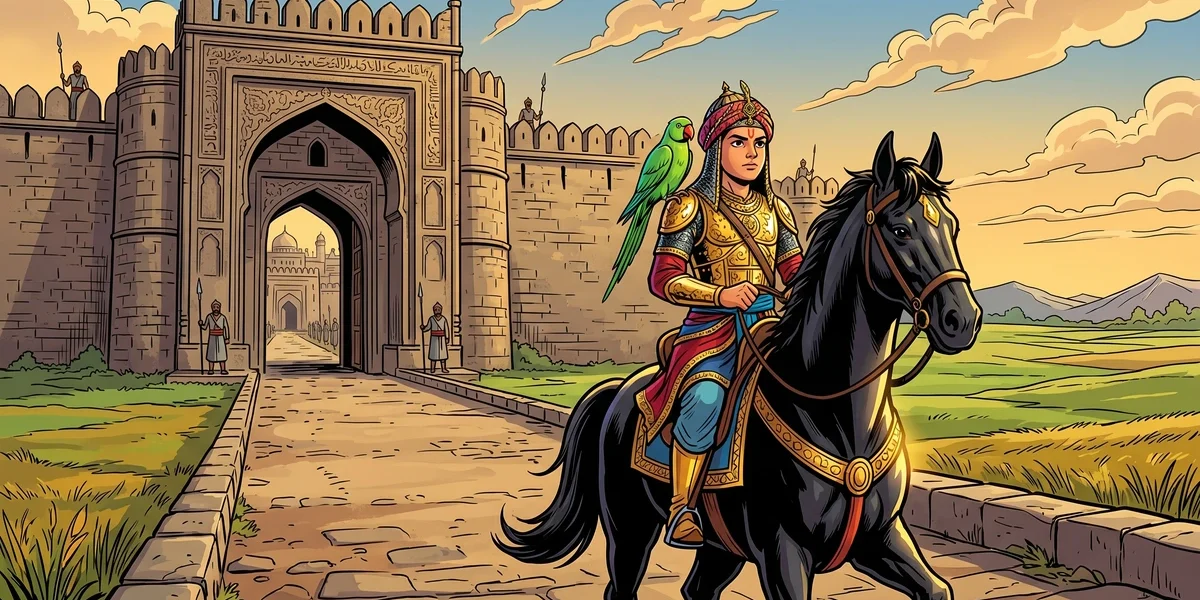
Eleven years had passed in the eight-doored underground hall. Rasâlu had grown straight and tall under its painted ceiling — the parrot Hîramân on his wrist, the black horse Bhaunr Irâqi powerful and restless in the gallery beside him, a fresh sword and spear and painted shield forged for him each year by the palace smiths above. But in the twelfth year, one year still short of the safe hour the astrologers had named, the boy began to hear the world.
Through the narrow shafts that brought him daylight, he heard the bells of cattle coming home in the evening, the women laughing at the wells, the cry of camel-drivers on the road to Sialkot, and the answering songs of the boatmen on the rivers. The eighth door of the hall could be opened only from inside. Very slowly, the longing in him grew louder than the warning of the stars.
His old nurse caught him by the hem of his cloak and begged him to wait one year more. He laughed in her face — the bright, careless laugh of a hero whose hour has come — and told her, “Nay! I stay no longer here for any man!” He saddled Bhaunr Irâqi himself, put on his shining armour, set the parrot on his shoulder, and rode out of the hall by the eighth door into the open daylight he had not seen since his birth. The astrologers, when they were told, covered their faces. The queen did not speak.
The Pitchers at the Well
Mindful of what his nurses had often told him about the dust of the world and the rules of cleanliness, Rasâlu turned aside at the first river he came to, dismounted, washed himself and his clothes, and rode on clean. So — fair of face, clean of raiment, and brave of heart, as the Punjabi singers always describe him — he came at last to the city of his father, Sâlbâhan of Sialkot, and sat down to rest in the shade of an old pîpal tree by a stone-rimmed well at the city gate.
Round that well the women of the city were drawing water in earthen pitchers, balancing the full ghaḍas on the cloth coils on their heads, talking and laughing. Rasâlu, who had spent twelve years underground and had never in his life seen a woman who was not his nurse, did what an untaught hero of his age does in a Punjabi tale: he took up small stones and flung them at the earthen pitchers, breaking pot after pot until every woman at the well was drenched and their pitchers lay in red shards on the path.
Wet and weeping, the women carried their complaint to the palace. The king listened. The king understood, before the women had finished, that no ordinary boy in the Punjab could have made an arm-shot like that. Sâlbâhan dared not send his guards to seize the offender — the prophecy of the Jôgis had told him that to look upon his son’s face before the safe hour passed would cost the king his own life. So he did the kingly thing instead: he opened his treasury, ordered new pitchers cast of iron and brass, and sent the women back to the well with vessels that no boy’s stone could break.
Rasâlu, watching from the shade of the pîpal, saw the iron and brass pitchers come back, and the laugh that rose in him then was a colder laugh. He drew his bow — the bow that had grown with him underground — and one after another the iron pitchers and the brass pitchers split open under the steel of his arrows as the clay had split under his stones. Every shot was a message to the king: walls of clay you may replace with walls of iron, but the child whose hour is come is not to be kept out by either.
“I Came to Greet Thee, King…”
Even then Sâlbâhan did not send for him. The cycle is very precise on this point: the king did not refuse to see his son out of cruelty, but out of a fear that, in Punjabi storytelling, has always been treated as a separate kind of love — the love that prefers its own death to a meeting with the beloved at the wrong hour. Rasâlu, who knew nothing yet of the prophecy, read his father’s silence as rejection. He mounted Bhaunr Irâqi, rode up the long ramp to the audience-hall of Sialkot, dismounted at the great inlaid doors, and walked in.
The hall was full of courtiers. At its head sat his father on the throne. Rasâlu — twelve years old, glittering in his mail, the parrot still on his shoulder — saluted with all the reverence the cycle expects of a prince in his father’s hall. Sâlbâhan, in fear of his own life and not daring to lift his eyes, turned his back upon his own son and would not answer the salutation. The boy stood in the middle of the hall, in the silence of every courtier who dared not draw breath, and spoke the line that has become the most-quoted line of the whole cycle:
“I came to greet thee, King, and not to harm thee! What have I done that thou shouldst turn away? Sceptre and empire have no power to charm me — I go to seek a worthier prize than they!”
With that line he renounced, in the public hearing of the whole Sialkot court, the throne he had been born to inherit. The Punjabi singers say it is one of the great moments of all their oral literature — the moment in which the cycle’s meaning is first stated aloud: that the prize Rasâlu is to seek is not a kingdom but the testing of the self that the kingdom would have hidden from him.
The Mother’s Window
Rasâlu strode out of the audience-hall full of bitterness, and the courtiers fell back as he passed. As he came under the high lattice-windows of the women’s apartments, he heard the sound that softened him: his mother Lonâ weeping. He stopped his horse, looked up at the window where the curtain swayed, and called up to her in the verse-form that the cycle always gives to grief:
“O heart crowned with grief, hast thou naught
But tears for thy son?
Art mother of mine? Give one thought
To my life just begun!”
Behind the lattice, Queen Lonâ had been told as plainly as her husband the price of looking on her son’s face in the unsafe hour. She had endured the long prophecied pregnancy, the twelve years of his underground seclusion, and now — with the boy in the courtyard below her window calling up in his own voice for the first time — she did the hardest thing the cycle ever asks of her: she did not look out. She answered him, but through the cloth of the curtain, and she begged him to ride on without forcing her to break the prophecy.
So Rasâlu — armoured, mounted, twelve years old, refused by his father in public and by his mother in private, with no household left to claim him and no throne he was willing to claim — turned Bhaunr Irâqi’s head outward from Sialkot, set the parrot Hîramân more firmly on his shoulder, and rode out by the city gate into the road that leads east toward the country of Gandgarh and the giant-haunted hills. His friends would join him on that road in the next canto; for now, he rode alone — and the cycle had given him exactly what the prophecy had promised: a son brave and good who had already begun to cause his mother to weep tears as bitter as those Queen Achhrâ had wept for Pûran.
Moral
The Punjabi tellers attach a stark proverb to this canto, one that any Sialkot grandmother will still recite if pressed: jis dā velā ā gayā, oh kandh nahīṁ rokdī — “When a person’s hour has come, no wall can hold them back.” The lesson is not simply that fate cannot be outrun. It is more careful than that. Sâlbâhan’s underground hall was not foolish; it was a kingly act of love, and it bought Rasâlu eleven safe years. The canto’s deeper teaching is the harder Punjabi maxim: protection without truth becomes its own injury. The boy in the hall was protected from the unlucky stars but kept ignorant of the price of his own birth — and so he came out into his father’s hall reading rejection where there was only fear, and pride where there was only love.
The wound this canto opens — the boy who renounces his father’s throne in public — is the wound the rest of the cycle will spend six tales healing. The Punjabi storytellers are very clear that the wound is not Rasâlu’s fault, and not Sâlbâhan’s fault either; it is the cost of a prophecy that no one in the cycle was ever permitted to refuse.
Why This Tale Has Lasted
This canto has lasted because every listener — child or grown — recognises in it the day on which a young person first walks out of the house and finds that the world the parents described is not the world that is. The breaking of the pitchers is a small comic moment; the renunciation in the audience-hall is a great tragic one; and the four lines under the mother’s window are the verse the cycle is most often quoted in, even by Punjabis who have never heard the rest of the Rasâlu material. “O heart crowned with grief, hast thou naught but tears for thy son?” is, in the central Punjab, what “To be or not to be” is in English: a verse so deeply embedded in the language that people quote it without remembering where it comes from.
The canto has also lasted because it does in a few pages what the longer Sanskrit and Persian epics need full cantos to accomplish: it stages the hero’s first public refusal of inherited power. The Mahābhārata’s Karna refuses Indra; the Shāhnāma’s Rustam quarrels with Kay Kāvūs; the Ramayana’s Rama walks out of Ayodhyā into the forest. Rasâlu’s “Sceptre and empire have no power to charm me” places him in that company — and the Punjabi singers know it. By the end of the canto the listener understands that the cycle is not, finally, a story about getting to the throne; it is a story about being the kind of person a throne would have ruined.
About the Raja Rasâlu Cycle
The Rasâlu cycle is the central heroic epic of the Punjab — a sequence of interlocking tales following the birth, seclusion, emergence, and adventures of Raja Rasâlu of Sialkot. Collected orally in the 1880s by Flora Annie Steel and annotated by R. C. Temple, the cycle was published in Tales of the Punjab (1894). Punjabi tradition places Rasâlu as a historical prince of Sialkot between the 8th and 10th centuries CE; the Mughal historian Abu’l-Fazl mentions him by name in the Ā’īn-i-Akbarī (c. 1590) as a famous old king of the Punjab.
Frequently Asked Questions
**Q: Why is this story important?**
You May Also Like
 Indian Folk Tales
Ages 3-5
Indian Folk Tales
Ages 3-5
The Story of a Kind Hearted Little Girl Named Tara
The Story of a Kind Hearted Little Girl Named Tara: Once there lived a little girl named Tara with her mother in a small hut near the forest. Tara was
 Indian Folk Tales
All Ages
Indian Folk Tales
All Ages
The Barbers Clever Wife
The Barbers Clever Wife: In a vast and ancient forest in the heart of India, there lived four inseparable friends: a crow named Kala, a mouse named Chuhiya, a
 Indian Folk Tales
Ages 3-5
Indian Folk Tales
Ages 3-5
The Legend Of Gwashbrari The Glacier Hearted Queen
The Legend Of Gwashbrari The Glacier Hearted Queen: Once upon a time, ever so long ago, when this old world was young, and everything was very different from