The Farmer And The Money Lender 2
The Farmer And The Money Lender 2: There was once a farmer who suffered much at the hands of a money-lender. Good harvests, or bad, the farmer was always poor
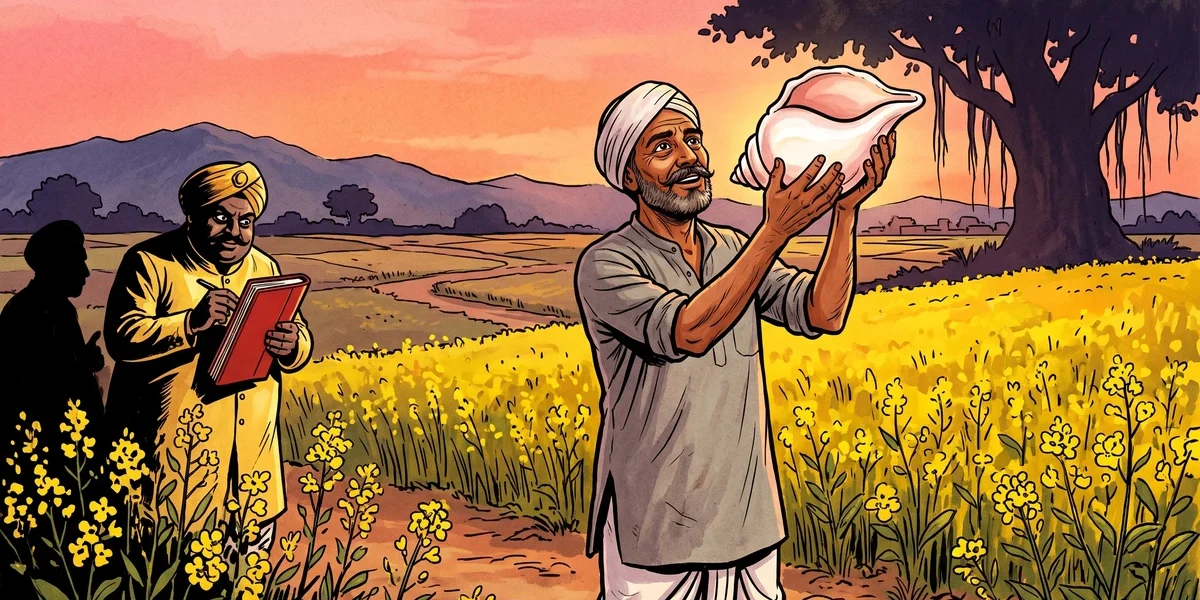
The Farmer and the Money-Lender is one of the small classic trickster tales of the Punjab, a story whose plot is so tightly engineered that it can be told in fifteen minutes around a hearth and remembered for fifty years. The tale was first written down for English readers by Flora Annie Webster Steel (1847–1929) in Tales of the Punjab, told by the people (Macmillan and Co., London & New York, 1894), illustrated by John Lockwood Kipling (Rudyard Kipling’s father, then Curator of the Lahore Museum) and annotated with extensive folkloric notes by Steel’s friend the colonial administrator Sir Richard Carnac Temple. Steel collected the story directly from village storytellers in the Patiala, Ludhiana and Hissar districts during the late 1870s and early 1880s, while she was Inspectress of Schools for the Punjab. Folklorists classify the tale under Aarne-Thompson-Uther tale type ATU 1331 “The Covetous and the Envious” (also called “The Two Wishes” or “The Wish for One Eye”), with motif clusters J2074 (the foolish wish that doubles for the rival), K1611 (substitute prize captured by the trickster), Q272 (avarice punished), W153 (the greedy moneylender), N812 (the disguised god as a helper of the poor), D1470.1 (magic conch granting wishes) and J1581.2 (clever bargain with one eye). The tale appears in Steel’s collection sandwiched between “The Son of Seven Mothers” and “The Death and Burial of Poor Hen-Sparrow,” and was retold by Joseph Jacobs as “The Farmer and the Money-Lender” in his Indian Fairy Tales (David Nutt, 1892), with illustrations by John Dickson Batten. The Punjabi village name for the tale is Kisân te Sâhûkâr, where kisân means “farmer, cultivator” and sâhûkâr — from the Sanskrit sâdhu-kâra, “maker of good [transactions]” — is the polite-cum-ironic Punjabi word for the village banker.
I. The Crushing Weight of Debt: A Punjabi Peasant in the Grip of the Sâhûkâr
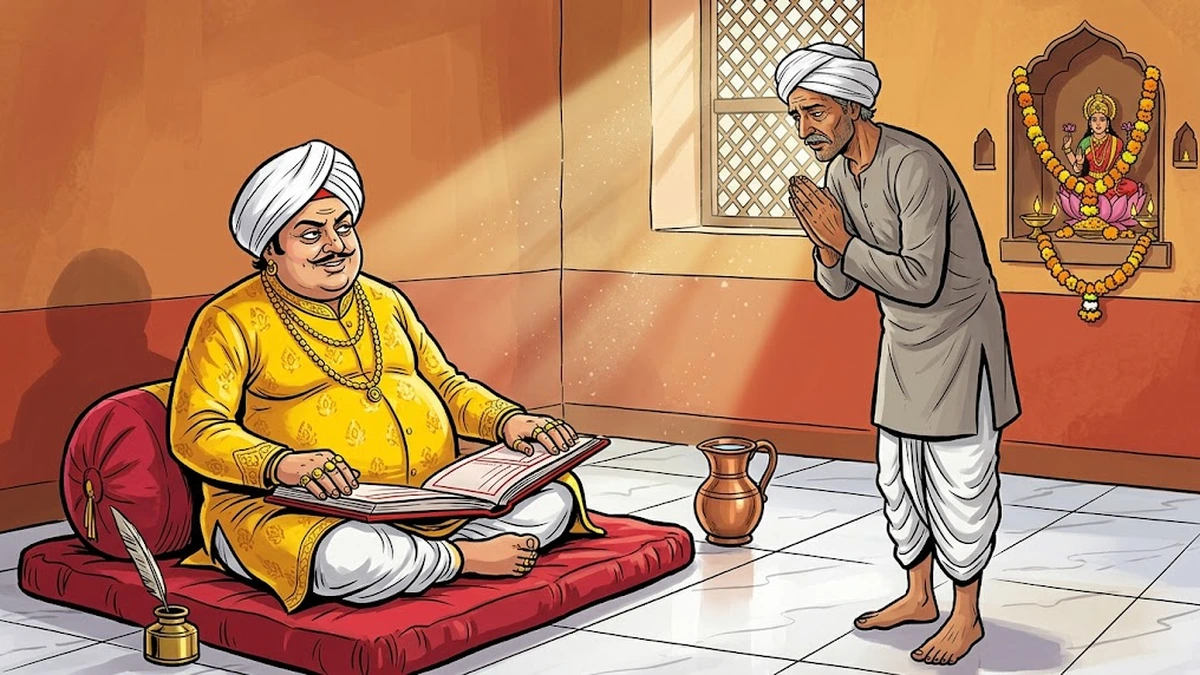
The story opens with a single, devastatingly accurate sociological observation: “There was once a farmer who suffered much at the hands of a money-lender. Good harvests, or bad, the farmer was always poor, the money-lender rich.” In two sentences Steel captures the central economic tragedy of the late-Mughal and colonial Punjab: a structural debt-trap so total that it floated free of the harvest itself. Whether the monsoon was generous or the locust came, whether the wheat ripened gold in baisâkh or shrivelled brown under a hot loo wind, the calculus did not change. The peasant’s share of the crop was already mortgaged to the sâhûkâr before the seed was even sown. Sir Richard Carnac Temple, in his note to Steel’s text, observed dryly that “the average Panjab cultivator does not understand compound interest, but the village banker does, and so the cultivator pays it.” The 1881 Punjab Census returned the average debt of a peasant household at roughly thirteen times the annual cash income; by the time Malcolm Lyall Darling published his classic The Punjab Peasant in Prosperity and Debt (Oxford University Press, 1925), the figure had risen to twenty-five.
The Punjabi sâhûkâr was not, in popular imagination, a single man but a type. He kept his accounts in a long red bahi-khâta ledger written in Mahajani script — an unvowelled commercial shorthand which the peasant could not read. He spoke with elaborate piety, filed his nails, smiled benignly, and called his clients “brother.” Behind the smile lay a system of kistbandi — instalment-bondage — which could pass debt down three generations. To owe the sâhûkâr in nineteenth-century rural India was to be slowly absorbed into him; the family fields, the standing crop, the brass cooking-pots, the bridal silver, the buffalo, and finally the labour of the unmarried son were all collateral, in that order. Steel’s opening sentence is therefore not a fairy-tale flourish but a documentary report.
The farmer in the tale, having lost his last copper paisâ, makes a decision of disarming village irony. He walks across to the sâhûkâr’s house and says: “You can’t squeeze water from a stone, and as you have nothing to get by me now, you might tell me the secret of becoming rich.” The Punjabi proverb behind the line — patthar tô pânî nahîn niklâ, “water cannot be wrung from a stone” — is one of the half-dozen sayings every cultivator in the doab knows by heart. It is the way a peasant tells a moneylender that his cup is empty without quite triggering the violence of an open quarrel. The sâhûkâr, amused at the cheek of it and probably bored, gives the only answer his theology has left him: “riches come from Ram—ask him.” He means it as a sarcastic dismissal. The farmer, in a magnificent stroke of literal-mindedness that is the hinge of the whole tale, decides to take him at his word. He bakes three roṭlîs — the small, hard tikkîs or hearth-cakes that travelling Punjabis still carry, wrapped in a cloth, on long pilgrimages — and sets out on foot to find Ram.
II. Three Cakes, Three Strangers: The Test of the Generous Heart
The journey-of-three-encounters is one of the oldest narrative architectures in world folklore. From the three brothers of the Grimms’ Die Bienenkönigin (KHM 62) to the three trials of Cinderella to the three nights of Vasilisa the Beautiful in the hut of Baba Yaga, the rule of three structures the moral economy of the folk tale: the first encounter sets the standard, the second confirms it, the third overturns it. Stith Thompson catalogued the device under motif Z71.1 (formulistic number three) in his Motif-Index of Folk-Literature (1932–36), and observed that the rule-of-three governs perhaps a third of all recorded folk plots worldwide.
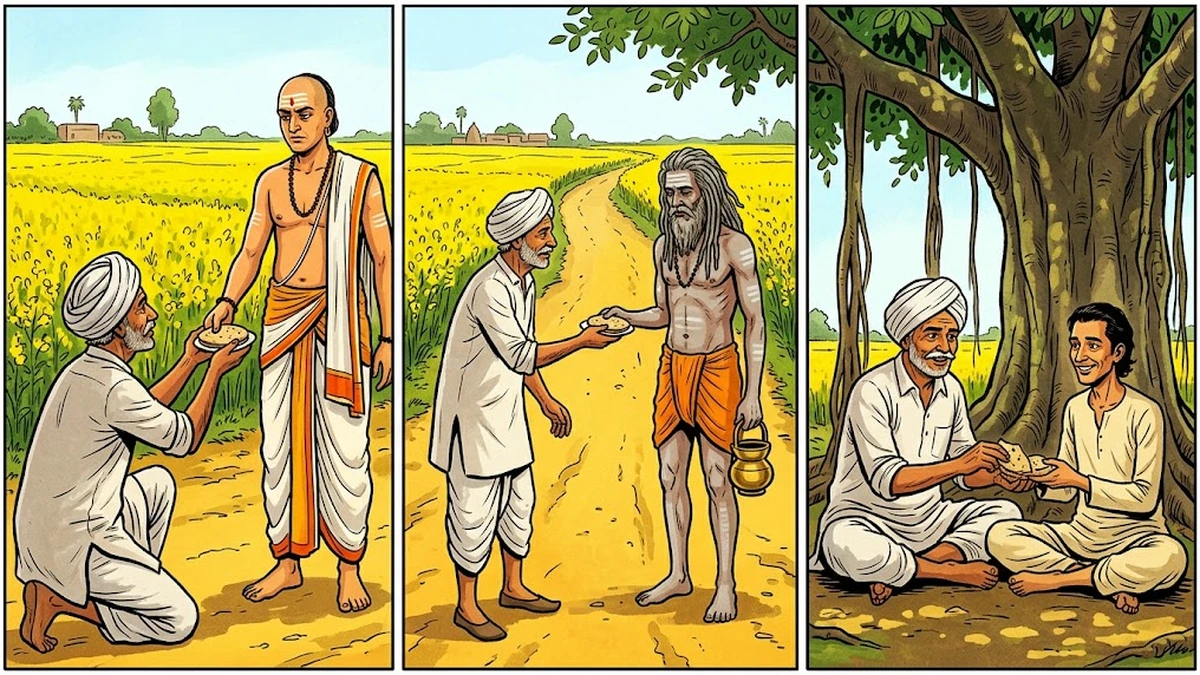
The Punjabi farmer, walking south from his village along a dust-white village track of cracked earth and prickly-pear cactus, meets first a Brâhmaṇa — a learned priestly Brahmin in a saffron-bordered white cotton dhoti, his forehead marked with the three-line tripuṇḍra of a Shaivite. The farmer offers him a cake and asks the way to Ram. The Brahmin takes the cake without a word and walks on. This first encounter is sharp social satire. The Brahmin in nineteenth-century rural Punjab was an ambivalent figure: ritually pure, learned in Sanskrit prayers, expected by the texts of the dharmaśâstra to feed the hungry — and yet, in lived practice, often a member of the village élite who took freely and gave little. Steel’s village storytellers, who were mostly themselves Jat or Khatri peasants, were happy to have the Brahmin take and walk away.
The second encounter, on the same road further on, is with a Jogi — a wandering Shaiva ascetic, the matted-haired kanphaṭa mendicant of the Nath sampradây tradition founded by the legendary Gorakhnath. The Jogi wears nothing but ash and a saffron loincloth, carries a kamaṇḍalu water-pot and a long iron tongs (chimṭâ), and has split earlobes plugged with great rings of horn or rhino-bone — the sign that has given the order its name (kân, ear; phaṭâ, split). Like the Brahmin he is supposed to be a holy man free of attachment to the body. Like the Brahmin he takes the cake and walks on without a word. The doubling of the failure is what the story needs structurally: the audience now expects the third figure, too, to disappoint. The pattern of three has built up tension; the relief, when it comes, will land hard.
The third encounter is the one that makes the tale Indian rather than merely human. The farmer comes to a great banyan tree, the vaṭa-vṛkṣa of Sanskrit, the symbolic axis-tree of village India whose aerial roots descend like pillars and whose canopy is held in folk thought to shelter sleeping gods. Beneath the banyan sits a thin, ragged man with no possessions. He is hungry. The farmer, who has only one cake left and a long road still ahead, sits down beside the stranger, breaks his last cake, and gives it freely. The detail that he then enters into conversation with the man — not preaching, not asking for help, simply talking — is the small ethical kernel of the whole tale. The farmer is generous to a stranger he assumes is poorer than himself, and treats that stranger as a person rather than as an obstacle. The poor man eats; smiles; asks where the farmer is going; and when the farmer says he is searching for Ram, replies, in one of the most quietly thrilling lines in Punjabi folk literature: “Perhaps I can tell you the way, for I am Ram.”
This is the disguised-god motif that folklorists call N812, “the gods reward humble hospitality,” the same motif that drives the Greek tale of Baucis and Philemon (Ovid, Metamorphoses VIII.611–724), the Hebrew story of the three angels at Mamre (Genesis 18), the Norse legend of Odin in beggar’s clothing, and the Tamil legend of Lord Shiva appearing as a starving Brahmin to test the saint Kannappar. The Indian recension is unusual only in that the disguised deity is Ram, the seventh avatar of Vishnu, and that the test is consciously the third in a structured series — the priest, the ascetic, and the visibly poor man. The first two represent the religion of pretence; the third represents the religion of the heart. The farmer passes by giving cake to all three, but the third is rewarded because the third was the one who genuinely needed it.
III. The Magic Conch and the Theft: The Sâhûkâr Strikes Back
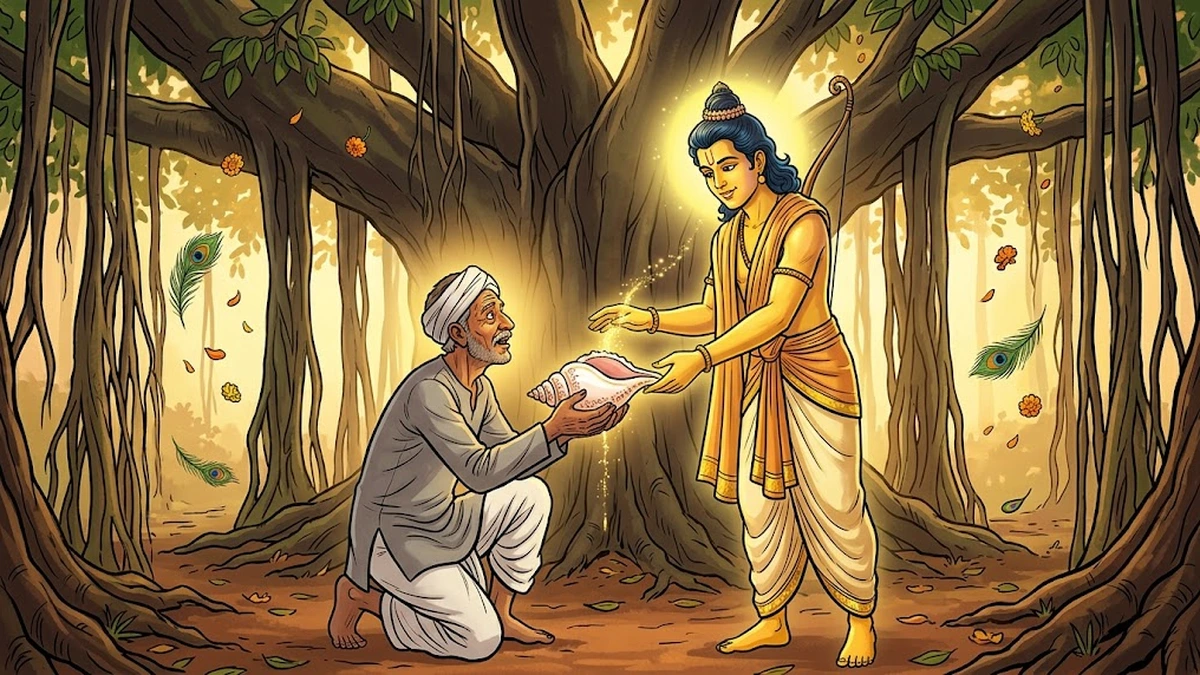
Ram, having revealed himself, gives the farmer a great spiral śaṅkha, a sacred conch-shell of the species Turbinella pyrum harvested from the Gulf of Mannar off the south Indian coast. The conch is the most ancient of Hindu ritual instruments. Krishna blew the Pâñchajanya conch on the field of Kurukshetra to open the Bhagavad-Gîtâ; Vishnu holds the conch as one of his four iconographic emblems; every village temple from Kashmir to Cape Comorin still begins the dawn âratî with three deep blasts of the śaṅkha. To put a wish-granting magic into a conch was therefore not, in the Punjabi imagination, an arbitrary fantasy but a familiar consecration: the ritual instrument of the god is the natural vehicle of the god’s gift. Stith Thompson’s motif D1470.1, “magic object provides treasure,” covers the action; but the local detail — śaṅkha, not lamp, not ring, not flute — is what makes it Hindu folk literature.
Ram teaches the farmer a particular rhythm of breath and lip on which the conch’s magic depends, and adds a parting warning that is the seed of the entire second half of the story: “Have a care of that money-lender, for even magic is not proof against their wiles.” The line is the storyteller’s way of telling the audience that the sâhûkâr is not yet finished. The farmer goes home, blows the conch in private, fills his rooms with grain and silver, repairs the leaking thatch, buys a strong young buffalo, marries his daughter respectably to a clean-shaven boy from the next village, and behaves, in short, like a man whose troubles have lifted at last. He carries himself with what Steel calls a jaunty step. The sâhûkâr, watching from his door, sees the new gait at once and reasons correctly that good fortune of some specific kind has befallen the farmer.
What follows is a beautifully observed scene of village social engineering. The sâhûkâr walks over — he does not summon, he visits — and congratulates the farmer warmly, as though he already knows everything. He drops casual hints, half-statements, knowing smiles, the technique that village confidence-men in Punjab still call thoṛî jihî gal piṭṭṇâ, “tickling out a little of the story.” The farmer, simple but not stupid, tells him about the cake-giving and the meeting with Ram and the gift of the conch — but does not reveal the secret rhythm of breath that makes it work. This careful half-disclosure is the moral fingerprint of the Punjabi peasant: open enough not to seem ungrateful, closed enough not to be ruined. Steel’s storytellers admired the farmer for it.
The sâhûkâr, baffled in his fishing for the secret, simply steals the conch one night when the farmer is sleeping. He carries it home, tries every breath and every angle, blows till he is purple in the face, and produces nothing but a sad watery hoot. The motif is the universal one of the imitator who copies the form of magic without the substance: the wolf wearing the goat’s skin, the fox preaching from the pulpit, the crane dancing the swan’s dance. It has been catalogued by folklorists under motif J2425, “the foolish imitation of magic.” What gives the Punjabi version its bite is the next move — the sâhûkâr’s pivot, when imitation fails, into negotiation.
IV. The Bargain of Doubling and the Wish for One Eye: The Trickster’s Triumph
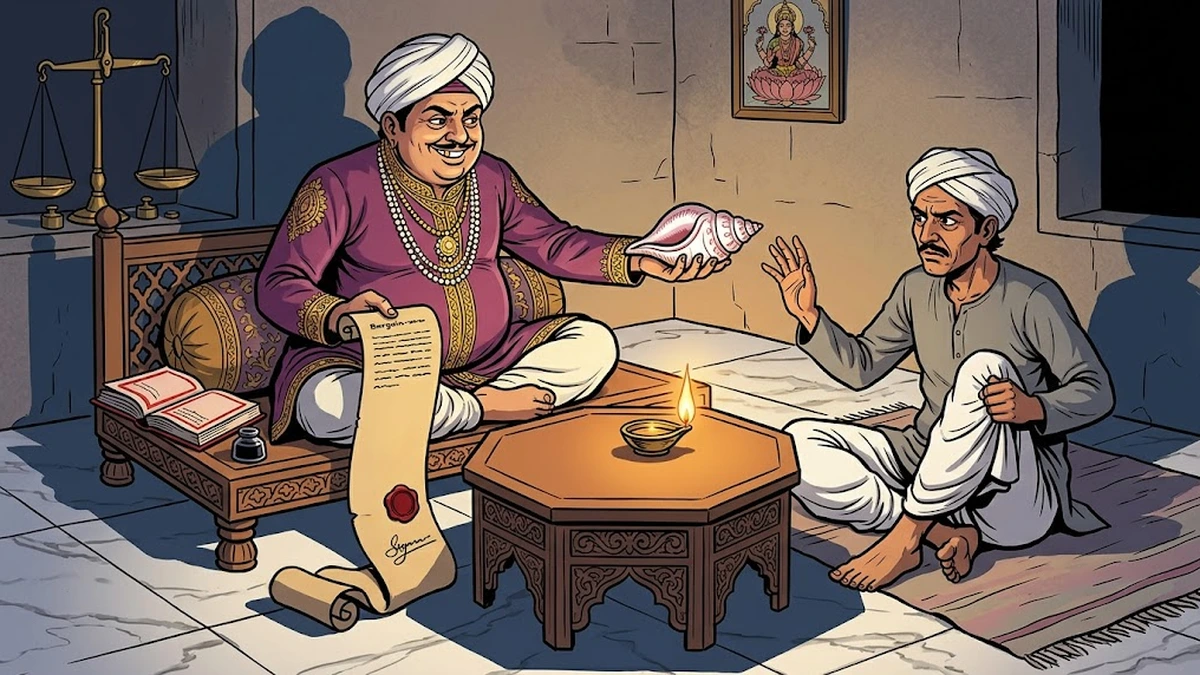
The sâhûkâr returns to the farmer with an offer disguised as a compromise. “I have your conch,” he says, “but I cannot use it. You haven’t got it, so neither can you. We are at a standstill. Let us make a bargain. I will give you back the conch and never interfere with your wishing on it — on one condition. Whatever you receive from it, I shall receive double.” The proposal is the structural heart of ATU 1331. It is a contract that looks fair on the surface and is ruinous beneath it. If the farmer wishes for one bag of gold, the sâhûkâr receives two; if for one cow, the sâhûkâr receives two; if for one fine house, the sâhûkâr receives two finer ones — meaning that any improvement in the farmer’s position widens the gap between them. The doubling clause is the perfect instrument of envy: it converts every act of the poor man’s good fortune into evidence of his still-greater inferiority.
The farmer’s first reply — in Steel’s text the only line of his dialogue in the bargaining scene — is the proverbial Punjabi groan: “Never! That would be the old business all over again!” The two halves of the line are pitch-perfect village idiom. Phir ohî kahânî (“then it’s the same story again”) is the way a Punjabi peasant tells a moneylender that the deal smells of the trap he has just escaped. But the sâhûkâr presses, and the farmer, knowing he cannot use the conch while the sâhûkâr holds it, eventually agrees. He signs the bargain, retrieves his conch, and goes home in the evening to think.
What happens next is the closing punchline that Steel preserves and that makes the tale unforgettable. The farmer thinks for a long time over his evening roṭî. He understands the doubling clause as a piece of mathematics. Whatever good he wishes for himself, the sâhûkâr receives twice as much. There is, however, an arithmetical exception: the doubling of negative things. If the farmer wishes for one piece of misfortune for himself, the sâhûkâr will receive two. The clever exploitation of this loophole is the entire tale. The next morning the farmer takes up the conch, blows it carefully in the rhythm Ram taught him, and makes his wish: “Let me lose one eye.”
He goes blind in one eye. The sâhûkâr, by the terms of his own bargain, goes blind in both. The farmer has paid a small disability for a great deliverance: the sâhûkâr, eyeless, can no longer keep his accounts, no longer read the bahi-khâta ledger in Mahajani script that has bound the farmer’s family for three generations, no longer track which crop is mortgaged or which buffalo is owed, no longer write down with steady hand the compound interest in the long red column. The whole apparatus of debt-bondage that pressed the village into the dust collapses overnight. The farmer, with his single remaining eye, blows the conch one more time, fills his store-room with grain, and lives out his days in modest plenty — the sâhûkâr reduced to feeling his way along the wall of his marble counting-house, his ledgers gathering dust on the shelf above him.
The closing image, in Steel’s village storytellers’ telling, was sometimes amplified into a coda: the farmer’s daughter, who had once been mortgaged by the year to the sâhûkâr, was now married freely; the farmer’s son, who had once been bound by kistbandi, now walked uncollected through the village; and the sâhûkâr’s ledgers, still propped on their shelf, were quietly eaten over the years by termites. Whether or not this coda is in any printed text, it represents the way the tale was actually told and remembered in the doab during Steel’s lifetime.
Moral
The Punjabi village line carried with the tale, sung and remembered into the twentieth century, runs:
Lobh dâ ant gham hai, te dânâ kâ ant rab hai.
“The end of greed is grief; the end of generosity is God.”
The line is the Punjabi distilled wisdom of the tale. The sâhûkâr, who turned every transaction into a doubling of his own gain, finds at last that the doubling clause works against him as readily as for him; greed is mathematically symmetrical, and a man who has built his life on always taking more cannot survive a single moment of always receiving more of the wrong thing. The farmer, who was generous to a hungry stranger when he himself had only one cake left to his name, finds Ram. The two endings of the proverb are the two endings of the story. The deeper teaching is not that cleverness is good but that cleverness rooted in compassion is invincible. The farmer’s loophole-wish for his own one-eyed disability is a trick, but it is a trick on behalf of a community of villagers crushed under generations of bonded debt; in folk-ethical terms, it is a holy trick, the kind of cunning that dharma permits when justice itself is on the line.
Why This Tale Has Lasted
What has kept The Farmer and the Money-Lender alive across four colonial-era English-language anthologies, three modern children’s editions, and an unbroken oral tradition that ran through the Indian Partition and into the diaspora libraries of London and Toronto, is its perfect structural economy. Three encounters, three cakes, one revealed god, one stolen conch, one doubling bargain, one self-mutilating wish: every element in the tale earns its place, and nothing is wasted. The story is a piece of village engineering as tight as a well-made bullock-cart: it has only as many parts as it needs, each part is shaped to its load, and the whole carries its moral cargo down a long road of generations without the wheels coming off.
It has also lasted because the underlying social problem has not, in many corners of South Asia, gone away. The compound-interest sâhûkâr of nineteenth-century Punjab has shed his red ledger and become the chit-fund operator, the microfinance defaulter, the loan-app harasser, the usurious crop-buyer of contemporary rural Bihar and Maharashtra. Each generation of Indian children who hear the tale recognise some version of him on their own village street; each generation of Indian parents who tell it pass on a small toolkit of moral resistance — the lesson that wit, kindness, and a steady refusal to be intimidated remain, in the long run, more powerful than mere wealth.
Historical & Cultural Context
India’s regional folk-tale tradition is one of the oldest unbroken oral inheritances in the world, carried by grandmothers, wandering bards, and village storytellers, preserving moral wisdom, social commentary, and cultural memory long before any of it was written down. The Punjab, lying along the great trade route from Central Asia to the Gangetic plain, was a particularly rich seed-bed: stories that originated in the Pañcatantra of Visnusarman moved north into Iran with the Sasanian translators, west into the Arab world as Kalîlah wa Dimnah, east into the Bengali oral tradition as the Thakurmâr Jhuli, and home again into the Punjab in new forms. The Farmer and the Money-Lender shares structural DNA with the Akbar-Birbal tales and the Tenâlî Râma cycle, where wit serves justice against corruption; it shares the moneylender-as-villain trope with the Marwari stories of Sêṭh Phûlchand and the Sikh moralities of the eighteenth-century Gurû kî Sâkhî; and it shares the doubling-wish gimmick with the Persian tale of the two viziers in Niẓâm al-Mulk’s Siyâsatnâma (1091 CE).
The farming communities of the late-nineteenth-century Punjab to whom Steel listened were caught in a real economic web that the tale described in miniature. The Land Alienation Act of 1900, passed by the British Indian government partly in response to growing peasant unrest, attempted to limit the moneylender’s power to seize agricultural land in default of debt. The Act was a direct legislative descendant of the moral universe of Kisân te Sâhûkâr: the recognition, written into colonial statute, that the village banker’s sâhûkârî was eating away the foundations of rural society.
Reflection & Discussion
- Was the farmer’s wish for one eye fair play, or a piece of dishonesty? Where, in your view, is the line between cleverness and cheating?
- Why does the story have the farmer feed three strangers in succession before he meets Ram? What would change in the meaning of the tale if Ram had been the first stranger he met?
- Why do village storytellers in many cultures choose money-lenders, judges, and tax-collectors as the recurring villains of folk tales rather than, say, soldiers or kings?
- If you had a magic conch shell whose every gift was matched at double the strength to your worst enemy, what would you wish for, and why?
- How might the moral of this tale apply to modern situations — predatory loans, payday lenders, exploitative employers? What is the equivalent of the farmer’s loophole-wish in a world without conch shells?
Did You Know?
- The Punjabi word sâhûkâr derives from the Sanskrit sâdhu-kâra, “maker of good things” — an originally neutral term that, like the English word “Shylock,” took on darker connotations through centuries of use.
- The śaṅkha conch in the tale is a real ritual object: the giant turbinella shell of South India, harvested in Tamil Nadu, sold across India for ritual use, and traditionally blown by a priest at the start of every Hindu temple service.
- Joseph Jacobs reprinted the story in 1892 in Indian Fairy Tales under the title “The Farmer and the Money-Lender,” and his version travelled into late-Victorian English nurseries through John Dickson Batten’s pen-and-ink illustrations.
- The doubling-wish trope of ATU 1331 is found in cultures from Korea to Ireland; the Korean version, “The Two Brothers and the Magic Hammer,” ends almost identically with the greedy brother having his nose stretched to twice the length of the kind brother’s.
- Flora Annie Steel, the recorder of this tale, wrote a celebrated novel about the 1857 Indian Mutiny called On the Face of the Waters (1896), and is one of the few colonial-era women whose folkloric collections are still cited as primary ethnographic sources.
What This Tale Teaches Us Today
Old stories keep their power because their lessons never stop being useful. Here is how this one still applies:
- Generosity practised when one has the least to give — the farmer’s last cake — is the ethical action that the universe rewards in folk literature, and the one that real human relationships still recognise as character.
- Cleverness without compassion produces the sâhûkâr; compassion without cleverness produces a victim; the tale argues for the rare and difficult combination of both.
- Beware of contracts whose terms sound symmetrical but in practice always benefit the more powerful party. The doubling-clause looks fair until you map out its actual consequences.
- Reading and retelling folk tales aloud to children is a quiet form of moral inoculation: a child who has heard The Farmer and the Money-Lender at six recognises an exploitative bargain at twenty-six.
Why This Story Still Matters
The Farmer and the Money-Lender joins a vast global library of folk tales that human beings have been telling one another for thousands of years. Every culture has produced its own stories, but the deepest themes — courage, kindness, cleverness, loyalty, the cost of greed — appear again and again in different clothes. Modern readers who spend time with folk tales inherit something precious: a sense that people have always wrestled with the same basic questions, and that good stories can still help us find good answers.
Cultural Context and Continuing Influence
Folk tales like this one survived for hundreds of years through oral storytelling before any scholar thought to write them down. Grandparents told them to grandchildren, travelers traded them along roads and rivers, and mothers repeated them to babies who would one day repeat them to their own children. Each small retelling sharpened the story, discarded unnecessary parts, and polished the essential lesson. The Farmer and the Money-Lender in particular passed through Brahmin pulpit and Sikh kirtan and Sufi qawwali court and English nursery before settling into its modern form, and it has been polished by every retelling.
Reading Folk Tales With Children
Reading folk tales aloud to children is one of the oldest and most effective forms of moral education. Unlike a lecture or a rule, a story slides past a child’s natural resistance and plants its lesson in the imagination, where it quietly grows. When reading this story with a young listener, try pausing at the moment Ram reveals himself, or at the moment the farmer thinks for a long time over his evening roṭî, and asking the child what they would do next. Let them guess, even if their guess is wrong. That small act of prediction turns a passive listener into an active thinker.
A Final Word
Every folk tale carries within it the accumulated judgment of thousands of listeners across many generations. When a story has been told for a thousand years and still moves children today, that is not an accident. It is proof that the story is saying something true about the human condition. We hope this telling of The Farmer and the Money-Lender gave you something worth carrying into your day — a small lesson, a useful image, a question to ask your child at dinner.
Frequently Asked Questions
**Q: Why is this story important?**
You May Also Like
 Indian Folk Tales
Ages 6-8
Indian Folk Tales
Ages 6-8
Si Tanggang: The Ungrateful Son and the Curse of Stone
Si Tanggang: The Ungrateful Son and the Curse of Stone: In a small fishing village nestled along the Malaysian coast, where the sea whispered ancient secrets
 Indian Folk Tales
Ages 9-12
Indian Folk Tales
Ages 9-12
Sura and Baya: The Shark and the Crocodile
Sura and Baya: The Shark and the Crocodile: In the waters where the great Brantas River of Java spreads into the sea, there existed a boundary that was
 Indian Folk Tales
All Ages
Indian Folk Tales
All Ages
The Beetle And The Silken Thread
The Beetle And The Silken Thread: In a bustling town in ancient India, A tiny beetle accomplished what seemed impossible by following a silken thread. The