The Lambikin 2
The Lambikin 2: Once upon a time there was a wee wee Lambikin, who frolicked about on his little tottery legs, and enjoyed himself amazingly. Now one day he
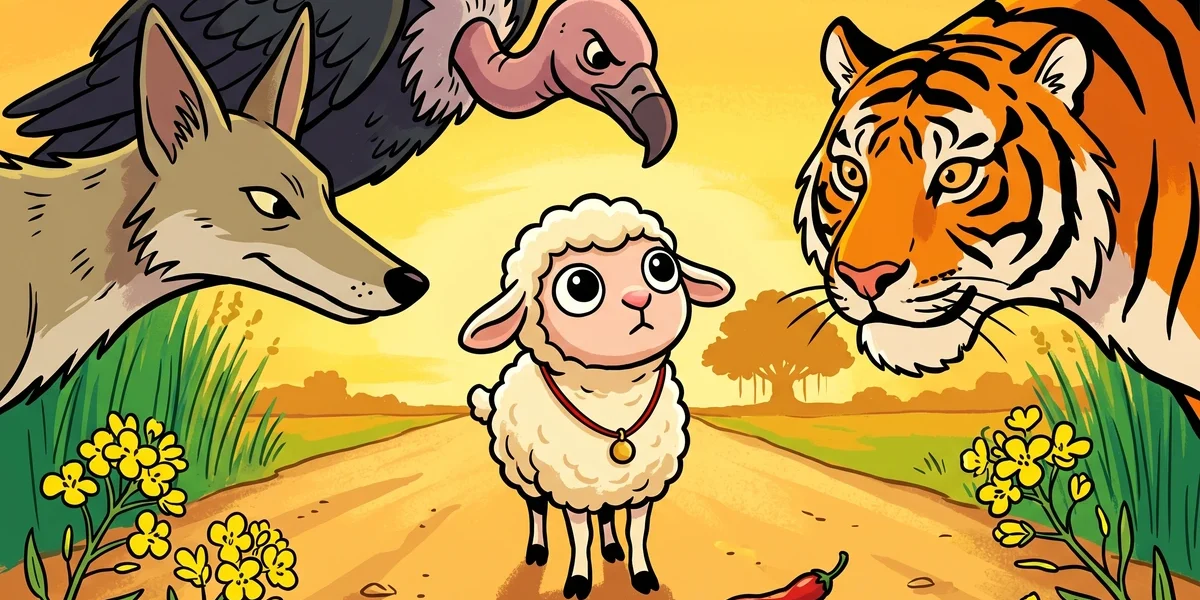
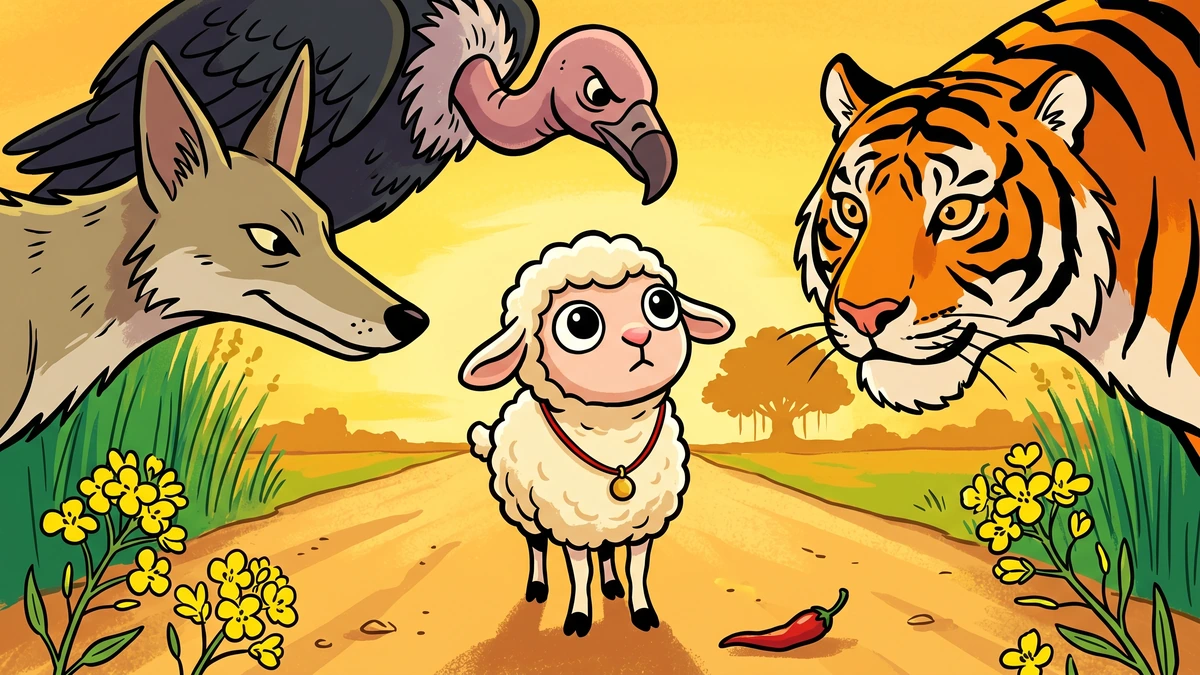
The Lambikin is one of the most beloved animal trickster tales of the Punjab, first published in English by Flora Annie Steel and Major Richard Carnac Temple in Tales of the Punjab: Told by the People (Macmillan, 1894), with the now-iconic line drawings of John Lockwood Kipling — Rudyard Kipling’s father and curator of the Lahore Museum. Steel collected the story in her years as a Civil Service wife in the rural Punjab, where village women told it to their grandchildren as a fireside lullaby with a sting in the tail. In the international tale-type indices, the story stands at the meeting point of ATU 122F* “Wait Till I Get Fat” and the broader ATU 333 “The Glutton” family of cunning-prey tales, with Stith Thompson cataloguing its central tricks under motifs K553 “Wait until I get fat”, K607.3 “Disguise as drum”, and J1771 “Object thought to be animal”. The Punjabi original survives in oral form as the “Bakri da bachcha” cycle, and the rhyme the lambikin sings — a four-beat dactylic chant the predators always find “reasonable” — belongs to the same family of Indian nursery refrains that animate Singh Rajah and the Cunning Little Jackals and the Pancatantra‘s Vanarinda Jataka wits.
I. The Wee Wee Lambikin Sets Out
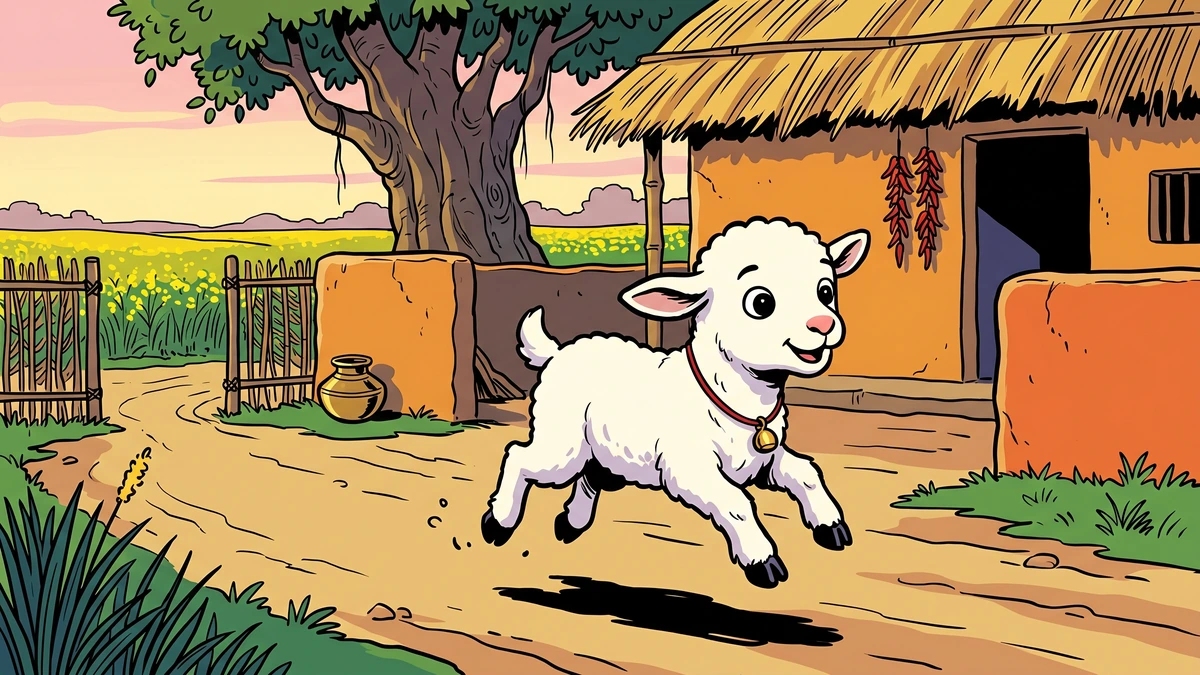
In a sun-dusted Punjabi hamlet of mud-walled compounds and mustard fields, a tiny white lamb — so small the village children called him only Lambikin, the diminutive of a diminutive — frolicked on legs that were “tottery” because they had carried him only a few weeks of mortal life. His coat was the colour of fresh churned cream; round his neck the shepherd-grandmother had tied a single thread of red mauli for protection from the evil eye, and a tiny tola of brass that tinkled when he leaped. He lived for the small joys: warm milk at dawn, the smell of wild fennel after rain, and the long shadows of the peepal tree in which he liked to play at being a grown ram.
One morning the longing came on him to visit his Granny — a widowed ewe who lived two villages distant, beyond the canal, in a hut roofed with sugarcane thatch. Granny, he knew, kept a corn-bin full of golden jowar and barley, and was famous in the flock for sneaking him extra handfuls when his mother was not looking. “I shall go,” he said to himself, in the small confident voice of the very young, “and I shall feast.” Without telling a soul he slipped through the wattle gate and started down the dust road, jumping with joy, his little brass tola tinkling at every bound.
Steel’s framing of this opening — three brisk sentences before any predator appears — is itself a piece of folk craftsmanship. In the Punjabi original, the storytelling grandmother (nani) would lean close to the child here and whisper the lamb’s name in a shrinking voice, so that by the time the first jackal slinks onto the page, the listener has already adopted the lambikin as a small piece of their own heart. It is a deliberate emotional ambush. The trick of the tale, after all, is that the smallest creature in the cast must outwit every other; the listener has to want him to win before the danger arrives.
II. The Predators on the Road — and the Refrain That Saves Him
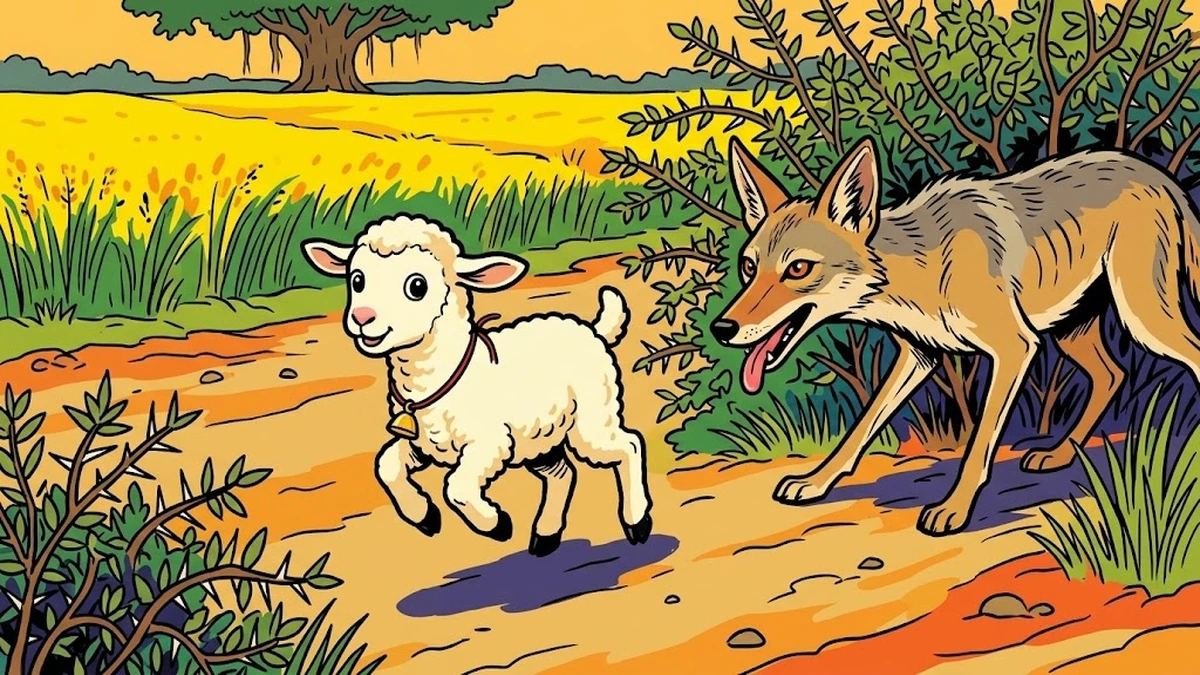
He had not gone half a kos when, from behind a clump of thorny kikar bushes, slunk a lean-flanked Jackal with eyes like hot copper coins. The Jackal looked at the tender young morsel and licked his thin black lips. “Lambikin! Lambikin! I’ll EAT YOU!”
But Lambikin only gave a little frisk, the tola jingling, and sang in his small clear voice the rhyme that would carry him through the entire tale:
“To Granny’s house I go,
Where I shall fatter grow;
Then you can eat me so.”
The Jackal, who was hungry but also vain of his own logic, considered the proposition. A thin lamb today, or a fat lamb the day after tomorrow? He calculated. He licked his lips one more time. He let the lambikin pass.
By and by came a black-ruffed Vulture wheeling down from a dead branch, her bald head cocked. “Lambikin! Lambikin! I’ll EAT YOU!” The lambikin frisked again and sang the same three lines. The Vulture, who in Punjabi tales always considers herself the wisest of carrion-judges, weighed thin meat against fat meat and let him pass. Then came the Tiger — orange as a marigold flame, his stripes black as kohl — and after him the grey Wolf, the village Pariah Dog, and finally the golden-eyed Eagle. Each one met him on the road; each one delivered the same hungry threat; each one heard the same little dactylic refrain; and each one — persuaded by the unanswerable arithmetic of patience — let the lambikin trot on toward Granny’s house.
This sequence is the structural heart of the story, and it is the place where folklorists most often pause. The repetition is not idle. Vladimir Propp would call it the multiplication of donors; Indian storytellers call it laharon ki kahani, “the tale of the waves,” because each predator is a wave the hero must pass through. Six predators is the canonical number in the Punjabi telling — sometimes five, sometimes seven, but always an odd reckoning so the listener can count along on the fingers of one small hand. Each repetition tightens the suspense a notch and teaches, almost subliminally, the lesson the lambikin already knows: a sufficient promise will buy you any amount of time, if the listener is greedy enough to believe in the future.
III. Seven Days in the Corn-Bin
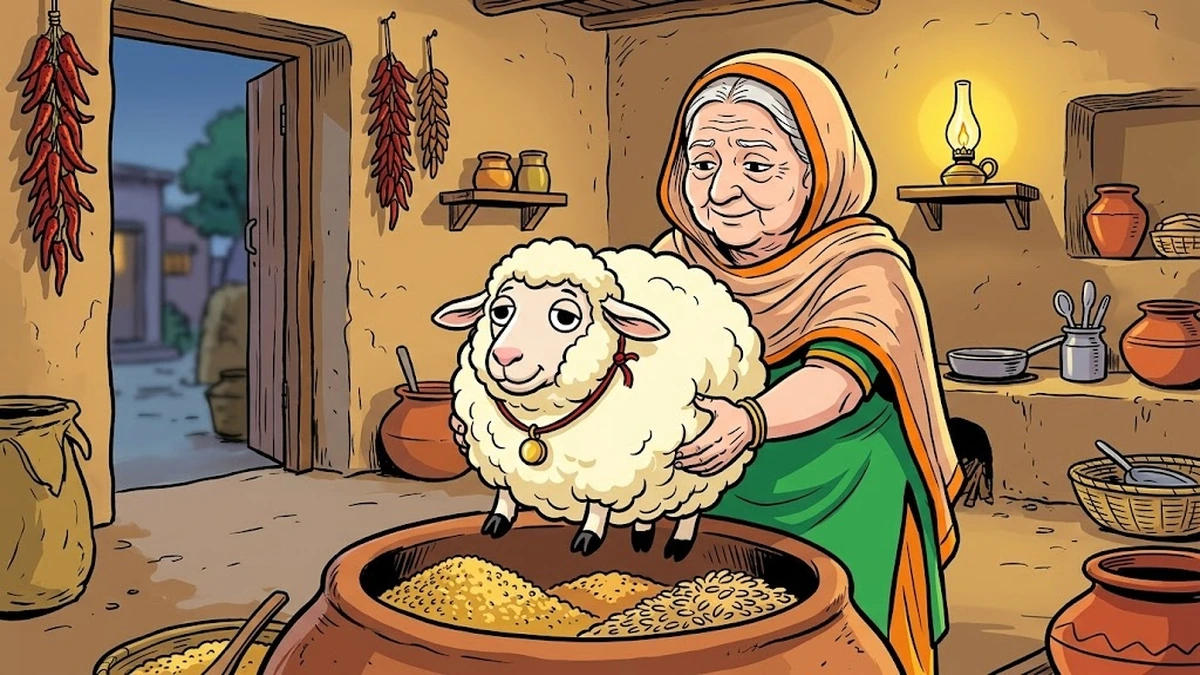
When at last the panting lambikin reached Granny’s hut and burst through the curtain of strung red chillies, he flung himself at her woolly knees and cried — all in a great hurry — “Granny, dear, I’ve promised to get very fat; so, as people ought to keep their promises, please put me into the corn-bin at once!” Granny, who had heard quite a lot of strange requests in her time but never one that promised so much eating, said he was a good boy and lifted him into the great clay kothi half-buried in the kitchen floor.
For seven days the lambikin lived inside that bin among the polished grains of jowar and barley, and he ate, and he ate, and he ate. He ate at sunrise when the Granny went to the well; he ate at noon when the Granny went to the canal; he ate at dusk when the Granny said her prayers facing the village shrine. By the seventh evening his coat was tight as a stretched drumskin and his small brass tola had to be loosened on its red thread. Granny lifted him out, marvelled at his roundness, and announced the visit was over: home he must go.
But the lambikin — who had grown not just round but cunning in the dark of the corn-bin — pointed out the obvious and dreadful problem. “Some animal would be sure to eat me on the way back, I am so plump and tender. I’ll tell you what you must do. You must make a little drumikin out of the skin of my little brother who died, and then I can sit inside and trundle along nicely, for I’m as tight as a drum myself.”
The mention of the little brother who died is the hinge on which the entire story turns from comedy into something stranger and older. Steel softens the moment; the village nani never did. In the unedited Punjabi telling, the dead lamb was the lambikin’s twin, lost to a fever or a wolf the previous winter, and the drum — the dholak or smaller dhamak — is built that very night in front of the listening child, the cured cow-hide stretched and pegged tight by Granny’s slow careful hands. The drum is at once a coffin, a disguise, and a musical instrument, and the lambikin will use it as all three. Indian folk metaphysics has always been comfortable with that triple register; the Pancatantra works the same vein when the jackal in Mitra-bheda wears the lion’s roar like a borrowed cloak.
IV. Trundling Home Inside a Drum
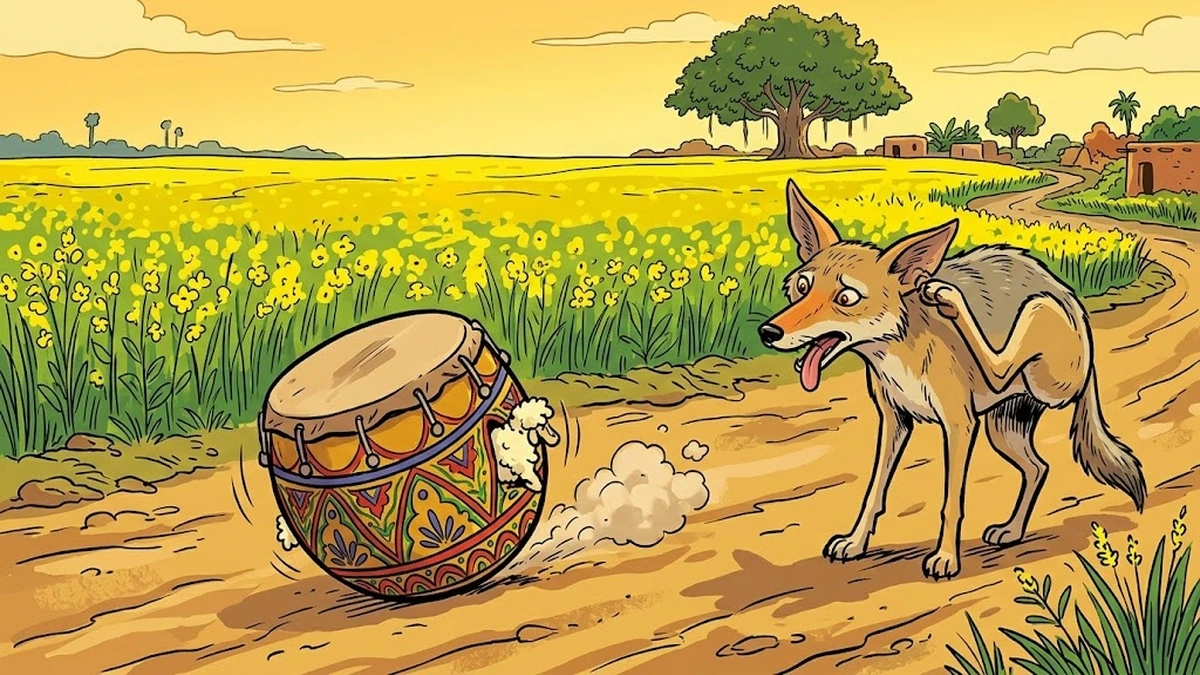
So Granny made the drumikin — small, painted ochre, the cow-hide head taut as a temple drum — and the lambikin curled himself snugly inside, a fat white lump of mutton hidden in a wooden shell no bigger than a bowl. Granny gave the drumikin a gentle push and it began to roll down the dust road toward home, slowly, then faster, bumping and trundling through the ruts.
And here, the predators returned in reverse. First the Eagle, then the Pariah Dog, then the Wolf, the Tiger, the Vulture, and last of all the Jackal — each one stalked out from the same clumps of kikar and ber, hungry, looking for a fat lamb. Each saw only a small painted drum trundling along by itself, and each — annoyed at having waited a week for nothing — called out impatiently: “Drumikin! Drumikin! Have you seen Lambikin?”
From inside, in a voice as muffled as if it came from a long way underground, the lambikin sang back his second and final rhyme, the one the Punjabi villages still teach to children:
“Fallen into the fire, and so will you,
On — little Drumikin! Tum-pa, tum-too!”
Each predator, fooled by the cunning of the disguise, growled and let the drumikin pass. The Tiger thought it was beneath his dignity to question a piece of furniture. The Vulture, who could not see anything that was not carrion, lost interest at once. The Wolf and the Dog thought a drum was no business of theirs. The Eagle screamed and flew off in disgust. And so the little drumikin trundled the long road home, slipped through the wattle gate of his own village, rolled to a stop at his mother’s feet, and out tumbled the lambikin — fat, alive, and twice as cunning as he had been the morning he set out. The Jackal, last and hungriest of the predators, was left sitting in the middle of the empty dust road, scratching his ear with a hind foot, wondering — as Steel writes — “whatever had become of his promised dinner.”
The Moral — and the Older Punjabi Telling
The surface moral of The Lambikin is the moral most often printed beneath it in school primers from Lahore to London: cleverness defeats brute strength; wit is the small creature’s only armour. But the deeper Punjabi reading is more cunning still. The lambikin survives not because he is brave (he is not — he is terrified at every turn) and not because he is fast (he is too small to outrun a jackal, let alone a tiger). He survives because he understands a single hard truth about appetite: a hungry creature will always prefer a richer meal tomorrow to a thinner one today, provided the promise sounds reasonable. The whole tale is a small child’s primer in the management of bullies. You cannot fight them, the grandmother is whispering; you cannot outrun them; but you can talk to their greed.
“Akkal vada, te taakat chhoti — par bhukh sab tho vaddi.”
(Punjabi) — “Wit is great, and strength is small — but hunger is greater than both.”
The drum at the end is not a deus ex machina. It is the lambikin choosing to be invisible — choosing, that is, to spend a little dignity (curled inside a coffin made of his brother) in exchange for his life. The Punjabi grandmother, telling the tale at dusk, lets that beat sit in silence for a long heartbeat before the rhyme starts up again. It is the most quietly subversive line in nineteenth-century Indian children’s literature: survival sometimes asks you to disguise yourself in the skin of someone you have loved and lost.
The Comparative Frame — Lambikin in the Wider World of Cunning-Prey Tales
Folklorists comparing The Lambikin across cultures have long noted that the “Wait Till I Get Fat” trick is one of the deepest motifs in human storytelling — older than literacy, older than empire, older perhaps than agriculture itself. The Brothers Grimm catalogue a cousin in The Old Sultan (KHM 48), where a doomed dog buys time from his master by promising future usefulness. The Russian Kolobok (the Round Bun) escapes the wolf and the bear by a singing rhyme almost identical in cadence to the lambikin’s, only to be eaten by the cleverer fox at the end — a darker variant the Punjabi grandmother politely declines to import. In the Caucasus there is a small goat who hides in a cheese; in West African Anansi tales a tiny mouse hides in a calabash. Every settled people, it seems, has had to invent a story about how the smallest member of the household survives the appetites of the larger world. Steel’s Punjabi version is unusual chiefly in its tenderness — the lambikin is allowed to win cleanly, with no last-page reversal, because the village child listening at her grandmother’s knee deserves at least one bedtime story that ends in the survival of the small.
What makes the Indian framing especially rich is the underlay of the Pancatantra tradition, in which animal cleverness is not merely entertainment but a working manual of nitishastra — the practical statecraft of the weak. When the lambikin promises future fattening, he is performing the same diplomatic feint that the jackal Damanaka performs on the lion Pingalaka in the Mitra-bheda book of the Pancatantra: “Wait, sire, the meal you imagine will be richer if you delay.” The lambikin is, in miniature, a court vizier; the predators are, in miniature, the kings he must outmanoeuvre. Read this way, the nursery tale is preparing its small listener for a lifetime of negotiating with the powerful — which, in the Punjab of 1894 as in most places before and since, was exactly the survival skill she would need.
Why the Tale Has Lasted
Since 1894 The Lambikin has been re-printed, re-illustrated, and re-told in English, Punjabi, Hindi, Urdu, and a dozen other Indian languages; Joseph Jacobs adapted it for his Indian Fairy Tales the same year; the BBC dramatised it on Children’s Hour in the 1950s; and it remains a fixture of the NCERT and ICSE primary readers a century and a quarter after Steel first set it down. Its endurance owes something to the rhyme — the drumming, hypnotic tum-pa, tum-too that any four-year-old can chant — and something to the John Lockwood Kipling line drawings, in which the lambikin’s eyes are always two black dots of pure terrified intelligence. But mostly it endures because it is a perfectly compressed parable of how the powerless live alongside the powerful: by being clever, by being patient, by being willing to vanish inside a small painted drum when vanishing is the only road home. The Punjabi child who learns this story at three is being given, in the disguise of a nursery rhyme, a survival manual she will use for the rest of her life.
And the lambikin? He grew, in time, to be a fat well-spoken ram with a small brass tola still around his neck, and he never again left the village without first telling his mother where he was going.
Source & canonical attribution: Flora Annie Steel & Richard Carnac Temple, Tales of the Punjab: Told by the People (Macmillan, London, 1894), illustrated by J. Lockwood Kipling; collected in the Punjab oral tradition (Bakri da bachcha cycle); Joseph Jacobs, Indian Fairy Tales (David Nutt, 1892), tale XII; Aarne–Thompson–Uther ATU 122F* “Wait Till I Get Fat” with elements of ATU 333 “The Glutton”; Stith Thompson motifs K553, K607.3, J1771, K1839; cf. Pancatantra IV “Labdha-Pranasha” for the same trickster-prey schema; Vanarinda Jataka 57 and Sumsumara Jataka 208 for the South-Asian small-creature-outwits-large-predator tradition.
he Tale
Frequently Asked Questions
**Q: Why is this story important?**
You May Also Like
 Indian Folk Tales
Ages 6-8
Indian Folk Tales
Ages 6-8
The Demon With The Matted Hair
Five-Weapons Prince sticks to sticky-haired Silesaloma — then laughs, names his sixth weapon, and teaches the ogre the Five Precepts. Pañcāvudha-Jātaka for ages 6–8+.
 Indian Folk Tales
Ages 6-8
Indian Folk Tales
Ages 6-8
The Loyal Mongoose: A Heart-Breaking Tale of Misunderstanding
The Loyal Mongoose: A Heart-Breaking Tale of Misunderstanding: The Faithfulness That Could Not Be Spoken Long ago, in a small village nestled between two
 Indian Folk Tales
Ages 9-12
Indian Folk Tales
Ages 9-12
Her Childhood
A blue-eyed village girl who lives in books meets a songbird — then an empty nest — and learns that what we love may leave while love itself remains. Full unique literary short.