The Wind and the Sun
The Wind and the Sun: There was once an argument between the wind and the sun about who was stronger than the other. They argued for a long time but neither of
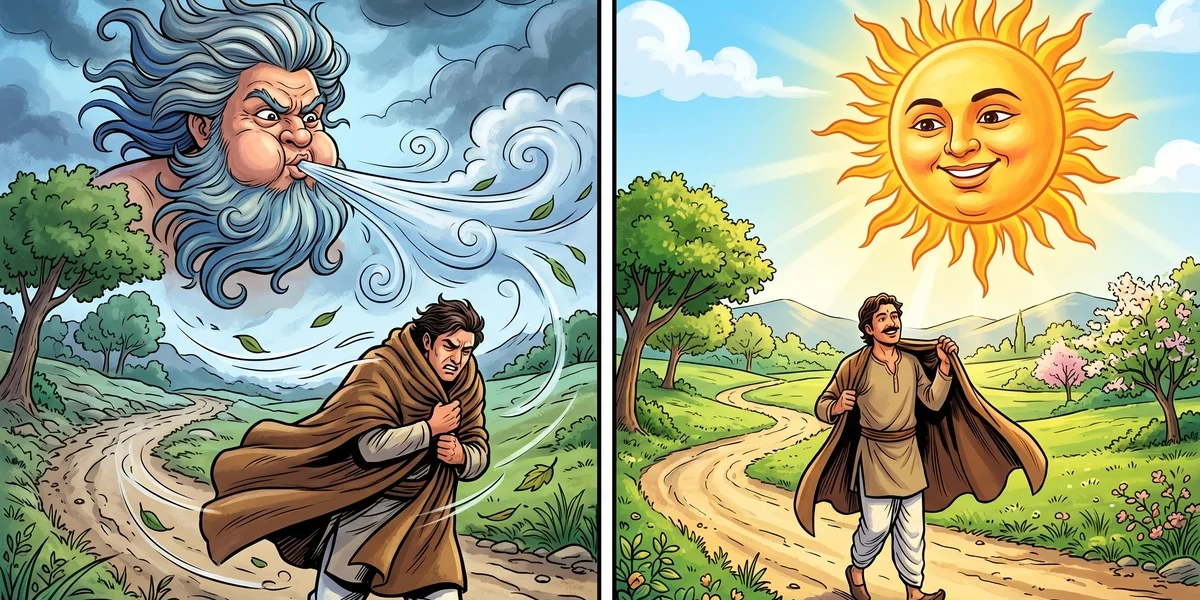
The Wind and the Sun: A Fable for Every Age of Management
Few fables have demonstrated more enduring relevance across centuries and cultures than the contest between Wind and Sun over which of them can make a traveller remove his cloak. Classified as Aesop’s Fable 143 (Perry Index), it circulates in versions from ancient Greece to medieval Arabic collections to modern Indian management training seminars — a longevity that speaks to the perennial freshness of its core insight: coercive force and persuasive warmth are not merely different styles but different ontologies of power, with fundamentally different effects on human behavior. The fable asks which form of power is genuinely superior, and answers with elegant economy: the one that works.
In the Indian retelling, the fable acquires cultural resonances unavailable to its Greek original. Wind — vayu — is not merely a meteorological force but a cosmic deity, the breath of the universe, the vehicle of prana. Sun — surya — is not merely a celestial body but the sovereign of light, the eye of the cosmos, the source of all energy and life. Their contest is therefore not between two natural phenomena but between two divine principles: the principle of force-in-motion (Vayu, associated with rajasic power, kinetic energy, and aggression) and the principle of radiant presence (Surya, associated with sattvic power, illumination, and nourishment). The fable’s verdict — that radiant presence defeats kinetic force — carries cosmological weight in the Indian frame.
Vayu vs. Surya: Two Models of Divine Power in Indian Cosmology
In the Vedic pantheon, Vayu (Wind) and Surya (Sun) occupy complementary but hierarchically distinct positions. Vayu is among the most powerful of the atmospheric devas, associated with speed, restlessness, and the dispersal of obstacles; his son Hanuman inherits these qualities and becomes the epitome of rajasic strength in service of righteous purpose. Surya is the sovereign light-source, whose daily journey across the sky maintains cosmic order (rita), whose twelve forms (dvadasha Adityas) govern the months, and whose energy ultimately sustains all organic life.
The Taittiriya Upanishad places Surya among the manifestations of Brahman — the ultimate reality — while characterizing Vayu as the cosmic breath (pranasya pranam — the prana of prana). Both are supreme in their domains, yet the fable’s logic — that warmth overcomes force in the domain of human behavior — reflects a deep Indian intuition about the difference between power that extracts and power that nourishes. Coercive power (Vayu-style) can compel external behavior but cannot change internal orientation; persuasive warmth (Surya-style) changes the interior state from which behavior naturally flows.
Danda vs. Sama: The Political Science of the Fable
Indian political philosophy (nitishastra) identifies four instruments of statecraft: sama (conciliation/persuasion), dana (gift/bribery), bheda (division/strategy), and danda (punishment/force). The fable dramatizes the contest between sama and danda in its purest form. Vayu’s attempt to strip the traveller’s cloak is pure danda — force applied externally, attempting to compel a behavioral outcome. The traveller’s instinctive response — gripping the cloak tighter — is the textbook reaction to danda: resistance, defensiveness, increased commitment to the targeted behavior. Danda, the Arthashastra acknowledges, is the instrument of last resort precisely because it often produces counter-mobilization rather than compliance.
Surya’s warmth is pure sama — creating conditions in which the traveller freely chooses the desired behavior. No compulsion is involved; the traveller removes the cloak because doing so now serves his own comfort. This is the political science of internalized motivation: the most stable behavioral change is the one the person experiences as their own choice. Kautilya ranks sama first among the four instruments for this reason — it produces durable results with minimal resource expenditure and no resistance. The fable makes this abstract political insight viscerally immediate through a single perfect image.
The Fable as Management Parable: Persuasion in the Modern Context
The Wind and the Sun has been adopted enthusiastically by contemporary Indian management education, and its metaphors appear in organizational behavior courses from IIM Ahmedabad to corporate leadership workshops in Bangalore. The reason for this uptake is not merely the fable’s antiquity but the precision of its diagnosis: organizational coercion (performance management by threat) consistently produces the same result as Vayu’s blast — compliance with tightened grip, minimal discretionary effort, increased turnover. Organizational warmth (purpose-driven leadership, genuine recognition, enabling conditions) produces the same result as Surya’s rays — voluntary, enthusiastic, sustainable engagement.
Behavioral economists studying intrinsic versus extrinsic motivation have reached the same conclusion through controlled experiments that Aesop (and his Indian retellerss) reached through narrative intuition: external compulsion undermines internal motivation when the two come into conflict. The overjustification effect, identified by Lepper, Greene, and Nisbett in 1973, is the Vayu-phenomenon in laboratory form — add external pressure to an intrinsically motivated activity, and intrinsic motivation collapses. The Sun’s approach — enhance the conditions for natural motivation — is what contemporary researchers call “autonomy-supportive” leadership. The fable was ahead of the data by approximately 2,500 years.
“The Wind commanded the traveller and was refused. The Sun offered warmth and was thanked. Both wanted the same thing — only one understood that wanting is not the same as earning.”
Why This Story Lasted
The Wind and the Sun has lasted across 2,500 years and a dozen cultural transformations because the human truth it encodes is invariant: coercion hardens resistance while warmth dissolves it. Every era rediscovers this in its own institutional language — Greek philosophical dialogue, Sanskrit nitishastra, medieval court manual, modern management theory — but the fable’s image is always more immediate than the theory, more portable than the treatise, and more memorable than the research paper. A traveller, a cloak, a wind, and a sun: this is all the illustration the truth needs.
Frequently Asked Questions
What is the origin of The Wind and the Sun fable?
The fable is classified as Aesop’s Fable 143 (Perry Index), originating in ancient Greece but circulating in versions across Arabic, Indian, and European traditions. Its presence in Indian retellings connects it to the Vedic pantheon — Vayu (Wind) and Surya (Sun) as cosmic devas — giving the Greek fable deeper cosmological resonance in the Indian frame.
How do Vayu and Surya differ as cosmic principles in Indian thought?
Vayu represents rajasic power — kinetic, forceful, dispersive energy, associated with speed and aggression. Surya represents sattvic power — radiant, illuminating, nourishing presence. The fable’s verdict (warmth defeats force in influencing human behavior) reflects the Indian cosmological intuition that power which nourishes outperforms power that extracts.
How does the fable relate to Kautilya’s four instruments of statecraft?
Kautilya’s Arthashastra identifies four instruments: sama (conciliation), dana (gift), bheda (strategy), and danda (force). The fable is a pure contest between danda (Wind’s compulsion) and sama (Sun’s warmth). Kautilya ranks sama first because it produces durable behavioral change without resistance — exactly what the fable demonstrates through its traveller’s response.
Why is The Wind and the Sun used in management education?
The fable precisely diagnoses the organizational coercion failure mode: external compulsion (like Vayu’s blast) produces compliance with tightened grip and increased resistance. Warmth-based leadership (like Surya’s rays) produces voluntary, sustainable engagement. This mirrors behavioral economics research on the overjustification effect — external pressure undermines intrinsic motivation, while autonomy-supportive leadership enables it.
What makes the fable’s image so memorable and portable?
A traveller, a cloak, a wind, and a sun: the image reduces a complex principle of power and motivation to its irreducible elements. Unlike a philosophical treatise or a research paper, the fable’s concrete scene is immediately graspable, emotionally immediate, and universally translatable — which is why it has survived 2,500 years and a dozen cultural contexts without losing any of its clarity.
Frequently Asked Questions
**Q: Why is this story important?**
You May Also Like
 Aesop's Fables
Ages 9-12
Aesop's Fables
Ages 9-12
The Oak and the Reed
The Oak and the Reed: Along the banks of a slow, meandering river, there grew two very different plants in close proximity to one another. One was a mighty oak
 Aesop's Fables
Ages 3-5
Aesop's Fables
Ages 3-5
The King and The Drum – An Indian Folktale
The King and The Drum – An Indian Folktale: Long ago there lived a king somewhere in the central part of India. He was very proud of his looks. He spent hours
 Aesop's Fables
Ages 9-12
Aesop's Fables
Ages 9-12
The Dog and His Reflection
The Dog and His Reflection: In a time before the great empires rose to power, when villages were small and the world seemed vast and mysterious to those who