The Dog and His Reflection
The Dog and His Reflection: In a time before the great empires rose to power, when villages were small and the world seemed vast and mysterious to those who
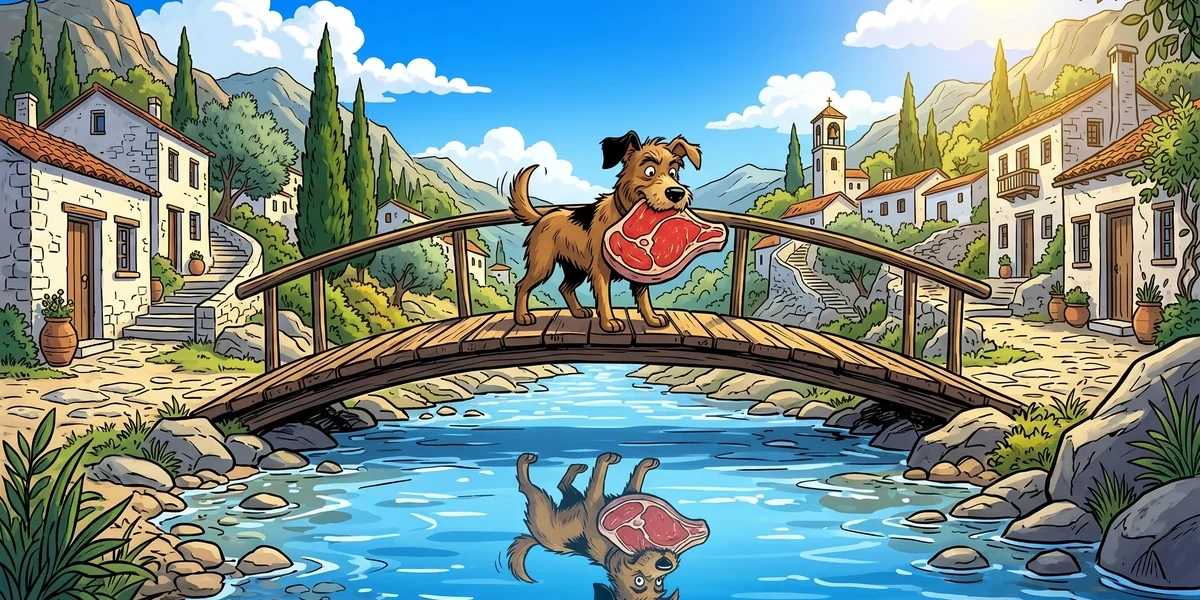
This is one of the small mirror-clear teaching-tales of the Aesopic corpus, and one of the very few fables in any tradition whose moral is almost universally recognisable in a single sentence: a creature, given enough, reaches for more, and in reaching for more loses what he had. The fable belongs to Aesop, the Greek storyteller of the sixth century BCE, in whose corpus it is catalogued as Perry 133 under the Greek title Kyon kreas pherōn — “The Dog Carrying a Piece of Meat.”
The principal Greek source-form survives in the Augustana recension of the prose Aesopica (1st-2nd c. CE). It was retold in beautiful Latin verse by Phaedrus as Fable I.4 — Canis per fluvium carnem ferens — in the first century CE, and in Greek choliambic verse by Babrius as Fable 79. It came down through Avianus, the medieval Romulus collections, and Walter of England’s verse-Aesop into modern English through William Caxton’s first printed Aesop in 1484, then Roger L’Estrange (1692), Samuel Croxall (1722), Thomas Bewick (1818), and Joseph Jacobs (1894). Jean de La Fontaine retold it as Book VI Fable 17 of his celebrated French Fables (1668) — Le Chien qui lâche sa proie pour l’ombre — “The Dog Who Drops His Prey for the Shadow.” It is classified in the Aarne-Thompson-Uther index as type ATU 34A.
This is the story.
The Lucky Dog
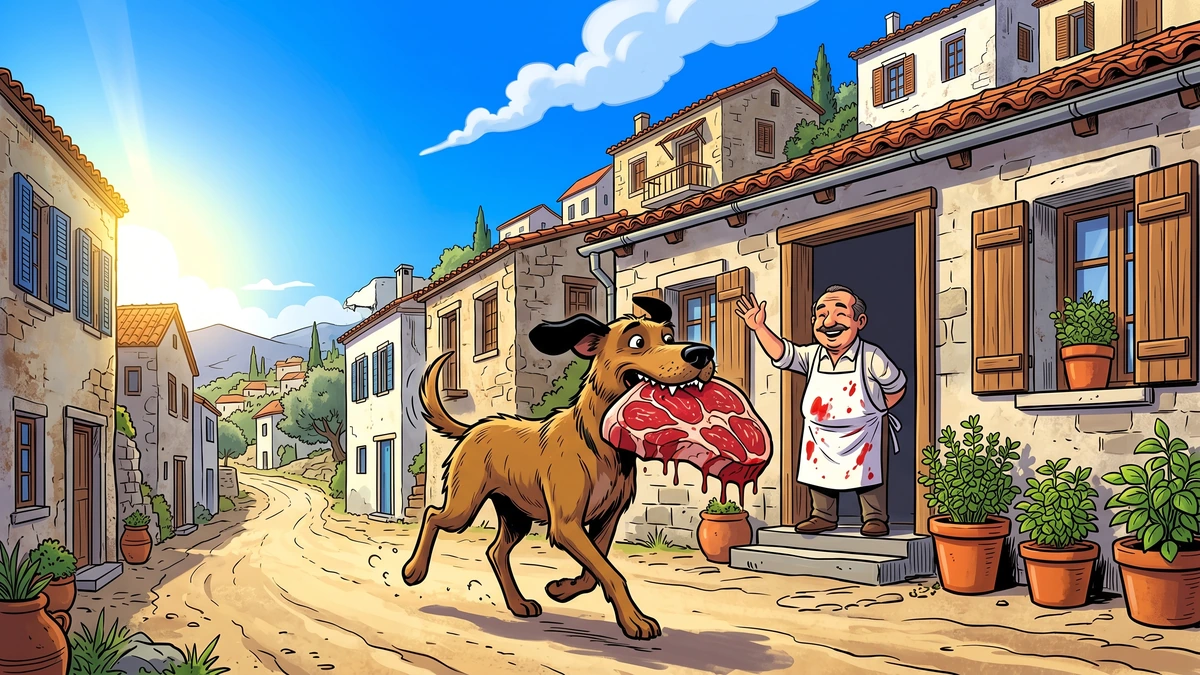
It happened, the old tellers said, on a bright sunny morning at the back door of a butcher’s shop in a small mountain village in central Greece. A scruffy brown street-dog of perhaps five years of age, lean and hungry, with a black ear and a wagging stump of a tail, had been making his rounds of the village market — as he made his rounds every morning of his short hard life — looking for any small scrap of meat that the housewives had been careless enough to drop or that the butchers had been generous enough to throw away. He had so far, this morning, found nothing. His belly was empty. His paws were sore.
And then, as he turned the corner past the butcher’s shop, the small kind butcher in his blood-spattered white apron, who had a soft heart for stray dogs and who had recognised this particular brown dog over many mornings, leaned out the back door with a broad smile and held out — to the dog’s astonishment — a magnificent fat juicy piece of red beef as big as the dog’s own head, fresh from the morning’s slaughter, dripping with blood, smelling of richness.
“Take it, lad,” said the butcher. “And mind you don’t lose it on the way home.”
The dog could not believe his luck. He took the piece of meat carefully in his strong jaws, wagged his stumpy tail twice to thank the butcher, and trotted off down the dusty village road with the magnificent fat juicy piece of red beef hanging from his mouth, the morning sun shining on his lean brown coat, and his small hard heart full of the simple uncomplicated joy of a creature who has, on a single bright morning, gone from nothing to a feast.
The Bridge
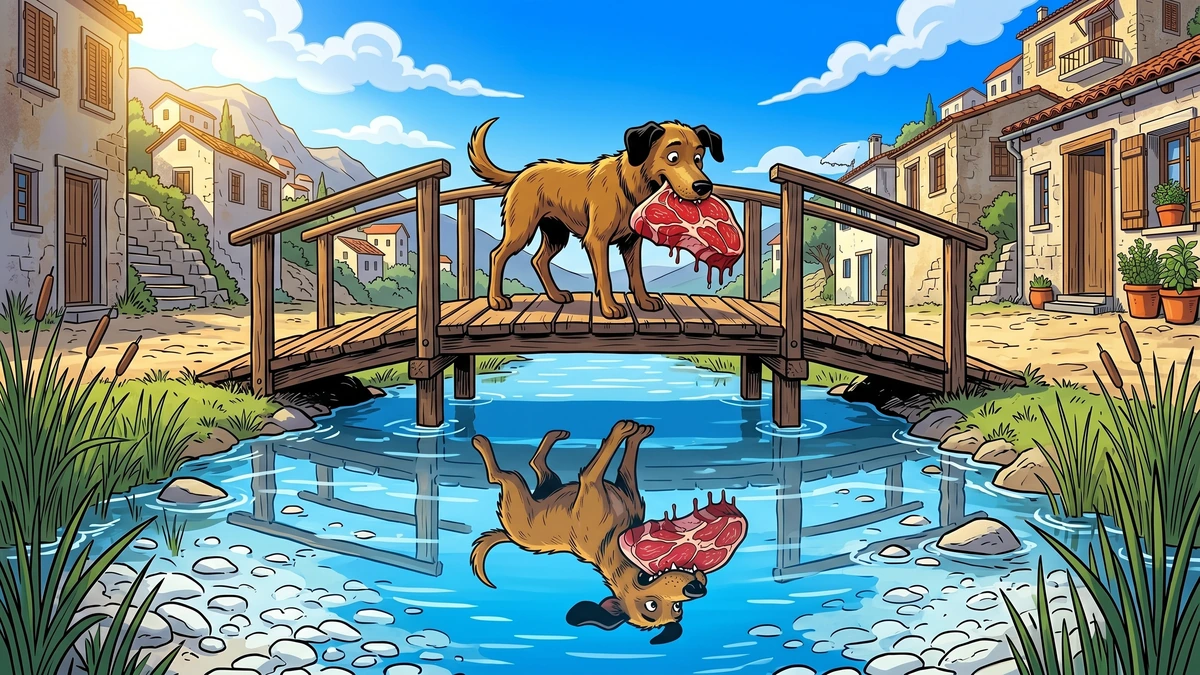
His way home led, as it always did, across a small wooden footbridge over a clear shallow stream that ran through the village on its way down from the mountains. The dog had crossed this bridge perhaps two thousand times in his short hard life. He knew every plank of it. He paid it no special attention.
But on this morning, with the sun shining and the fat juicy piece of red beef in his mouth and his small heart full of joy, the dog paused, on the middle of the bridge, to look down idly at the clear blue water beneath him. He looked down. The water was perfectly clear. The pebbles at the bottom were perfectly visible. And in the smooth mirror surface of the stream, the dog saw — looking up at him from below — another scruffy brown dog with a black ear, looking exactly like himself, holding in his jaws a fat juicy piece of red beef that was, by every appearance, even larger and even juicier than his own.
The dog did not, of course, understand the small clear truth that you and I understand: that what he was looking at was his own reflection. The dog had no education. The dog had no philosophy. The dog had only the small clear practical mind of a hungry stray, and that mind, looking down at the water, saw not a reflection but a rival — a second dog, in the water, with a second piece of meat, larger than his own, that could be — that must be — taken.
The Greedy Snarl
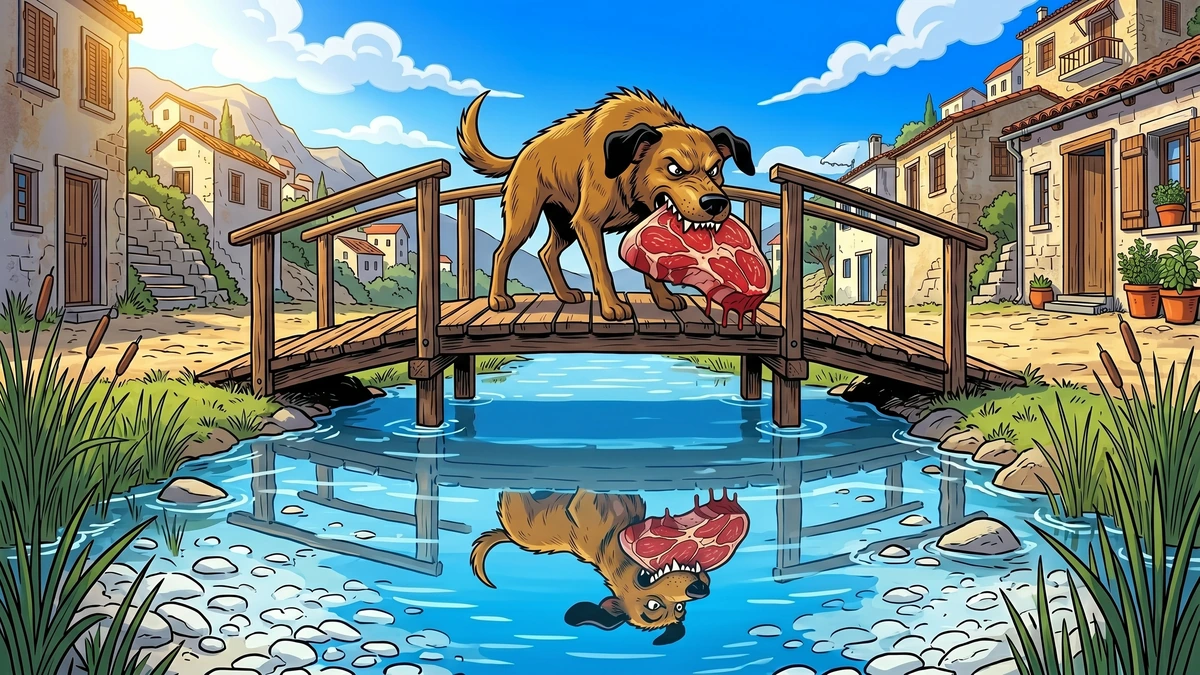
The dog dropped his head to growl at the rival in the water. He bared his sharp white teeth. He snarled. The rival in the water snarled back. He snarled louder. The rival snarled louder. He decided, with the slow patient certainty of a hungry dog who has just seen a second piece of meat, that he would lunge down and snatch the second piece from the rival’s jaws — and have two pieces of meat instead of one, and so go home in even greater triumph than he had set out.
He opened his mouth to lunge.
The Splash
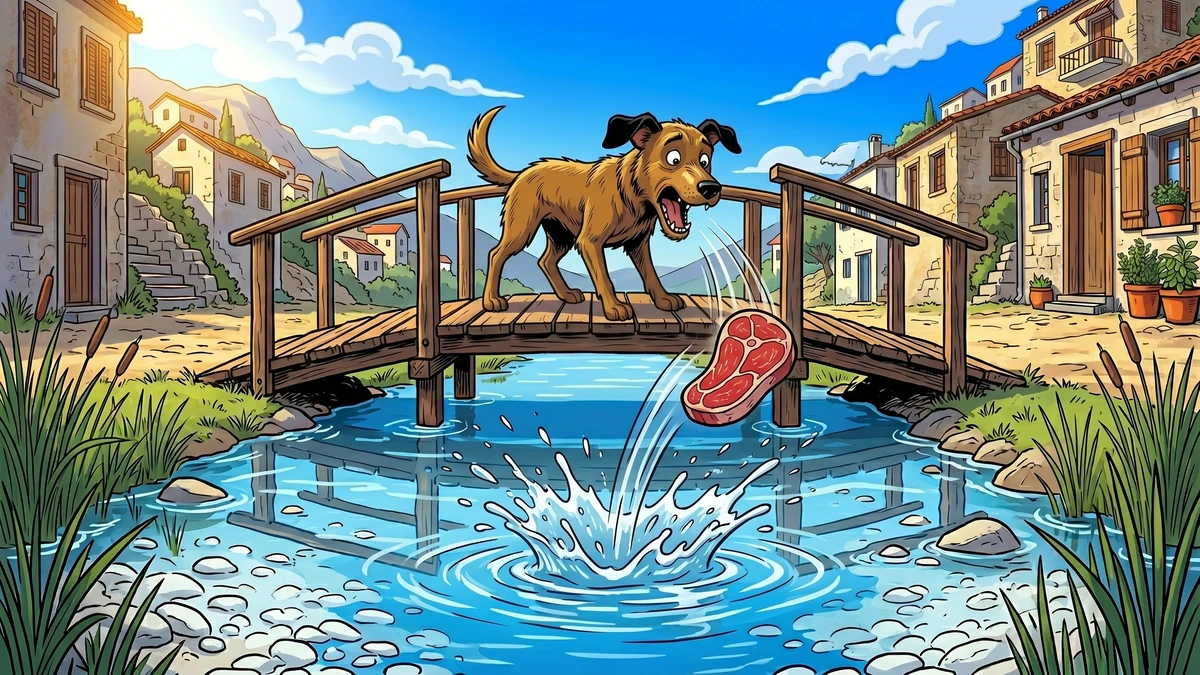
And the moment his sharp white teeth opened, the magnificent fat juicy piece of red beef that he had been holding so carefully in his jaws fell — with a single soft heartbreaking plop — into the clear blue water of the stream below.
It sank. It tumbled. It was carried away by the current. The dog, on the wooden bridge, watched in stricken silence as his beautiful piece of meat — the only piece of meat he had touched in two long hungry weeks — drifted off downstream and disappeared around the bend. The other dog in the water — the rival — disappeared at the same moment. There had never been any other dog. There had never been any second piece of meat. There had been, only, a small reflection of his own self and his own meat in the still water of the stream — and now there was nothing.
The dog stood for a long minute on the bridge. The cicadas hummed in the cypress trees. The clear blue water flowed quietly beneath him. And the small hard truth that the world had just taught him sank, slowly and bitterly, into the small hungry place at the bottom of his chest.
He had had everything. He had reached for more. And in reaching for more he had lost everything.
He turned around and trotted slowly back down the dusty village road toward the butcher’s shop, his stumpy tail no longer wagging, in the small bitter mood of a creature who has just learned the oldest lesson in the world.
The Moral
The Greek prose Aesopica preserves the moral in this form:
“Ho mythos deloi hoti pros tous pleonektas ho logos houtos eulogos.”
“The fable speaks well of those who are greedy.”
And La Fontaine, in his celebrated French verse Fable VI.17 (1668), preserves the same teaching in the title alone: Le Chien qui lâche sa proie pour l’ombre — “the dog who drops his prey for a shadow.” The pithy modern English form, descending through Croxall and Jacobs, is the proverb every English-speaking child has heard:
“Grasp at the shadow and you lose the substance.”
And the Sanskrit teachers in India, who taught the same teaching in the language of the Pancatantra, summed it up in three words: lobhah papasya karanam — “greed is the cause of ruin.”
Why This Story Has Lasted
It has lasted for two and a half thousand years because every adult who has ever, in his life, held in his hands something that was already enough — a job, a relationship, a small house, a quiet evening — and looked down at the smooth surface of his own thoughts and seen there the false rival reflection of more, and reached for it, and dropped what he had — already knows the small soft heartbreaking plop of the meat falling into the water. The fable is not about cruelty. It is not about wickedness. It is about something quieter and more universal: the small everyday delusion that the reflection of what we have is somehow larger than what we have.
Two and a half thousand years after Aesop, two thousand years after Phaedrus, three hundred and fifty years after La Fontaine, in our own age of comparison and aspiration and the constant smooth-surfaced pull of the digital water that whispers always that someone else has more — the small clear voice of the dog on the wooden bridge is still telling us the same thing. Hold the meat. Walk past the bridge. The rival in the water is yourself.
And the meat in your jaws — the small good thing you already have — is, more often than not, exactly enough.
You May Also Like
 Aesop's Fables
Ages 6-8
Aesop's Fables
Ages 6-8
Cinderella For Our Era
Cinderella For Our Era: Once upon a time, there were two sisters who lived with their mother. All three of them were cranky and selfish and cruel. It didn’t
 Aesop's Fables
Ages 9-12
Aesop's Fables
Ages 9-12
The Talkative Tortoise
The dual-rooted Indian fable of Kambugrīva — "Conch-Necked," the tortoise of Phullotpala pond — and his two wild-goose friends Saṅkaṭa and Vikaṭa, who try to lift him out of a drought by carrying him on a stick. The story comes to us through two ancient traditions at once: the Buddhist Pali Canon as Kacchapa Jātaka No. 215, and the Hindu Panchatantra as Book I, Mitrabheda. It is not, as is often claimed, a tale of Aesop. T.W. Rhys Davids' 1880 translation is preserved in full alongside the Sanskrit retelling, with Sanskrit names restored, the dual-tradition origin explained, and the story's two-thousand-year journey through Pahlavi, Arabic, Persian, Hebrew, Latin, and finally La Fontaine's French traced.
 Aesop's Fables
Ages 3-5
Aesop's Fables
Ages 3-5
The City Of Paithan A Story Of Love And Duty In The Mughal Era
The City Of Paithan A Story Of Love And Duty In The Mughal Era: Close to the city of Paithan, in a small village called Sauviragram, which lay along the banks