The Story Of The King Who Would Be Stronger Than Fate
The Story Of The King Who Would Be Stronger Than Fate: Once upon a time, far away in the east country, there lived a king who loved hunting so much that, when
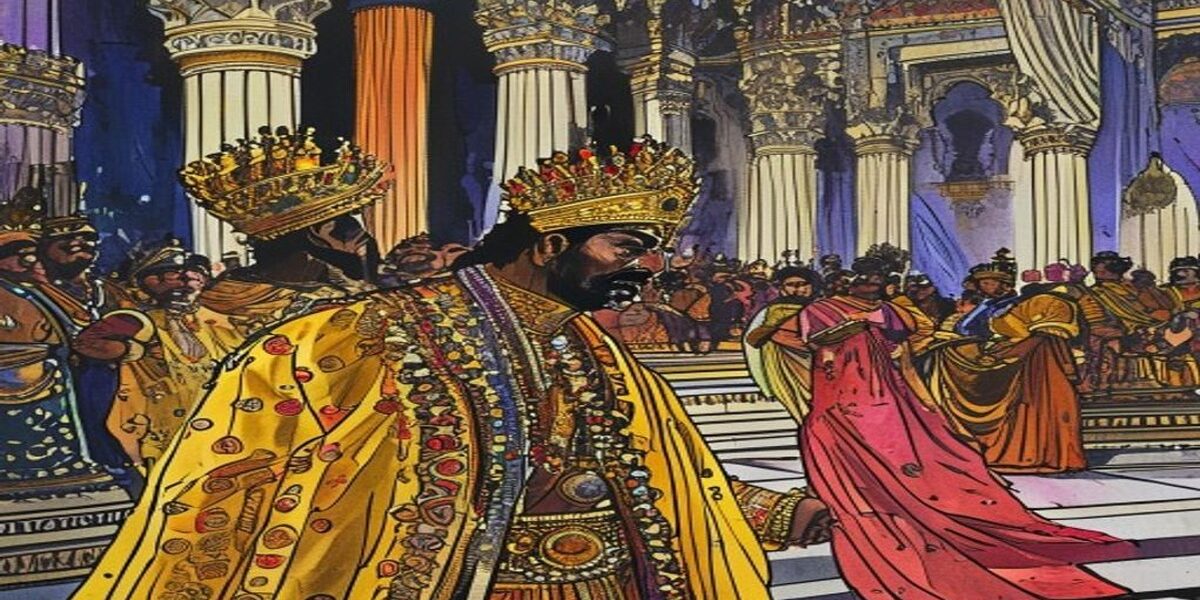
The King Against Fate: Power’s Ultimate Limit
Of all the philosophical paradoxes embedded in Indian folk narrative, none is more persistently explored than the collision between human will — especially royal will, the most potent form of human agency — and daiva, the divine decree or fate that governs the arc of events beyond any individual’s control. The Story of the King Who Would Be Stronger Than Fate belongs to a distinguished lineage of Indian didactic tales that deploy royal protagonists precisely because kings represent the maximum possible human power. If even a king cannot outrun fate, then no human can — and the tale’s lesson is simultaneously democratic (fate is the great leveler) and theological (reality has a structure that exceeds human ordering).
The Sanskrit philosophical tradition is rich with debate on this exact question. The Mahabharata’s Shanti Parva dedicates extended passages to the dialogue between daiva (fate/divine decree) and purusha-kara (human effort), with various sages arguing for different balances. Bhishma teaches that effort and fate are like two sticks rubbed together to produce fire — neither alone is sufficient, and their interaction is itself the mystery. Yet folk narrative, unlike philosophy, must resolve its plot, and the resolution almost always vindicates fate’s primacy while honoring the effort that preceded the recognition.
Daiva-Pariksha: The Ordeal of Testing Providence
The tale’s plot typically involves a king who learns — through astrology, prophecy, or divine oracle — that some fate awaits him or his kingdom, and who then deploys all the resources of royal power (armies, sages, engineering, treasure) to prevent it. This structure constitutes what Sanskrit aestheticians might call a daiva-pariksha: a testing of providence through systematic human effort. The dramatic irony — which every audience recognizes from the tale’s first moments — is that the very actions the king takes to avert fate frequently become the instruments by which fate is fulfilled. This is the Indian equivalent of the Greek concept of peripeteia: the reversal of fortune achieved precisely through the protagonist’s energetic attempt to avoid it.
Indian narrative theory does not consider this dramatic irony to be pessimistic. The Yoga Vasistha — one of the most philosophically elaborate Sanskrit texts — argues that purushakara (human effort) is always worthwhile even when it cannot alter ultimate outcomes, because the effort itself transforms the person making it. The king who exhausts every resource in a noble attempt to protect his kingdom has fulfilled his rajya-dharma even if the outcome is determined by forces beyond his reach. The tale thus affirms effort without naively claiming that effort always wins.
The Astrologer’s Warning and the Architecture of Tragic Knowledge
The tale’s inciting mechanism is typically prophetic knowledge: an astrologer, sage, or divine voice warns the king of what is coming. This creates a distinctive narrative structure — the protagonist knows his fate, and so does the audience, yet the story proceeds through his attempts to avert it. This structure — what Aristotle called dramatic irony and Indian rhetoricians called vakrokti (oblique speech) of destiny — is among the most emotionally powerful in world literature precisely because it transforms action into a form of dignified refusal. The king does not simply suffer fate; he contests it, and the dignity of that contest is the tale’s emotional and moral core.
The astrologer figure is particularly interesting: in Indian tradition, the jyotishi (astrologer) does not merely predict but interprets the cosmic text — the planets are letters, the horoscope a sentence. When the jyotishi warns the king, he is translating divine intention into human language. The king’s response — attempting to edit the sentence by changing the grammar of events — is simultaneously hubristic and heroic. He is not accepting a passive role in his own story, even when the story’s author is the cosmos itself.
Recognition, Acceptance, and the Peace Beyond Resistance
The tale’s resolution typically brings what Sanskrit aesthetics calls shanta rasa — the aesthetic experience of peace and equanimity — as the king finally recognizes fate’s fulfillment and achieves the inner stillness that comes from having truly tried and truly understood. This resolution distinguishes the Indian tale from both Greek tragedy (which tends toward catastrophic suffering) and Western fairy tale (which tends toward triumphant subversion of fate). The Indian king neither destroys himself in resistance nor magically overcomes providence; he arrives at vairagya — dispassion — through the exhaustion of striving. He has earned his equanimity.
This resolution encodes the Bhagavad Gita’s central teaching: act fully, without attachment to outcomes. The king who strove with everything he had against a fate he could not change has practiced nishkama karma (action without craving for results) at the most extreme possible scale. His acceptance at the end is not defeat but fulfillment — the recognition that he was always an actor in a larger drama whose script was not his to write, though his performance was entirely his own.
“He threw every treasure, every army, every prayer against fate — and fate, having received all of it with perfect patience, arrived exactly on schedule, wearing the face of everything he had done.”
Why This Story Lasted
The Story of the King Who Would Be Stronger Than Fate endures because it poses the question every human being eventually faces: what do I do when the outcome I most want is beyond my control? The king’s answer — strive fully, exhaust every resource, then accept with dignity — is perhaps the most honest and livable answer available. It neither surrenders to fatalism nor indulges the fantasy of omnipotence. It holds the tension between agency and providence as the defining condition of a conscious life, and it dignifies the effort even when the effort fails. Every generation faces its own version of this tension; the tale’s formal structure is their mirror.
Frequently Asked Questions
What is daiva in Indian philosophy and how does it shape this tale?
Daiva refers to divine decree or fate — the cosmic ordering of events beyond individual control. The Mahabharata’s Shanti Parva extensively debates the balance between daiva and purushakara (human effort). The tale dramatizes this debate: the king’s maximum effort is honored even as fate’s primacy is confirmed, reflecting the Indian view that effort and fate are like two sticks that together produce fire.
Why does the king’s effort to avoid fate make it more likely to happen?
This is the tale’s central dramatic irony — peripeteia in Indian narrative terms. The king’s attempts to avert fate become the very instruments of fate’s fulfillment. Indian narrative theory does not frame this as pessimism but as the cosmos’s structural property: conscious effort creates the conditions for destiny to arrive through precisely those efforts, not despite them.
What is nishkama karma and how does it relate to the king’s story?
Nishkama karma — action without attachment to outcomes, the Bhagavad Gita’s central teaching — is embodied in the king’s arc. He acts fully (dharmic effort), exhausts every resource, yet without the fantasy that effort guarantees outcomes. His eventual acceptance is not defeat but the lived realization of nishkama karma: the performance was entirely his; the script was the cosmos’s.
What role does the astrologer play in the story’s structure?
The astrologer (jyotishi) translates the cosmic text — planets as letters, horoscope as divine sentence — into human language. His warning creates the tale’s dramatic irony: audience and protagonist both know what is coming, yet the king’s dignified resistance transforms the narrative from simple fatalism into an exploration of human agency within cosmic constraint.
How does the story’s ending achieve shanta rasa?
Shanta rasa — the aesthetic experience of peace and equanimity — arises when the king, having genuinely exhausted every available means, recognizes fate’s fulfillment and achieves inner stillness. This distinguishes the Indian resolution from Greek tragedy’s catastrophe or Western fairy tale’s triumph: the king earns vairagya (dispassion) through the completion of total effort, not through victory or surrender.
Frequently Asked Questions
**Q: Why is this story important?**
You May Also Like
 Aesop's Fables
Ages 3-5
Aesop's Fables
Ages 3-5
The Magic Pitcher
The Magic Pitcher: Long, long ago there lived far away in India a woodcutter called Subha Datta and his family, who were all very happy together. The father
 Aesop's Fables
Ages 3-5
Aesop's Fables
Ages 3-5
The Ass and The Mule
A stubborn ass rejects the mule's help and dies from pride. Humility saves; ego destroys.
 Aesop's Fables
Ages 3-5
Aesop's Fables
Ages 3-5
Boy Cried Wolf
An Aesop's Fable story. A boy's cries of wolf are ignored when the wolf finally comes. Lies destroy trust forever.