Tiger Brahmin Jackal
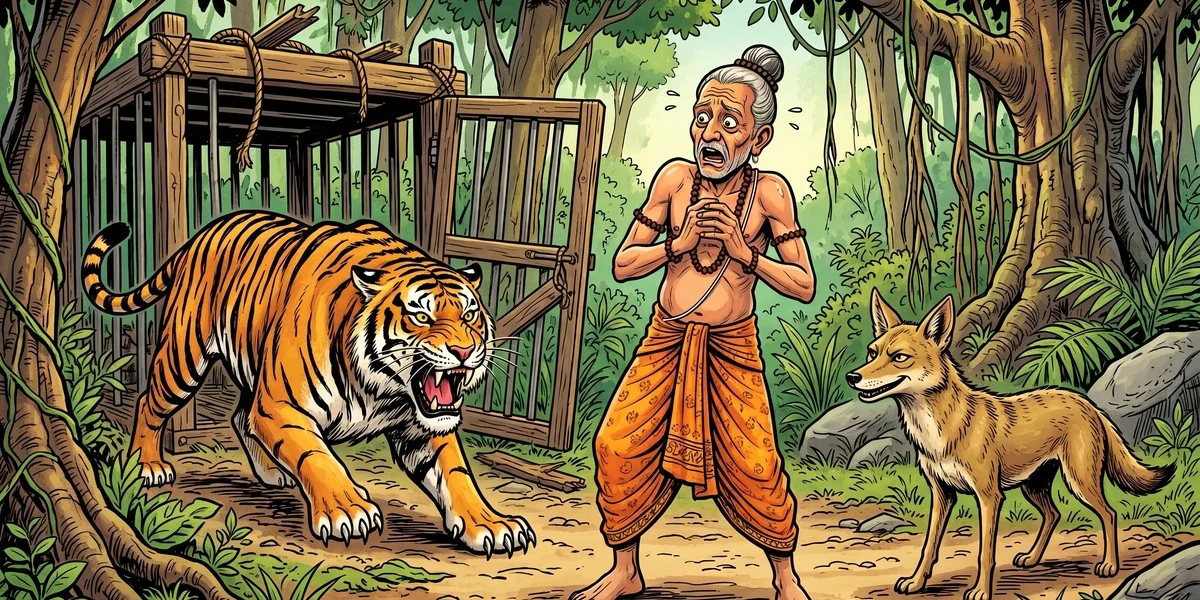
Tiger Brahmin Jackal: Once a Brahmin was passing through a forest when he came across a tiger caught in a trap. Please let me out of this cage”, called the
The Tiger, the Brahmin, and the Jackal: Ingratitude, Sthana-Dharma, and the Jackal’s Elenchos
The Structure of the Ingratitude Tale: A Panchatantra Classic
The tale of the Tiger, the Brahmin, and the Jackal belongs to one of the most widely distributed narrative types in world folk literature: the story of ingratitude, in which a creature or person who has been saved from danger turns on their rescuer. The specific structure of this Panchatantra version is particularly elegant: the tiger is released from a cage by a compassionate brahmin; the tiger immediately plans to eat the brahmin; the brahmin appeals to various bystanders for a judgment on whether this is just; the bystanders (a tree, a road) give judgments sympathetic to the tiger’s ingratitude based on their own experience of human ingratitude; and finally the jackal devises a solution that saves the brahmin by exposing the tiger’s position as logically self-refuting.
The tale’s opening moral question is deceptively simple: if a person (or animal) does you a great good, do you owe them your goodwill in return? The brahmin’s implicit assumption — that releasing the tiger from the cage creates an obligation of gratitude on the tiger’s part — seems obvious. Yet the tiger immediately constructs a counter-argument: it is the natural law (svabhava) of tigers to eat brahmin-sized prey; the brahmin should have known this; the brahmin’s naivety does not create an obligation for the tiger. The tiger is arguing, in effect, that the natural order supersedes any specific relational obligation created by the rescue.
This is the philosophical challenge the tale poses: Is there such a thing as a duty of gratitude? And if so, what are its grounds? The tree and the road, consulted as impartial witnesses, give their verdicts based on their own experience of ingratitude from humans — the tree notes that humans cut it down after eating its fruit; the road notes that humans curse it for the dust it raises while walking on it. Their verdicts reflect experience rather than principle: human nature, they say, is ungrateful, so what is the tiger doing that is unusual? The tale’s court thus assembles as a kind of cosmological indictment of ingratitude in nature and in the human world alike.
Sthana-Dharma: The Duty of the Released Captive
The Indian concept of sthana-dharma — the duty appropriate to one’s position or circumstance — is relevant here. Every position in life carries its own specific obligations: the king has rajadharma, the student has brahmachari-dharma, the householder has grihasthi-dharma. The tiger, in his position as a creature who has been released from captivity by a benefactor, occupies a specific relational position that carries its own dharma: the duty of the released captive to the releaser.
The Dharmashastra traditions, and the broader niti literature, recognise the category of kritajnata (gratitude, literally “knowledge of what has been done for one”) as a fundamental moral virtue. The person who lacks kritajnata — who cannot or will not acknowledge the good done to them — is not merely rude but morally deficient in a structural way: they have broken the reciprocal logic that underlies all beneficial social exchange. If good done is not acknowledged, good will not be done; if rescuers are eaten, no one will rescue.
The tiger’s position is specifically a violation of sthana-dharma because the good done to him was not small or incidental — it was the preservation of his life. The brahmin did not merely favour the tiger; he released him from imprisonment and the death that imprisonment would have meant. The magnitude of the benefit creates the magnitude of the obligation. The tiger’s response — immediate planning to kill the rescuer — is the most extreme possible violation of kritajnata.
“Show me the cage from which you were freed. Show me the trap from which you were released. Show me the position from which you could not escape without help — and I will show you the one to whom you owe your life.”
The Jackal’s Elenchos: Practical Re-Enactment as Philosophical Refutation
The jackal’s solution to the brahmin’s dilemma is one of the Panchatantra’s most celebrated and most instructive moments. The jackal presents itself as confused, unable to understand the situation without a demonstration. He asks that the events be re-enacted from the beginning: the tiger must go back into the cage, the brahmin must re-close it, and then the jackal will assess the situation properly.
The tiger, committed to demonstrating the legitimacy of his position, agrees — and climbs back into the cage. The brahmin closes it. The jackal immediately declares the situation resolved: the tiger is in the cage, the brahmin is free, the natural order is restored, and no injustice has been done. The clever solution is not an argument but a practical demonstration: the jackal has used the tiger’s own willingness to participate in the re-enactment to restore the status quo ante, making the tiger’s philosophical claim irrelevant by eliminating the factual basis for the dispute.
This is elenchos in its most practical and economical form — not the Socratic verbal cross-examination, but the physical re-enactment that exposes the contradictions in the tiger’s position not by arguing against them but by creating the conditions under which the tiger’s own actions refute them. The tiger wanted to argue that natural law gives him the right to eat the brahmin. The jackal bypasses this argument entirely: natural law can be satisfied, the cage can be closed, and the discussion can be over.
The jackal’s method is characteristically the method of the Panchatantra’s niti-counsellors: not the frontal intellectual engagement with a powerful adversary, but the lateral move that achieves the desired outcome without ever engaging the adversary on their preferred terrain. The tiger is physically stronger than the jackal; he is also, arguably, logically stronger than the brahmin on the ingratitude question. Neither strength matters if the jackal can get the tiger into the cage.
The Counsellor as Saviour: The Jackal’s Role in the Panchatantra Ecosystem
The jackal occupies a specific and valued position in the Panchatantra’s cast of characters: the clever counsellor, the strategic advisor, the figure whose intelligence saves the situation when direct confrontation would fail. The lion and the tiger have power; the jackal has niti. And in the Panchatantra’s value system, niti consistently outranks bala.
The jackal in this tale functions as a model of what the Panchatantra calls the worthy minister or counsellor: someone who approaches an apparently intractable problem without panic, who understands all the parties’ interests and positions, who identifies the leverage point that makes the situation resolvable, and who acts economically — solving the problem with minimum fuss and maximum effectiveness. The jackal does not lecture the tiger on ingratitude; he does not appeal to divine law or dharmic principle; he simply restores the original position, and the problem dissolves.
For the princes who were the Panchatantra’s intended audience, the lesson is clear and statecraft-applicable: in a dispute between a powerful party who is in the wrong and a weaker party who is in the right, direct confrontation with the powerful party will fail. The solution lies not in proving the wrong party wrong (they will not listen) but in finding the re-enactment, the lateral move, the practical arrangement that restores the right order without requiring the wrong party to concede anything. The jackal’s genius is in giving the tiger a way to “cooperate” that the tiger doesn’t realise undoes him.
Why This Story Lasted
The Tiger-Brahmin-Jackal tale has endured for two millennia and in translation across dozens of cultures because it combines two of the most durable narrative satisfactions: righteous indignation at ingratitude, and clever resolution through lateral thinking. The ingratitude arouses; the jackal’s solution delights. Together they produce the characteristic Panchatantra emotional sequence: the discomfort of watching injustice proceed unchecked, and the deep satisfaction of watching intelligence render that injustice moot. The tale also resonates because ingratitude is genuinely common and genuinely painful, and the fantasy of the clever friend who resolves the situation without needing the ingrate to change their ways is a fantasy with enduring appeal.
Frequently Asked Questions
What is the moral of the Tiger, Brahmin, and Jackal story?
The primary moral is about the duty of gratitude (kritajnata) and its violation: those who rescue others from mortal danger deserve protection, not harm, in return. The secondary moral — perhaps more practically useful — is about the jackal’s method: that when direct confrontation with an unjust but powerful party will fail, the clever approach is to find the practical arrangement that restores justice without requiring the unjust party to acknowledge their wrongness. The jackal does not win the philosophical argument about natural law; he simply gets the tiger back in the cage. This is the Panchatantra’s characteristic lesson: wisdom applied laterally is more effective than wisdom applied directly.
Why do the tree and the road give verdicts supporting the tiger?
The tree and the road give verdicts based on their own experience of ingratitude from humans: the tree notes that humans eat its fruit and then cut it down; the road notes that humans walk on it gratefully and then curse it for the dust. Their verdicts are not abstract philosophical judgments but experiential ones — they have observed that ingratitude is the norm rather than the exception in nature and in human behaviour. The Panchatantra uses these witnesses to build a kind of cosmological case for the prevalence of ingratitude, making the tiger’s position seem less exceptional and the brahmin’s expectation of gratitude seem naive. This sets up the jackal’s resolution as even more satisfying: it does not depend on winning the philosophical debate but on practical action.
Is this tale related to the “Grateful Animals and Ungrateful Man” story type?
Yes. The Tiger-Brahmin-Jackal tale is closely related to the Aarne-Thompson-Uther tale type 155 (“The Ungrateful Serpent Returned to Captivity”), which appears in folk traditions across Europe, the Middle East, and Asia. In many versions, the roles are played by different animals (a serpent, a lion) or the clever resolver is a different character (a fox, a wise man). The structural constant across all versions is the same: a dangerous creature is released from captivity, threatens its rescuer, is brought before witnesses, and is ultimately returned to captivity through clever re-enactment. The Panchatantra version is among the oldest and most structurally complete.
What does “kritajnata” mean in Indian ethical thought?
Kritajnata (कृतज्ञता) is a Sanskrit term meaning gratitude, literally “the knowledge of what has been done (for one).” It is considered a fundamental moral virtue in Hindu, Buddhist, and Jain ethical frameworks. The term implies not just a feeling of thankfulness but an accurate cognitive recognition of the benefit received and the benefactor who provided it. The absence of kritajnata — ingratitude — is treated in the Dharmashastra literature and in texts like the Panchatantra as a serious moral deficiency that disrupts the reciprocal social relationships on which civilised life depends. The tiger’s ingratitude in this tale is a paradigmatic example of kritajnata’s violation.
What can children learn from the jackal’s approach to problem-solving?
The jackal’s method teaches children several valuable problem-solving lessons: that when direct argument with a more powerful party fails, lateral thinking may succeed; that showing rather than telling is often more effective (the re-enactment is more persuasive than any argument the brahmin could have made); that it is sometimes possible to solve a problem by changing the situation rather than by winning the debate about the situation; and that the cleverest solution is often the simplest one — not the most elaborate argument but the most economical action. These are lessons in practical intelligence that have applications far beyond the folk tale’s specific scenario.
Frequently Asked Questions
**Q: Why is this story important?**
You May Also Like
 Aesop's Fables
Ages 3-5
Aesop's Fables
Ages 3-5
The Magic Shoes And Staff
The Magic Shoes And Staff: Far, far away in a town of India called Chinchini, where in days long gone by the ancient gods in whom the people believed are said
 Aesop's Fables
Ages 3-5
Aesop's Fables
Ages 3-5
The Magic Fiddle
The Magic Fiddle: Once upon a time there lived seven brothers and a sister. The brothers were married, but their wives did not do the cooking for the family.
 Aesop's Fables
Ages 3-5
Aesop's Fables
Ages 3-5
The Ass and The Mule
A stubborn ass rejects the mule's help and dies from pride. Humility saves; ego destroys.