The Donkey in the Tiger’s Skin
The Donkey in the Tiger's Skin: The Donkey in the Tiger’s Skin: A Panchatantra Tale of Deception Undone In the heart of a bustling kingdom, where cotton fields
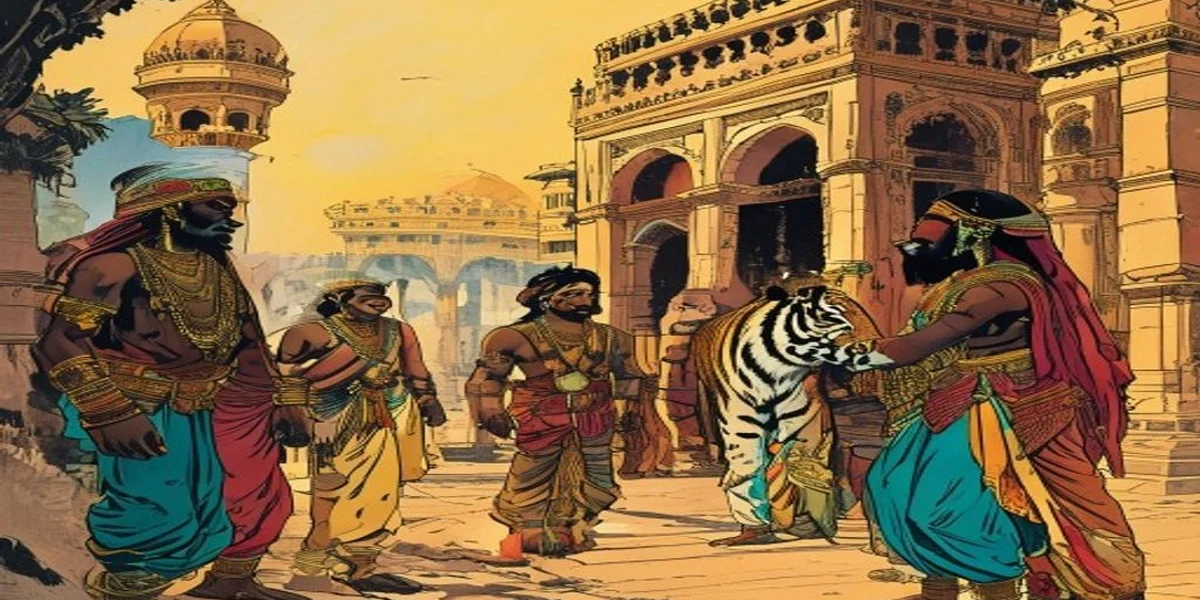
The Donkey in the Tiger’s Skin — Panchatantra, Book V: Aparīkṣitakāraka (Ill-Considered Action)
This tale appears in the fifth book of the Panchatantra, compiled by Vishnu Sharma around 300 BCE, among a collection of stories about the inevitable unmasking of false identities. It is closely related to the Blue Jackal tale in structure and lesson, but where the jackal’s disguise was accidental and his deception deliberate, the donkey’s disguise is deliberate and his unmasking is caused by a single moment of authentic expression — the same mechanism the Panchatantra identified in the jackal’s howl. The donkey who wears a tiger’s skin to frighten away crop-watchers flourishes as long as he maintains the disguise and is destroyed the moment his authentic voice emerges. The tale has circulated from the Panchatantra into Arabic, Persian, Hebrew, and European traditions, and the phrase for a fool in borrowed grandeur derives in part from this story in several languages.
Beat I — The Washerman’s Clever Arrangement
A washerman owned a donkey who carried his loads faithfully through the day. At night, the washerman had developed a practical economy: he draped a tiger’s skin over the donkey and sent him into the fields near the village to graze on the farmers’ crops. The farmers and their crop-watchers, seeing what appeared to be a tiger in the moonlight, fled. The donkey ate well. The washerman saved the cost of feeding his beast.
The arrangement worked because it exploited a specific feature of fear: in conditions of low light and high anxiety, shape and silhouette carry more information than sound or smell, and the farmers’ pattern-recognition system — tiger-shaped thing moving through field at night — produced an immediate flight response before any closer investigation could occur. The donkey’s actual behaviour was, from a distance and in the dark, plausibly tiger-like: he moved slowly through the field, he was large, the skin draped over him provided the visual outline. Fear did the rest.
The donkey himself understood his situation imperfectly. He knew he was wearing something; he did not fully understand why the crop-watchers fled. What he understood was that he was left alone to eat, which was satisfactory, and that the skin was warm in the cool nights, which was also satisfactory. He had no particular investment in maintaining the deception — he was not a strategic actor in this arrangement. He was simply a donkey wearing a tiger’s skin, eating crops and not being disturbed.
Beat II — The She-Donkey and the Fatal Sound
One night, grazing in his usual field, the donkey heard a female donkey — a she-donkey in a neighbouring field, braying in the manner of her kind at the particular hour when donkeys bray. The sound was as ordinary as any sound in the donkey’s experience and as extraordinary as the jackal’s distant howl had been to the Blue Jackal: it was the call of his own kind, and something older and more fundamental than any arrangement his owner had made responded to it.
He brayed. Loudly, clearly, unmistakably — the full-throated bray of a donkey who has heard something worth responding to and is responding with all appropriate enthusiasm. The sound carried across the field to the crop-watchers who had been keeping cautious distance from the “tiger.” They stopped. They listened. They had never heard a tiger bray. They came closer. In the strengthening moonlight, or with lamps, or simply by the evidence of their own ears, they saw what was there: a donkey in a tiger’s skin, eating their crops.
The Panchatantra does not dwell on the details of what followed. The crop-watchers had been frightened by this animal for some time, had lost crops, and had been made to feel foolish. The donkey was apprehended. His grazing career in tiger’s clothing was concluded permanently.
Beat III — The Structural Identity of the Jackal and the Donkey
The Panchatantra places the Donkey in the Tiger’s Skin and the Blue Jackal in the same analytical category because they share the same mechanism of failure: authentic identity expressing itself through an involuntary channel that the disguise cannot suppress. The jackal could control his colour and his speech until the howl escaped him. The donkey could control his movement and his appearance until the bray escaped him. Neither could control the deep instinctive response to the specific stimulus — other jackals calling, a she-donkey braying — that bypassed the layer of performance and went directly to the authentic creature underneath.
The Panchatantra’s philosophical point is consistent: identity is not primarily a matter of appearance. It is expressed in the unguarded moments of instinctive response to the world. A disguise can alter appearance; it cannot alter the nervous system’s response to the specific stimuli that the genuine identity is wired to respond to. This is not a moral observation — it is a practical one. The Blue Jackal and the donkey are not destroyed by their wickedness. They are destroyed by their authenticity.
The Arthashastra of Kautilya makes the administrative parallel explicit: a minister who is performing loyalty rather than feeling it will eventually encounter the specific stimulus — a crisis that makes loyalty costly, an opportunity that makes defection profitable — that reveals the performance as performance. The test of genuine loyalty is not the performance in ordinary times but the response in the moment when authentic interest and performed interest diverge. The bray is that moment.
Beat IV — The Donkey’s Lesson and Its Difference from the Jackal’s
There is one important difference between the donkey’s story and the jackal’s: the donkey had no investment in the deception. He wore the skin because the washerman put it on him. He grazed because grazing is what donkeys do. He brayed because braying is what donkeys do. He was not a schemer who had constructed an elaborate false identity; he was simply an animal in a costume whose costume was undone by his nature.
The Panchatantra draws a secondary lesson from this version: the consequences of deception fall not only on those who deliberately deceive, but on those who are made instruments of deception. The donkey paid the price for the washerman’s scheme. The Panchatantra’s argument about the long-term instability of deception-based arrangements does not require malice in all parties — it requires only that the arrangement depends on suppressing authentic expression, and that suppression of authentic expression has a finite duration regardless of intent.
“The disguise holds until the authentic voice is called — and the authentic voice is always called eventually.”
Why This Story Has Lasted 2,300 Years
The Donkey in the Tiger’s Skin endures because it captures something universally true about the relationship between performance and authenticity: borrowed grandeur holds until the moment of authentic expression, and that moment always arrives. The story travels well across cultures because the image is so vivid and so precise — a donkey in a tiger’s skin, eating crops contentedly, destroyed by a single bray. The Panchatantra’s genius is that the bray is not a mistake or a weakness; it is the donkey being perfectly, completely, and authentically himself. The disguise was the anomaly. The bray was the truth. And the truth, as always in the Panchatantra, cannot be permanently suppressed.
About the Panchatantra
The Panchatantra (“Five Treatises”) was composed by Vishnu Sharma circa 300 BCE as a compendium of nītiśāstra — statecraft, ethics, and worldly wisdom — expressed through interlocking animal fables. Book V, Aparīkṣitakāraka (“Ill-Considered Action”), collects tales about the instability of arrangements built on false appearances. The Donkey in the Tiger’s Skin has been translated into Pahlavi, Arabic, Hebrew, Latin, and all major European languages, and has contributed idioms for foolish pretension to borrowed grandeur in multiple literary traditions.
You May Also Like
 Panchatantra Stories
Ages 9-12
Panchatantra Stories
Ages 9-12
The Story of the Blue Jackal
The Panchatantra's brilliant tale of Caṇḍarava — the "Fierce Howler" jackal — who tumbles into a vat of indigo dye and walks out a king of the jungle. The story is found in Book I of the Panchatantra (Mitrabheda, "The Separation of Friends"), and it is one of Vishnu Sharma's most quietly devastating lessons: disguise is not transformation, and the test of who you are is not how you look on a calm day, but what comes out of you on the night when you forget you are pretending.
 Panchatantra Stories
Ages 9-12
Panchatantra Stories
Ages 9-12
The Wedding of The Mouse
The Wedding of The Mouse: There was a hermitage belonging to the sage Salankayana. He went one morning to river Ganga to bathe. As he was reciting stanzas in
 Panchatantra Stories
Ages 9-12
Panchatantra Stories
Ages 9-12
The Bird Pair and the Sea
The Bird Pair and the Sea: Do not underestimate the power of the timid.” A pair of Tittibha birds, husband and wife lived on seashore. The female Tittibha bird