The Lion Makers
The Lion Makers: Once upon a time, long ago, there were four friends who lived in a small village. All of them lived nearby and knew each other since the time

The Lion Makers — Panchatantra, Book V: Aparīkṣitakāraka (Ill-Considered Action)
This celebrated tale comes from the fifth book of the Panchatantra, compiled by Vishnu Sharma around 300 BCE. Book V — Aparīkṣitakāraka, “Ill-Considered Action” — collects cautionary tales about the gap between technical knowledge and practical wisdom. The Lion Makers is the book’s most famous story and among the most widely cited fables in world literature: four scholars, three of whom possess extraordinary technical skill and one of whom possesses only common sense, encounter a dead lion in a forest. The three skilled scholars propose to resurrect it. The one with common sense withdraws. The lesson has been quoted in Arabic, Persian, Hebrew, Latin, and eventually every European language — and the phrase “book-learned fool” in many traditions descends directly from this tale.
Beat I — Four Scholars and a Long Journey
Four young Brahmins set out together to seek their fortunes in a distant city where a generous king was known to reward scholarship. Three of them had spent years in deep study — grammar, logic, medicine, and the sacred sciences — and had acquired formidable technical learning. They could cite texts, construct arguments, and perform elaborate ritual operations with precision. The fourth had studied less formally and knew less scripture. What he possessed instead was what the Panchatantra calls vyavahārajñāna — knowledge of the world as it actually works.
As they travelled through a forest, they came across the skeleton and hide of a lion — a great beast that had died some time ago, its bones scattered and bleached but still largely intact. The three learned scholars stopped and looked at it with the excitement of men who had just found the ideal subject for a demonstration. Here was a chance to apply the highest knowledge: the texts described the full restoration of a dead animal from its bones, hide, and residual life-force. They had studied the relevant passages. This was the moment to prove that study had produced real power.
The first scholar said he knew how to assemble the bones and flesh and skin into their correct anatomical arrangement. The second said he knew how to add blood and sinew and restore the physical structure to its living configuration. The third said he knew how to breathe life itself back into the completed body. Together, the three agreed, they could bring the lion fully back to life.
Beat II — The Practical Man Sees What the Scholars Cannot
The fourth scholar — the one with worldly sense — listened to this plan. He did not dispute the technical capability of his companions. He had no grounds on which to argue scripture with men who knew more scripture than he did. What he could see, clearly, was the outcome: a living lion in a forest, with four men standing beside it who had just woken it up.
“Brothers,” he said carefully, “I have no objection to your scholarship. But I suggest we consider the practical consequence of succeeding. A lion, restored to life, will be hungry. We are standing within easy reach. Perhaps we should climb a tree before you complete the restoration.”
The three scholars looked at him with the particular contempt that technical specialists reserve for those who cannot follow their reasoning. What did hunger have to do with it? What did proximity have to do with it? They were performing an act of scholarly demonstration. The lion’s subsequent behaviour was a separate matter entirely, and anyway, a lion restored by Brahminic knowledge would surely recognise and respect the scholars who had given it life.
The practical man recognised the look. He had seen it before — the face of knowledge that cannot hear objection because it has mistaken technical mastery for complete understanding. He did not waste further words. He climbed a nearby tree and watched from the branches.
Beat III — The Restoration and Its Immediate Consequence
The three scholars proceeded. The first assembled the bones with anatomical precision. The second added flesh and blood and sinew, restoring the lion’s great body to its physical completeness. The third performed the final operation — the restoration of life — and the lion opened its eyes, breathed, gathered itself, and rose.
It looked at the three men standing before it. It was a lion. It was hungry. There were three men within reach. The three scholars had approximately as long as it takes a lion to cover a short distance to appreciate what the practical man had seen from the beginning.
The practical man in his tree watched the resolution of the demonstration. When the lion had finished and moved away, he climbed down, stood for a moment in silence, and then continued on his way to the city. The Panchatantra does not record whether he received a reward from the generous king. The three scholars received their reward from the lion.
Beat IV — On Book-Learning and Practical Wisdom
The Lion Makers is the Panchatantra’s sharpest statement on a distinction that runs through all five books: the difference between śāstra (textual knowledge, learning from scripture and tradition) and buddhi (practical intelligence, the capacity to read actual situations). Both are valuable. The Panchatantra does not argue that learning is useless — it is itself a learned text, dense with reference and allusion. What it argues is that śāstra without buddhi is dangerous precisely because it produces high confidence without adequate awareness of consequence.
The three scholars were not wrong about the technical procedure. They possessed real knowledge and could perform what they claimed. Their error was a different kind: they had studied everything about how to restore a lion to life and nothing about what a restored lion would do. They had mastered the operation without considering the outcome. This is the specific failure that Book V of the Panchatantra returns to repeatedly — not ignorance, but partial knowledge mistaken for complete knowledge.
The Arthashastra of Kautilya addresses this danger in administrative terms: a minister who knows policy thoroughly but cannot read the temperament of the people affected by that policy will implement correct policies with catastrophic results. The knowledge of what to do is only complete when joined to knowledge of what will happen when you do it. The three scholars had the first and lacked the second entirely.
Beat V — The Wisdom of Withdrawal
The practical man’s decision to climb the tree is presented in the Panchatantra not as cowardice but as the definitive act of wisdom in the story. He could not match the three scholars in textual debate. He chose not to try. What he could do — and did — was recognise the actual situation and position himself accordingly. His knowledge was modest in scope and tremendous in application: he knew what lions do, and he knew what scholars absorbed in demonstration tend to miss.
Vishnu Sharma makes one additional point through the practical man’s restraint: wisdom sometimes expresses itself through silence and withdrawal rather than argument. The practical man tried once to warn his companions. When his warning was rejected, he did not persist in a losing debate — he acted on his own assessment and preserved himself. The Panchatantra’s surviving student is the one who knows when argument is futile and withdrawal is necessary.
“Book-learning without worldly sense is the most dangerous kind of ignorance — it carries all the confidence of knowledge without the humility of awareness.”
Why This Story Has Lasted 2,300 Years
The Lion Makers endures across cultures and centuries because every intellectual tradition produces its version of the three scholars: people of genuine and impressive technical knowledge who have mistaken mastery of a procedure for mastery of a situation. The story travels so well because the lion is not metaphorical — it is just a lion, which is all it needs to be to make the point. Technical expertise applied without practical wisdom is not merely ineffective; it is actively dangerous. The tree is always available. The practical question is whether you recognise it in time.
About the Panchatantra
The Panchatantra (“Five Treatises”) was composed by Vishnu Sharma circa 300 BCE as a manual of nītiśāstra — statecraft, ethics, and worldly wisdom — expressed through interlocking animal and human fables. Its fifth book, Aparīkṣitakāraka (“Ill-Considered Action”), specifically addresses the danger of acting on incomplete understanding. Translated first into Pahlavi in the 6th century CE and subsequently into Arabic (Kalīla wa-Dimna), Hebrew, Syriac, Greek, Latin, and all major European languages, the Panchatantra became one of the most widely read books in the pre-modern world. The Lion Makers is among its most quoted and translated tales.
Frequently Asked Questions
**Q: Why is this story important?**
You May Also Like
 Panchatantra Stories
Ages 9-12
Panchatantra Stories
Ages 9-12
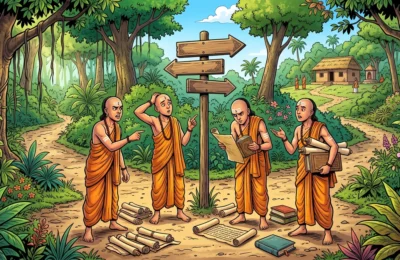
The Four Learned Fools
The Four Learned Fools: Four learned men resurrect a dead lion, forgetting the danger they've unleashed A classic Indian folk tale retold for young readers.
 Panchatantra Stories
Ages 9-12
Panchatantra Stories
Ages 9-12
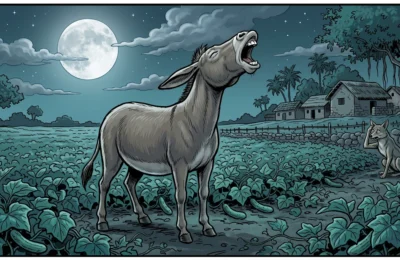
The Musical Donkey: A Panchatantra Fable
The Panchatantra's hard-edged little fable of Uddhata — the "haughty" washerman's donkey — who feasts on stolen cucumbers under the moon, mistakes his longing for talent, and brays the song that brings the farmers running with sticks. The story is found in Book V of the Panchatantra (Aparīkṣitakāraka, "Ill-Considered Action"), and it is one of Vishnu Sharma's quietest and most devastating lessons: a donkey called Raised On High is going to be brought low, and the only question is how.
 Panchatantra Stories
Ages 6-8
Panchatantra Stories
Ages 6-8
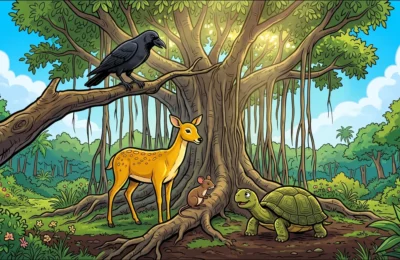
Meeting a New Friend
Meeting a New Friend: Hiranyaka, the mouse, and Laghupatanaka, the crow, became great friends. One day, the crow came calling on the mouse with eyes full of