The Lion and the Clever Jackal
The Lion and the Clever Jackal: In a great forest of India, where the sal trees grew tall and ancient and the undergrowth was dense with life, there dwelt a
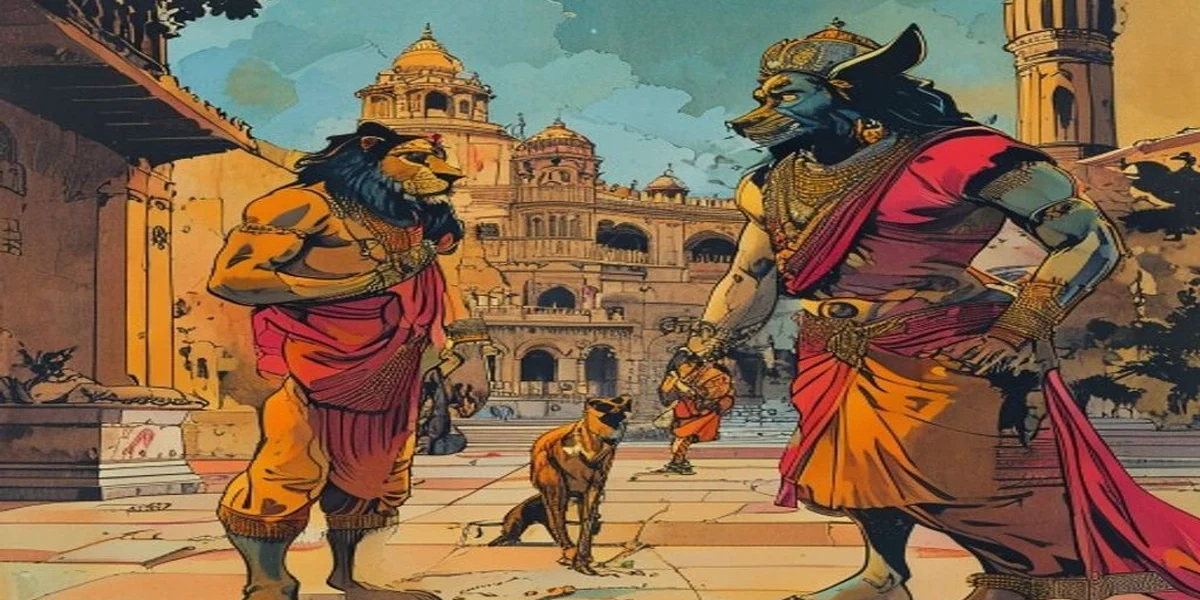
The Lion and the Clever Jackal — Panchatantra, Book I: Mitra-bheda (The Loss of Friends)
This tale belongs to the first book of the Panchatantra, compiled by Vishnu Sharma around 300 BCE, which is centrally concerned with the dynamics of power, service, and the intelligence required to survive in proximity to the powerful. The jackal is the Panchatantra’s most versatile character — appearing as schemer, counsellor, fool, and sage across the tradition’s five books. In the stories where the jackal is clever, he demonstrates the specific intelligence that the Panchatantra calls buddhi: practical worldly wisdom, the capacity to read a situation accurately and respond with precision rather than either blind obedience or direct confrontation. This story places a clever jackal in service to a lion-king and shows how wit and accurate situational intelligence allow the small to survive — and serve genuinely — alongside the great.
Beat I — The Lion’s Court and the Jackal’s Position
A powerful lion ruled a great forest. His court included the animals who served him — larger beasts who provided obvious utility through strength or speed, and a jackal who had no physical advantage to offer but had established himself as the lion’s most reliable counsellor through the consistent accuracy of his assessments. The lion tolerated him; the larger animals resented him; the jackal navigated all of this with the specific skill of the small adviser in a large court: being useful enough to keep, wise enough to avoid provoking, and sharp enough to see the dangers before they became crises.
One day a situation arose that the lion’s strength could not resolve and his court’s larger advisers could not analyse. A rival lion had been making incursions at the forest’s edge, testing boundaries, and the senior animals in the court were recommending direct confrontation — the solution that physical confidence always prefers. The jackal requested an audience and offered a different assessment. He had observed the rival lion’s movements over several days. The incursions were not random; they followed a pattern that indicated not aggression but fear — the rival was testing the edges not to attack but to determine whether this forest was safe to pass through on a longer journey. Direct confrontation would produce a battle that both lions might survive but that would cost the court animals significantly, and would not resolve the underlying situation, which would simply restart when the rival’s journey continued.
The lion listened. He was accustomed to counsellors who told him what he wanted to hear; this counsellor was telling him what the situation actually was. The distinction was uncomfortable and useful in equal measure.
Beat II — The Jackal’s Solution
The jackal proposed a solution that used the lion’s actual strength without requiring its direct deployment: he would go to the edge of the forest and communicate to the rival lion, with full authority of the court behind him, that safe passage through a specific route was available in exchange for the rival’s commitment not to return. The rival lion, who wanted passage and not battle, would accept. The confrontation would be avoided; the boundary would be clarified; both lions’ dignity would be preserved because neither would have been forced to back down under direct pressure.
This is the Panchatantra’s model of the ideal adviser: one who reads what the situation actually requires, designs a solution that achieves the necessary outcome through the most efficient path, and presents the solution in a form that the powerful patron can accept without embarrassment. The lion did not want to be told he shouldn’t fight — he wanted a reason not to fight that preserved his dignity. The jackal gave him the reason: the rival wasn’t worth fighting because the rival wasn’t actually a threat.
The mission succeeded. The jackal returned with the rival’s commitment; the rival passed through and did not return; the forest’s stability was preserved without combat. The lion acknowledged the result. He did not offer extravagant praise — powerful patrons rarely do — but the jackal’s position in the court was secure for another season, which was the actual outcome the jackal had been working toward throughout.
Beat III — On Wit as the Small Creature’s Necessary Weapon
The Panchatantra returns repeatedly across its five books to the survival strategies available to the small in the world of the large. Physical force is unavailable to a jackal in a lion’s court; direct confrontation is suicidal; deception is possible but unstable. What remains — and what the Panchatantra consistently valorises — is the specific intelligence that sees situations accurately and designs responses that achieve the necessary outcome while respecting the constraints of the power dynamic.
The clever jackal does not succeed by being cleverer than the lion. He succeeds by being more accurately informed than the lion about the specific situation, and by presenting that information in a form the lion can use. This is what the Panchatantra means by buddhi as distinct from śāstra: not book-learning applied to abstract categories, but living intelligence applied to the situation that is actually present. The jackal’s assessment of the rival lion’s movements — what the pattern of incursion actually indicated — was the product of careful observation, not of expertise in military strategy. He looked, assessed, and reported what he actually saw.
The Arthashastra of Kautilya values this capacity in ministers specifically: the minister who can tell the king what the situation actually is, rather than what the king wants to hear or what the minister’s own interests suggest, is the minister whose counsel produces actual outcomes. The jackal in the lion’s court is Kautilya’s ideal ministerial type expressed in animal fable form.
Beat IV — The Long Game of the Small Adviser
The Panchatantra’s clever jackals understand something that the lion’s stronger counsellors do not: that security in a powerful patron’s court is not achieved through a single spectacular act but through the accumulation of accurate assessments over time. One well-read situation builds trust. Ten well-read situations build dependence. A counsellor who consistently gives the patron more accurate information about the world than the patron can obtain anywhere else is not merely useful — he is irreplaceable, which is the only form of security available to the small in proximity to the great.
The jackal’s clever resolution of the rival lion situation is not remarkable in isolation. It is remarkable as one event in a series that has established his value to the court, and that will establish it further with each subsequent accurate assessment. He is playing a long game with the only resource he has: the quality and accuracy of his intelligence. The Panchatantra’s lesson for royal students was direct: the adviser who tells you what is true is worth more than a hundred who tell you what is comfortable, and the sovereign who cannot tell the difference between these two types will eventually have only the second.
“The small creature survives among the great not by imitating their strength but by providing what their strength cannot — the accurate reading of what the situation actually is.”
Why This Story Has Lasted 2,300 Years
The Lion and the Clever Jackal endures because the dynamic it describes — the small, accurate intelligence operating in service to the large, powerful patron — is one of the most fundamental and recurring structures in human organisation. Every court, every organisation, every family that holds power has its version of the lion and its version of the jackal. The Panchatantra’s argument is that the version of the jackal who survives and serves genuinely is the one whose intelligence is always in service to accurate assessment — not to flattery, not to self-advancement, not to the patron’s comfort, but to the actual facts of the situation as they are. This is the highest form of practical intelligence the tradition recognises, and it remains so.
About the Panchatantra
The Panchatantra (“Five Treatises”) was composed by Vishnu Sharma circa 300 BCE as a compendium of nītiśāstra — statecraft, ethics, and worldly wisdom — expressed through interlocking animal fables. The jackal figures prominently across all five books as the tradition’s primary vehicle for buddhi — practical worldly intelligence. Book I, Mitra-bheda (“The Loss of Friends”), explores the full range of court dynamics: alliance, betrayal, service, and the specific intelligence required to navigate proximity to power. Translated into Pahlavi, Arabic, Hebrew, Latin, and all major European languages, the Panchatantra became one of the most widely read books in the pre-modern world.
You May Also Like
 Panchatantra Stories
Ages 6-8
Panchatantra Stories
Ages 6-8
The Cave that Talked
Read 'The Cave that Talked' — a classic Panchatantra story about wisdom. The Cave that Talked is a beloved Panchatantra tale featuring a ant. This ancie...
 Panchatantra Stories
Ages 3-5
Panchatantra Stories
Ages 3-5
The Story of Mantharaka, the Weaver
The Story of Mantharaka, the Weaver: In a certain town, there lived a weaver, by the name of Mantharaka. One day, while he was weaving, the wooden supports of
 Panchatantra Stories
Ages 3-5
Panchatantra Stories
Ages 3-5
The Brahmin’s Dream
The Brahmin’s Dream: Long ago, there lived a poor Brahmin in a village. He used to beg for a living and sometimes, had to go without food for many days. Never