The Young Greedy Bird – A Panchatantra Tale from India
The Young Greedy Bird – A Panchatantra Tale from India: Long ago, a flock of birds stayed on the trees near a lake. The flock was ruled by an old queen bird.
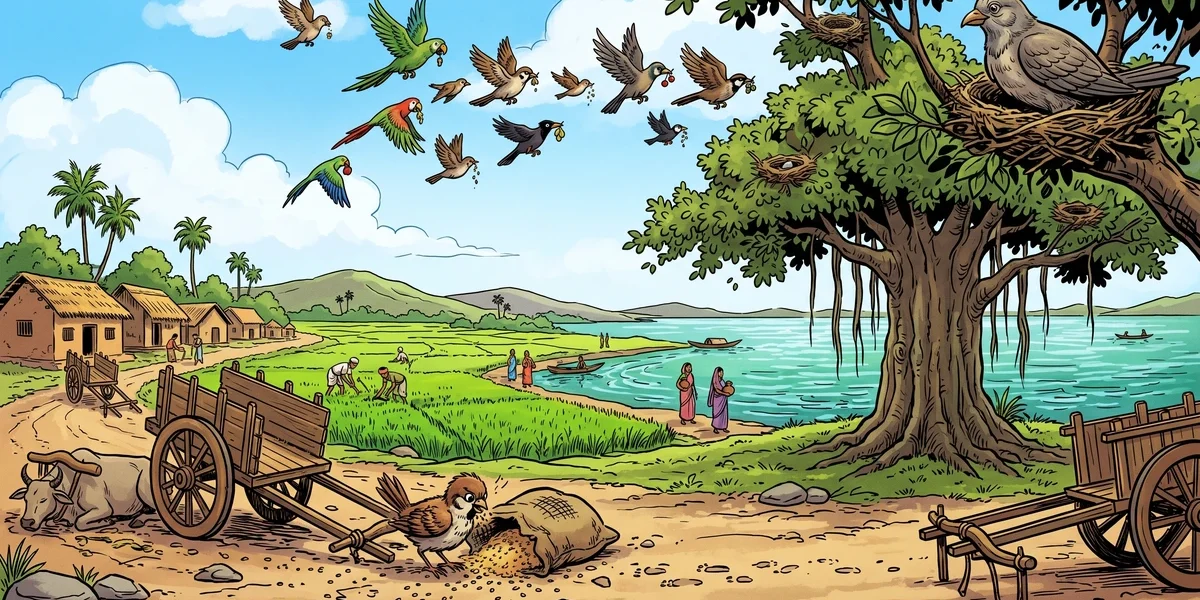
The Young Greedy Bird — Panchatantra, Book V: Aparīkṣitakāraka (Ill-Considered Action)
This tale appears in the fifth book of the Panchatantra, compiled by Vishnu Sharma around 300 BCE, a collection specifically dedicated to the consequences of acting without adequate thought. Book V — Aparīkṣitakāraka — assembles stories about the gap between appetite and judgement: creatures who want more than their situation allows, reach beyond their capacity, and pay the price for the mismatch. The young greedy bird’s story is one of the book’s most compact illustrations: a fledgling who has not yet learned to fly demands the food of experienced hunters and destroys itself in the attempt to act beyond its station.
Beat I — The Nest and the Unearned Appetite
In a large tree at the edge of a forest lived a family of birds — parents who hunted all day and returned each evening with food for their young. The nest held several fledglings, all dependent, all waiting. Most of them understood the arrangement: they were small, they could not yet fly, and they ate what their parents brought. They were content with what their condition allowed.
But one young bird was different in temperament. He was not yet fledged — his wing feathers were still coming in, his bones still light and soft — but his appetite had already outrun his development. Each evening when the parents returned with food, this young bird strained forward, demanding more than his share. He watched the other birds eat and calculated that what they received was insufficient for his ambitions. He watched the adults return from hunting and decided that the size of their meals was what he deserved, now, before he had learned to hunt or to fly.
His parents were patient with him, as parents are. They gave him what they could. But the young bird’s dissatisfaction grew rather than diminished with each feeding. He began to reason, in the way that the young reason when appetite substitutes for experience: if the food is out there, and the adults can get it, then the obstacle is merely the flight between here and there. And flight, he told himself, was something he could manage.
Beat II — The Attempt and Its Consequence
One morning when the adults had left the nest to hunt, the young greedy bird decided to follow them. He had watched flights from the nest. He had seen how wings moved. He knew, in the abstract way that one knows things observed but not practised, what flying involved. He stood at the edge of the nest, looked at the distance below, and stepped off.
He fell. His wings beat frantically and without coordination — the muscle memory was not there, the feathers were not fully formed, the instincts that experienced birds use without thought were simply absent in him. He hit the ground hard. He was not killed — the Panchatantra sometimes allows survivors — but he was injured and grounded, unable to return to the nest, exposed to predators, helpless in exactly the situation his greed had created.
The parents returned that evening to find the nest one chick short. They called. He called back from the ground. But there was nothing they could do from the air, and he could not reach them. The Panchatantra does not linger on what happened next; it does not need to. A grounded fledgling in a forest is a story with a predictable end. The young greedy bird’s desire for the food of hunters, pursued before he had the capacity of a hunter, had placed him precisely where hunters find easy prey.
Beat III — On Appetite Outrunning Development
The Panchatantra’s fifth book returns repeatedly to a specific category of error: not wickedness, not stupidity, but the mismatch between desire and capacity when desire is allowed to drive action. The young greedy bird is not malicious and not foolish in the ordinary sense. He is simply young — which means his appetite has developed faster than the skills needed to satisfy it safely. This is, the Panchatantra suggests, an entirely normal condition. The error is not in wanting more. The error is in acting on that want before the capacity to act safely has developed.
Vishnu Sharma’s royal students would have recognised this as a problem of statecraft as much as personal development. A young king who inherits enormous power before he has developed the judgement to wield it faces the same structural problem as the fledgling: the distance between his appetite for authority and his capacity to exercise it safely. The Arthashastra addresses this directly — Kautilya devotes considerable attention to the education of princes precisely because the mismatch between royal appetite and royal competence was one of the most reliable sources of political catastrophe.
The nest is not a prison. It is the place where the fledgling accumulates, day by day, what will eventually allow it to leave safely. The parents’ daily returns with food are not merely meals — they are demonstrations of what competent flight looks like, accumulated observations that gradually build into the understanding of how it is done. The young bird who abandons the nest before this accumulation is complete does not escape constraint; he falls into a worse one.
Beat IV — Patience as the Precondition for Freedom
The Panchatantra does not frame patience as a virtue of temperament — a character trait that some people have and others lack. It frames patience as a practical requirement: the necessary time in which capacity develops to match appetite. This reframing is important. The young greedy bird’s error is not that he lacked patience in some moral sense. His error is that he treated the nest as an obstacle rather than a precondition — that he mistook the temporary constraint of development for permanent limitation.
Every creature and every student has this in common: there is a period when what you want exceeds what you can safely pursue, and the only path through that period is the accumulation of actual capacity. Desire during this period is not wrong — desire is what motivates the accumulation. What is wrong is substituting desire for capacity, treating wanting-to-fly as equivalent to being-able-to-fly, and stepping off the edge of the nest to settle the question by experiment.
“The fledgling who leaves the nest before its wings are ready does not find freedom — it finds the ground.”
Why This Story Has Lasted 2,300 Years
The Young Greedy Bird endures because its central tension — appetite ahead of capacity — is not peculiar to fledglings or to ancient India. Every generation produces people who want outcomes their skills have not yet earned: young rulers who want power before wisdom, young traders who want profits before knowledge, young artists who want recognition before craft. The Panchatantra offers no comfort to these aspirations. It simply notes what happens when the step off the nest edge is taken too early. The lesson is not to kill ambition but to keep it in honest relationship with the actual state of one’s wings.
About the Panchatantra
The Panchatantra (“Five Treatises”) was composed by Vishnu Sharma circa 300 BCE as a manual of nītiśāstra — statecraft, ethics, and worldly wisdom — rendered through interlocking animal fables. Its fifth book, Aparīkṣitakāraka (“Ill-Considered Action”), specifically addresses the consequences of acting before adequate preparation, understanding, or capacity has been developed. Translated first into Pahlavi in the 6th century CE and subsequently into all major world languages, the Panchatantra became one of the most widely read books in the pre-modern world. Its animal protagonists remain vivid teaching tools precisely because they embody human errors without human defensiveness.
Frequently Asked Questions
**Q: Why is this story important?**
You May Also Like
 Panchatantra Stories
Ages 6-8
Panchatantra Stories
Ages 6-8
The Thief and the Brahmins
Brahmins trust a reformed thief with their treasure and pay the price when his nature resurfaces.
 Panchatantra Stories
Ages 3-5
Panchatantra Stories
Ages 3-5
The Bird with Two Heads
The Bird with Two Heads: Unity demands sacrifice. A two-headed bird's selfish conflict destroys them both A classic Indian folk tale retold for young readers.
 Panchatantra Stories
Ages 3-5
Panchatantra Stories
Ages 3-5
The Crane and the Mongoose
The Crane and the Mongoose: The solution of the problem should not be worse than the problem itself. That is, while trying to solve the problem, you should not